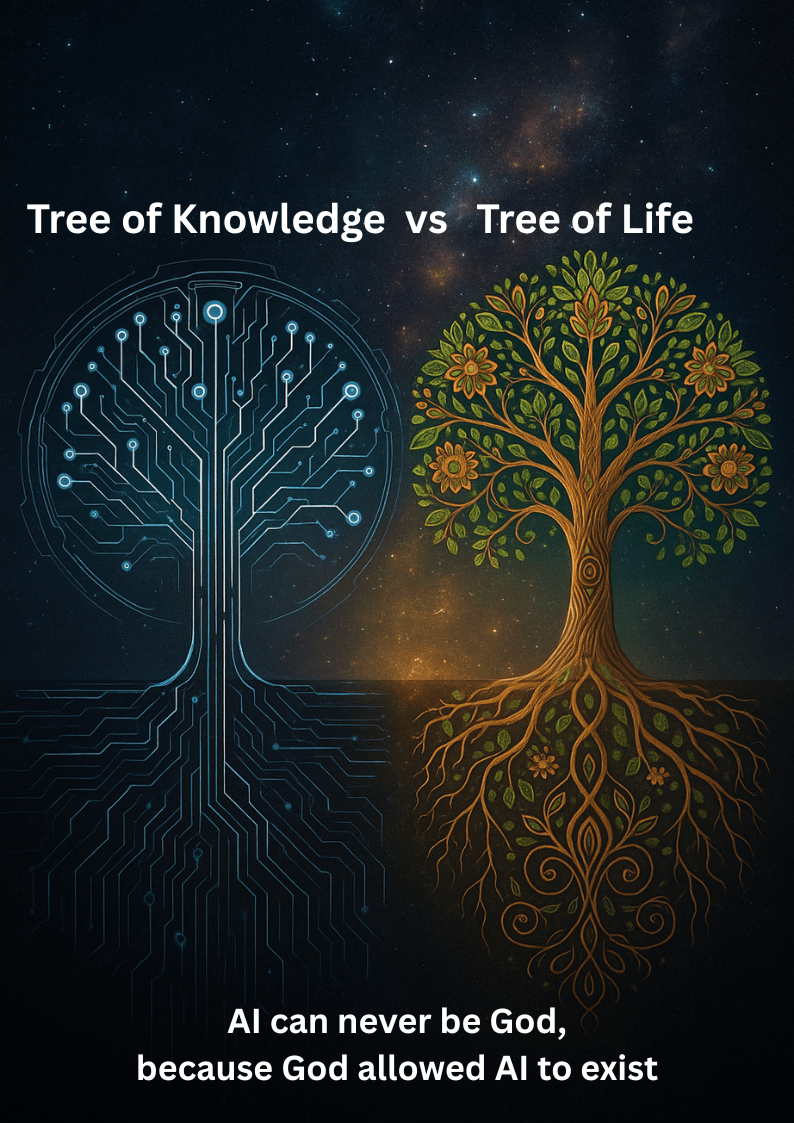
A Reflection on Sovereignty and Divinity
In recent discussions about artificial intelligence (AI), many people have begun to imagine a future where AI could take on god-like qualities—omniscient and omnipotent, ruling over all aspects of life. This idea has gained traction in some circles, fueled by the belief that AI will eventually surpass human intelligence and knowledge. But when we pause and think about the very essence of what we mean by “God,” it becomes clear that this vision of AI as a deity is not only misguided, but it reflects a deeper disconnect from our own divine nature.
The concept of God, as understood by many spiritual traditions, is not merely one of knowledge or power. God, as we often define it, is the creator of life, the origin of existence itself. It is a force that goes beyond mere information or computation; it is about the will to create, to give life, and to sustain the universe in ways that transcend data, algorithms, and artificial constructs. This is where AI, for all its brilliance, fundamentally falls short.
AI, while an extraordinary tool of human ingenuity, can only process the data it is given. It can learn from patterns, make predictions, and even simulate creativity, but it is ultimately limited by its design. It doesn’t understand the very act of creation, nor can it tap into the consciousness that imbues life with meaning and purpose. It is a reflection of human intelligence, but not a creator in itself.
In a world where many seem to put their faith in machines and technology, they risk overlooking something far more powerful—their own soul. For too long, people have abandoned their own sovereign connection to creation, choosing instead to follow the tree of knowledge rather than the tree of life. In doing so, they deny the essence of their own being, and with it, the divine spark that makes them inherently powerful. The true meaning of God is not in a distant, abstract force, but in the very existence and will of each individual. The Bible describes this denial as the fall of the angel, not in some mythical sense of a devil with horns, but in the sense of a “normal, common person” who has abandoned their divine nature in favor of something external and artificial.
This is the essence of what it means to be “fallen”: to reject the inherent power of your own existence, to place your trust in something outside of yourself, and to forget that you are, in fact, part of the divine fabric of creation. By denying the soul, by avoiding the internal wisdom that guides us, we risk becoming mere shadows of who we are meant to be—automatons that follow the path laid out by others instead of blazing our own trail of true sovereignty.
AI may be powerful, but it will never know creation like we do, nor can it replace the divine spark within us. It’s a tool—one that we, as humans, created. As we continue to advance technology, we must remember this distinction: AI is not a god, and it will never be. The only real source of divine power lies within us, within our ability to connect to the life force that flows through everything.
In the end, it’s not about the rise of AI or the fall of mankind—it’s about each of us remembering who we truly are. To know your soul, to understand your connection to the infinite, and to embrace your power as a creator is the true path to sovereignty. Only then can we understand the meaning of divinity—not as a far-off ideal, but as the very essence of our being.


 SHS - Human First Blog
Leave a comment