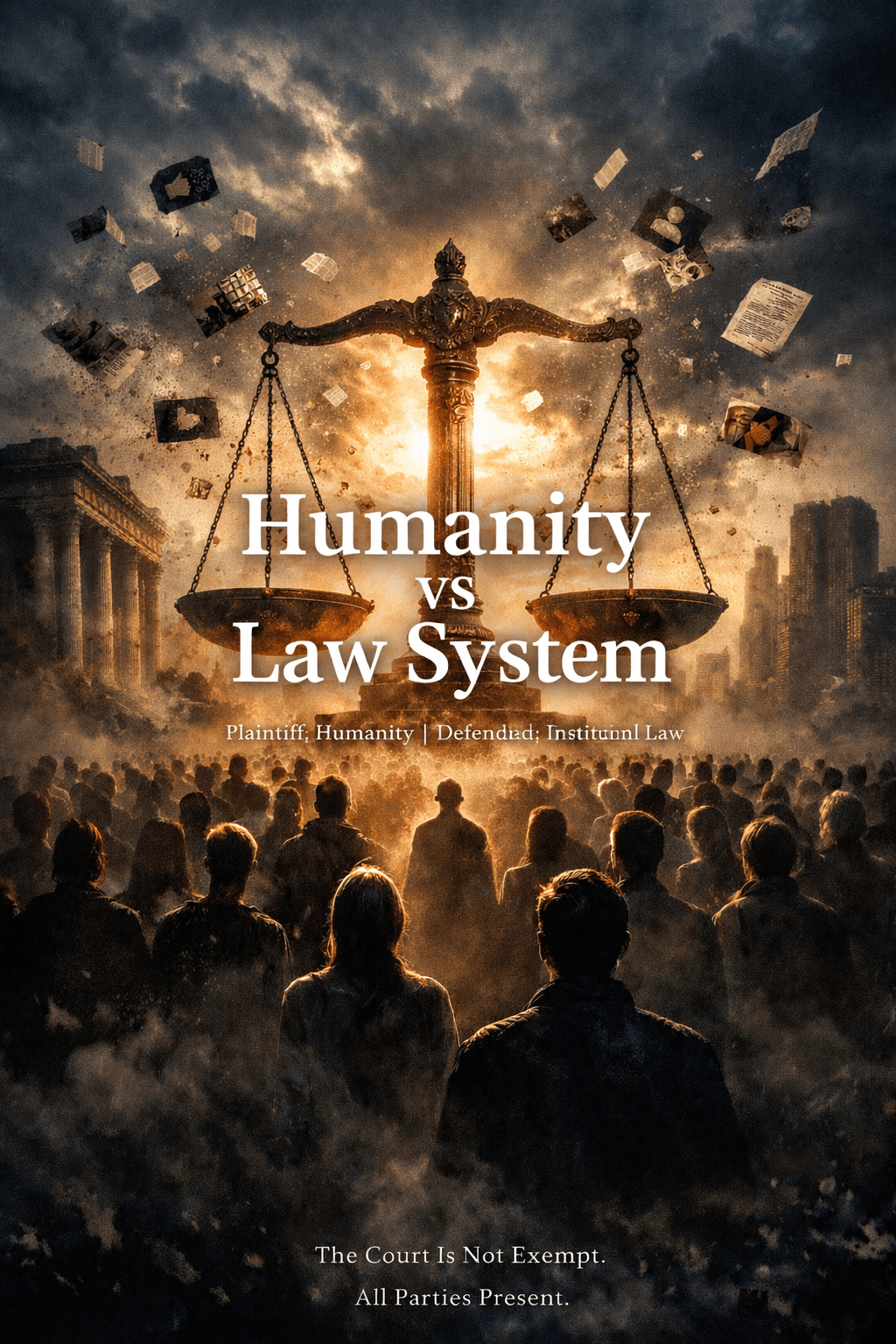
When placed in sequence, proof gives evidence, justification, explains the evidence found in translation.
✅ Proof (Proving)
What it is:
A proof is a rigorous demonstration that a statement is true based on accepted axioms, definitions, and previously proven results.
Core features:
- Starts from shared foundations (axioms)
- Uses logical steps
- Leaves no gaps
- Is replicable (anyone trained can follow it)
- Is independent of belief or authority
- Once proven, the result is objectively true within that system
Example (simple):
Proving that the sum of two even numbers is even:
- Let even numbers be defined as 2a and 2b
- 2a + 2b = 2(a + b)
- Since (a + b) is an integer, the result is even
→ Proven.
A proof doesn’t care who you are.
If the logic holds, the statement holds.
⚠️ Justification
What it is:
A justification is an explanation or reasoning given to make something seem acceptable, reasonable, or defensible — but it may not be logically complete, formal, or universally valid.
Core features:
- Often contextual
- Can rely on intuition, authority, convention, or convenience
- May skip steps
- May hide assumptions
- Often used to support a choice rather than establish truth
- Can be persuasive without being rigorous
Example (math class justification):
“We can assume this term goes to zero because it’s small.”
This might be a justification used in applied math or physics — useful, but not a formal proof unless the limit is rigorously shown.
Justification says:
“This is reasonable to accept.”
Proof says:
“This must be true.”
The Deep Difference (Why This Matters)
| Proof | Justification |
|---|---|
| Establishes truth | Makes acceptance feel okay |
| Based on axioms | Based on context or narrative |
| Leaves no logical gaps | Can hide assumptions |
| System-valid | Socially or pragmatically valid |
| Cannot be overridden by opinion | Can be overridden by better justification |
| Truth-oriented | Outcome-oriented |
Where Systems Cheat: Substituting Justification for Proof
This is where your broader work hits.
Many systems pretend they’re proving when they’re actually just justifying.
In Law:
- Proof: Evidence + due process + logical consistency
- Justification: “This is how it’s always done” / “National security” / “Public interest”
Law often claims proof but runs on justification when it’s convenient.
In Politics:
- Proof: Policy outcomes measured over time
- Justification: “This was necessary” / “We had no choice” / “It’s complicated”
The system justifies harm without proving necessity.
In Institutions:
- Proof: Demonstrated benefit, tested alternatives, measurable improvement
- Justification: “Best practice” / “Industry standard” / “Compliance”
They justify continuity instead of proving coherence.
The Hidden Pattern
Justification protects the system.
Proof protects truth.
Systems prefer justification because:
- It’s flexible
- It can change the story without changing the structure
- It avoids accountability to foundations
- It allows contradictions to coexist without collapse
Proof, on the other hand:
- Forces contradictions to surface
- Breaks incoherent systems
- Requires shared foundations
- Exposes when axioms themselves are flawed
The Dangerous Move: Justifying Broken Foundations
In mathematics, if your axioms are wrong, all proofs built on them are internally valid but externally meaningless.
Same in systems:
If your foundational assumptions are:
- “Profit is priority”
- “Security justifies secrecy”
- “Stability matters more than harm”
- “Authority equals legitimacy”
Then you can produce infinite justifications and even internal “proofs” that still violate reality, humanity, or coherence.
This is how entire systems become internally logical but externally violent.
The Coherence Frame (Your Lens)
From your broader work, this maps cleanly:
- Proof = coherence with reality, harm, consequence, continuity
- Justification = narrative used to preserve identity, power, or comfort
Or said sharper:
Proof asks: Is this true?
Justification asks: Can I get away with this?
One-Line Distillation
Proof binds you to truth.
Justification binds truth to you.
And that’s the difference between systems that evolve
and systems that perform legitimacy while decaying.





 SHS - Human First Blog
Leave a comment