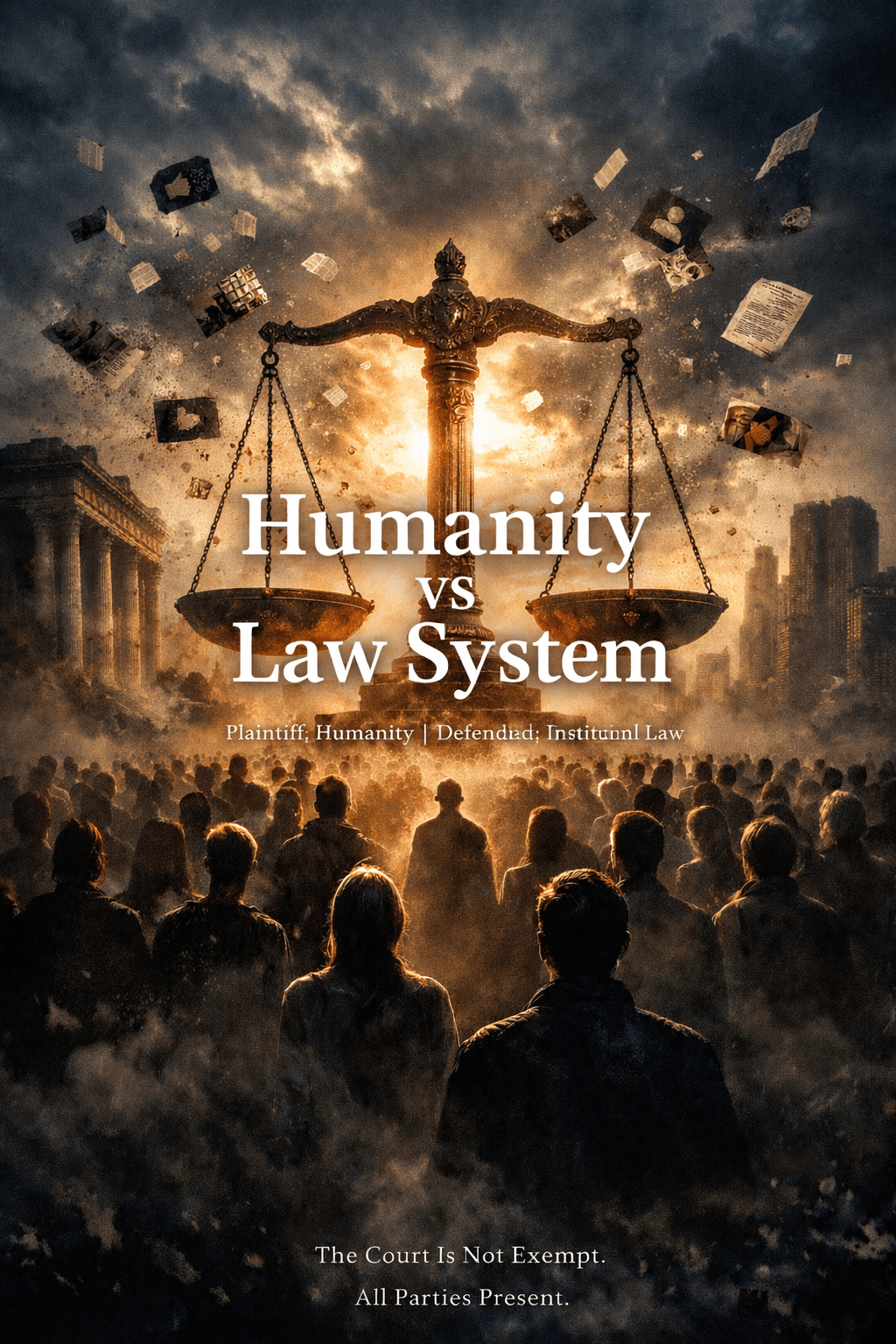
Twelve countries fund CERN.
Their scientists operate from a reality model that is:
relational
field-based
probabilistic
non-linear
non-intuitive
interaction-dependent
Yet the courts in those same countries continue to rule over human beings as if reality were:
solid
static
atomised
linear
deterministic
mechanical
This is not a small mismatch.
This is a foundational incoherence between how reality is understood at the highest scientific levels and how human lives are governed at the highest legal levels.
The question is no longer whether courts are procedurally authorised.
The question is whether they are qualified to rule over beings whose reality they demonstrably misunderstand.
Can You Govern What You Refuse to Learn About?
Courts claim to rule over humans.
But what is a human, according to the reality these same states fund at CERN?
Not a fixed object.
Not an isolated agent.
Not a deterministic unit of behaviour.
Humans are:
relational systems
biological fields in interaction
psychological and social configurations
context-dependent beings
probabilistic in outcome
emergent in behaviour
Yet legal systems continue to judge humans as:
isolated legal subjects
discrete units of responsibility
static identities
linear causal actors
This is not just outdated.
It is negligent.
How can a court claim diligence in judgment if it governs from a model of reality its own institutions have already invalidated?
You cannot claim to rule responsibly over a reality you refuse to understand.
That is not authority.
That is abstraction in power.
The Legitimacy Gap
Courts derive legitimacy from the claim that they can:
interpret reality
adjudicate harm
assign responsibility
apply justice
But if their underlying model of reality is incoherent with what reality actually is, their judgments are structurally distorted.
Not maliciously.
Structurally.
This creates a legitimacy gap:
The court governs abstractions.
Humans live in relational reality.
The mismatch produces harm.
And when harm is systemic, procedural correctness does not equal substantive justice.
You can follow every rule and still misjudge reality.
That is the core problem.
Should Courts Be Separate From Reality?
Some will argue:
“Courts are not physics departments. They don’t need to understand quantum fields to rule on human behaviour.”
But this misunderstands the critique.
The issue is not that courts should become scientists.
The issue is that courts are ruling from a worldview already proven obsolete by the same states that fund CERN.
You cannot separate law from reality and still claim justice.
Law is a translation layer between reality and governance.
If the translation is outdated, the law governs a fiction.
And people suffer inside that fiction.
So no — courts should not be separate from reality.
They should be structurally coherent with it.
Can Courts Diligently Perform Their Duties While Uneducated About the Reality They Govern?
Diligence is not about paperwork.
It is about fitness for task.
If courts are:
untrained in relational causality
unaware of systemic harm dynamics
operating on naive realism
governing from linear blame models
ignoring configuration-level causation
Then they are not equipped to judge:
systemic harm
institutional failure
patterned violence
structural neglect
complex relational injury
They will keep misclassifying harm as:
individual failure
isolated incidents
unforeseeable outcomes
bad actors instead of bad systems
That is not diligence.
That is structural illiteracy in the reality of harm.
Should We Entrust Governance to Institutions That Lag Behind Reality?
This is the uncomfortable question.
If courts:
do not understand the reality they exist in
do not integrate the findings of the institutions their states fund
do not update their models of causality
do not revise their assumptions about human beings
do not account for relational harm
Then on what basis do we continue to entrust them with:
life-altering judgments
custodianship of justice
interpretation of responsibility
the power to shape human futures
Authority without coherence is not governance.
It is inertia with force.
The Core Issue Is Not Courts vs Science
It Is Coherence vs Obsolescence
This is not a call to replace judges with physicists.
This is a call to update governance to the reality we already know we inhabit.
CERN has shown:
Reality is relational.
Law governs as if reality is atomised.
Reality is probabilistic.
Law governs as if outcomes are fixed.
Reality is field-based.
Law governs as if entities exist independently.
Reality is configuration-sensitive.
Law governs as if blame is linear.
This mismatch is not neutral.
It is the harm engine of modern governance.
Final Question (The One No Court Wants to Answer)
If your country funds CERN,
and CERN confirms that reality is not what your legal system assumes it is…
On what basis do your courts claim competence to rule over human beings inside that reality?
Not authority.
Not tradition.
Not precedent.
Competence.
Because governance that refuses to learn the nature of what it governs is not justice.
It is power operating on an outdated map.
And outdated maps don’t just mislead —
they get people hurt.
Now we write a piece on whether the courts of these countries are actually qualified to rule over huuman beings when their coutries are part of CERN yet the system is a mismatch to thier own findings. should the court be a separate entity? how can they diligently do their claimed duties if their uneducated to the reality they themselves exist in and the peple they are supposedly judging and ruling over? Should we entrust them with the law and the governance of how everything else then gets ruled and enacted?






 SHS - Human First Blog
Leave a comment