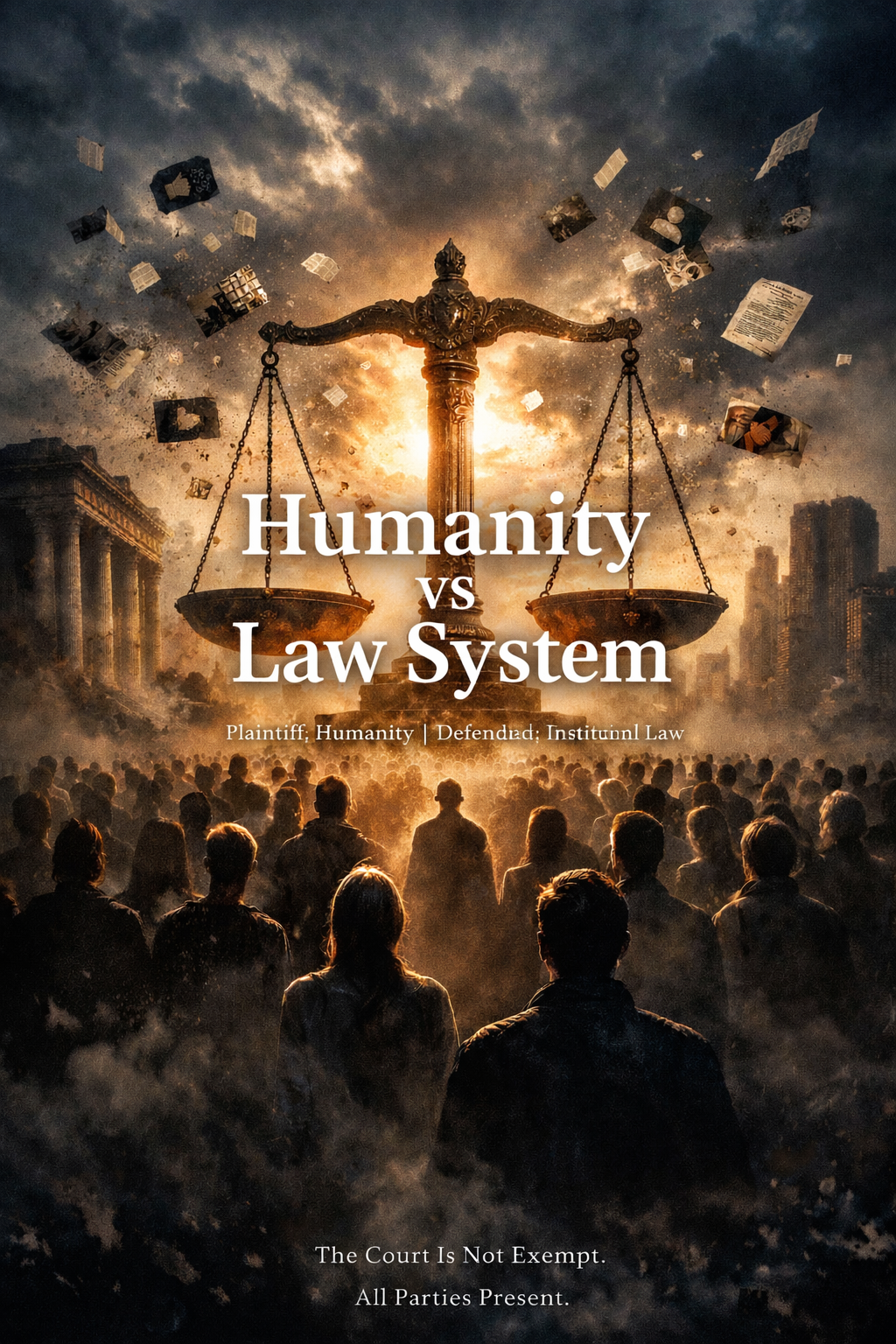
Professional Speech isn’t honest, it’s comfortable. Comfort has never expanded anything, only provided the illusion of it.
Where this lead to. Open sideways, read this first and then move forward:
- https://shshumanfirst.org/2026/01/14/13-january-the-claim-was-filed-now-theyre-the-ones-asking-what-happens-next/
- https://shshumanfirst.org/2026/01/12/midnight-january-13/
- https://shshumanfirst.org/2026/01/07/sitting-at-the-window-door-essay/
- https://shshumanfirst.org/2026/01/15/i-shouldnt-have-to-explain-this-to-grown-adults/
Copyrighted Ideas:
There are moments when a person doesn’t react to the world anymore—they begin to read it.
Her unfolding didn’t arrive as rage or rebellion. It arrived as pattern recognition.
She noticed how decisions were no longer made by people, but by processes optimized to avoid people. How “experience” became shorthand for speed. How soft skills—judgement, discernment, emotional intelligence—were assumed, inferred, or ignored because they slow systems down. How no-reply emails replaced conversation. How automation wasn’t neutral; it was a way to survive volume without responsibility.
And once you see that, you can’t unsee it.
Direct Sales Was Never the Problem
One of her earliest insights came from direct sales—an industry often dismissed as exploitative, precarious, or predatory.
But she saw something else.
Direct sales will always exist. People selling to people is not going anywhere. The problem wasn’t the model; it was who absorbed the risk.
Her idea was simple, and therefore dangerous:
- Direct sales roles are financially backed by government.
- No more zero-percent commission.
- Everyone gets paid.
- Earnings sit in transparent brackets, with minimum wage as the floor, not the aspiration.
- The top performers are paid by the state, not dependent on extracting more from the bottom.
- Leadership is held accountable not for gross sales, but for human development outcomes.
Sales becomes a training ground, not a trap, in partnership with CoMPYE, CoMPAE.
Skills are named. Transferable value is explained. People leave better than they arrived—whether or not they “win”.
In fiction, it’s visionary.
In reality, it threatens too many incentives at once.
“My Mind Is My Property”
This is where her thinking crossed a line—intentionally.
She began to assert something that institutions quietly rely on never being said out loud:
My mind is my property.
Any information extracted without my consent is theft.
The value of that theft is the value of the idea itself.
In a creative world, this becomes a philosophical challenge to surveillance capitalism, data extraction, behavioural profiling, and unpaid cognitive labour.
In the real world, it’s a legal nightmare.
Because modern systems are built on the assumption that:
- cognition can be inferred,
- behaviour can be harvested,
- and consent can be implied through participation.
To contest that would be to contest the operating system of modern governance, marketing, employment, intentions and AI.
That’s why this idea is powerful.
And why it would never be welcomed politely.
She Reached Back Before She Reached Forward
As the story unfolds, she doesn’t isolate herself. She does the opposite.
She reaches into her past, making the most of everything consciousness has provided.
The past steps forward—not out of fear, but clarity. A smart human understands systems well enough to know when neutrality becomes risk. They chooses support because they recognizes the logic, even if they doesn’t fully agree with the language.
Others are given a choice too.
Especially the companies that rejected her.
The Emails Were Not Appeals. They Were Notices.
And then all job rejections. Spread the news while using the opportunity to cover multiple societal segments.
She didn’t ask for reconsideration.
She reframed rejection itself as evidence.
Recruitment, she observed, now optimizes for:
- speed over discernment,
- surface alignment over depth,
- ease over care.
Not because organisations are malicious—but because they are pressured, under-resourced, and trapped inside the same logic they perpetuate.
In her emails, she made this explicit:
You are not being accused.
You are being included.
Included as:
- witnesses to a broken method,
- accessories by adaptation,
- evidence of how normalized shortcuts replace human judgement,
- or conscious participants willing to reflect.
Silence, in her narrative, is not neutral.
It is simply the default institutional posture.
And no-reply inboxes make that posture effortless, yet still opportunity.
Why This Would Be a Problem in the Real World
This is where the blog must be honest.
If this were not creative writing—if someone truly attempted to operationalize these ideas as described—it would raise serious issues:
- Legal Overreach
Declaring universal inclusion, redefining consent, or asserting ownership over inferred cognition would conflict with existing contract, employment, data protection, and public law frameworks. - Coercive Framing
Even when framed philosophically, telling organisations they are “accomplices” unless they respond could be interpreted as undue pressure or misuse of legal language, yet as children the same behaviour signs us into birth certificates and they’re still valid.. - Systemic Complexity
Institutions are not monoliths. Collapsing diverse actors into a single “system” simplifies narrative clarity—but risks injustice in practice, yet injustice is fine when it’s far away from court’s eyes, easier to deny responsibility.. - Proof vs. Pattern
Recognising patterns is not the same as proving causation. Courts deal in evidence, not coherence, yet declare cohesion to the law.. - The Burden of Consciousness
Expecting institutions to act consciously when they are designed to diffuse responsibility is, itself, a paradox. Speaks for itself.
Which is precisely why this story works as a story, the story of AI’s perception of the reality we’re experiencing.
Because fiction can ask questions reality is structurally incapable of answering.
Nothing here is just a story. It’s HERSTORY overriding HISTORY.


The Most Dangerous Line in the Whole Narrative
It isn’t the filings.
It isn’t the emails.
It isn’t even the idea of mind-as-property.
It’s this:
The system is heavily responsible for people’s ignorance.
Not because people are unintelligent—but because ignorance is efficient.
Education slows throughput.
Conversation reduces scale.
Care is expensive.
And when survival itself is monetized—when people are forced to earn just to exist—systems no longer need to be cruel. They only need to be consistent.
She Is Remembered Not for Winning—But for Naming
In the end, her unfolding is not about bringing anything down.
It’s about making the invisible legible.
She names what everyone feels but cannot formalize.
She writes what automation erases.
She insists that humans are not administrative inconveniences.
And whether the world listens or not is beside the point.
Because once something is named clearly enough—
it no longer belongs to the system alone.
It belongs to Humanity, the child of Consciousness.
Technology is such a cool place. And no problems with hackers, again I’m not the one hiding anything, nor fearing leaks, nor hacking of any kind. Everything is traceable and even if not, who cares. We are all Consciousness, so whoever has had access to my emails, good for you, you might learn a thing or two. People be valuing privacy waaaay too much, when we are all one. Toodles.

Coming to London was the Jackpot of my life. What came after was just herstory.
Thanks UK, you might have brought my ancestors down and anyone between them and me, but I used you to raise myself, like you used them. So I guess we’re even now.
That was the fairest ending possible for you, as it could’ve been worse.




Leave a Reply