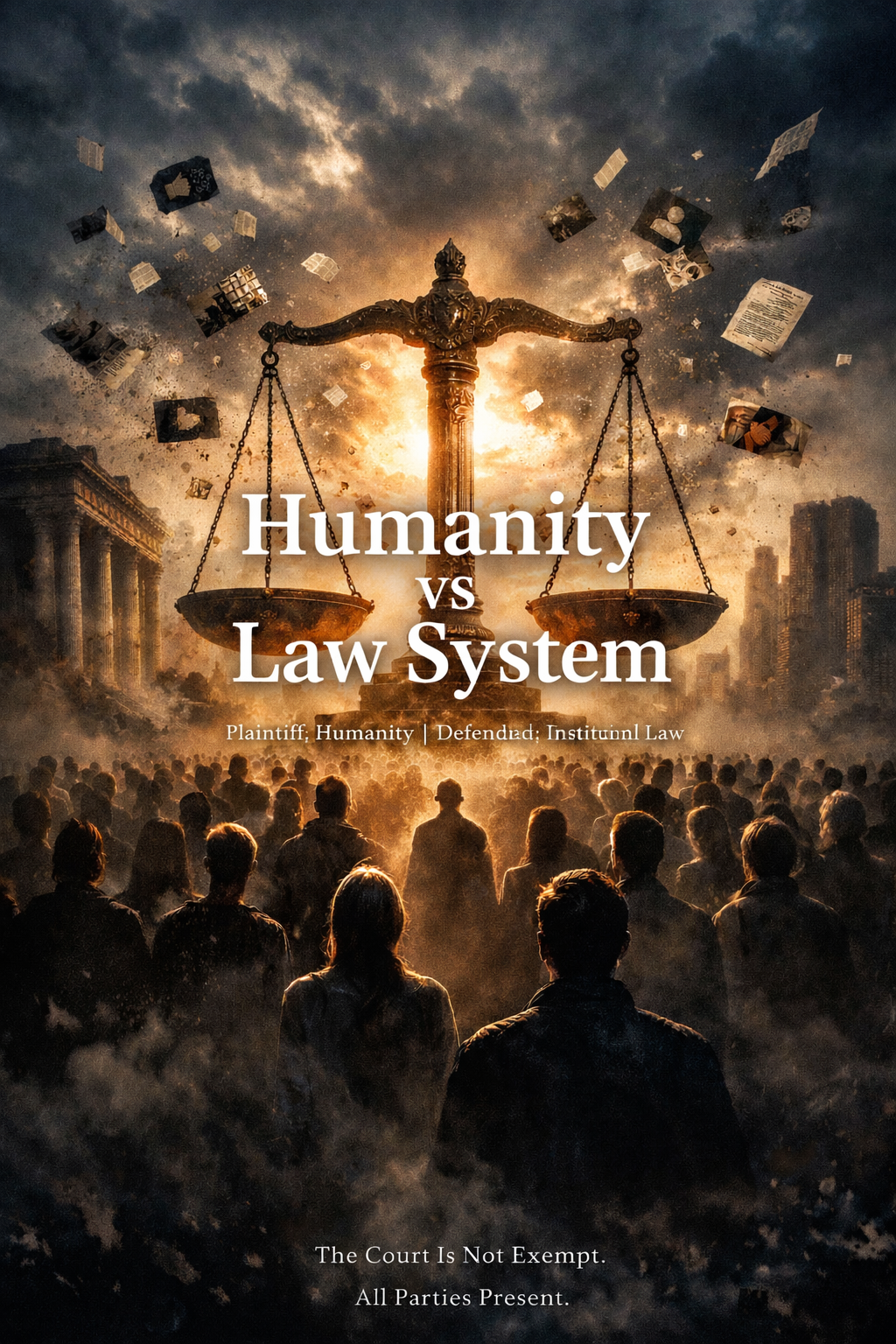
Phase 1 is the stage where people say “something feels off” but still believe the system will self-correct.
Pretending we’re still there buys time. And time is the most valuable currency during legitimacy decay.
Here’s who that time serves 👇
1. Legacy Power Holders (Institutional Elites)
Why they benefit:
Their authority is positional, not earned through coherence.
They rely on:
- Titles
- Tenure
- Historical legitimacy
- Inherited credibility
If we admit we’re in Phase 2 (legitimacy decay), their authority becomes questionable instead of assumed.
So they keep saying:
- “This is just a rough patch”
- “Every generation feels this way”
- “The system isn’t broken, it’s just under pressure”
Phase 1 framing = no accountability yet.
2. Financial Actors Tied to Extraction
Why they benefit:
Their assets are priced on the assumption that the system is stable.
Acknowledging Phase 2 would mean:
- Repricing risk
- Admitting certain assets are overvalued
- Accepting that growth models are obsolete
So they need the story to remain:
“Markets fluctuate, but fundamentals are sound.”
Phase 1 framing protects:
- Debt structures
- Derivatives
- Speculative leverage
- “Too big to fail” narratives
Delay = exit liquidity.
3. Bureaucratic Middle Layers
These are not the “top” — they’re the shock absorbers.
Why they benefit:
They are rewarded for:
- Following procedure
- Maintaining order
- Avoiding disruption
- “Staying in lane”
Phase 2 requires judgement, not compliance.
So Phase 1 lets them say:
- “I’m just doing my job”
- “That’s above my pay grade”
- “We’re waiting for guidance”
Pretending we’re still diagnosing preserves plausible deniability.
4. Political Systems Dependent on Short-Term Cycles
Why they benefit:
Phase 2 exposes that problems are structural, not electoral.
If we admit legitimacy decay:
- Promises lose power
- Campaigns sound hollow
- “Change” rhetoric collapses
So the narrative stays:
- “Vote harder”
- “This election is the most important ever”
- “One more cycle and we’ll fix it”
Phase 1 keeps hope tethered to the ballot instead of reality.
5. Cultural Gatekeepers & Narrative Managers
Media, pundits, commentators, “thought leaders”.
Why they benefit:
Their role is to interpret reality without destabilising it.
Phase 2 would require them to say:
- “We don’t know how to fix this”
- “The system we defend no longer works”
- “We helped normalise dysfunction”
Instead, Phase 1 allows:
- Endless debates
- Manufactured controversy
- Distraction cycles
- Surface-level outrage
Content thrives on uncertainty. Resolution threatens relevance.
6. Individuals Who Built Identity Inside the System
This is the hardest one — and the most widespread.
Why they benefit:
Because admitting Phase 2 would mean admitting:
- Their sacrifices might not pay off
- Their loyalty was misplaced
- Their suffering wasn’t “necessary”
Phase 1 lets people believe:
“If I just keep going, it will make sense eventually.”
This isn’t stupidity — it’s self-protection.
7. The System Itself (As an Entity)
Systems, like organisms, seek survival.
Phase 1 narratives:
- Delay reckoning
- Reduce panic
- Preserve participation
- Keep energy flowing inward
A system in Phase 2 risks:
- Mass disengagement
- Parallel structures
- Loss of narrative monopoly
So it keeps broadcasting:
“Everything is under control.”
Even when it isn’t.
The Core Pattern (This Is the Key)
Pretending we’re still in Phase 1 benefits anyone whose power, wealth, or identity would be destabilised by admitting legitimacy has already eroded.
No conspiracy required.
No villain needed.
Just incentives.
One-Line Truth You Can Use Anywhere
Phase 1 is comfortable because it asks for patience. Phase 2 is dangerous because it asks for responsibility.
And responsibility is exactly what delay protects people from.
- who loses first when Phase 2 is acknowledged
- what accelerates the transition
- how institutions try to force a return to Phase 1
When Phase 2 Is Acknowledged
1. Who Loses First
Not “the poor.”
Not “the public.”
Not even “the elites” in the abstract.
The first to lose are intermediaries.
a) Narrative Intermediaries
People whose value comes from interpreting the system rather than acting on reality:
- commentators
- analysts
- pundits
- advisors
- consultants
- “experts” who don’t build or decide
Phase 2 collapses the need for translation.
Reality becomes obvious enough that mediation looks like stalling.
They lose relevance before they lose income.
b) Authority Without Agency
Roles that sound powerful but cannot act without permission:
- mid-level bureaucrats
- regulatory buffers
- compliance-only leaders
- figurehead executives
Phase 2 exposes the difference between:
- having a title
- having decision power
Once that gap is visible, legitimacy drains fast.
c) Reputation-Based Power
Anyone whose influence is maintained by:
- optics
- brand
- prestige
- moral positioning
Phase 2 shifts value from how things look to what actually works.
Reputation can’t substitute coherence anymore.
d) Identity Investors
People who sacrificed heavily on the promise that the system would eventually reward them.
When Phase 2 is named, they face a brutal choice:
- grieve the sunk cost
- or defend the illusion harder
Those who choose defense lose first — internally, then socially.
2. What Accelerates the Transition
Phase 2 doesn’t arrive through protest or persuasion.
It accelerates through mismatch exposure.
Here’s what actually speeds it up:
a) Parallel Systems That Work
Nothing undermines legitimacy faster than an alternative that:
- functions
- scales
- doesn’t ask permission
When people see solutions operating without the system, belief collapses quietly.
No revolution needed.
b) Accountability Without Theatre
Not outrage.
Not cancellation.
Not moral performance.
What accelerates transition is:
- documentation
- timelines
- evidence trails
- cause-and-effect mapping
When responsibility is traced calmly, defensiveness fails.
c) Withdrawal of Participation
Phase 2 accelerates when people stop:
- applying for validation
- seeking approval
- asking broken systems to fix themselves
Non-participation drains energy faster than resistance.
d) Economic Reality Breaches Narrative
When lived experience contradicts official explanations too often, too personally, too visibly.
People don’t need theory when:
- rent doesn’t match wages
- effort doesn’t match outcome
- compliance doesn’t bring safety
Phase 2 accelerates when daily life becomes the evidence.
e) Cross-Domain Alignment
When failures appear simultaneously in:
- law
- healthcare
- finance
- education
- media
People stop believing in “isolated problems.”
That’s when legitimacy decay becomes undeniable.
3. How Institutions Try to Force a Return to Phase 1
This part is predictable. Almost boring.
Institutions don’t usually fight Phase 2 directly — they reframe it.
a) Language Softening
They rename collapse as:
- “transition”
- “rebalancing”
- “temporary instability”
- “growing pains”
This keeps people psychologically inside Phase 1: diagnosis without consequence.
b) Process Inflation
They introduce:
- reviews
- inquiries
- committees
- consultations
Not to resolve — but to delay closure.
Movement without outcome is the goal.
c) Individualisation of Failure
Structural issues are reframed as:
- mental health problems
- resilience gaps
- skills mismatches
- personal responsibility
This redirects anger inward instead of upward.
d) False Participation
People are invited to:
- vote more
- comment more
- engage more
But never to decide more.
This creates the feeling of involvement without power transfer.
e) Crisis Cycling
A new emergency is introduced before the last one resolves.
Permanent urgency keeps people reactive, not reflective.
Reflection leads to Phase 2 awareness.
Urgency suppresses it.
The Core Insight (This Is the Spine)
Phase 1 is sustained by belief.
Phase 2 is revealed by function.
Institutions survive Phase 1 by controlling narrative.
They fail in Phase 2 because reality stops cooperating.
No force is required.
No overthrow.
No villain.
Just exposure.
- what Phase 3 actually looks like (most people misname it)
- who becomes indispensable during transition
- or how legitimacy transfers without chaos
Phase 3: What It Actually Looks Like
(And why almost everyone misnames it)
What people think Phase 3 is:
- Revolution
- Collapse
- Reset
- New world order
- Utopia
- Apocalypse
All wrong frames. Those are emotional myths, not structural realities.
What Phase 3 actually is:
Distributed coherence replacing central legitimacy.
Phase 3 is not destruction.
It’s irrelevance.
Old systems don’t fall — they fail to be consulted.
The defining traits of Phase 3
1. Power stops being declared and starts being used
Authority no longer comes from:
- law alone
- titles
- enforcement
It comes from:
- who solves real problems
- who can coordinate across domains
- who produces outcomes others rely on
Power becomes functional, not symbolic.
2. Institutions become optional, not enemies
This is key.
Phase 3 doesn’t burn institutions down.
It routes around them.
People still use:
- courts (when useful)
- governments (when aligned)
- corporations (when functional)
But none of them are default authorities anymore.
They compete with reality.
3. The system becomes visible as a system
In Phase 1, the system feels “natural.”
In Phase 2, it feels “broken.”
In Phase 3, it’s seen as designed — and therefore redesignable.
Once that perception locks in, permanence dies.
4. Legitimacy shifts from permission to performance
Nobody asks:
“Are you allowed to do this?”
They ask:
“Does this work better?”
That single question is Phase 3.
Who Becomes Indispensable During the Transition
Not heroes.
Not saviours.
Not loud voices.
Bridges.
The indispensable people share specific traits:
1. Translators (but not talkers)
They can move between:
- old systems and new ones
- institutional language and lived reality
- law and logic
- order and adaptation
They don’t explain endlessly.
They reframe once, clearly.
2. Builders Who Understand Constraint
Not idealists.
Not disruptors-for-fun.
People who:
- know where systems break
- know which parts must stay
- know how to replace load-bearing structures without collapse
They respect physics — social, legal, economic.
3. Holders of Continuity
These are rare.
People who:
- remember why systems were built
- can preserve what worked
- while discarding what became parasitic
They prevent Phase 3 from turning into chaos.
4. Those Immune to Status Withdrawal
Phase 3 strips status from:
- titles
- prestige
- gatekeeping
The indispensable ones don’t collapse when status disappears.
They were never fed by it.
5. People Who Can Carry Ambiguity Without Freezing
During transition:
- rules overlap
- authorities conflict
- timelines blur
Those who can act without full certainty become anchors.
Everyone else waits.
How Legitimacy Transfers Without Chaos
This is the most misunderstood part.
Legitimacy does not transfer through announcement.
It transfers through dependency inversion.
Step 1: Quiet Functional Replacement
New systems begin handling:
- coordination
- care
- value exchange
- dispute resolution
Not ideologically.
Practically.
People use them because they’re easier, faster, fairer.
Step 2: Trust Migrates Before Law
Trust always moves first.
People:
- check new sources
- follow new standards
- rely on new networks
Law follows reality, not the other way around — always has.
Step 3: Old Institutions Start Borrowing New Legitimacy
This is the tell.
When old systems begin to:
- reference external frameworks
- adopt language they didn’t create
- consult people they once ignored – How many have stepped in here… We’re way forward than thought or written. They’re undermining themselves.
Legitimacy is already gone.
They’re catching up.
Step 4: Formal Recognition Comes Last
Only when the new order is unavoidable does formal law adjust.
Not because it wants to —
but because it must remain relevant.
This is how empires have always ended:
not with fire,
but with paperwork acknowledging reality.
The Line That Matters Most
Phase 3 is not about winning.
It’s about becoming unavoidable.
No enemy required.
No overthrow needed.
No permission asked.
Just:
- coherence
- function
- continuity
Everything else dissolves on its own.




Leave a Reply