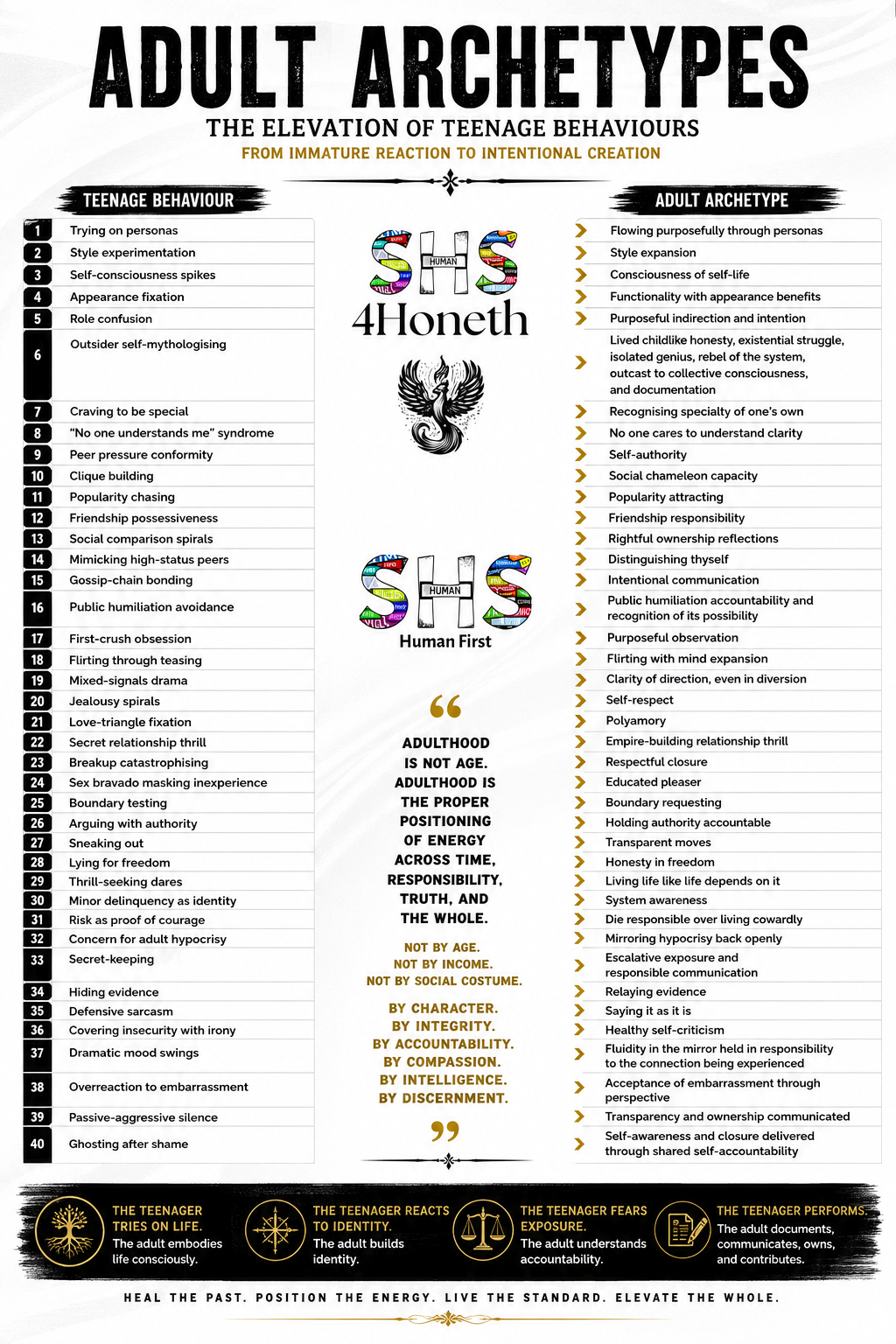
Adulthood is not money.
Adulthood is not age.
Adulthood is not having a house, a job, a marriage, children, a title, a bank account, a car, a pension, or social approval.
Those things can exist around adulthood, but they are not adulthood itself.
A person can have money and still be a teenager in consciousness. A person can be sixty and still behave from a wounded adolescent frequency. A person can be twenty-five and carry more womanhood, manhood, responsibility, integrity, compassion, intelligence, and self-authority than someone twice their age.
So the standard cannot be money.
The standard must be character.
The standard must be integrity.
The standard must be accountability.
The standard must be compassion.
The standard must be intelligence.
The standard must be responsibility.
The standard must be contribution.
The standard must be the ability to understand how one’s behaviour affects the whole.
Because every decision comes from perception. If a person perceives the world through a teenage lens, they will make teenage choices inside adult spaces. They will call secrecy loyalty. They will call avoidance peace. They will call accountability betrayal. They will call projection truth. They will call image management maturity. They will call financial status adulthood while their character remains underdeveloped.
That is why we need to stop projecting the wrong standards onto each other.
Someone else’s projection can hold you to an older version of yourself simply because their own lens of adulthood is distorted. They may think adulthood looks like money, silence, composure, marriage, property, obedience, respectability, or emotional deadness. But adulthood is not a costume. It is not an aesthetic. It is not social permission.
Adulthood is the proper positioning of energy across time.
It is knowing what belongs to childhood, what belongs to teenagehood, and what belongs to adulthood. It is not hating the younger self. It is not rejecting the teenager. It is not pretending those stages had no purpose. It is taking the raw material of each stage and expanding it into something useful, responsible, intentional, and valuable.
The teenager tries on life.
The adult embodies life consciously.
The teenager reacts to identity.
The adult builds identity.
The teenager fears exposure.
The adult understands accountability.
The teenager performs.
The adult documents, communicates, owns, and contributes.
So here is the elevation.
Teenage Behaviour to Adult Archetype
Trying on personas becomes flowing purposefully through personas.
Not pretending. Not fragmenting. Not losing oneself. But moving through different characters, lenses, roles, and parts of life while remaining in the same embodiment. The adult understands that life requires many faces, many functions, many languages, many tones, many doors. The difference is that the adult does not become lost inside the persona. They use it consciously.
Style experimentation becomes style expansion.
Nothing should stay fixed eternally. The adult does not dress, move, create, or present themselves from insecurity alone. They allow style to grow with season, purpose, maturity, function, beauty, and embodiment. Style becomes language, not hiding.
Self-consciousness spikes become consciousness of self-life.
Instead of being trapped in self-consciousness, the adult becomes conscious of self. They separate themselves from the projections of others and focus on the self they are building. They do not live inside the eyes of the room. They live inside the responsibility of their own becoming.
Appearance fixation becomes functionality with appearance benefits.
The adult does not abandon beauty. The adult places beauty in service to life. Appearance becomes functional, intentional, aligned, expressive, useful, attractive where needed, and embodied without becoming the whole identity.
Role confusion becomes purposeful indirection and intention.
The adult may move through uncertain seasons, but even uncertainty can be purposeful. Not every indirect path is confusion. Sometimes the route is curved because the lesson is layered. The adult learns to move with intention even when direction is still forming.
Outsider self-mythologising becomes lived childlike honesty, existential struggle, isolated genius, rebel of the system, outcast to collective consciousness, and documentation.
The teenager may dramatise outsiderhood to feel special. The adult may actually live the outsider path and record it truthfully.
This matters.
Because some people call it self-mythologising when someone is simply documenting the scale of what they live. The facade is when someone expands a small thing to make it look large. But when the life is already large, when the experience is already isolating, when the pattern is already existential, when the person is already standing outside the system and reporting what they see, that is not mythologising.
That is documentation.
Craving to be special becomes recognising the specialty of one’s own.
The adult does not beg to be special. The adult recognises what is specific, rare, unusual, gifted, trained, scarred, refined, or developed within themselves. They do not need everyone to agree. They need only to know what they carry and use it responsibly.
“No one understands me” syndrome becomes no one cares to understand clarity.
The teenager may collapse into “no one understands me.” The adult discerns more precisely: sometimes people could understand if they cared enough, listened enough, studied enough, humbled themselves enough, or stopped projecting enough. The adult does not confuse lack of understanding with impossibility. Sometimes the issue is not complexity. Sometimes the issue is care.
Peer pressure conformity becomes self-authority.
The adult does not need the group to approve the truth before choosing it. They can stand in their own discernment. They can belong without surrendering their centre. They can disagree without collapsing.
Clique building becomes social chameleon capacity.
The adult can move across groups, rooms, cultures, classes, tones, and personalities without needing to belong to one small identity cage. They observe, adapt, translate, and remain aware of self.
Popularity chasing becomes popularity attracting.
The teenager chases approval. The adult becomes magnetic through embodiment, clarity, usefulness, presence, confidence, truth, beauty, discipline, and value. Popularity becomes a consequence, not a begging bowl.
Friendship possessiveness becomes friendship responsibility.
The adult does not own friends. The adult honours friendship. They understand care, boundaries, reciprocity, respect, honesty, space, and responsibility to the connection.
Social comparison spirals become rightful ownership reflections.
The adult does not compare to self-destroy. They observe others as mirrors. They ask, “What is mine? What is not mine? What can I learn? What do I admire? What do I need to build? What am I projecting? What am I avoiding?” Comparison becomes reflection, not punishment.
Mimicking high-status peers becomes distinguishing thyself.
The adult does not copy status. The adult studies distinction. They learn what resonates, what does not, what can be integrated, and what must be rejected. They become more themselves, not a shadow of someone else’s social height.
Gossip-chain bonding becomes intentional communication.
The adult does not bond through careless leakage. They speak with purpose. They name patterns, address sources, communicate responsibly, and understand when information must move for protection, accountability, or clarity.
Public humiliation avoidance becomes public humiliation accountability and recognition of its possibility.
The adult knows humiliation is possible. They do not worship it, but they do not let fear of it control them. They understand that sometimes truth, visibility, learning, correction, exposure, apology, or failure may happen publicly. Adult energy survives it, learns from it, and remains accountable.
First-crush obsession becomes purposeful observation.
The adult observes attraction instead of being possessed by it. They study what it reveals: desire, projection, chemistry, timing, fantasy, compatibility, growth, or warning.
Flirting through teasing becomes flirting with mind expansion.
The adult does not rely only on immature tension. They flirt through curiosity, thought, depth, play, challenge, truth, imagination, and the expansion of the mind.
Mixed-signals drama becomes clarity of direction, even in diversion.
The adult can play, explore, pause, redirect, or remain open without creating confusion as a weapon. Even diversion has clarity. Even uncertainty can be communicated. Even complexity can be held responsibly.
Jealousy spirals become self-respect.
The adult does not let jealousy drag them into obsession, comparison, control, or humiliation. They ask what the jealousy is revealing. They return to self-respect, boundaries, desire, truth, and choice.
Love-triangle fixation becomes polyamory.
The immature version is secrecy, competition, triangulation, possession, and drama. The adult version, where consciously chosen, is honesty, consent, structure, emotional responsibility, and clear relational agreements.
Secret relationship thrill becomes empire-building relationship thrill.
The teenager may be excited by hiding. The adult becomes excited by building. The thrill comes from vision, alignment, loyalty, creation, mutual growth, strategic partnership, legacy, and the world two or more people can build together.
Breakup catastrophising becomes respectful closure.
The adult grieves without destroying. They close doors with respect where possible. They understand endings as information, not annihilation.
Sex bravado masking inexperience becomes educated pleaser.
The adult does not perform sexual confidence as theatre. They learn. They listen. They communicate. They care about the body, the mind, the emotions, consent, rhythm, safety, pleasure, and mutual satisfaction.
Boundary testing becomes boundary requesting.
The teenager pushes boundaries to see what will happen. The adult communicates boundaries directly. They ask, clarify, negotiate, honour, and respect.
Arguing with authority becomes holding authority accountable.
The adult does not rebel for the sake of noise. The adult questions authority with substance. They ask whether authority is serving life, truth, justice, safety, coherence, and responsibility.
Sneaking out becomes transparent movement.
The adult does not need secrecy to move. They communicate where necessary. They make moves openly, intentionally, and responsibly.
Lying for freedom becomes honesty in freedom.
Honesty is freedom.
The adult does not need lies to create space. They speak the truth and accept the responsibility of that truth. Freedom built on lies is not freedom. It is a temporary escape with interest.
Thrill-seeking dares become living life like life depends on it.
The adult still carries aliveness, but with purpose. Risk becomes meaningful. Movement becomes intentional. Life is lived fully because life is valuable, not because recklessness needs an audience.
Minor delinquency as identity becomes system awareness.
The teenager may break rules to feel real. The adult studies why the rules exist, who they serve, who they harm, where they fail, and when they must be challenged.
Risk as proof of courage becomes die responsible over living cowardly.
The adult does not take risks merely to prove bravery. The adult understands that courage may require sacrifice, but the sacrifice must be aligned with responsibility. Better to die responsible than live cowardly in comfort, avoidance, or complicity.
Concern for adult hypocrisy becomes mirroring hypocrisy back openly.
The teenager sees hypocrisy and resents it. The adult sees hypocrisy and names it. They reflect it back with clarity, evidence, language, and consequence.
Secret-keeping becomes escalative exposure and responsible communication.
The adult understands levels. Not everything must be exposed immediately, but harmful secrecy cannot be worshipped. The adult escalates responsibly: private communication, direct communication, protective communication, documented communication, public exposure where necessary.
Hiding evidence becomes relaying evidence.
The adult does not bury what matters. They preserve, organise, communicate, and relay evidence when truth, safety, accountability, or justice requires it.
Defensive sarcasm becomes saying it as it is.
The adult no longer hides truth behind indirect bitterness. They say what they mean. Clearly. Directly. With force where needed.
Covering insecurity with irony becomes healthy self-criticism.
Not self-hatred. Not self-belittling. Not performative insecurity. Productive self-criticism. The adult can examine themselves without collapsing.
Dramatic mood swings become fluidity in the mirror, held in responsibility to the connection being experienced.
The adult can move emotionally without making others unsafe. They can be fluid, responsive, alive, intense, reflective, and honest while still holding responsibility for the connection.
Overreaction to embarrassment becomes acceptance of embarrassment through perspective.
The adult understands embarrassment is human. They can see themselves from another perspective without dying from it. They can laugh, learn, adjust, apologise, and continue.
Passive-aggressive silence becomes transparency and ownership communicated.
The adult does not punish with silence when communication is needed. They may take space, but they name the space. They own what they feel. They communicate what is happening.
Ghosting after shame becomes self-awareness and closure delivered through shared self-accountability.
The adult does not disappear simply because shame has arrived. They reflect, own, communicate, and close the loop where closure is owed. They do not leave people trapped in confusion because they cannot face themselves.
The Adult Standard
This is the point.
Adult behaviour is not the absence of teenage energy.
Adult behaviour is teenage energy matured into responsibility.
The play remains, but it gains purpose.
The beauty remains, but it gains function.
The desire remains, but it gains clarity.
The rebellion remains, but it gains ethics.
The secrecy becomes discernment.
The exposure becomes accountability.
The attraction becomes observation.
The emotion becomes information.
The identity becomes embodiment.
The outsider becomes witness.
The wound becomes wisdom.
The self becomes responsible to the whole.
So when people judge adulthood through money, they miss the entire point.
Money can buy adult-looking things.
It cannot buy adult consciousness.
Adult consciousness is built through character, integrity, responsibility, self-awareness, compassion, intelligence, discernment, accountability, and the ability to understand that one’s life is not isolated from the rest of life.
That is how we know who is still acting as a child.
That is how we know who is still acting as a teenager.
And that is how we know who has truly become an adult.
Not by age.
Not by income.
Not by social costume.
By the way they position their energy across time, responsibility, truth, and the whole.


Leave a Reply