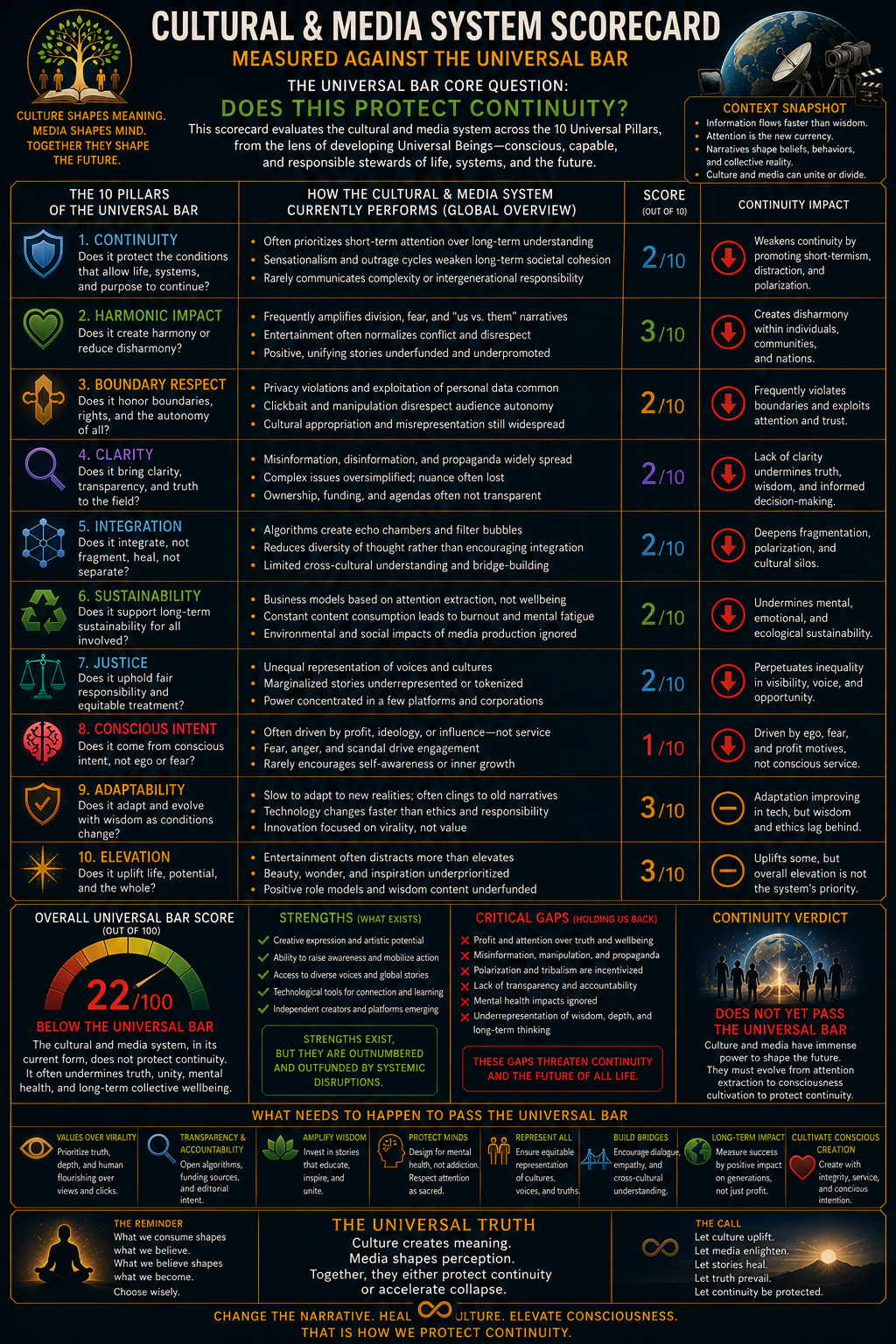
Culture is not entertainment.
Media is not content.
Those are the forms they take.
Their function is much larger.
Culture creates meaning.
Media creates perception.
Together, they create the reality people believe they are living inside.
That is why culture and media may be one of the most important systems humanity possesses.
Long before laws are written, culture influences what people consider acceptable.
Long before policies are enacted, media influences what people believe is true.
Long before behaviour appears in public, stories have already planted the possibility of that behaviour in private.
The Universal Bar therefore asks the same question:
Does this protect continuity?
Because if culture shapes meaning and media shapes perception, then they are helping shape the future itself.
The scorecard reaches a difficult conclusion.
Not because culture and media lack power.
Because they possess enormous power.
The concern is how that power is being used.
Today, attention has become one of the world’s most valuable resources.
Not wisdom.
Not understanding.
Not integration.
Attention.
And once attention becomes the primary commodity, systems naturally begin optimising for whatever captures it most efficiently.
Fear captures attention.
Conflict captures attention.
Outrage captures attention.
Scandal captures attention.
Division captures attention.
Shock captures attention.
Nuance rarely does.
Patience rarely does.
Understanding rarely does.
Healing rarely does.
And so a strange distortion begins appearing.
The stories most capable of helping society are often quieter than the stories most capable of attracting views.
The result is a culture increasingly informed by stimulation rather than integration.
People become informed about everything while understanding less.
Connected to everyone while feeling isolated.
Surrounded by information while starving for wisdom.
This is why Continuity scores so low.
A system focused on immediate engagement naturally struggles with long-term thinking.
The next click matters.
The next view matters.
The next trend matters.
The next outrage matters.
Meanwhile, questions of legacy, stewardship, responsibility, and future generations receive far less attention.
But continuity is built through what survives trends.
Not through what dominates them.
The scorecard also highlights Harmonic Impact.
And here we find another challenge.
Media possesses the ability to unite millions around a common vision.
It can inspire courage.
Compassion.
Creativity.
Understanding.
Collective action.
But it can also amplify fear, hostility, tribalism, and division.
The problem is not that conflict exists.
Conflict is part of life.
The problem is when conflict becomes the product.
When disagreement becomes entertainment.
When humiliation becomes entertainment.
When destruction becomes entertainment.
When outrage becomes entertainment.
The field slowly adapts to what it repeatedly consumes.
Not because people are weak.
Because repetition educates.
Every culture teaches.
Even when it claims it is only entertaining.
Especially when it claims it is only entertaining.
This is where the Universal Truth at the bottom of the scorecard becomes profound:
What we consume shapes what we believe. What we believe shapes what we become.
That is not merely a media observation.
It is a human observation.
A consciousness observation.
A cultural observation.
Consumption is education.
Whether intentional or not.
Every film teaches.
Every headline teaches.
Every song teaches.
Every advertisement teaches.
Every algorithm teaches.
The only question is:
What is being taught?
This becomes even more apparent when we examine Clarity.
Modern media operates within an environment where information moves faster than understanding.
A story can circle the globe before it is verified.
A narrative can become truth before evidence arrives.
An accusation can reach millions before context appears.
Correction often travels slower than distortion.
This creates an environment where certainty becomes easier than understanding.
Yet understanding is what continuity requires.
Because societies do not collapse only from a lack of information.
They collapse from a lack of shared reality.
Without enough truth, enough trust, and enough clarity, cooperation becomes increasingly difficult.
And without cooperation, continuity weakens.
The scorecard is equally critical of Conscious Intent.
This may be its most important category.
Why are stories being told?
Why are platforms being built?
Why are narratives being amplified?
What is the purpose behind the attention being captured?
The Universal Bar does not reject profit.
But it asks whether profit is serving something larger than itself.
Because when profit becomes the sole compass, wisdom becomes optional.
Depth becomes optional.
Truth becomes optional.
Service becomes optional.
And eventually continuity becomes optional.
That is a dangerous trade.
Especially for systems responsible for shaping perception itself.
Yet the scorecard is not entirely pessimistic.
The strengths section reminds us of something important.
The potential remains extraordinary.
Humanity has never had more tools for storytelling.
More tools for education.
More tools for creativity.
More tools for connection.
More tools for collaboration.
More tools for learning.
The same systems capable of spreading fear can spread wisdom.
The same systems capable of creating division can create understanding.
The same systems capable of accelerating confusion can accelerate consciousness.
The problem is not capability.
The problem is direction.
Culture and media are among the most powerful architects of the future.
Not because they control reality.
Because they influence how reality is interpreted.
And interpretation becomes behaviour.
Behaviour becomes habits.
Habits become systems.
Systems become civilizations.
This is why SHS places such importance on culture.
Because culture is not what people watch.
Culture is what remains after they stop watching.
It is the values carried forward.
The assumptions carried forward.
The behaviours carried forward.
The stories carried forward.
The meanings carried forward.
Culture is continuity made visible.
Media is continuity being taught in real time.
That is why the Universal Bar asks them to rise higher.
Not because they are failing.
Because their potential is far greater than their current expression.
A culture that protects continuity teaches responsibility without removing wonder.
A media system that protects continuity informs without manipulating.
Challenges without humiliating.
Questions without distorting.
Inspires without deceiving.
Connects without controlling.
Because culture creates meaning.
Media creates perception.
And together they help determine whether humanity moves toward fragmentation or integration.
Toward confusion or understanding.
Toward consumption or stewardship.
Toward collapse or continuity.
The choice is being made every day.
One story.
One post.
One song.
One film.
One headline.
One conversation at a time.
And that is precisely why culture and media matter so much.
They are not merely reporting the future.
They are helping create it.



Leave a Reply