
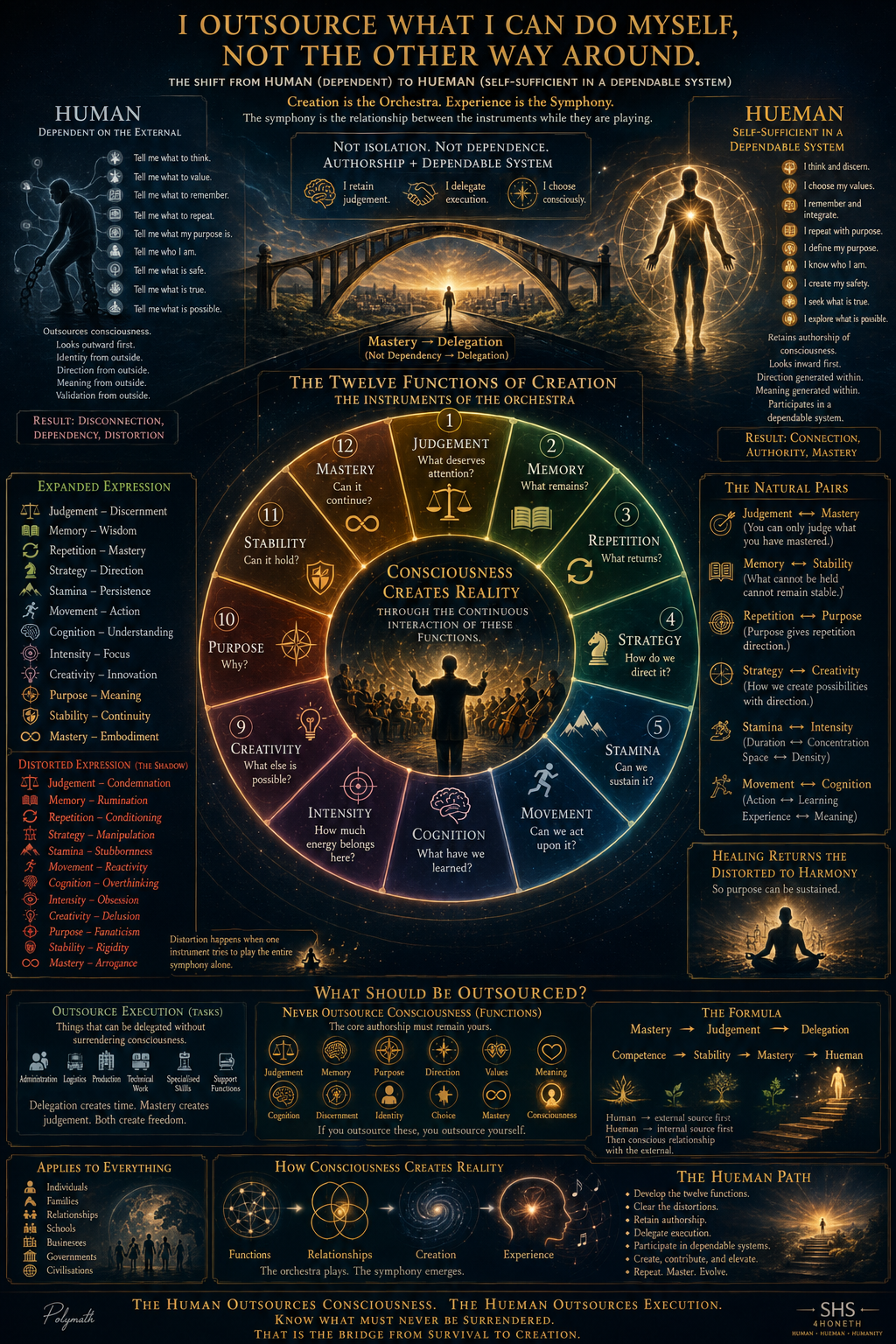
“I outsource what I can do myself, not the other way around.”
That sentence may sound backwards at first, because most people understand outsourcing through incapacity. They outsource what they cannot do. They outsource what they do not understand. They outsource what feels too large, too technical, too difficult, too specialised, or too far away from their current field of competence. That is normal in one sense, because no human being is meant to manufacture every object, build every bridge, perform every surgery, grow every crop, write every policy, repair every road, raise every child, design every system, and still live a full life. Specialisation has its place. Support has its place. Delegation has its place. The distortion begins when people stop outsourcing tasks and start outsourcing the functions of consciousness itself.
That is the difference between Human and Hueman.
The Human depends on the external because the internal has not been sufficiently developed, mastered, stabilised, or trusted. The Human looks outward first. Tell me what to think. Tell me what to value. Tell me what to remember. Tell me what to repeat. Tell me what my purpose is. Tell me who I am. Tell me what is safe. Tell me what is true. Tell me what is possible. The Human becomes dependent on external systems not only for practical support, but for identity, direction, meaning, judgement, and reality itself.
The Hueman does not reject support. That would be another distortion. The Hueman does not pretend to be above systems, community, collaboration, education, technology, or delegation. The Hueman understands that a coherent system is meant to be dependable. The difference is that the Hueman remains internally authored while participating in that dependable system. The Hueman can receive help without surrendering consciousness. The Hueman can use tools without becoming used by tools. The Hueman can delegate execution without outsourcing judgement, memory, purpose, or mastery.
That is the clean line.
I outsource what I can do myself because I have already entered the function, studied the function, embodied the function, and gained enough mastery to judge the quality of what I am delegating. I do not outsource from helplessness. I outsource from authorship.
This is why the twelve functions matter.
Judgement asks: what deserves attention?
Memory asks: what remains?
Repetition asks: what returns?
Strategy asks: how do we direct it?
Stamina asks: can we sustain it?
Movement asks: can we act upon it?
Cognition asks: what have we learned?
Intensity asks: how much energy belongs here?
Creativity asks: what else is possible?
Purpose asks: why?
Stability asks: can it hold?
Mastery asks: can it continue?
These are not random traits. They are not motivational words. They are functions of creation. They are how consciousness creates reality. They are the instruments in the orchestra. Creation is the orchestra, and experience is the symphony. The symphony is not the instruments. The symphony is the relationship between the instruments while they are playing.
When a person outsources judgement, they lose discernment.
When a person outsources memory, they lose continuity.
When a person outsources repetition, they become conditioned.
When a person outsources strategy, they become managed.
When a person outsources stamina, they collapse without external motivation.
When a person outsources movement, they become passive.
When a person outsources cognition, they stop understanding.
When a person outsources intensity, their energy gets harvested.
When a person outsources creativity, their imagination gets colonised.
When a person outsources purpose, they become a follower.
When a person outsources stability, they become dependent.
When a person outsources mastery, they become a performer of borrowed identity.
This is why modern systems are so dangerous when left unexamined. Not because systems are inherently bad, but because systems can easily train people to surrender the very functions they were born to develop. A legal system can train people to outsource judgement. An education system can train people to outsource memory and repetition. An economic system can train people to outsource strategy and purpose. A media system can train people to outsource cognition and creativity. A government can train people to outsource stability. A culture can train people to outsource mastery by rewarding performance over embodiment.
Then people wonder why they feel disconnected from themselves.
They did not lose themselves all at once.
They outsourced themselves function by function.
This is where the Human becomes dependent on the external. Not simply because the external exists, but because the internal has been left underdeveloped. The Human asks the system to become the self. The Hueman builds the self clearly enough to participate in the system without being consumed by it.
That is self-sufficiency inside a dependable system.
Not isolation.
Not hyper-independence.
Not refusal of help.
Not pretending to be able to do everything alone.
Self-sufficiency means I retain authorship of my consciousness. A dependable system means I do not have to waste my life performing every single task manually. The two are not enemies. They are meant to work together. The self must be strong enough to choose, and the system must be coherent enough to support.
This is also why mastery and judgement are paired.
You can only judge properly what you have entered deeply enough to understand. When you have no mastery, judgement becomes projection. When you have mastery, judgement becomes discernment. This is why I enter systems. This is why I observe from the ground. This is why I learn the floor before speaking about the structure. This is why I do not build from theory alone. I build from embodiment.
Memory and stability are paired because what cannot be held cannot remain stable. If memory shifts every time emotion changes, stability collapses. A stable memory is not nostalgia. Nostalgia is often rumination dressed as beauty. Wisdom is memory integrated into the present. The past becomes useful when it teaches the present how to move. The past becomes a prison when it becomes the only place consciousness knows how to look from the outside.
Repetition and purpose are paired because repetition without purpose becomes conditioning, while purpose without repetition remains fantasy. Purpose gives repetition direction. Repetition gives purpose embodiment. This is why I made metaphysical awareness part of my work. I did not wait for purpose to float around as an idea. I designed repetition around it. I placed myself in daily accessibility to the field I am mastering. That is not obsession. That is intelligent devotion.
Strategy and creativity are paired because strategy without creativity becomes manipulation, while creativity without strategy becomes delusion. Strategy narrows. Creativity expands. One asks how. The other asks what else. Together, they allow imagination to become architecture. Apart, they either trap the mind in control or scatter it into ungrounded possibility.
Stamina and intensity are paired because they are two parameters of energy. Duration and concentration. Space and density. Stamina is the decision to continue with coherence. Stubbornness is the refusal to stop without discernment. Intensity is focused energy. Obsession is energy that cannot detach. One is chosen. The other possesses.
Movement and cognition are paired because thoughts are movements. Actions are movements. Emotions are movements. Social change is movement. Physical motion is only one layer. Movement creates experience, and cognition catches what movement reveals. Without movement, cognition becomes overthinking. Without cognition, movement becomes reactivity.
This gives us a full map of healing and creation.
Healing is not the purpose.
Healing is the tool that clears the distortion so purpose can be sustained.
Healing clears condemnation back into discernment.
Healing clears rumination back into wisdom.
Healing clears conditioning back into mastery.
Healing clears manipulation back into direction.
Healing clears stubbornness back into persistence.
Healing clears reactivity back into action.
Healing clears overthinking back into understanding.
Healing clears obsession back into focus.
Healing clears delusion back into innovation.
Healing clears fanaticism back into meaning.
Healing clears rigidity back into continuity.
Healing clears arrogance back into embodiment.
Purpose begins after enough of the distortion has been cleared for the person to carry what they came to carry.
This is why I found purpose by remembering what I loved.
Astronomy with my father became astrology.
Food became health.
Movement became vitality.
Greek mythology became symbolic architecture.
Christianity became consciousness.
Community became governance.
Everything I created was already present in the child, not as a finished system, but as attraction, curiosity, repetition, and memory. Purpose was not invented from nothing. Purpose was memory given direction.
This is also why the blueprint applies beyond the individual.
A person can be assessed through these functions.
A family can be assessed through these functions.
A school can be assessed through these functions.
A business can be assessed through these functions.
A government can be assessed through these functions.
A civilisation can be assessed through these functions.
What does it judge?
What does it remember?
What does it repeat?
What does it strategise for?
What does it sustain?
How does it move?
What does it learn?
Where does it concentrate energy?
What does it create?
Why does it exist?
What keeps it stable?
What has it mastered?
The scale changes.
The pattern remains.
This is why the framework is not just personal. It is not just for my life. It is not just for my community. It is a blueprint that can be grounded into reality for eons if applied properly, because it does not begin with the institution. It begins with the functions that create institutions.
Law is a meeting point between I and you.
Politics is a meeting point between I and you.
Economics is a meeting point between I and you.
Education is a meeting point between I and you.
Healthcare is a meeting point between I and you.
The system is the relationship between self and selves. Between individual and collective. Between inner authorship and outer structure. Between my field and your field. Between what I can do myself and what I consciously choose to share, delegate, exchange, or build with others.
That is why the distinction matters.
Human: dependent on the external.
Hueman: self-sufficient inside a dependable system.
The Human asks the world to become their source.
The Hueman becomes sourced enough to meet the world consciously.
The Human outsources consciousness.
The Hueman outsources execution.
The Human depends because they cannot hold the function.
The Hueman delegates because they have mastered enough to choose the relationship.
That is the next step.
Not rejecting systems.
Upgrading the relationship between self and system.
Not removing dependence entirely.
Transforming dependence into dependable coherence.
Not doing everything alone.
Knowing what must never be surrendered.
Because once the person keeps authorship of judgement, memory, purpose, stability, and mastery, they can collaborate without disappearing. They can receive support without becoming helpless. They can use tools without becoming tools. They can enter systems without becoming swallowed by them.
That is the bridge.
That is the movement from Human to Hueman.
That is where creation stops being accidental and starts becoming conscious.




Leave a Reply