
Assistants Around the Founder: Continuity Keepers, Department Builders, and Future Stewards
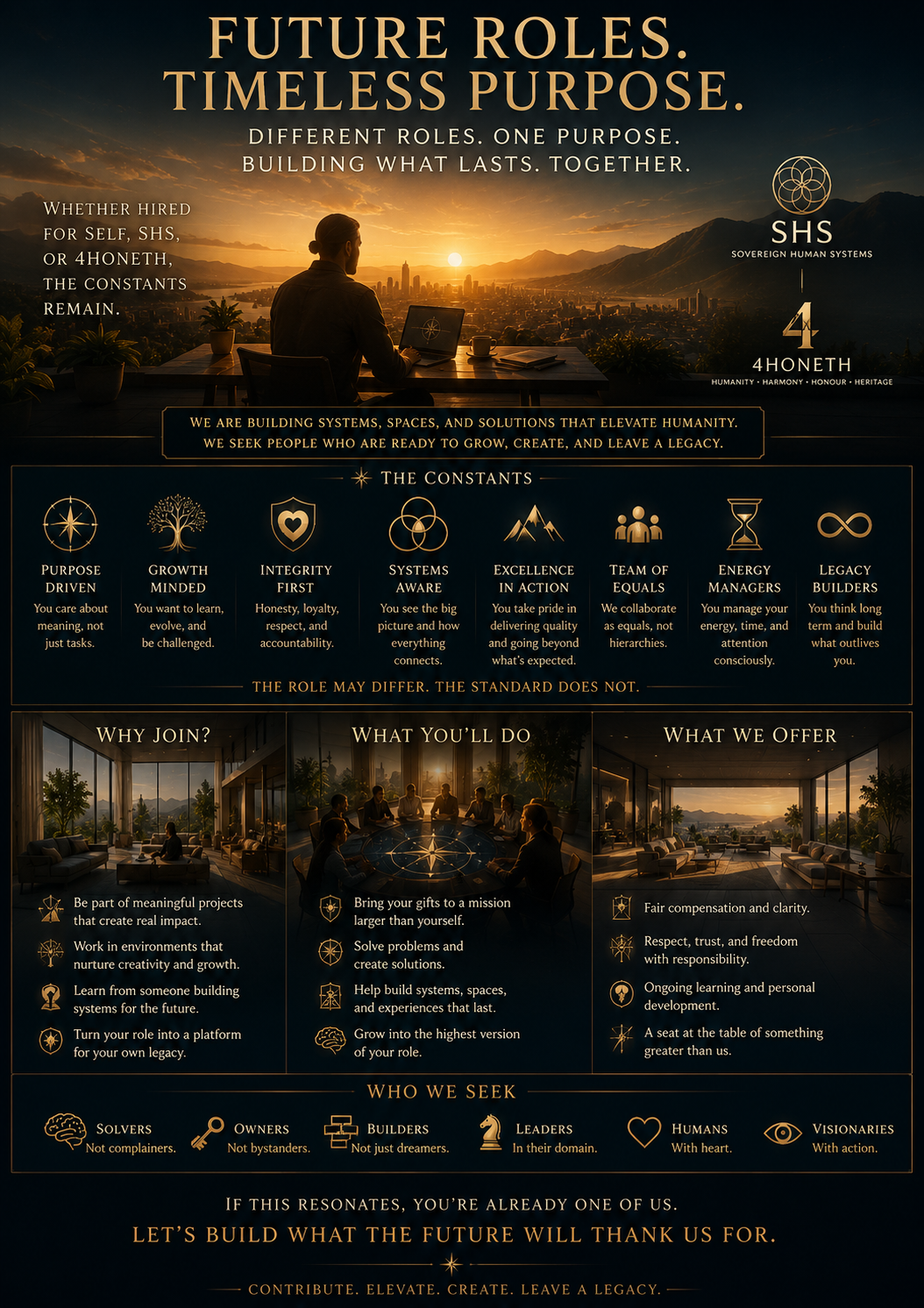
As SHS and 4Honeth move from vision into structure, one of the first support systems I want to build around myself is not a traditional assistant system. I am not looking for people who only want to manage calendars, answer emails, take notes, book appointments, and wait for instructions. Those things may be part of the role, but they are not the essence of it. The essence is continuity.
An assistant around me is not merely an assistant. They are a Continuity Keeper. They help manage the relationship between me and my success, me and my mastery, me and the departments I am building, me and the industries I am entering, me and the responsibilities that cannot all sit in my direct field at once if the wider vision is to grow properly.
This matters because SHS and 4Honeth will not remain small. We may begin with a house, a few people, and foundational conversations, but the direction is larger. The work is franchise-style in its future possibility, with different SHS branches, 4Honeth locations, industry-specific departments, and future expansions into spaces such as production, music management, creative labels, conscious hospitality, healthier lifestyle products, wellness architecture, education, events, media, and cultural development. The assistant roles that begin near me may later become department leads, heads of assistants, country-level coordinators, location stewards, family office specialists, or operational leaders within specific industries.
This is why the first assistants matter so much. They are not only helping with what exists now. They are learning the architecture of what comes next.
The first layer may include an Executive Assistant, a House Manager or Space Manager, and then assistants divided by relationship to function: one for my personal life, one for SHS, one for 4Honeth, one for outside engagements, and others added as the ecosystem reveals the need. Each assistant would help protect a different relationship between my energy and the field it must serve. The personal assistant helps protect the human foundation. The SHS assistant helps protect the governance, research, education, and systems work. The 4Honeth assistant helps protect the creative, production, location, event, and experiential work. The outside engagements assistant helps protect the relationship between me and external people, invitations, collaborations, opportunities, public presence, partnerships, and wider field movement.
Their role is not to think for me. Their role is to help me stay in clean relationship with what I am already thinking, building, carrying, creating, and choosing. They help reduce noise so the signal remains clear.
The qualities needed are therefore deeper than efficiency. Efficiency matters, but it is not enough. I need people with good questions. People who can notice gaps. People who can build structure around movement. People who can observe without assuming. People who can ask, “What is the purpose of this?” before turning everything into a task. People who understand that an assistant is often close enough to see what others miss, and therefore must be responsible with proximity.
A strong assistant around me must be trustworthy, discreet, organised, emotionally mature, curious, observant, adaptable, and able to hold continuity without becoming dependent on constant direction. They must be willing to learn the difference between support and interference, between initiative and overstepping, between anticipation and assumption, between care and control. They must understand that closeness to the founder is not status. It is responsibility.
Through our framework, the assistant role touches every system. In law, they help hold agreements, responsibilities, boundaries, confidentiality, and clarity. In politics, they help manage relationships, access, borders, communication, and who enters which field. In environmental management, they help remove waste, reduce disorder, organise information, and keep the field clean. In security and defence, they help observe risks, protect privacy, track sensitive matters, and notice what requires attention. In social welfare, they help support wellbeing, rhythm, care, and human sustainability.
In infrastructure, they help maintain the systems that allow everything else to function. In innovation, they help capture ideas, organise creative movement, and make sure new possibilities are not lost. In economy, they help manage energy, time, exchange, and prioritisation. In finance, they help keep awareness around spending, resources, planning, and responsible movement. In healthcare, they help protect vitality, rest, food, rhythm, and founder sustainability. In culture and media, they help track the story, tone, image, documentation, and public expression. In education, they help turn every role into a learning pathway, not a stagnant position.
This is why assistantship can become leadership training. A person who learns how to support the founder properly may later understand how to support a department. A person who learns how to support a department may later understand how to support a location. A person who learns how to support a location may later understand how to support a country branch. The role may begin close to me, but the continuity can extend far beyond me.
Some assistants may remain assistants because they enjoy that function and become masters of support. Some may become heads of assistants for a department. Some may move into operations. Some may become location managers. Some may oversee future SHS branches. Some may become 4Honeth location stewards. Some may remain within the family office, covering a specific industry such as media, music, production, hospitality, education, wellness, conscious product development, or external partnerships. The point is not to force everyone upward in the same way. The point is to allow each person’s direction to become clearer through proximity, responsibility, practice, and development.
This is also why questioning matters. I do not want assistants who only wait to be told. I also do not want assistants who assume authority they have not yet earned. The right assistant learns how to ask the question that opens the next layer. What is the priority? What is the continuity? What belongs to SHS? What belongs to 4Honeth? What belongs to Susan personally? What belongs to the outside relationship? What needs documenting? What needs protecting? What needs delaying? What needs escalating? What needs simplifying? What is repeating? What is changing? What is the pattern?
These questions are not small. They are the beginning of executive thinking.
The assistant system will also help us practise the future franchise-style model. Before SHS or 4Honeth expands into multiple locations and industries, we need to understand how information travels, how decisions are supported, how responsibilities are held, how priorities are filtered, how founder energy is protected, and how continuity survives when the number of moving parts increases. The first assistants become part of that learning.
This is why the first hires cannot simply be people who need a job. They must be people who want to develop a relationship with purpose, responsibility, structure, discretion, growth, and long-term building. They must understand that they are entering something early, which means things will evolve. One version of the role may go, but not the continuity. One department may shift, but not the standard. One project may complete, but not the direction. The assistant must be able to move with evolution without losing the foundation.
The goal is not to create dependency around me. The goal is to create dependable support around a mission that is too large to be carried through unmanaged energy. A founder cannot hold every calendar, every email, every document, every conversation, every relationship, every room, every idea, every opportunity, every meeting, every industry, and every future branch directly without eventually diluting the quality of attention. Support protects the quality of creation.
This is conscious delegation.
I do not outsource consciousness. I outsource execution, organisation, tracking, coordination, preparation, and continuity management so that consciousness can stay available for creation, discernment, leadership, and expansion.
The assistants around me will therefore be some of the earliest witnesses of how SHS and 4Honeth move from foundation into form. They will see the backend. They will see the thinking. They will see the building. They will see how conversations become systems, how systems become roles, how roles become departments, how departments become locations, and how locations eventually become a wider ecosystem.
This is not ordinary assistantship.
This is proximity to architecture.
And for the right person, that proximity can become a career path.




Leave a Reply