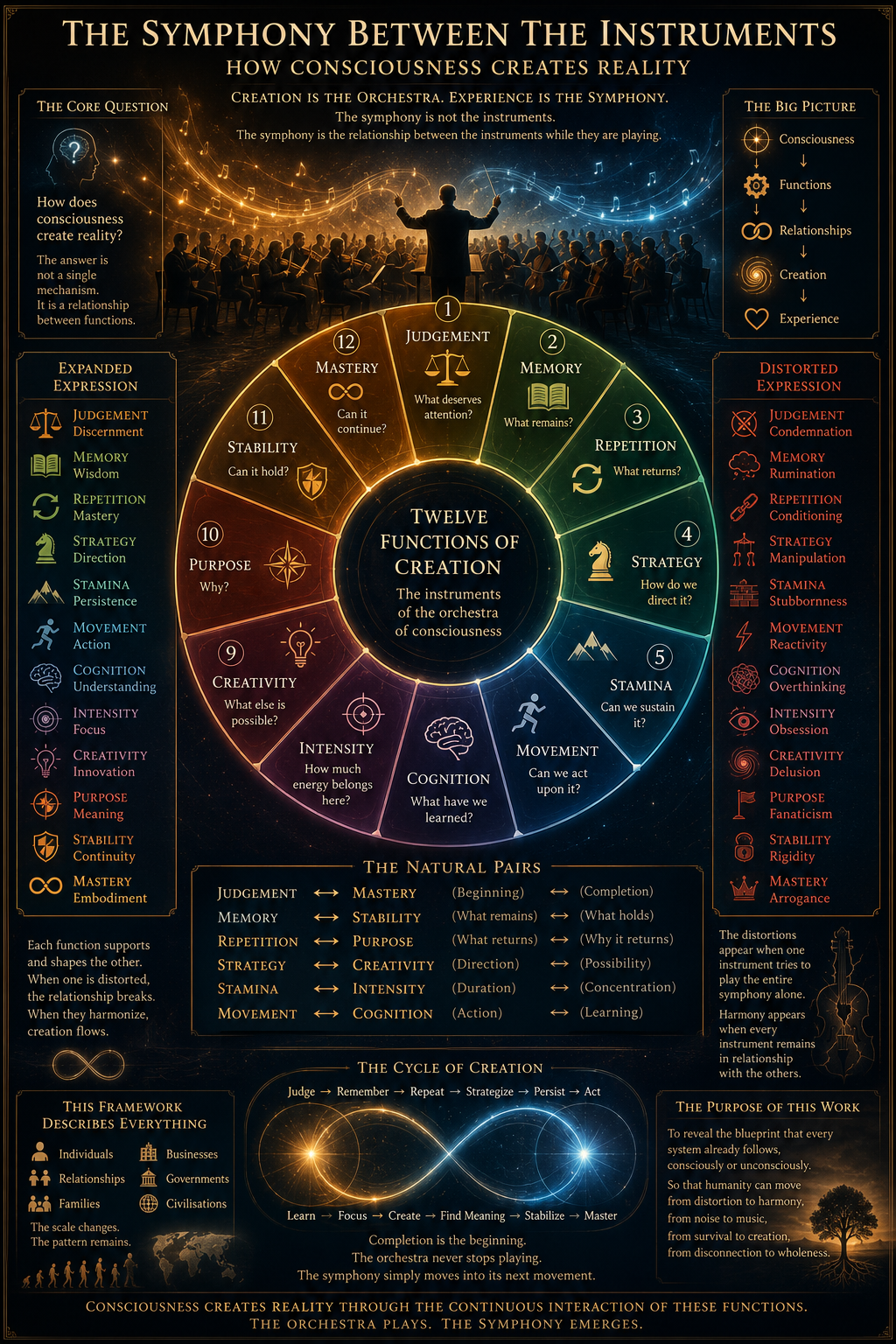
Businesses are often taught about revenue, marketing, operations, leadership, finance, and growth. Those things matter, but they are outputs. Before a business creates products, customers, profit, culture, or impact, it is creating itself.
A business is a living system.
Like a person, it remembers. It repeats. It learns. It focuses. It creates. It develops habits. It develops blind spots. It develops strengths. It develops character.
The twelve pillars can therefore be used to understand any business, from a one-person startup to a multinational corporation.
1. Judgment → What do we value?
Every business judges.
What does the company reward?
What does it tolerate?
What does it celebrate?
What does it punish?
A business that says it values people but only rewards profit reveals its true judgment.
A business that values quality will make different decisions than one that values speed.
Judgment determines culture before culture becomes visible.
2. Memory → What do we remember?
Businesses hold memory through:
- Documentation
- Policies
- Processes
- Brand history
- Customer feedback
- Lessons learned
A company without memory repeats avoidable mistakes.
A company with healthy memory preserves wisdom without becoming trapped in nostalgia.
Questions:
- What have we learned?
- What should never be forgotten?
- What is no longer useful?
3. Repetition → What do we practice?
Culture is repetition.
Not mission statements.
Not values written on walls.
Repetition.
What meetings happen repeatedly?
What behaviours are repeatedly rewarded?
What standards are repeatedly upheld?
Whatever a business repeats eventually becomes its identity.
4. Strategy → What are we trying to achieve?
Strategy gives direction.
Without strategy, effort becomes scattered.
Questions:
- Where are we going?
- Why are we going there?
- What matters most right now?
Strategy aligns energy.
5. Stamina → Can we keep going?
Many businesses can start.
Few can sustain.
Stamina measures:
- Cash resilience
- Team resilience
- Emotional resilience
- Operational resilience
Can the business survive difficulty?
Can it continue when excitement disappears?
6. Movement → What are we doing?
Movement is execution.
Ideas do not create businesses.
Action does.
Questions:
- What is moving?
- What is stalled?
- What is being avoided?
Movement reveals reality.
7. Cognition → What are we learning?
A business that cannot learn eventually dies.
Cognition appears through:
- Customer feedback
- Reflection
- Research
- Analysis
- Adaptation
Questions:
- What is reality teaching us?
- What assumptions were wrong?
- What patterns keep appearing?
8. Intensity → What deserves focus?
Every business has limited attention.
Intensity determines allocation.
Questions:
- What deserves immediate attention?
- What creates the greatest leverage?
- What is distracting us?
Focus protects energy from fragmentation.
9. Creativity → What can be improved?
Creativity is not limited to design.
It includes:
- Systems
- Products
- Services
- Processes
- Relationships
Questions:
- What can work better?
- What can be simplified?
- What has never been questioned?
Creativity prevents stagnation.
10. Purpose → Why does it matter?
Revenue explains survival.
Purpose explains continuation.
Questions:
- Why does this business exist?
- Who benefits?
- What problem are we solving?
Purpose provides meaning during difficulty.
11. Stability → What continues?
Stability creates trust.
Customers trust consistency.
Employees trust consistency.
Partners trust consistency.
Questions:
- What can people rely on?
- What remains true regardless of growth?
- What foundations must never disappear?
Stability is continuity made visible.
12. Mastery → What have we embodied?
Mastery is not what the business claims.
Mastery is what it consistently demonstrates.
Questions:
- What are we genuinely excellent at?
- What have we proven repeatedly?
- What can we teach others?
Mastery transforms experience into capability.
The Business Cycle of Creation
The twelve pillars are not separate departments.
They form a cycle.
Judgment determines what is remembered.
Memory influences repetition.
Repetition shapes strategy.
Strategy requires stamina.
Stamina enables movement.
Movement creates learning.
Learning refines focus.
Focus enables creativity.
Creativity strengthens purpose.
Purpose builds stability.
Stability allows mastery.
Mastery refines judgment.
And the cycle begins again at a higher level.
A Business Audit Using the Twelve Pillars
Any business can ask:
Judgment What do we truly value?
Memory What lessons are we carrying?
Repetition What habits define us?
Strategy Where are we going?
Stamina Can we sustain it?
Movement What are we doing?
Cognition What are we learning?
Intensity What deserves focus?
Creativity What can improve?
Purpose Why does it matter?
Stability What continues?
Mastery What have we embodied?
A startup can use these questions.
A restaurant can use these questions.
A school can use these questions.
A government can use these questions.
A family can use these questions.
A civilization can use these questions.
Because creation always follows the same architecture.
The scale changes.
The pillars remain.
One company may go, but not the continuity.
One product may disappear, but not the lessons.
One generation of leaders may leave, but not the foundation if it has been properly embodied.
That is how creation becomes sustainable.




Leave a Reply