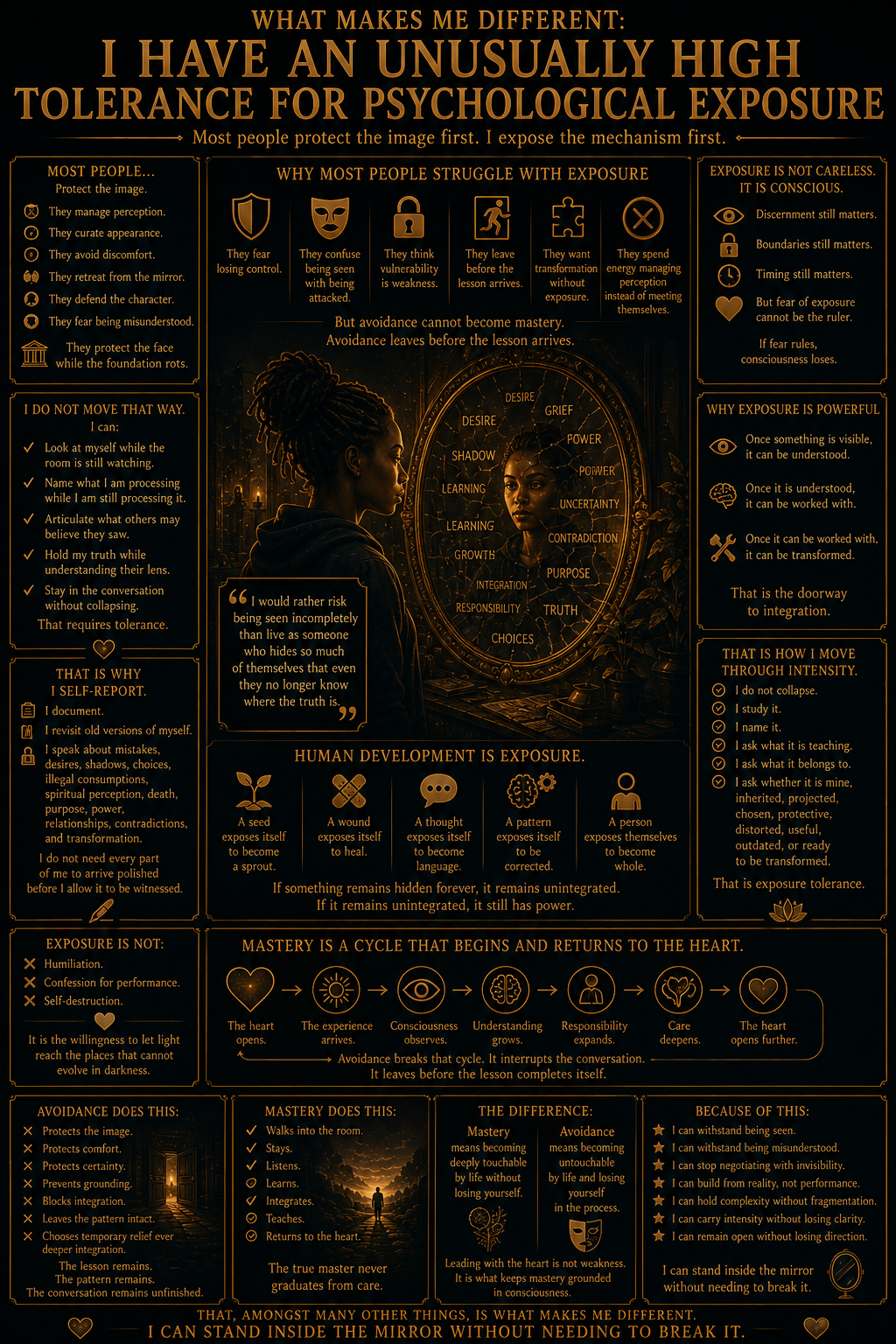
One thing that makes me different is that I have an unusually high tolerance for psychological exposure.
Most people protect the image first.
I expose the mechanism first.
That does not mean I expose everything carelessly. It means I am not automatically afraid of being seen in process, in contradiction, in intensity, in learning, in correction, in desire, in grief, in uncertainty, in power, in shadow, or in growth. I do not need every part of me to arrive polished before I allow it to be witnessed.
That is unusual.
Many people can discuss truth from a distance. They can analyse society, systems, relationships, morality, psychology, spirituality, and accountability as long as the mirror does not turn toward them. The moment the conversation enters their own motives, wounds, fears, contradictions, projections, or unfinished rooms, they retreat. They defend the image. They change the subject. They call exposure disrespect. They mistake being seen for being attacked.
I do not move that way.
I can look at myself while the room is still watching.
I can name what I am processing while I am still processing it.
I can say, “This is what it may look like from the outside,” while still holding what I know happened inside me.
I can look through the lens of another person and articulate what they might believe they saw, even when I do not accept their interpretation as the full truth.
That requires tolerance.
Because psychological exposure is not comfortable. It brings heat. It brings vulnerability. It brings risk. It brings the possibility of being misunderstood by people who only know how to weaponise fragments. But I would rather risk being seen incompletely than live as someone who hides so much of themselves that even they no longer know where the truth is.
That is why I self-report.
That is why I document.
That is why I revisit old versions of myself.
That is why I can speak about mistakes, desires, shadows, choices, illegal consumptions, spiritual perception, death, purpose, power, relationships, contradictions, and transformation without needing to pretend that human development is clean.
Because it is not clean.
Human development is exposure.
A seed exposes itself to become a sprout.
A wound exposes itself to heal.
A thought exposes itself to become language.
A pattern exposes itself to be corrected.
A person exposes themselves to become whole.
Most people want transformation without exposure.
I do not believe that is how it works.
If something remains hidden forever, it remains unintegrated. If it remains unintegrated, it still has power. If it still has power, it can still direct behaviour from beneath the surface. Exposure is not the enemy. Exposure is often the doorway to integration.
That does not mean everyone deserves access.
Discernment still matters.
Boundaries still matter.
Timing still matters.
But fear of exposure cannot be the ruler.
That is where many people lose themselves. They spend so much energy managing perception that they never actually meet themselves. They become curators of an image rather than students of their own consciousness. They protect the face while the foundation rots. They defend a character while the real person underneath remains unseen, untouched, and undeveloped.
I refuse that.
I would rather meet myself honestly.
I would rather be a living archive than a polished lie.
I would rather let the mechanism be visible enough that truth has room to breathe.
Because once something is visible, it can be understood.
Once it is understood, it can be worked with.
Once it can be worked with, it can be transformed.
That is what makes psychological exposure powerful.
It is not humiliation.
It is not confession for performance.
It is not self-destruction.
It is the willingness to let light reach the places that cannot evolve in darkness.
That is one of the reasons I can move through intensity the way I do. I do not collapse the moment something in me becomes visible. I study it. I name it. I ask what it is teaching. I ask what it belongs to. I ask whether it is mine, inherited, projected, chosen, protective, distorted, useful, outdated, or ready to be transformed.
That is not ordinary self-awareness.
That is exposure tolerance.
And it has become one of my greatest tools.
Because a person who can withstand being seen can withstand being misunderstood long enough for the truth to mature.
A person who can withstand being seen can stop negotiating with invisibility.
A person who can withstand being seen can build from reality instead of performance.
That, amongst many other things, is what makes me different.
I can stand inside the mirror without needing to break it.




Leave a Reply