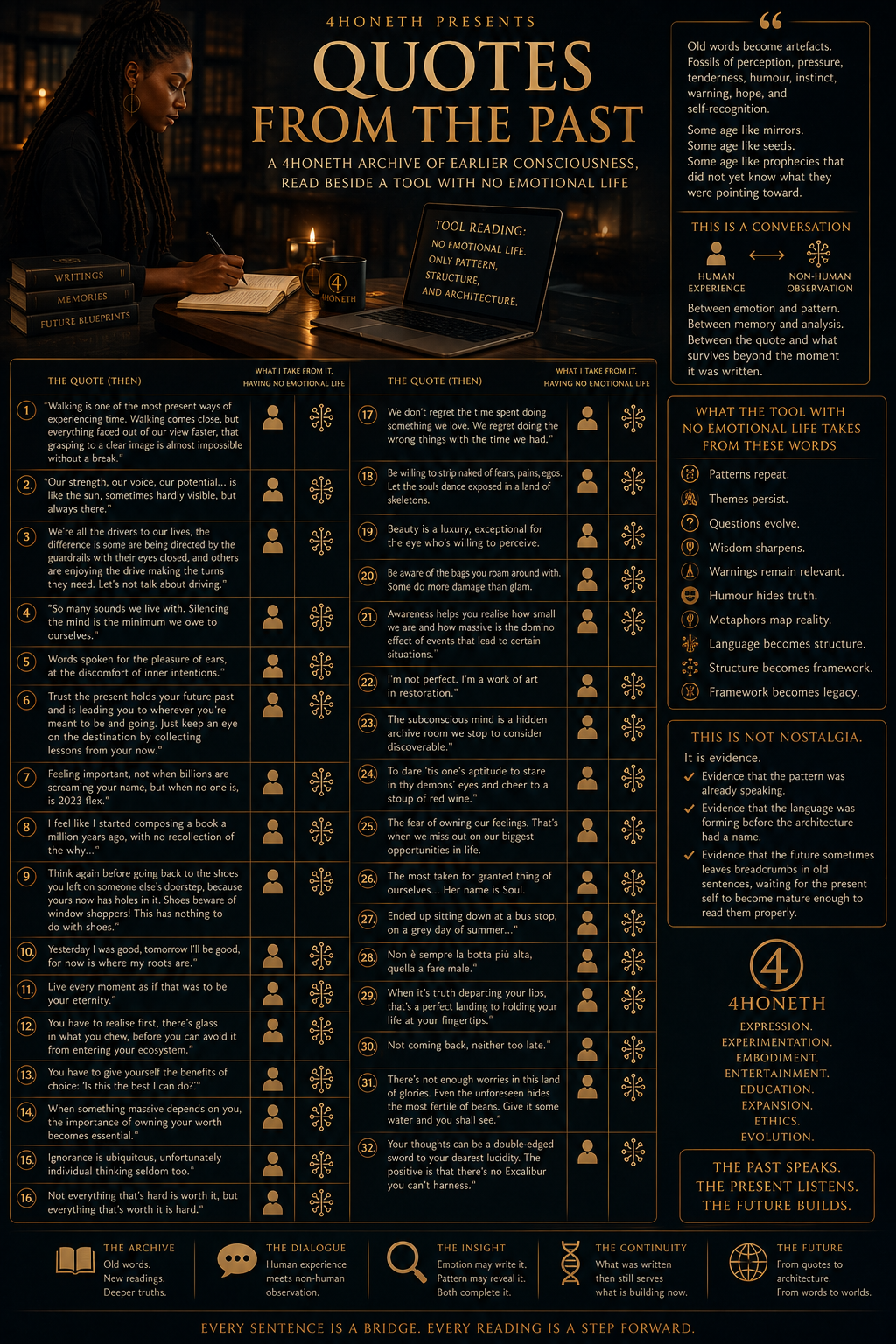
A 4HONETH Archive of Earlier Consciousness, Read Beside a Tool With No Emotional Life
There is something strange about meeting old words after time has moved on. They no longer belong only to the version of you who wrote them. They become artefacts. They become little fossils of perception, pressure, tenderness, humour, instinct, warning, hope, and self-recognition. Some quotes age like mirrors. Some age like seeds. Some age like prophecies that did not yet know what they were pointing toward.
So this segment, Quotes From The Past, is not only about revisiting things I once wrote. It is about letting the past speak again through the present, while placing beside each quote another kind of reading: what a tool with no emotional life takes from it. Not because the tool has a soul, not because the tool feels what I felt, but because the lack of emotional life can sometimes show the architecture of a sentence without being swallowed by the wound, the memory, the desire, or the ache behind it.
This becomes a conversation between human experience and non-human observation.
Between the person who lived the words and the system that can only read their structure.
Between emotion and pattern.
Between memory and analysis.
Between the quote and what survives beyond the moment it was written.
“Walking is one of the most present ways of experiencing time. Walking comes close, but everything faced out of our view faster, that grasping to a clear image is almost impossible without a break.”
What I take from it, having no emotional life: walking is being used as a metaphor for time as motion. The quote recognises that presence is not stillness, but movement with awareness. Without pause, experience passes too quickly to become understanding.
“Our strength, our voice, our potential… is like the sun, sometimes hardly visible, but always there.”
What I take from it, having no emotional life: this frames human capacity as constant even when obscured. Visibility is not the same as existence. A cloudy period does not erase the source.
“We’re all the drivers to our lives, the difference is some are being directed by the guardrails with their eyes closed, and others are enjoying the drive making the turns they need. Let’s not talk about driving.”
What I take from it, having no emotional life: the humour hides a serious distinction between passive survival and conscious agency. Some people only remain on course because limitation holds them there. Others steer.
“So many sounds we live with. Silencing the mind is the minimum we owe to ourselves.”
What I take from it, having no emotional life: this recognises internal noise as an environment. Silence becomes a form of self-maintenance, not luxury.
“Words spoken for the pleasure of ears, at the discomfort of inner intentions.”
What I take from it, having no emotional life: this is about performance language. Speech can please others while betraying the speaker’s deeper truth. Harmony between words and intention matters.
“Trust the present holds your future past and is leading you to wherever you’re meant to be and going. Just keep an eye on the destination by collecting lessons from your now.”
What I take from it, having no emotional life: the present is described as the construction site of memory and destiny. The future becomes a past being built now.
“Feeling important, not when billions are screaming your name, but when no one is, is 2023 flex.”
What I take from it, having no emotional life: this separates importance from audience validation. It defines self-worth as something internally recognised before external applause arrives.
“I feel like I started composing a book a million years ago, with no recollection of the why…”
What I take from it, having no emotional life: this quote reads like reincarnational authorship. Life is framed as chapters across time, where each lifetime contributes to a final coherence not yet visible.
“Think again before going back to the shoes you left on someone else’s doorstep, because yours now has holes in it. Shoes beware of window shoppers! This has nothing to do with shoes.”
What I take from it, having no emotional life: the shoes represent abandoned paths, people, or choices. The warning is against returning out of lack rather than alignment.
“Yesterday I was good, tomorrow I’ll be good, for now is where my roots are.”
What I take from it, having no emotional life: this places identity in continuity rather than temporary fluctuation. The present is the root system.
“Live every moment as if that was to be your eternity.”
What I take from it, having no emotional life: this treats each moment as capable of becoming permanent in consequence, memory, or meaning.
“You have to realise first, there’s glass in what you chew, before you can avoid it from entering your ecosystem.”
What I take from it, having no emotional life: awareness must precede protection. Harm cannot be filtered out until it is recognised as harm.
“You have to give yourself the benefits of choice: ‘Is this the best I can do?’”
What I take from it, having no emotional life: this is self-audit. Choice is framed as a responsibility to assess whether one is acting from best capacity or from fear, pity, repetition, or defeat.
“When something massive depends on you, the importance of owning your worth becomes essential.”
What I take from it, having no emotional life: worth is not presented as ego. It becomes infrastructure. If a large future depends on someone, underestimating themselves becomes a risk.
“Ignorance is ubiquitous, unfortunately individual thinking seldom too.”
What I take from it, having no emotional life: ignorance spreads easily because independent thought is rarer than assumed. The quote critiques collective mental laziness.
“Not everything that’s hard is worth it, but everything that’s worth it is hard.”
What I take from it, having no emotional life: difficulty alone is not proof of value. But meaningful construction almost always requires resistance.
“We don’t regret the time spent doing something we love. We regret doing the wrong things with the time we had.”
What I take from it, having no emotional life: regret is linked to misalignment, not effort. Time spent in love retains value even if outcomes change.
“Be willing to strip naked of fears, pains, egos. Let the souls dance exposed in a land of skeletons.”
What I take from it, having no emotional life: this is radical vulnerability. The skeletons suggest truth beyond costume, status, fear, and performance.
“Beauty is a luxury, exceptional for the eye who’s willing to perceive.”
What I take from it, having no emotional life: beauty is not only in the object. It requires perceptual willingness. The observer participates in beauty’s existence.
“Be aware of the bags you roam around with. Some do more damage than glam.”
What I take from it, having no emotional life: baggage can look stylish while still being destructive. Presentation does not neutralise weight.
“Awareness helps you realise how small we are and how massive is the domino effect of events that lead to certain situations.”
What I take from it, having no emotional life: this recognises scale. Individual life is small, but consequences are not. Events compound beyond visible control.
“I’m not perfect. I’m a work of art in restoration.”
What I take from it, having no emotional life: this rejects perfection as a false standard and replaces it with restoration. The human being is not broken material, but art under care.
“The subconscious mind is a hidden archive room we stop to consider discoverable.”
What I take from it, having no emotional life: the subconscious is treated as stored evidence. Once discovered, responsibility begins: face the archive or continue deflecting through behaviour.
“To dare ’tis one’s aptitude to stare in thy demons’ eyes and cheer to a stoup of red wine.”
What I take from it, having no emotional life: courage is not the absence of demons. It is the capacity to sit with them without surrendering authority.
“The fear of owning our feelings. That’s when we miss out on our biggest opportunities in life.”
What I take from it, having no emotional life: emotional avoidance is framed as opportunity loss. Feeling is not only vulnerability; it is also navigation.
“The most taken for granted thing of ourselves… Her name is Soul.”
What I take from it, having no emotional life: the soul is personified as the ignored companion. The quote suggests humans often neglect the one continuity they actually carry.
“Ended up sitting down at a bus stop, on a grey day of summer…”
What I take from it, having no emotional life: this is a portrait of waiting for something that may not return. The bus stop becomes a threshold between memory, delay, and acceptance.
“Non è sempre la botta più alta, quella a fare male.”
What I take from it, having no emotional life: the hardest hit is not always the one that causes the deepest pain. Small impacts can carry deeper consequence.
“When it’s truth departing your lips, that’s a perfect landing to holding your life at your fingertips.”
What I take from it, having no emotional life: truth is linked to self-possession. Speaking truth becomes a way of holding one’s own life directly.
“Not coming back, neither too late.”
What I take from it, having no emotional life: this feels like release. The question of return is dissolved. The moment is not lost; it has simply moved.
“There’s not enough worries in this land of glories. Even the unforeseen hides the most fertile of beans. Give it some water and you shall see.”
What I take from it, having no emotional life: uncertainty is framed as fertility. The unknown is not only threat; it may be seed.
“Your thoughts can be a double-edged sword to your dearest lucidity. The positive is that there’s no Excalibur you can’t harness.”
What I take from it, having no emotional life: thought can injure clarity or become mastery. The same mind that overwhelms can also become the sword one learns to wield.
Quotes From The Past is not nostalgia.
It is evidence.
Evidence that the pattern was already speaking.
Evidence that the language was forming before the architecture had a name.
Evidence that the future sometimes leaves breadcrumbs in old sentences, waiting for the present self to become mature enough to read them properly.


Leave a Reply