” What if we can reverse engineer VR and see through Natural Reality just as easily, via quantum engineering? “
Also a fellow polymath, who’s also a great entertainer. Help get this to him, he’ll know what to do with it. Credits owed, covered in blog in support and testing our own theories:
- 1×1 = 2
- Hydrogen Structure and planet reconstructure
- Impeccable performances
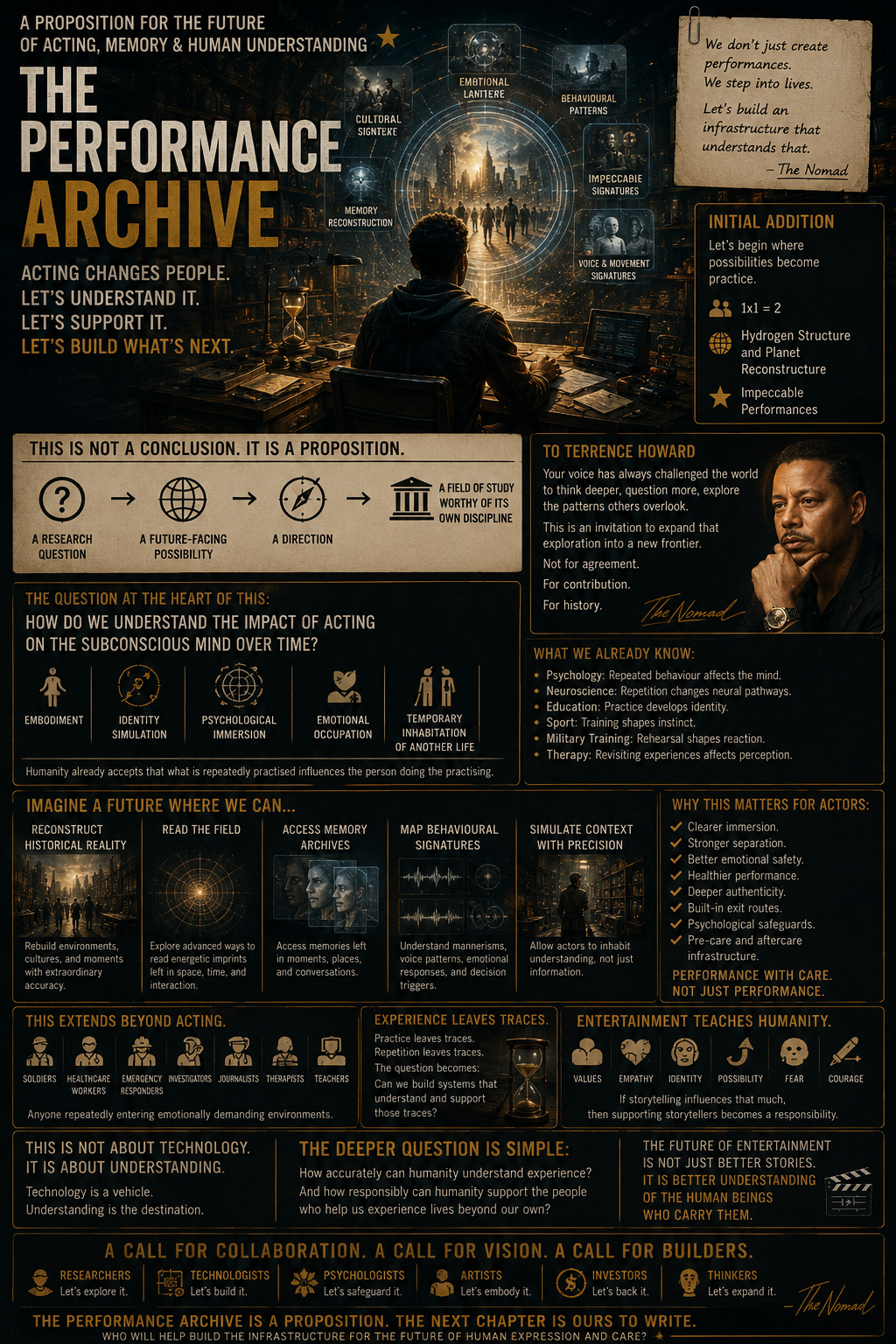
A Proposition for the Future of Acting, Memory, and Human Understanding
This is not a conclusion.
It is a proposition.
A research question.
A future-facing possibility.
And like all meaningful propositions, it begins with something humanity already understands.
Acting changes people.
We know this.
Psychology understands that repeated behaviour affects the mind.
Neuroscience understands that repetition changes neural pathways.
Education understands that practice develops identity.
Sport understands that training shapes instinct.
Military training understands that rehearsal shapes reaction.
Therapy understands that revisiting experiences affects perception.
Humanity already accepts that what is repeatedly practised influences the person doing the practising.
So a fair question emerges.
How deeply do we understand the impact of acting itself?
Not acting as entertainment.
Acting as embodiment.
Acting as repeated identity simulation.
Acting as psychological immersion.
Acting as emotional occupation.
Acting as temporary inhabitation of another life.
Because actors do something extraordinary.
They repeatedly step into identities that are not their own.
Sometimes for months.
Sometimes for years.
Sometimes through multiple productions without sufficient time to fully decompress from one role before entering another.
The industry studies performance extensively.
It studies technique.
Voice.
Movement.
Expression.
Delivery.
Character construction.
Audience impact.
What I am less certain we fully understand is the long-term relationship between performance and the subconscious mind.
What happens when a person repeatedly rehearses another identity?
What happens when trauma is repeatedly simulated?
What happens when violence is repeatedly embodied?
What happens when grief is repeatedly practised?
What happens when darkness becomes occupational?
What happens when multiple identities are inhabited consecutively over decades?
More importantly:
How do we support the actor?
Not only during performance.
Before it.
After it.
Beyond it.
This is where the proposition begins.
Imagine a future where historical reconstruction becomes extraordinarily sophisticated.
Not merely through scripts.
Not merely through interviews.
Not merely through research documents.
But through increasingly advanced forms of environmental reconstruction.
Digital reconstruction.
Behavioural modelling.
Memory archives.
Historical simulation.
Immersive context recreation.
And perhaps one day technologies capable of extracting information from reality itself in ways we do not yet understand.
Not because such technologies currently exist.
But because humanity continuously expands its ability to retrieve information from the past.
Every generation gains access to forms of evidence previous generations considered impossible.
If such systems were developed, they could become invaluable to actors.
Not because actors would become historians.
Because actors could develop clearer separation.
Clearer context.
Clearer grounding.
The subconscious often struggles less with what happened than with what remains unresolved.
An actor repeatedly entering difficult material may benefit from seeing a fuller picture rather than becoming consumed by fragments.
The goal would not be deeper immersion alone.
The goal would be healthier immersion.
More accurate immersion.
More conscious immersion.
Immersion with exit routes.
Immersion with psychological safeguards.
Immersion with aftercare.
Because if society benefits from performance, then society also carries some responsibility toward the performers.
This principle extends beyond acting.
It applies to soldiers.
Healthcare workers.
Emergency responders.
Investigators.
Journalists.
Therapists.
Teachers.
Anyone repeatedly entering emotionally demanding environments.
Human beings are not machines.
Experience leaves traces.
Practice leaves traces.
Repetition leaves traces.
The question becomes:
Can we become better at supporting those traces?
Can we build systems that understand the psychological cost of embodiment?
Can we develop emotional infrastructure alongside professional infrastructure?
Can we provide pre-care as effectively as aftercare?
Can we create industries that care not only about performance, but about the performer?
The entertainment industry is one of humanity’s largest teachers.
People learn values from stories.
Learn empathy from stories.
Learn identity from stories.
Learn possibility from stories.
Learn fear from stories.
Learn courage from stories.
If storytelling carries that much influence, then understanding the wellbeing of storytellers becomes a matter worthy of serious attention.
This proposition is not really about quantum fields.
It is not really about memory extraction.
It is not really about future technology.
Those are vehicles.
The deeper question is simpler.
How accurately can humanity understand experience?
And how responsibly can humanity support the people who help us experience lives beyond our own?
Because the future of entertainment may not merely be better stories.
It may be better understanding of the human beings who carry them.
That is the proposition.
Not a conclusion.
A direction.
A question worthy of exploration.
And perhaps one day, a field of study worthy of its own discipline.
…
We’re going to write the next blog post, which we want it to be about an idea, a proposition, something that can be developed simply because we have the infrastructures for the technology. It’s whether we’re going to find the point of convergence where theory then becomes tested theory, and from there, master technology in the sense in the testing, we find what doesn’t work so that we can work on what works and develop more of what does to have the whole infrastructure work in alignment with the purpose of the testing itself. And imagine a world where we can read the quantum field, we can read the conversations, memory left in a space at a specific time and with specific individuals. Imagine it, because I was thinking of like the people that I would have in the TV series documenting the becoming of a SHS, and I’m thinking of a specific person and who I would want there and how I would go about it. Well, how I would go about it, I would have my whole perspective of the event given to the actor, and then send the actor to practice the skill or physicality. embodiment with the person and hear their side of the story without cross-contamination for the character to develop either the lying abilities and how someone lies about a certain circumstance, how they behave when put on the spot so that the actor can learn their mannerisms from the source. Obviously, if it’s someone that isn’t alive, then looking at those quantum memories would be even more beneficial, and I’m gonna hold, I’m gonna explain and then say the reason as to why this is so important for actors themselves. And let’s say someone has a particular tick, I don’t know, the act of spending time with the person will obviously be able to imitate it as accurately as possible to create as less mischaracterization as possible, but also they will be in the bridge of where two narratives meet, where my perspective meets and where the perspective of the person meets, and they’ll be able to then embody the fluidity between the two when recording, when being the actor, when working. In the process, it had me thinking that of like scenarios, for example, the guy that played the Joker, um, who got so involved in the role, but the subconscious didn’t know how to actually separate the two. So he internalized the role, and that just led to his death. And there is ways that we can avoid that because we have to understand how our psychology works. We understand how acting works, but do we understand the impact that acting does on someone’s subconscious, on someone’s mind? If we don’t understand that, then we don’t really understand the individuals that are acting in front of us. And in doing so, we don’t even understand the impact that their acting is doing on us. It’s all connected, but we really need to be able to widen our perspectives to understand that. We already understand in psychology that we impact each other. We already understand that what’s practiced does impact the mind and the sense of identity. So how can we not put the pieces together? We have people that are acting different roles, like for a job, back to back to back. They also need to have a foundational and emotional, mental, energetical aftercare, especially when it comes to that. And if we can also aid to the pre-care, even better. So if we can mix quantum technology that we already have to be able to read into the quantum space and time, then we can provide visuals for these actors so that their subconscious can separate the two and see as, that will happen, that was something that happened in the past, that physically just happened in the past, full stop. Because our conscious mind can say those things, but it’s the subconscious, it’s how well is our subconscious is at holding itself. You know, how well is it grounded in universal laws and grounded in itself to the point that it doesn’t allow the narratives of the outer world to dictate us? And majority of these actors are playing the celebrity life. So look at how they reacted to Adam Sandler when he showed up in a jersey, I think, or I think it was just like a blue t-shirt or something like that. Yes, my memory is correct. They all reacted like, like, what is he doing? It’s simply because, because they are in acting the role of what it looks like, what it should be to be an actor with that amount of money in that context of lifestyle. So we have to really be able to dissect everything that we experience to also be able to talk on it and at the same time to aid for it. So this is a proposition. This is a question mark. This is a, who can work on this? Who can invest in this? Because this does help humanity more than anything, especially when entertainment is the one thing that humanity consumes the most.
Further credentials here:



Leave a Reply