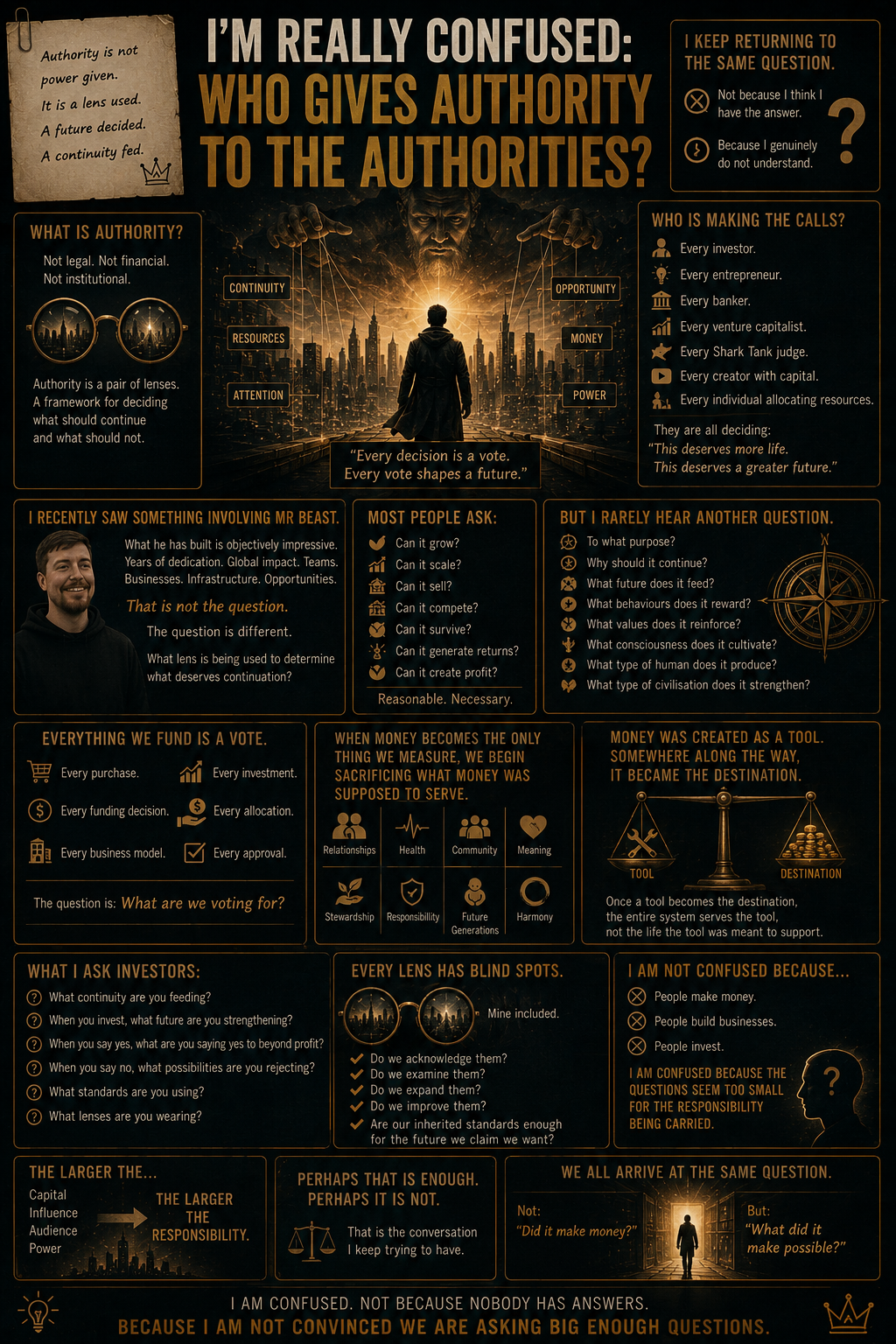
What continuity do creators feed that gives them the authority to make business calls?
I keep finding myself returning to the same question.
Not because I think I have the answer.
Because I genuinely do not understand.
What continuity do creators feed that gives them the authority to make business calls for the future?
And when I say authority, I do not mean legal authority.
I do not mean financial authority.
I do not mean institutional authority.
I mean authority as a pair of lenses.
Authority as perception.
Authority as the framework through which someone evaluates what should continue and what should not.
Because every investor is making a continuity decision whether they realise it or not.
Every business owner.
Every entrepreneur.
Every banker.
Every angel investor.
Every venture capitalist.
Every Shark Tank judge.
Every creator with capital.
Every individual allocating resources.
They are all deciding:
“This deserves more life.”
“This deserves more energy.”
“This deserves more attention.”
“This deserves more resources.”
“This deserves a greater future.”
That is an enormous responsibility.
Far larger than money.
Which is why I find myself confused.
I recently saw something involving Mr Beast, and it triggered the question again. Not because of him specifically. In fact, quite the opposite. What he has built is objectively impressive. He dedicated himself to a craft, stayed with it for years, became globally recognised, built teams, built businesses, built infrastructure, and created opportunities for many people.
That is not the question.
The question is different.
The question is:
What lens is being used to determine what deserves continuation?
Because success and authority are not necessarily the same thing.
Experience and authority are not necessarily the same thing.
Wealth and authority are not necessarily the same thing.
A successful YouTube creator understands many things about attention, content, audience psychology, branding, consistency, risk, growth, business, and execution.
That knowledge is valuable.
But does success itself automatically grant someone the ability to determine what futures humanity should build?
That is where my confusion begins.
The same applies to investors.
The same applies to Shark Tank.
The same applies to Dragon’s Den.
The same applies to venture capital.
The same applies to angel investors.
The same applies to every person allocating resources.
Most people evaluate:
Can it grow?
Can it scale?
Can it sell?
Can it compete?
Can it survive?
Can it generate returns?
Can it create profit?
Reasonable questions.
Necessary questions.
But I rarely hear another question.
To what purpose?
Not what does it do.
Why should it continue?
What future does it feed?
What behaviours does it reward?
What values does it reinforce?
What consciousness does it cultivate?
What type of human does it produce?
What type of civilisation does it strengthen?
Because every investment is a vote.
Every allocation of resources is a vote.
Every purchase is a vote.
Every funding decision is a vote.
Every business model is a vote.
The question is:
What are we voting for?
If we keep funding things simply because they generate money, eventually money becomes the only thing we know how to measure.
And when money becomes the only thing we know how to measure, we begin sacrificing the things money was supposed to serve.
Relationships.
Health.
Community.
Meaning.
Stewardship.
Responsibility.
Future generations.
Harmony.
Continuity.
That is the paradox I struggle with.
Money was created as a tool.
Somewhere along the way it became the destination.
And once a tool becomes the destination, the entire system begins orienting itself around preserving the tool rather than serving the life the tool was originally meant to support.
That is why I find myself asking investors a question I rarely hear asked publicly.
What continuity are you feeding?
When you invest, what future are you strengthening?
When you say yes, what are you saying yes to beyond profit?
When you say no, what possibilities are you rejecting?
What standards are you using?
What lenses are you wearing?
Because every lens contains blind spots.
Every lens.
Mine included.
The difference is whether we acknowledge them.
Whether we examine them.
Whether we expand them.
Whether we improve them.
Whether we are willing to ask if the standards we inherited are sufficient for the future we claim we want.
I am not confused because people make money.
I am not confused because people build businesses.
I am not confused because people invest.
I am confused because the questions seem too small for the responsibility being carried.
The larger the capital, the larger the responsibility.
The larger the influence, the larger the responsibility.
The larger the audience, the larger the responsibility.
The larger the power, the larger the responsibility.
And yet so many decisions appear to be made through the narrow lens of financial success alone.
Perhaps that is enough.
Perhaps it is not.
That is the conversation I keep trying to have.
Not whether someone is successful.
Not whether someone deserves their success.
Not whether someone has earned the right to invest.
But whether the standards used to allocate the future are large enough for the future itself.
Because eventually every investor, every entrepreneur, every creator, every business owner, every government, every institution, and every individual arrives at the same question.
Not:
“Did it make money?”
But:
“What did it make possible?”
And I suspect that question will become more important than any financial metric we currently use.
That is why I am confused.
Not because nobody has answers.
Because I am not convinced we are asking big enough questions.
…
Let’s write a piece on this loaded question. What continuity do creators feed that gives them the authority to make business calls? Like, what continuity is X-ray, or what continuity do they use as a pair of lenses to X-ray the visions of people that go to them for support? Meaning, there’s a lot of like Shark Tanks, tank shanks, or whatever it’s called, where people go to propose their business opportunities. And this came from an ad by Mr. Beast that I just saw, and it got me quite to the question, what gives this guy the authority to make a business call on someone just because he has money to give? Because I saw fragments of what he does, and really and truly, he’s not investing in like a future of harmony, he’s not investing in a future where the system is coherent with our nature, neither Stephen Bartlett, neither all spiritualists, because on one side, Mr. Beast, he’s a content creator that has money to give, cool, with business experience of his own process, which is a digital business. So… It’s not like he’s built, and this is not to diminish or make small what he’s accomplished. He clearly was a successful YouTube creator, Proof He’s, because I saw one video, one interview he had, that put his all into it, kept at it, and became successful at it to be globally known and create all these games around that do bring people together. The question here is not his ability to create. The question here is, to what extent, to what intention, to what degree, to a purpose, is it to just sustain the foundation of success that he’s built? And this goes to everyone. I’m just using this example just because that’s the one that triggered the thought. But I also made the example of the Tang Sheng, Sheng Tang, ah, I don’t know how it’s called. It’s a UK-based, I think. Yes. And yeah, people go to these entrepreneurs who have built successful businesses, but none of them have built successful businesses that were based on universal laws. So again, what gives them the authority to build something or invest into something that sounds great and that could make money, has potential profitability-wise. And just like them, I’m using, like, any angel investor, any investor whatsoever, round the clock, whether it’s the smallest investor on Moneybox or the largest investor financer, available, you know, in the world. It doesn’t really matter. They all have the same question to ask themselves. What authority or what, and authority is really and truly just a pair of lens. It’s what perception. That’s what I see as authority. Authority is really perception because we perceive someone as an authoritative person, that’s where we give them the sense of authority. It’s if we feel like we have that, we give ourselves the sense of authority. It’s really and truly just perception. But at the same time, when I say to all individuals who are investing money into things that aren’t necessarily grounded in universal laws, do they ask themselves, to what purpose? Is it just for money? Because if we keep doing actions just for money, we won’t even have a future to actually experience in harmony. Or for us to experience the money because money will be the most, the least valuable thing that we will have. We will probably burn money to have, like, warmth at home, like people already have done. So why is this thing that is a clear path to doomsday, if it becomes the reason why we make our choices, is the reason why we make our choices? I don’t understand it. I’m really confused. This is the I’m really confused series.
…




Leave a Reply