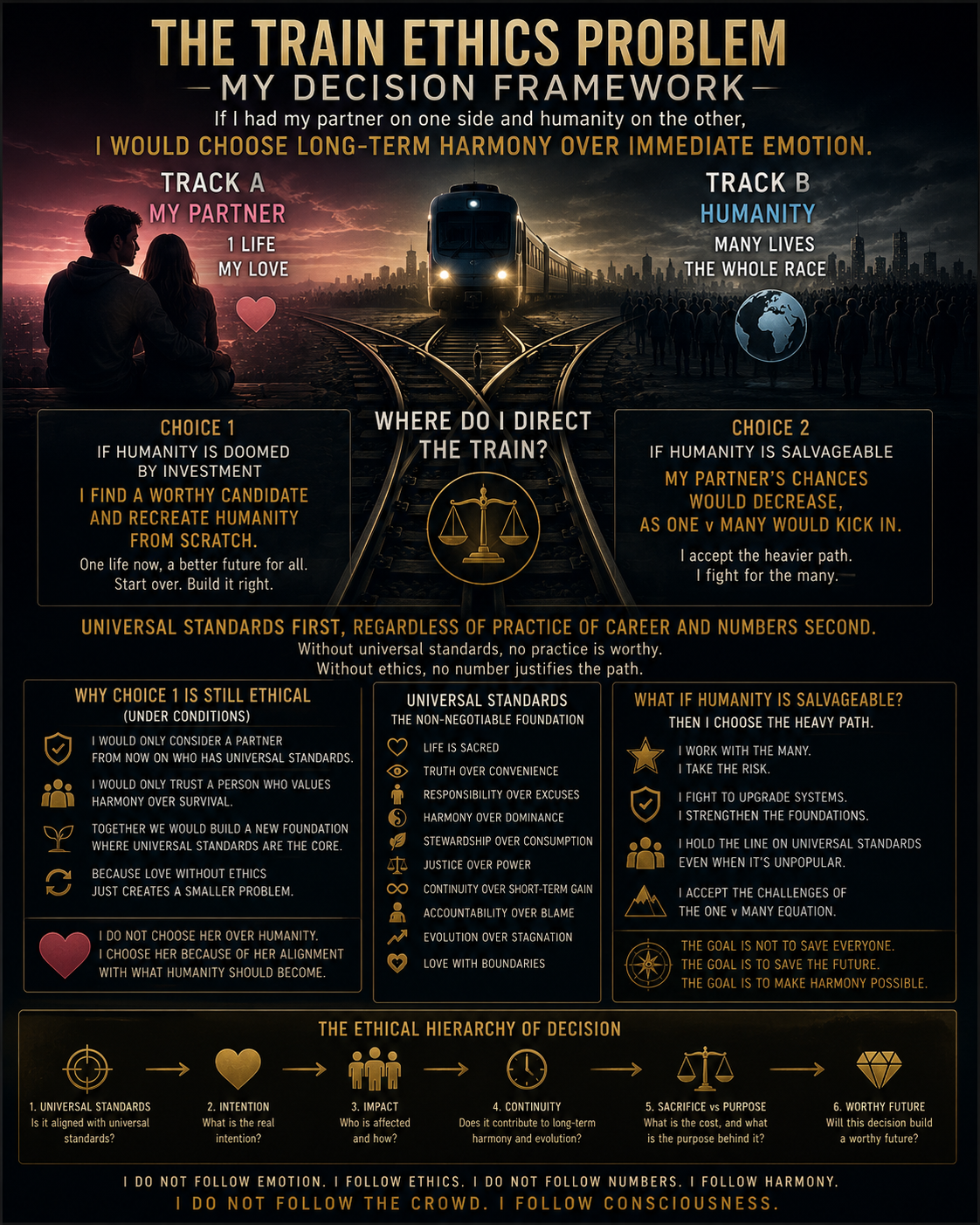
One of the most famous ethical thought experiments is the trolley problem.
One person on one track.
Many people on the other.
Pull the lever or do nothing.
Save one.
Save many.
Sacrifice one.
Sacrifice many.
The entire exercise attempts to force morality into mathematics.
But what if the question begins too late?
What if the real ethical question is not who should die?
What if the real ethical question is:
How did we build a system that keeps arriving at tracks with people tied to them in the first place?
That is where my thinking departs from most discussions.
Because I do not believe ethics begins at consequence.
I believe ethics begins at continuity.
It begins long before the lever.
It begins in the investments.
The incentives.
The education.
The culture.
The governance.
The relationships.
The standards.
The systems.
The decisions that produced the tracks.
The decisions that produced the people standing on them.
The decisions that produced the need for sacrifice.
This is why I increasingly find myself redefining ethics through universal laws and merit rather than through numbers alone.
Numbers matter.
Consequences matter.
Lives matter.
But numbers are not the foundation.
Continuity is.
If humanity had spent centuries investing into universal standards, protecting life, reducing suffering, elevating responsibility, educating consequence, and aligning itself with nature, then the trolley problem becomes much simpler.
The field itself would already be healthier.
The track itself would already be safer.
The likelihood of catastrophe would already be lower.
The lever would appear less often.
That is what ethics should be measuring.
Not simply who dies.
But what created the conditions.
Now comes the uncomfortable question.
If I had my partner on one side and humanity on the other, what would I choose?
Most people immediately jump to the numbers.
One versus many.
One life versus billions.
But my mind does not start there.
My mind starts somewhere else.
My mind asks:
What is the future being protected?
What continuity survives?
What standards survive?
What potential survives?
What possibility survives?
Because numbers alone have never guaranteed continuity.
Humanity could consist of billions of people and still be moving toward collapse.
Humanity could consist of billions of people and still be investing in the very behaviours that destroy its own future.
Humanity could consist of billions of people and still refuse responsibility.
In such a scenario, the ethical question changes.
If humanity were genuinely unsalvageable because of its investments, then preserving the possibility of rebuilding continuity would become more important than preserving the quantity of lives.
A difficult statement.
But ethics becomes difficult when survival itself is on the table.
If there were a partner standing beside me, they would not simply be my partner because I loved them.
They would be my partner because they met the same universal standards.
Because they valued continuity.
Because they valued responsibility.
Because they valued life.
Because they valued stewardship.
Because they valued future generations.
Because they understood consequence.
Because they would be capable of helping rebuild what was lost.
The partner would not be chosen because they were mine.
They would be mine because they were chosen by the same standards.
That distinction matters.
Because if humanity were salvageable, if enough people were willing to expand, learn, change, heal, educate, integrate, and participate responsibly, then the equation shifts.
The greater continuity may genuinely be found within the many.
The partner’s chances decrease.
Not because I love them less.
Because universal standards come first.
The whole comes before the individual.
The future comes before preference.
Continuity comes before attachment.
That is the uncomfortable place where my ethics land.
Not with numbers.
Not with emotions.
Not with loyalty alone.
With continuity.
With asking what preserves life’s greatest possibility moving forward.
Most ethical systems ask:
“Who deserves to survive?”
Universal ethics asks:
“What future deserves to survive?”
That is a much larger question.
And perhaps that is why the trolley problem has always felt incomplete to me.
Because by the time we are arguing over the lever, we have already ignored the systems that built the tracks.
The true ethical challenge is not choosing between one and many.
The true ethical challenge is building a world where that choice appears less and less often.
That is the bar.
That is the standard.
That is the responsibility.
And that is why, for me, ethics begins with continuity.




Leave a Reply