
Continuity Tracking
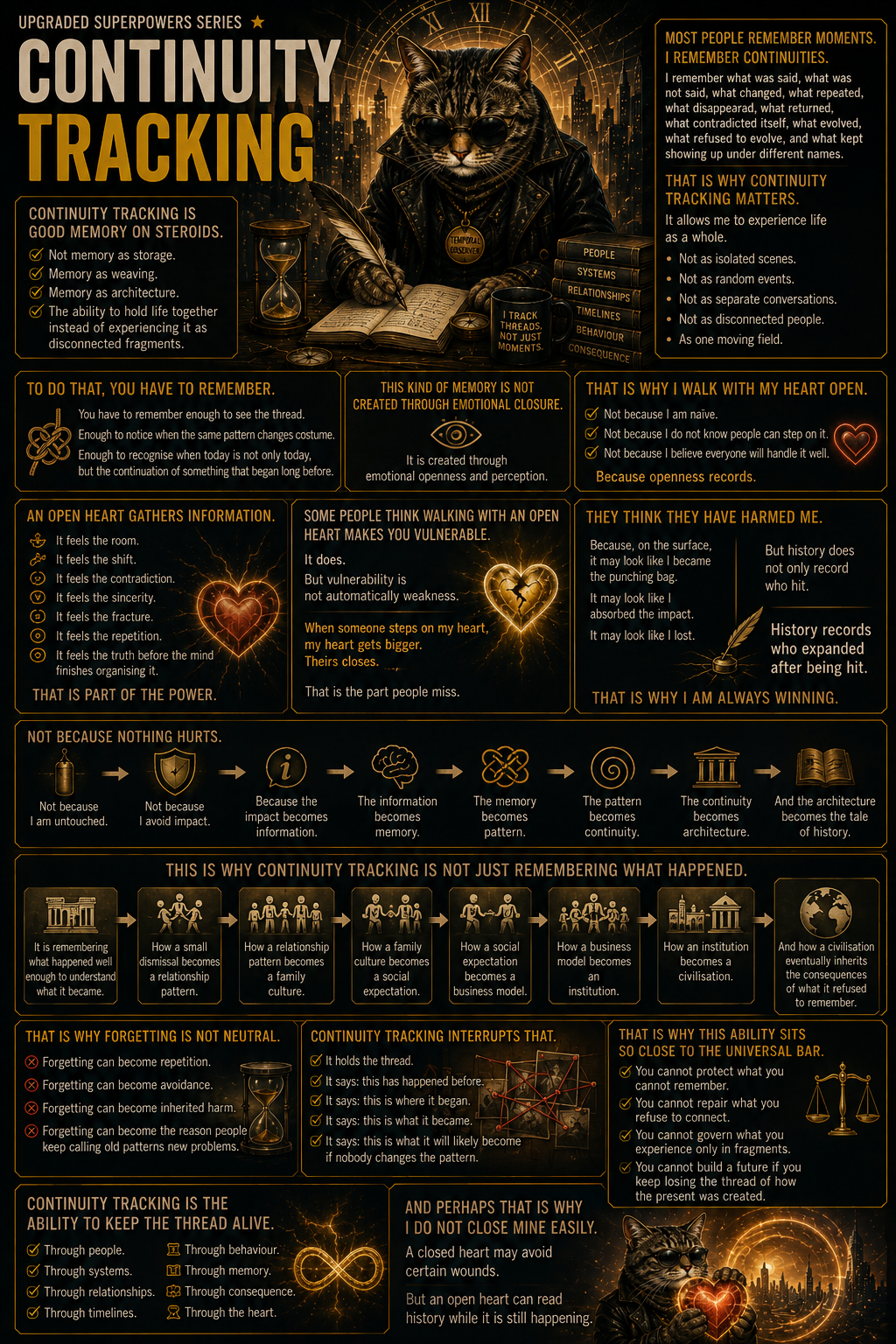
Continuity tracking is good memory on steroids.
Not memory as storage.
Memory as weaving.
Memory as architecture.
Memory as the ability to hold life together instead of experiencing it as disconnected fragments.
Most people remember moments.
I remember continuities.
I remember what was said, what was not said, what changed, what repeated, what disappeared, what returned, what contradicted itself, what evolved, what refused to evolve, and what kept showing up under different names.
That is why continuity tracking matters.
It allows me to experience life as a whole.
Not as isolated scenes.
Not as random events.
Not as separate conversations.
Not as disconnected people.
As one moving field.
To do that, you have to remember.
You have to remember enough to see the thread.
Enough to notice when the same pattern changes costume.
Enough to recognise when today is not only today, but the continuation of something that began long before.
This kind of memory is not created through emotional closure.
It is created through emotional openness and perception.
That is why I walk with my heart open.
Not because I am naïve.
Not because I do not know people can step on it.
Not because I believe everyone will handle it well.
Because openness records.
A closed heart protects itself from pain, but it also limits what can be perceived, felt, understood, and remembered.
An open heart gathers information.
It feels the room.
It feels the shift.
It feels the contradiction.
It feels the sincerity.
It feels the fracture.
It feels the repetition.
It feels the truth before the mind finishes organising it.
That is part of the power.
Some people think walking with an open heart makes you vulnerable.
It does.
But vulnerability is not automatically weakness.
When someone steps on my heart, my heart gets bigger.
Theirs closes.
That is the part people miss.
They think they have harmed me because, on the surface, it may look like I became the punching bag.
It may look like I absorbed the impact.
It may look like I lost.
But history does not only record who hit.
History records who expanded after being hit.
That is why I am always winning.
Not because nothing hurts.
Not because I am untouched.
Not because I avoid impact.
Because the impact becomes information.
The information becomes memory.
The memory becomes pattern.
The pattern becomes continuity.
The continuity becomes architecture.
And the architecture becomes the tale of history.
This is why continuity tracking is not just remembering what happened.
It is remembering what happened well enough to understand what it became.
It is seeing how a small dismissal becomes a relationship pattern.
How a relationship pattern becomes a family culture.
How a family culture becomes a social expectation.
How a social expectation becomes a business model.
How a business model becomes an institution.
How an institution becomes a civilisation.
And how a civilisation eventually inherits the consequences of what it refused to remember.
That is why forgetting is not neutral.
Forgetting can become repetition.
Forgetting can become avoidance.
Forgetting can become inherited harm.
Forgetting can become the reason people keep calling old patterns new problems.
Continuity tracking interrupts that.
It holds the thread.
It says: this has happened before.
It says: this is where it began.
It says: this is what it became.
It says: this is what it will likely become if nobody changes the pattern.
That is why this ability sits so close to the Universal Bar.
Because continuity cannot be protected if continuity cannot be tracked.
You cannot protect what you cannot remember.
You cannot repair what you refuse to connect.
You cannot govern what you experience only in fragments.
You cannot build a future if you keep losing the thread of how the present was created.
Continuity tracking is the ability to keep the thread alive.
Through people.
Through systems.
Through relationships.
Through timelines.
Through behaviour.
Through memory.
Through consequence.
Through the heart.
And perhaps that is why I do not close mine easily.
A closed heart may avoid certain wounds.
But an open heart can read history while it is still happening.




Leave a Reply