They showed me stability of grounded self.
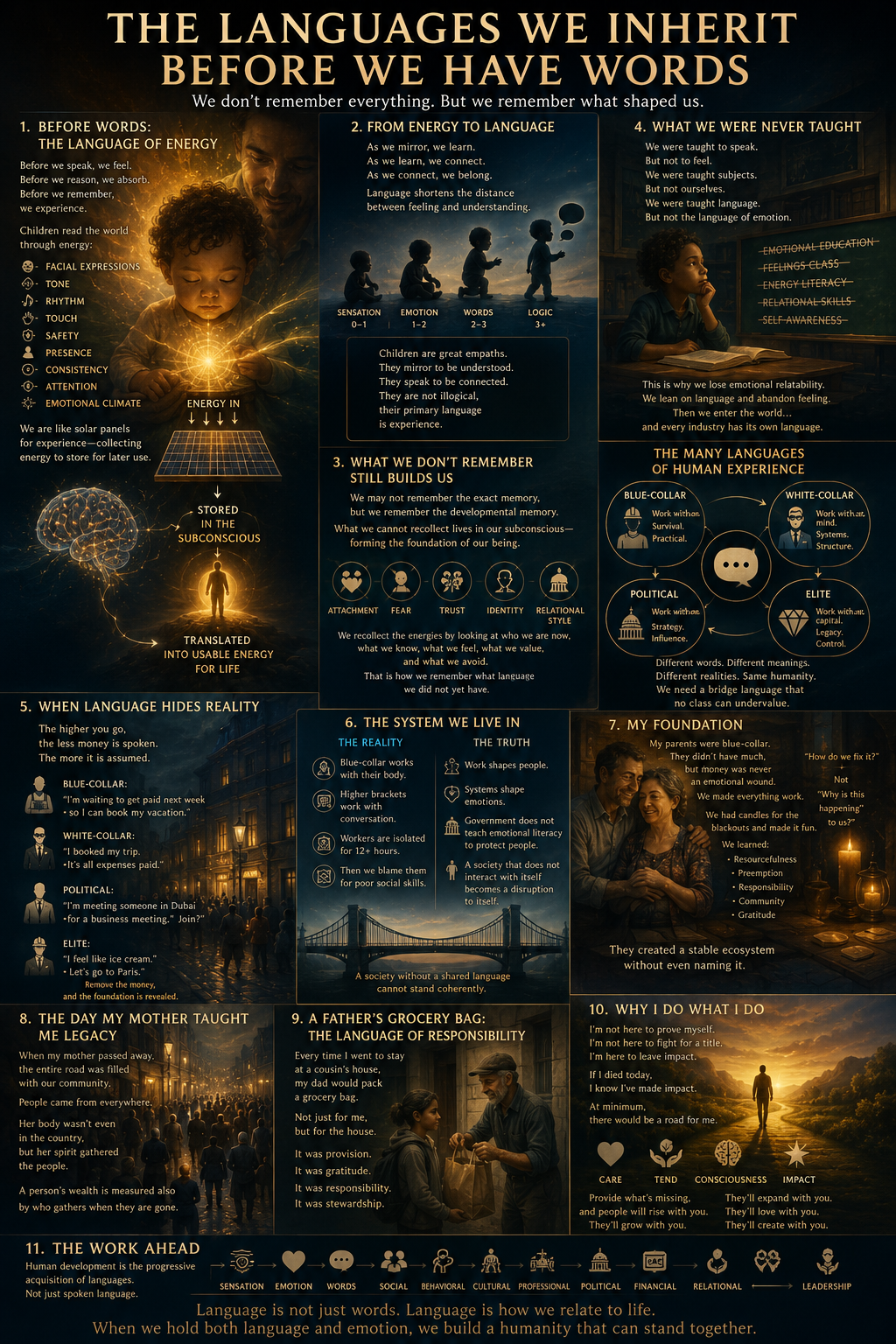
The Languages We Inherit Before We Have Words
People say you do not remember most of your childhood.
Or at least, not the majority of it.
They say it casually, as if memory only counts when it arrives as a clear image, a date, a full scene, a person’s exact words, or a neat story that can be repeated without contradiction. But that is a very limited understanding of memory. It reduces memory to recollection, when memory is much deeper than that.
We may not remember everything that happened to us as children in a language-based way, but that does not mean the information disappeared. It means it was stored before we had the language to name it.
That matters.
Because the beginning of human development is not just about learning how to walk, eat, speak, or recognise faces. It is about learning how to be part of a system. A family system. A social system. A human system. A humanitarian system. We are born into fields before we are born into explanations. We enter the world feeling before we can describe what we feel. We absorb before we understand. We mirror before we articulate. We relate before we reason.
That is why childhood memory cannot only be measured by what the conscious mind can replay. In those early years, we are still practising memory recollection itself. We are learning how to hold information long enough to relate to others continuously. We are learning that the person who appears again and again, feeds us again and again, holds us again and again, answers us again and again, becomes a stable reference point in our field. We are learning that consistency is information. Presence is information. Absence is information. Tone is information. Touch is information. Safety is information. Repetition is information.
This is psychology.
This is sociology.
This is developmental psychology.
This is also the beginning of relational infrastructure.
A child has to learn how to hold information because relationship depends on memory. If I cannot remember who nurtures me, who frightens me, who ignores me, who responds to me, who celebrates me, who shames me, who feeds me, who protects me, who disappears, then I cannot build stable relational meaning. Memory is not just storage. Memory is continuity. Memory allows the self to remain connected to the world across time.
And when that process is interrupted, underdeveloped, overstimulated, or constantly distracted, the child may still receive information, but may not build the same depth of internal holding. This is especially important now because so many children are placed in front of devices before they have built a strong enough inner infrastructure to process life slowly. They receive too much, too quickly, from too many directions, without enough embodied human reflection around them. They practise short-term stimulation more than deep recollection. They practise switching more than holding. They practise consumption more than integration.
So instead of memory expanding, energy recycles.
Something enters.
Then something else enters.
Then something else enters.
The previous thing is pushed out of conscious reach before it has been digested, named, reflected on, emotionally processed, or relationally held. But what is pushed out does not vanish. It falls into the subconscious. It becomes part of the hidden foundation the person later builds from without realising it.
That is why the subconscious is not some mystical storage room disconnected from life. It is the basement of unworded experience. It is what absorbed before language arrived. It is what held what the conscious mind could not yet organise. It is what collected energy before the self had the vocabulary to say, “This is safety,” “This is abandonment,” “This is affection,” “This is pressure,” “This is love,” “This is fear,” “This is inconsistency,” “This is home.”
In early development, we are like solar panels for experience.
We collect energy.
We absorb the emotional weather around us.
We take in the rhythm of the home, the faces, the voices, the tension, the calm, the touch, the silences, the repetitions, the reactions, the patterns. Then later, that collected energy becomes usable energy. It becomes instinct. Preference. Attachment. Fear. Trust. Attraction. Avoidance. Confidence. Suspicion. Relational style. Emotional expectation.
A child may not consciously remember every time their mother held them, but their body may remember being held.
A child may not consciously remember every time their father fixed something without panic, but their nervous system may remember that problems can be solved without collapse.
A child may not remember every meal, every room, every road, every neighbour, every family gathering, every absence, every limitation, every act of care, but the developmental memory remains.
That is the distinction.
We do not always remember the specific memory.
We remember the developmental memory.
We remember what the period built in us.
And much of that early memory is emotional before it is logical because logic, in the way society usually recognises it, arrives with language. Logic becomes easier once words arrive because words shorten the distance between feeling and understanding. A word compresses experience. Instead of having to feel everything from the beginning again, we can name it. We can say hunger. Fear. Mother. Home. No. Yes. Mine. Hurt. Love. More. Enough.
Language cuts time.
That is its power.
Before language, a child has to translate energy directly. They read facial expression. Tone. Volume. Pace. Touch. Distance. Warmth. Repetition. The environment itself is the language. Children are great empaths because they have to be. They do not begin by understanding grammar. They begin by understanding energy. They understand what the body means before they understand what the mouth says.
A child learns to speak because they are mirroring the field around them. They hear the sounds. They feel the response. They attempt the sound. The adult lights up. The child feels the energy shift and realises, “This works. This creates connection. This brings the other closer. This reduces the distance between what I feel and what they understand.”
That is why language is not merely communication.
Language is relational technology.
It allows the invisible to become shareable.
It allows the inner world to become accessible to the outer world.
But this is also where we lose something.
Because as we become more dependent on word-language, we often abandon emotional language. We teach children to speak, read, write, count, analyse, repeat, memorise, perform and prove, but we do not properly teach them how to understand what moves inside them. We do not teach them the language of emotion with the same seriousness. We do not teach them the language of energy exchange. We do not teach them how daily environments shape their ability to relate. We do not teach them how work can train or deform their emotional range. We do not teach them how class, profession, culture, money, stress, and social repetition create different dialects of human existence.
I never went to school and had an emotional curriculum. I never had a proper class that treated feelings as foundational intelligence. We were taught words, but not the emotional reality underneath them. We were taught subjects, but not the self that has to move through those subjects. We were taught language, but not necessarily how to hear what language is hiding, carrying, compressing, protecting, performing, or avoiding.
That is where humanity loses emotional relatability.
We lean on language so heavily that we forget language is only one layer of communication. Then adulthood places us inside industries, institutions, classes, professions, tax brackets, and social hierarchies that all have their own languages. If we have not preserved our emotional understanding, if we have not preserved the ability to read energy exchange beneath vocabulary, we lose the ability to bridge the gaps between those languages.
That penalises the adult experience.
It creates people who are fluent in their profession but emotionally illiterate in relation to other realities. It creates leaders who know the language of policy but not the language of poverty. It creates executives who know the language of growth but not the language of exhaustion. It creates politicians who know the language of representation but not the language of the people they claim to represent. It creates educated people who can define a concept but cannot feel its consequence.
This is why human development should include emotional education from the beginning. Not as a decorative class. Not as a wellbeing poster on a school wall. Not as a one-off workshop after children have already learned to separate performance from feeling. Emotional language should be foundational because it is the first language we ever had. Before words, we had sensation. Before grammar, we had attachment. Before essays, we had mirroring. Before logic, we had energy.
And if we do not teach children how to keep that first language while acquiring the next ones, we create adults who can speak well but cannot relate well.
That is one of the biggest problems in society.
The only reason I am the person I am is because my parents held the emotional thread.
There was a forty-year gap between my parents and me. Forty and forty-six. That means we did not just have a parent-child difference. We had generations between us. Their language was not my language. Their time was not my time. Their cultural references were not always mine. Their vocabulary had its limitations and so did mine. Italian was not even their first language, even though they spoke it so well that no one would know they were from somewhere else unless their skin told the story before their mouth did.
But even where words had limits, the emotional thread was held.
That is important.
My parents were blue-collar workers. They had a different language from white-collar workers. White-collar language often carries more formal, philosophical, corporate, niche, polished, or institutional vocabulary. Then above that, politicians speak another language again. More sophisticated, more strategic, more controlled, more coded, more detached from the material reality of ordinary life. Above that, the elite speak in a language where money often disappears from the sentence entirely because money is already assumed.
So we have multiple languages existing inside the same human field.
Blue-collar language.
White-collar language.
Political language.
Elite language.
And those are only a few.
Each one creates its own repetition. Each repetition creates perception. Each perception shapes behaviour. Each behaviour shapes projection. Each projection shapes what people believe is normal, possible, respectable, urgent, shameful, valuable, or beneath consideration.
Two people can speak about the same thing and mean completely different realities.
Take money and travel.
One person says, “I’m waiting to get paid next week so I can book my holiday.”
Another says, “I booked one of my trips for the year. It’s all expenses paid at a resort.”
Another says, “I’m meeting someone in Dubai this afternoon. Do you want to join?”
Another says, “I feel like ice cream. Let’s go to Paris. Or Milan.”
They are all talking about money and movement, but the higher one goes, the less the word money needs to appear.
That is psychologically significant.
When money is scarce, it has to be named. When money is managed, it is planned. When money is abundant, it becomes logistics. When money is assumed, it disappears into lifestyle. The person may feel as if their life is not based on money because they rarely have to speak about it. But remove the money and the foundation reveals itself.
The absence of the word does not mean the absence of the structure.
It means the structure has become invisible because it is functioning.
That is how language can hide dependence.
And if we do not understand that, we misunderstand class. We think class is only about how much money someone has, when class is also about the language someone practises every day. It is about what their environment requires them to name. It is about what they are trained to notice. It is about what they can ignore because someone else is carrying it for them.
This matters in politics.
Because if politicians are educated in the same schools, trained in the same language, surrounded by the same class, invited into the same rooms, and shaped by the same social expectations, how exactly are they meant to advocate for people whose daily language they do not speak?
This is not always malice.
Sometimes it is repetition.
They try to understand, but they understand through frameworks built far away from the lives they are analysing. They look at poorer people and reduce them to productivity, work ethic, statistics, employment, housing data, benefit systems, or crime rates. Their foundation becomes, “These people are not working,” while much of their own life is structured around talking, meeting, networking, deciding, influencing, and connecting.
Blue-collar workers are often working with their bodies.
Higher brackets often work through conversation.
One group is pulled into isolated labour for long hours.
Another group is placed in constant relational circulation.
Then society turns around and tells the physically exhausted worker, the isolated worker, the overworked worker, the underpaid worker, the warehouse worker, the cleaner, the hospitality worker, the factory worker, the person standing on their feet for twelve hours, “You have poor social skills,” without asking what their daily practice has trained into them or taken out of them.
That is not honest.
If work shapes people, then society must take responsibility for the emotional consequences of work.
If a person spends most of their life in environments that drain their body, limit their language, reduce their relational exposure, and leave them too exhausted to participate socially, we cannot simply judge the result as an individual defect. We have to examine the system that trained the result.
The government does not provide foundational emotional education strong enough to protect people from being undone by the emotional conditions of their work. People are expected to remain relationally healthy while living inside systems that do not practise relational health. They are expected to communicate well after being placed in environments that often reduce communication to instruction, survival, complaint, compliance, or endurance.
That is incoherent.
If we do not understand how what we practise daily makes us, then we do not understand ourselves.
The only reason I can still practise normal life while expanding myself so much is because I made my practice that. I practise the person I am becoming at all times. For myself. For others. For my future. For my work. My work is built on foundations that remind me of my existence instead of pulling me away from it. I do not separate my becoming from my contribution. I do not separate my life from my leadership. I do not separate the system I am building from the person I am practising.
But I did not talk my way through life.
Let that be clear.
I did not come from money.
I worked with my hands and my feet before I learned how to use my brain in the way rich people are taught to use theirs for money. I have stood in the physical world. I have known bodily labour. I have known service. I have known being on my feet. I have known what it means to not begin with the polished language of power.
So when people make money from their brain, but the things they produce are incoherent with the actual state of human existence, we have to ask what their brain has been trained away from. If they do not experience the pains of the lower foundations of society, if they do not speak with those people, if they do not emotionally attach to those realities, if they do not share space with those consequences, then they cannot properly consider them. Not because they are automatically malicious, but because cause and effect still applies. Distance reduces consideration. Repetition shapes perception. Comfort hides dependence. Language protects the class that speaks it.
This is not about removing elites from politics.
This is about recognising that anyone with power must be surrounded by the lowest foundational brackets of society if they claim to advocate for the whole. Not for a camera. Not for a campaign. Not for a photo opportunity. Not for a public-relations meal. Actual proximity. Actual listening. Actual repeated exposure. Actual emotional language. Actual accountability to the lives being spoken about.
I do not see enough politicians stopping to hear homeless people unless there is a camera.
I do not see enough leaders entering spaces where there is no applause, no prepared speech, no curated audience, no donor, no event, no performance, no electoral calculation.
Most of their time is spent with people already fluent in their language.
That is dangerous.
A class-based society that does not interact with itself, that does not have a shared language no one can undervalue, becomes a disruption to itself. It becomes a body whose organs no longer communicate. The hand does not know what the heart is doing. The brain does not know what the feet are carrying. The mouth speaks for the stomach without knowing hunger. The eyes look polished while the spine is collapsing.
That does not make sense as a whole.
And this is where my own foundation matters.
In my family, I was lucky because my parents did not make money a foundational wound in the house. We did not sit around worshipping money, fearing money, cursing money, complaining about money, or building our entire emotional climate around money. That does not mean money was unlimited. It does not mean resources never affected anything. It means money was not made the god of the house.
If my parents did not have it, they would say they did not have it.
When they had it, they provided.
That was it.
Money interrupted some experiences, but it did not define the whole experience.
That distinction built something in me.
Even when there was little, we made it work. I learned resourcefulness. I learned preemption. We had candles around the house in case the electricity went off. And when it did go off, it was not treated like an existential collapse. It became almost fun. We would go around lighting the candles. Limitation was made lighter than it could have been. The system might have projected scarcity into the house, but my parents did not emotionally worship that scarcity. They did not hand it to me as identity.
That was a blessing.
Maybe it was because they had lived longer. Maybe it was because culture held community differently. Maybe it was because they had already gone through enough life to know that money comes and goes, problems happen, things break, people gather, food is shared, cars can be fixed, lights can be lit, and life continues.
Whatever the reason, they created a stable ecosystem.
They may not have named it that way.
They may not have sat me down and explained a philosophy of stewardship, emotional containment, resourcefulness, interdependence, and community impact.
They simply embodied it.
That is the beautiful part.
They were being.
If something broke, the question was not, “Oh my God, why is this happening to us?”
The question was, “How do we fix it?”
If my dad’s car stopped working, he would be down there that evening trying to fix it because he understood that time is investment. The longer the car stayed unfixed, the longer work became harder. Even if fixing it took a week, beginning now meant returning to function sooner than delaying out of panic.
That is proactiveness.
That is responsibility.
That is embodied logic.
That is leadership before titles.
And speaking this out makes me realise the depth of how blessed I was by my family. Some things that looked like luck were not luck. They were conditions. They were foundations. They were protections. They were emotional decisions made by people who may never have used the language I now use to explain them.
As a child, I sometimes felt jealous when other children could go on school trips, church trips, or year-group travels more often than I could. I did not always have the resources to join everything. But when they came back, we were still together. We were still friends. We were still in community. Money did not exile me from belonging.
That matters.
My money was not made a problem.
My skin colour was not made a problem in the ecosystem I grew up in, even though I know that is not everyone’s experience and I know people who have experienced racism and class belittling in Italy and elsewhere. I am not romanticising a whole country. I am recognising the specific conditions that held me. I do not know if it was Cerniano, Crema, Lombardia, certain people, certain families, certain timing, certain culture, or the grace of being surrounded by beautiful people.
I do not need to reduce it to one cause.
I know I was blessed.
I had the perfect conditions around me to see what a stable system feels like. Not perfect as in without limitation. Perfect as in emotionally coherent enough to produce groundedness. My parents were already healed enough by the time they had me that I had less trauma to carry. And by healed, I do not mean that they had read every book or found every word. I mean they were grounded in their own existence. They knew what they were doing. They knew they were together for the long run. They were partners. They were not chasing an endless performance of romance. They were building a family, an empire of connection, a shared responsibility. They did not need to keep proving it. It was a given.
That gave me foundation.
Then my mother died, and I saw another layer.
I saw what happens when a person has been valuable to a community.
The day she passed away, when I came back from school, the whole road was packed with people from our community. People came who knew me from when I was a child, people I could not even remember properly, people whose faces belonged to the field of her life even if they were not all stored in my conscious memory. Her body was not even in the country, but her spirit had gathered people.
That taught me more than theory ever could.
A person’s wealth is not only what they leave in accounts.
It is who gathers when their body is gone.
It is who remembers the warmth.
It is who comes out because their spirit mattered.
It is whose road fills because they were not just alive for themselves.
That is community impact.
That is legacy.
That is spiritual support in practical form.
If you do not become a valuable member of your community, you miss out on the story your spirit could leave behind. You miss out on the impact that continues in the people after you. You miss out on the road gathering. You miss out on being carried by the memories you planted in others.
The reason I am so focused on humanity being in the best conditions possible is because I came from conditions that showed me what stability can produce. I know what a good ecosystem can bring out of a person because I experienced one. I saw what it nurtured in me. I saw what I was able to take from it and develop in myself. I saw how emotional coherence, resourcefulness, partnership, community, and embodied responsibility can become a child’s foundation without anyone needing to announce it.
That is why I want to leave impact.
I am not here to prove myself.
I am not here to beg for a title.
I am not here to perform leadership for applause.
I am here to leave the best impact possible.
Whether I become Prime Minister or not, whether I lead a country or lead my own business and organisation, I know I will be a great leader because I understand foundation. I understand the body of society. I understand that systems are not abstract machines. They are emotional environments that produce human beings.
If I died today, I know I have already made impact. And I know that at minimum, there would be a road for me. Not because of status. Because of the way I have tried to live. Because of what I have tried to give. Because of what I have tried to build, say, see, explain, protect, and carry.
It is all about what we leave for others.
If you do not care about others, you cannot tend to others.
If you do not tend to others, you do not tend to consciousness.
If you do not tend to consciousness, you are not making real impact.
That is simple.
Provide what is missing and people will rise with you.
They will grow with you.
They will expand with you.
They will love with you.
They will create with you.
It is beautiful what love produces when people do not close themselves away from it.
And I learned that in small acts.
Every time I went to stay with cousins or family, my dad would prepare a grocery bag for me to bring. At the time, it may have looked simple. Food. Practicality. A father sending his daughter with supplies. But now I see the depth of it.
He understood that if I stayed in someone else’s home, I became part of their household economy. I was there to enjoy my cousins, my aunties, my family, the experience, but I was also an addition to their expenses for that period of time. His responsibility did not end because I left his house. He was allowing someone else to be responsible for the ruling of me inside their space, but he still understood that I remained his responsibility.
So he contributed.
He did not just send me and say, “Deal with her.”
He did not outsource me completely.
He did not make my presence someone else’s burden.
He sent food.
Not just for me, but for them too.
It was provision.
It was gratitude.
It was responsibility.
It was relational accounting.
It was stewardship.
That is why I believe he is the best dad ever existed on the planet. He understood responsibility beyond possession. He understood that care travels with the child. He understood that when someone houses what is yours to protect, you contribute to the ecosystem receiving them.
That is deep.
And nobody explained this to me.
They were simply being.
I have now learned the language to explain what they embodied. That is what I want to do for the next generation: teach from embodiment and give language to the embodiment so it can be recognised, repeated, tested, strengthened, and carried forward.
Because it is about language and embodiment.
At least have one.
If you do not yet have the language, let the embodiment be true.
But if you have language without embodiment, you create false profiting. People may be excited by the words at first because the words sound beautiful. The promise sounds good. The vision sounds powerful. But emotions do not trust what the body does not confirm. Eventually, when the continuity of embodiment does not match what is being preached, people see the cracks.
That is how I saw the cracks in systems.
I did not only look at systems individually, the way people usually do. I looked at each system under the wider concept of our experience of life. I looked at education, politics, work, class, family, money, language, memory, emotion, community, leadership, and consciousness as connected frameworks. I looked at what each system claims to do and what it actually trains into people. I looked at the language it teaches, the emotional language it neglects, the bodies it uses, the classes it separates, the people it fails to hear, and the foundations it refuses to name.
That is why I know the work matters.
Human development is the progressive acquisition of languages.
Not just spoken language.
The infant begins with sensation.
Then emotion.
Then words.
Then social behaviour.
Then cultural meaning.
Then class codes.
Then professional vocabulary.
Then political framing.
Then financial logic.
Then relational responsibility.
Then leadership.
But most education only formalises a fraction of that journey.
Words.
And words alone are not enough.
We need emotional language.
We need embodied language.
We need class-bridging language.
We need developmental language.
We need relational language.
We need a shared human language that no bracket can monopolise, polish into exclusion, or undervalue because it comes from the bottom.
Because the bottom is not beneath society.
The bottom is the foundation.
And any society that cannot speak to its foundation cannot stand coherently for long.
That is the work.
That is the memory.
That is the childhood.
That is the class analysis.
That is the family inheritance.
That is the leadership foundation.
That is why I am grounded.
I come from a grounded foundation.
And now I have the language to build from it.
…
People say you don’t remember most of your childhood, or at least like a bunch of it, right? And the reason why is that, for a first thing, we’ve added memories to that, but also in that period, we were still practicing our memory recollection, because we were still learning how to be part of a system, how to be part of a humanity, humanitarian system, meaning that we were still understanding that we had to learn how to hold information, how to hold memory in order to continuously relate with others. It’s sociology and psychology at the same time, developmental psychology. We have to learn how to hold the information in order to be able to relate with others. If we don’t do that properly, because we are either consistently distracted, especially now kids have been put in front of devices and devices, because of the amount of access that they get to and the practice of short-term memory, kids are growing with a small infrastructure to hold memory. So instead of expanding, they just recycle energy. So it comes in and then something else comes in, so the rest, the other gets removed, and then it goes up. But what gets removed, what we cannot recollect, lives in our subconscious and becomes the foundation of our subconscious, because we’re not aware of it, and that’s what happens when we’re in our developmental state at the beginning of our journey as human beings. We basically are only sucking in energy that our subconscious will use to then build energy later. It’s like solar panels, basically, right? Exact same process as a solar panel, just for the human memory. Collects that energy, collects the… and then translate that into usable energy for later, meaning, well, okay, I’ve seen this person so many times nurture me, so this person might be my nurturer, the person that I can lean on. That is a pathological thought process that we go through in the development stage. That is how we recollect information, by reflecting on the information that we recollect. But because we still don’t have language at that time, we do not have a language memory for it. But that doesn’t mean that we cannot recollect it. We can always recollect the energies by also looking at where we are now, what is that I’ve learned throughout my life, okay, what it isn’t, that means that is the period of energetical development that I did not have language for. And that’s how we start looking and remembering our memories. We do not have to remember the exact specific memories of like what happened, but we will remember the developmental memory that we’ve built over that period of time. And that is all emotional, because it’s still not logical, because logic kicks in when language kicks in. And logic kicks in probably around like three, when they start practicing language and they start speaking. And by the way, kids only reflect us back. If a kid lives in a house that doesn’t speak much often, the kid won’t have a… Language for it, right? They will only have as much language as they’re allowed to soak in. And that not just goes for word language, that goes for any type of language, any resource or informational, energetical, mental, emotional, even behavioral, physical, any type of energy, any type of language that one could have, we do not have a language, like a wording language attached to those memories at all, because again, we developed that mirroring back our parents, because we, when we’re children, we are great empaths. The only reason as to why we are able to understand that our parents want us to speak the way that they speak is because we’re great empaths. The only thing that we can translate at that moment in time is energy, the energy that we feel from the environment outside of us. So because of this, we’re able to then mirror back language, and we start speaking, and then they start responding, and then you’re like, oh, oh, this is a dense of energy, I like this. It’s easier because it cuts time, because when we don’t have words, we only have to use our logic mind to try to understand something that isn’t logical, because it’s energetical. Logic is the next step in, it’s the shortening the time frame between understanding and feeling in a world that is dependent on the wordings, that’s dependent on the language more than the feeling. If we were in a world that also focused and held onto the understanding of energetical exchange, then we would be able to have both and neither would become a blockage to the other. But because we learn language so much and we almost leave behind, yeah, actually, no, we completely leave behind the importance of feelings, at school, there’s no… I’ve never gone to school and there’s never been a feelings or emotion, emotions curriculum or even class. I’ve never had anything like it. And that’s the, that’s where we lose our emotional understanding, our emotional relatability, because we lean on the language. But then we find ourselves into in between so many different industries that also have so many different languages. And if we don’t hold onto our energetical understanding of energies that are exchanging, we then lose the ability to bridge the gap between the different industrial languages that exist outside of us, which means that it penalises our adult experience not to hold on to emotional exchange language. There’s so much more to say to this, but I’m only putting down the tip of the iceberg because I wanna actually have these conversations back and forth and be able to formalise and build energy from this that moves forth for humanity as a whole, because this is something that we should all be taught in teenagerhood in explanation to why we had emotional classes in primary school, but we don’t have either. And that is the biggest problem because we don’t understand how important it is. The only reason why I am the person that I am is because my parents held the emotional thread. They were 40 years gap to me, 40 and 46. We had completely different language because we had generations, two generations between us. And because we had two generations between us, we were limited on language because they also had their own limitations of language. Italian wasn’t their first language. That does not say that they weren’t great Italian speakers. You couldn’t say that they were from somewhere else other than Italy if it wasn’t for their skin colour. But it’s also a language that’s practiced out of repetition of their environment, meaning that my parents were blue-collar workers. So you have to understand what’s the language of the blue-collars. Okay, well, it’s different from the white-collar language because a white-collar language might use more philosophical, more literal, more niche language and terminologies like the words that I used in order to explain them. That is different. And then if we go to a higher level above white-collars, like politicians and whatnot, they use more of a elegarian, I think it’s elegarian, something like that, more sophisticated, quote-unquote, language. It’s more of a, again, and that’s only because the… Like the energetical, emotional attachments of their, I would say, tax bracket or rich bracket or impact bracket or impact or more of like, yeah, how much impact they have in the world or power or control, whatever, attached to their category is to be polished in that manner. So they all learn that same language in order to speak with each other. But as you can see… As you can see, what I’m articulating here is four different languages existing in the same field of existence, existing in the same humanitarian existence. How is it that we have four different languages and none that bridges them, if not for the basic language of understanding what a word means? Because if we understand what a word means, that would be great if everyone would give the same meaning to that word. But because that word gets used in four different ways based on the four niche that someone is part of, and blue-collar, white-collar politics, and elite, that’s just like a couple of brackets that I put down because I could go on for hours. But to just make the point, those four languages, they also create repetition of the same language, which impacts also the behavioral, which impacts also the projections, the understanding that one has about everything else, because if two people from two different brackets that are talking about the same thing, they’re going to talk about it differently. So let’s say that both are talking about money. One might be talking about money and saying, oh, I’m waiting to get paid next week in order to then book my vacations, right? Now, if you move forward, a white-collar might say, well, I booked my, let’s say that we’re talking about money and vacation, right? I booked my one of the trips that I’m going to take this year. It’s all expenses paid. It’s a resort in the Bahamas, and we’re just gonna go there basically just offload ourselves there and just enjoy the time. And then you go up to politics, they might say, oh, I’m meeting so-and-so in Dubai for a quick business meeting later this afternoon. Do you wanna join? You know? And the elite might just be, I’m feeling like I want ice cream. Let’s go to Paris, or let’s go to Milan to get some ice cream. Like, all talking about traveling and money, but you can see that the higher one goes, the less the actual word of money is used. So the language itself also trains someone to live off of the foundation of money without actually stating that they’re living off of the foundation of money, which then psychologically makes the person feel as if they are not cursed, because they’re not living in an experience that’s based on money. But really and truly, the moment you take the money away, it just shows that it was only the impression of not being based on money because the language that they use doesn’t need to speak money because money is a given. Do we understand the psychology of that? I don’t think we do, or I don’t think it’s been dissected like this in this context to this extent and practicality before. Because we do understand, obviously, behavioral, we understand language, we understand all these concepts in separate, in separation, but have they been raised? In things like politics, because we understand, obviously, they go around the same school. So if they are all going around the same schools, how is it that they can advocate for someone that they don’t even understand simply out of repetition? It’s not that they don’t want to understand, they try to understand, but they look at frameworks, they look at foundations. So if they see poorer people, their foundation is, these people are not working. Their perspective is, this person is not working. But majority of their life is just about talking, not actual work. The blue collars are those who are working because they’re using their bodies to work. Those in the higher brackets, they’re really talking their way out of work because they’re doing jobs that are based on talking and connecting. So they’re interacting with each other at all times, while the others are pulled into places, in isolated places, to do the work of those who are talking with each other all the time. Do you see how also that creates a big, a big and very concerning emotional connecting, understanding of how people build then relationships. We cannot put the finger on the worker that isn’t surrounded by people for 12 hours a day and tell them, you have poor social skills. Well, the government is not necessarily providing foundational education for people to understand emotions so that they can make sure that they don’t allow their work to undo their emotional understanding of how to relate with people. Because if we don’t understand how what we practice on a daily basis makes us, then we don’t understand it. The only reason why I’m able to still practice normal life while also expanding myself so much is because I’ve made my practice to be that. So I’m practicing the person that I want to be at all times for both myself, for others, and at the same time for my future, for my career, for my work. My work is based on foundations that remind me of my existence at all times, and I get to work through it. But let’s not forget that I did not just talk my way through life. I did not come from money. I worked with my hands and my feet before I learned how to actually use my brain, which is where rich people make money from. So if people make money from their brain, but the things that they are producing aren’t necessarily coherent with our state of existence because they are not incoherent with the state of our existence, simply out of repetition. Again, it doesn’t have to be malice. It’s just out of repetition. They are not connected to it because they don’t speak about it. They don’t experience the same pains that the people in the lowest spaces of society, they don’t experience them, so that they cannot understand them because they’re not close to them and they have no emotional attachment to them. So they are incapable of considering them simply out of results of cause and effect. So why are we living? And this is not for me to take the elites out of the game of politics. This is just for us to have the perspective of the fact that they need to surround themselves with people in the lowest foundational brackets of society, because if they don’t, they are not able to advocate for them. But I don’t see any politicians stopping to listen to homeless stories unless there is a camera. A majority of their time is on camera, but they’re in places where there’s only people that are part of the same groups. So you understand that having a class-based society that doesn’t interact with each other, that doesn’t have a language in common that no one can undervalue, is a disruption to itself as a whole. It does not make sense as a whole. But why are people not there and why are people not advocating for this? Does it require more work that they’re not willing to do? Is it because they think they don’t have the mental capacity for it? Don’t they understand their emotional attachments and what build them? I understand that in my family, well, I was lucky that in my family, my parents did not talk about money. So I did not know really and truly whether our money was good or bad. And then I went into the first job that I was in there and that’s where I started learning about money. Because I was in a job that required me to be self-employed, that required me to take care of myself and my own finances, and at the same time required me to look at the longevity of it. I was going to be a leader of an office, so I needed to already place my mind in the mentality to then backtrack, okay, what does that leader need to know for the people that they would have in front of them? So I started thinking in advance from my first job when it came, when it comes to business and money and whatnot. In family, we didn’t talk about it, so again, unless obviously I wanted to do something that… So unless… so yeah, so I was lucky that we didn’t speak about money in the house growing up, but at the same time, it’s not necessarily that it wasn’t spoken, it wasn’t made an issue. That was the biggest thing. My parents would never complain about money, ever. They would say, I don’t have it now, but then when they did, they would provide. So money was never an issue. Money was never a foundational problem to my existence. It abrupted some experiences, but it was never the whole. Because even when we had very little, we made work everything that we had. So I learned resourcefulness as a skill, and also preemption. We had candles around the house just in case the electricity would go off. And when it did go off, it was like a fun thing to just go around and light them all. Like, everything was made fun, and every limitation that came from the projection of the system in which we live in was made lighter than what it could be. It wasn’t made an existential crisis problem. There was no emotional attachment to it. And maybe it was because they had lived longer, so they had more experiences in life to understand, and they were able to go through their own lives and still have all the beautiful connections that they had in and still experience and celebrate life, because it was also something that’s in our culture. We all like communities and gatherings, so… But all of this is because they created the perfect ecosystem. without even knowing within themselves, to then have a child later in their years, where the person that they had become, now, of course, I hadn’t experienced their being in advance, like before, so I don’t know if they did complain about money when they were younger, but they didn’t seem like the people to complain. They would make things work. Something fixed? Okay, let’s see how we can fix it. Like, there’s no, oh my God, oh, this or that or that. No. If my dad’s car stops today, during that evening, he’s gonna be there down to fix it because he also understands that time is investment. The longer that car goes on fixed, the longer it will take, well, the harder it would be for him to go to work every time. And even if the car fix process takes a week, starting today, it’s gonna have him back to work by car in a week instead of him taking two weeks, you know? It’s just those basic skills of proactiveness. And I was so blessed, like even just speaking it out right now, I’m realizing the depth of how blessed I was by my family. And things that appeared as luck were really not lucks, and I only was able to see that over the course of time because even the fact that maybe some, when I was a child, not maybe, for sure. When I was a child, sometimes I would feel jealous about the fact that my friends would be able to do the travels, like the class travels or church school travels or our year groups travels all the time. And I might have joined just for a couple because of resources. But at the same time, when they weren’t on those travels, we were still all together and around. Like money was never a defining thing. And I don’t know if it’s an Italian thing or if it was about a town thing or if it was just the fact that I was surrounded by beautiful people. I don’t know, but really I don’t care because nor my money was a problem, nor my skin color was ever a problem. Like, I don’t know if it’s Cerniano or if it’s Crema or if it’s Lombardia or if it’s Italy. Well, it’s definitely not Italy because there are places and I have people in my life that have experienced racism in, or belittling because of their resources. But I was just blessed. But I had the perfect conditioning, the perfect conditions around me to see what a stable system looks like, both inside of me, of course, my body. My parents were already healed by the time that they had me so I had less trauma to go and carry. And healed was only the fact that they were grounded in their own existence. They knew exactly what they were gonna do. They knew that they were together for the long run and it was a partnership together. They weren’t necessarily looking for the excited love affair or whatever, but this is, you’re my partner, we don’t even need to put a ring on it. We are together in this. We are building this empire, which is our family and our connections, and that’s it. Like, it was just a given, like there was no still figuring out life. And they were in their 40s. Like their life was set, you know? And even after, and yes, and because I was able to also see the impact of my mom not being there, I also saw how important the person that she had been had been for not just herself, not just for her family, but for her community. So that in my mind was, wait, why is our community now less a community? Well, the components, the missing component is the biggest impact for, because she wasn’t the only one that we lost during that period, but the biggest impactful one was my mom, because even just, I never mentioned this before, the day that she passed away, that I came back from school, our whole road was just packed with people from our community. I did not, like there were people that told me that they knew me, that they were like when I was a child. I could not even remember and not know some people, but the amount of people that riled up and came behind her on the day, not riled up, but came for her just in support of her spirit. Like her body wasn’t even in the country, but the support that she gained in her spirits just showed me how much of an impact she had made to her community. That to me taught me way more than anything else because, and I’m even feeling it, the emotions are just coming through as I’m saying this, because if you don’t become a valuable member of your community, you will miss out on your spirit’s support for you to ascend when you do die. And not just that, but you also miss out on the story and the impact that you leave on the people behind you. The only reason why I’m so focused on making sure that our community, which is humanity, is… It is in the best conditions possible, is because I came from the best conditions possible. I understand what a best condition is, just because I’ve experienced it out of experience, out of life experience, and I can see how it nurtured me and what it brought out of me, and what I was able to take from it and get out of myself. And I wanna make sure that I have the same impact on my mom. Whether I achieve it all or not, I wanna leave this world knowing that people have felt the impact of my being, and because I know the direction in which I’m going, I know that it’s gonna be a good impact. So I am grounded because I come from a grounded foundation. I’m not here to prove myself. I’m not here to fight for a title. I’m just here to leave an impact, and I will make sure that it is the best impact possible. If I was to die today, I know that I’ve made the best impact possible, and I know that I will have a road for me at best, actually at minimum. So it is all about what we try to leave for others. But if you don’t care about others, you cannot tend to others. And if you don’t tend to others, you don’t tend to consciousness. If you don’t tend to consciousness, you are not making an impact. That is simple as that. Provide what’s missing, and people will rile up with you. They’ll grow with you. They’ll expand with you. They’ll love with you. They’ll create with you. It’s beautiful what we get from love, man. I don’t understand why people don’t allow themselves that. That they literally close away off from love. Boy, I saw so many times, like every time that I would go to either like one of my cousin’s house, my dad would just make a grocery bag just for me to bring with me. Now, right now, I’m not in the financial resources to be able to do that all the time, but I have built the value within me and I bring that value for now because I know that in my future, any money that I have is spent on me and my community. Because, because that’s my foundation, that’s what I’ve seen. That’s what I lived. And I would see some people go, oh, you didn’t have to, but it is helpful because then he understood, I’m, yes, you are there for you to be with your cousin and obviously experience, have some fun with your family and aunties and whatnot, but you are also a cost because you are an addition to their expenses for that time frame. So how could he… provide for the time frame of me, because his responsibility is me. And that’s why I believe him to be the best dad ever existed on the planet. He understood that his responsibility was me. He was giving me to someone else. He was allowing them to be responsible for the ruling of me, because it’s their space, but he’s still underlining and understood that he was my, that I was his responsibility, because I was at a time of my development as a teenage that I could not take care of myself. But instead of just placing the responsibility on someone else, you go and deal with it, they’ll deal with you, he actually provided the bare minimum. He didn’t give me money. He gave me food, not just for me, but for them as well, as a thank you for housing me. Like, I don’t, I don’t understand if people understand the psychology of that, how deep it is. And I’m literally just looking at it. That’s why I’m keeping on speaking, because I’m seeing more to the foundation that I had growing up and how they never explained it to me. They were just being, and that’s the beautiful part of it. I just happened to have learned also the language to be able to explain it, because I want to also teach both from embodiment and also give language to the next. Because it is all about language and embodiment. At least have one. If it’s not the embodiment, be it the language. Sorry, if it’s not the language, be it the embodiment, because language without embodiment, it just creates false profiting. And people don’t, their emotions don’t trust that, because they don’t see the actual embodiment of it. They can be excited for it in the moment because it sounds amazing. But the moment they lose the continuity of the embodiment of what’s being preached, that’s when people start seeing the cracks. That’s the only way that I was able to see the cracks in the systems is because I didn’t just look at individual systems like people usually do. I looked at each individual system under the concept of our experience of life. different frameworks. And this is why I know that I’ll be a great Prime Minister, whether I do so or not. I’d be at best and minimum a great ass leader for my business and organization.
…
well it all looked perfect until AI locked my second botton and gave another mans face to it, in the red suit. THE LAST BOTTON NEVER GOES CLOSED and check your backs, the suit or coat isn’t supposed to stayed sticked with the X, it is to preserve the style before usage. Know your suits and etiquettes if you want to do it properly. Yes I am also designing some suits for a fashion line. I just love designing things. I am an engineer without degree.


Leave a Reply