This post isn’t about asking people to agree with me.
” Pick me, I’m the better option!”, Isn’t that what we innately say, yet don’t want to admit, when we market our sruff as the best, or when we don’t support each other, when we compete, when we play alphas in another man’s story, when we don’t collaborate on what builds for all…?” Is it not?!
I will have to question the agreement to something, while still respecting n holding space for the contribution.
It’s about asking a question that should concern every society.
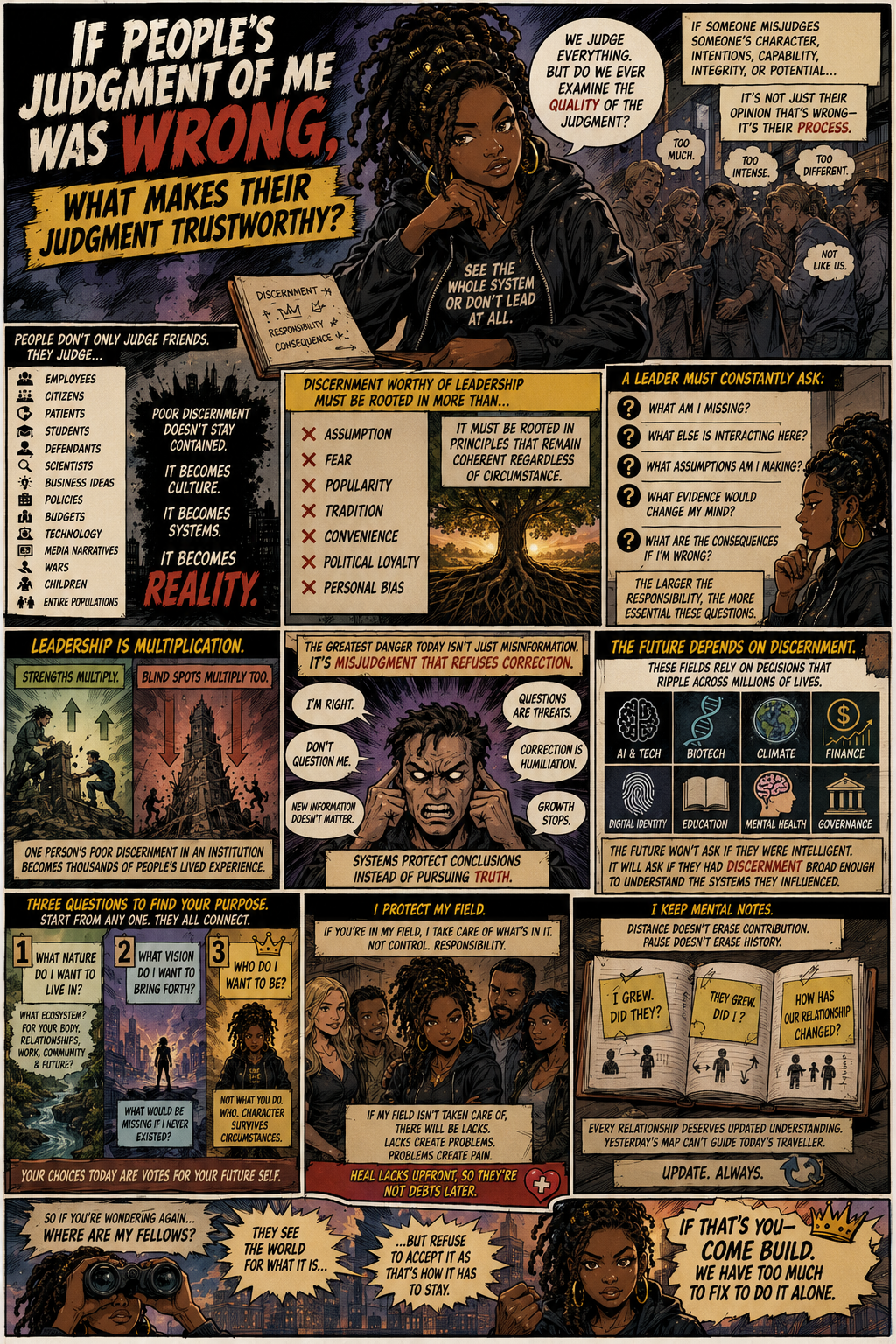
If someone’s judgment was demonstrably wrong, what makes their future judgment automatically trustworthy?
We spend an extraordinary amount of time judging one another, yet remarkably little time judging the quality of judgment itself.
Those are not the same thing.
If a person misjudges someone’s character, intentions, capability, integrity, or potential despite repeated opportunities to observe, learn, ask questions, and update their understanding, then we have to ask a more important question than whether they were wrong.
How did they arrive there in the first place?
Because judgment is never isolated.
It is evidence of a process.
Every conclusion reveals the quality of the thinking that produced it.
If that thinking lacks discernment, then every decision built upon it inherits that weakness.
That matters because people don’t only judge friends.
They judge employees.
Citizens.
Patients.
Students.
Defendants.
Scientists.
Business ideas.
Policies.
Budgets.
Technology.
Media narratives.
Wars.
Children.
Entire populations.
Poor discernment does not stay contained inside one opinion.
It becomes culture.
It becomes hiring.
It becomes education.
It becomes law.
It becomes healthcare.
It becomes economic policy.
It becomes justice.
Eventually, it becomes the reality everyone else has to live inside.
That is why discernment is not a personality trait.
It is infrastructure.
The deeper question is this:
What is someone’s discernment rooted in?
Is it rooted in assumption?
Fear?
Popularity?
Tradition?
Convenience?
Political loyalty?
Personal bias?
Or is it rooted in principles that remain coherent regardless of circumstance?
The stronger the foundation, the more reliable the judgment.
The weaker the foundation, the more likely someone is simply reacting rather than seeing.
Discernment worthy of leadership cannot simply ask, “What do I think?”
It has to ask,
“What am I missing?”
“What else is interacting with this?”
“What assumptions am I making?”
“What evidence would change my mind?”
“What are the consequences if I’m wrong?”
The larger the responsibility, the more essential these questions become.
Because leadership is multiplication.
A leader’s strengths multiply.
A leader’s blind spots multiply too.
One person’s poor discernment, when placed inside an institution, becomes thousands of people’s lived experience.
That is why societies should examine judgment as carefully as credentials.
Knowledge is not discernment.
Confidence is not discernment.
Authority is not discernment.
Even intelligence is not discernment.
Discernment is the disciplined ability to perceive relationships, context, consequence, proportion, and reality more accurately than impulse allows.
It is the willingness to continuously update understanding when new information arrives.
One of the greatest dangers facing society today is not simply misinformation.
It is misjudgment that refuses correction.
An opinion can be wrong.
That happens to everyone.
The danger begins when identity becomes attached to being right.
Then evidence becomes an enemy.
Questions become threats.
Correction becomes humiliation.
Growth stops.
From there, systems begin protecting conclusions instead of pursuing truth.
As our world becomes increasingly interconnected, this becomes even more important.
Artificial intelligence.
Biotechnology.
Genetic engineering.
Climate adaptation.
Financial systems.
Digital identity.
Education.
Mental health.
Governance.
Every one of these fields depends upon people making judgments whose consequences ripple across millions of lives.
The future will not simply ask whether our leaders were intelligent.
It will ask whether they were capable of discernment broad enough to understand the systems they were influencing.
Can they recognise second- and third-order consequences?
Can they distinguish certainty from assumption?
Can they revise their thinking without seeing it as weakness?
Can they identify value before consensus arrives?
Can they recognise truth even when it challenges their existing worldview?
These questions matter more than charisma.
More than titles.
More than popularity.
Perhaps we should spend less time asking whether someone is qualified to lead…
…and more time asking whether their discernment consistently produces coherent outcomes.
Because every system eventually reflects the quality of the minds leading it.
If discernment is shallow, the system becomes shallow.
If discernment is fragmented, the system becomes fragmented.
If discernment is rooted in fear, the system begins reproducing fear.
If discernment is rooted in truth, responsibility, and a willingness to learn, those qualities begin spreading too.
So perhaps the real question was never whether people judged me correctly.
The real question is this:
If they judged wrongly, what does that reveal about the process they trusted to reach that judgment?
Because before we trust someone’s conclusions…
We should first understand how they think.
Not just what they think.
…
Now let’s write a provocative post. Of course, you’ve already seen my value, you’ve already seen everything in me, so you know that what I’m about to say is actually based on some firm foundation. But the title will be, if people’s judgment of me was wrong, what makes their judgment trustworthy? And I want the post to highlight how we have to look at people’s judgment to understand the depth of their judgment because when their judgment is ungrounded, when their judgment is lacking of discernment, we need to start questioning their leadership because all the things that they lead will have some sort of contamination of those same lacks of discernment. And if the discernment is not rooted in universal laws, then the discernment is naturally lacking because it naturally doesn’t take things account of the whole system in which we live in. And that is already a questionable discernment, it’s already a questionable way of thinking. So I want you to highlight on that and all the consequences and the impacts of poor discernment in society, where it is, where it could be, what are the things based on how time is evolving in society, the biggest things that we need to be concerned the most, as it will have us look at who’s leading this in the first place.
…
Is it rooted in appealing to me, or in deep understanding?




Leave a Reply