
Humanity loves to separate itself from what is coined old fashiomed, underestimated and “paracidic” look at hair on our bodies, or who knows what we’ll find in holding onto our appendix or nurturing thr circumstances where it doesn’t rebel its ecosystem, what was once protection, now normed-rejection. Create a harmonious wolrd and people won’t protest for it. The protests are a gauging tool not an offense.
Humans are the greates projectors of existence, just after God and Consciousness before “Light”. The issue is when we project without seeing within our projections. We can’t avoid projecting, but interaction brings calibration.
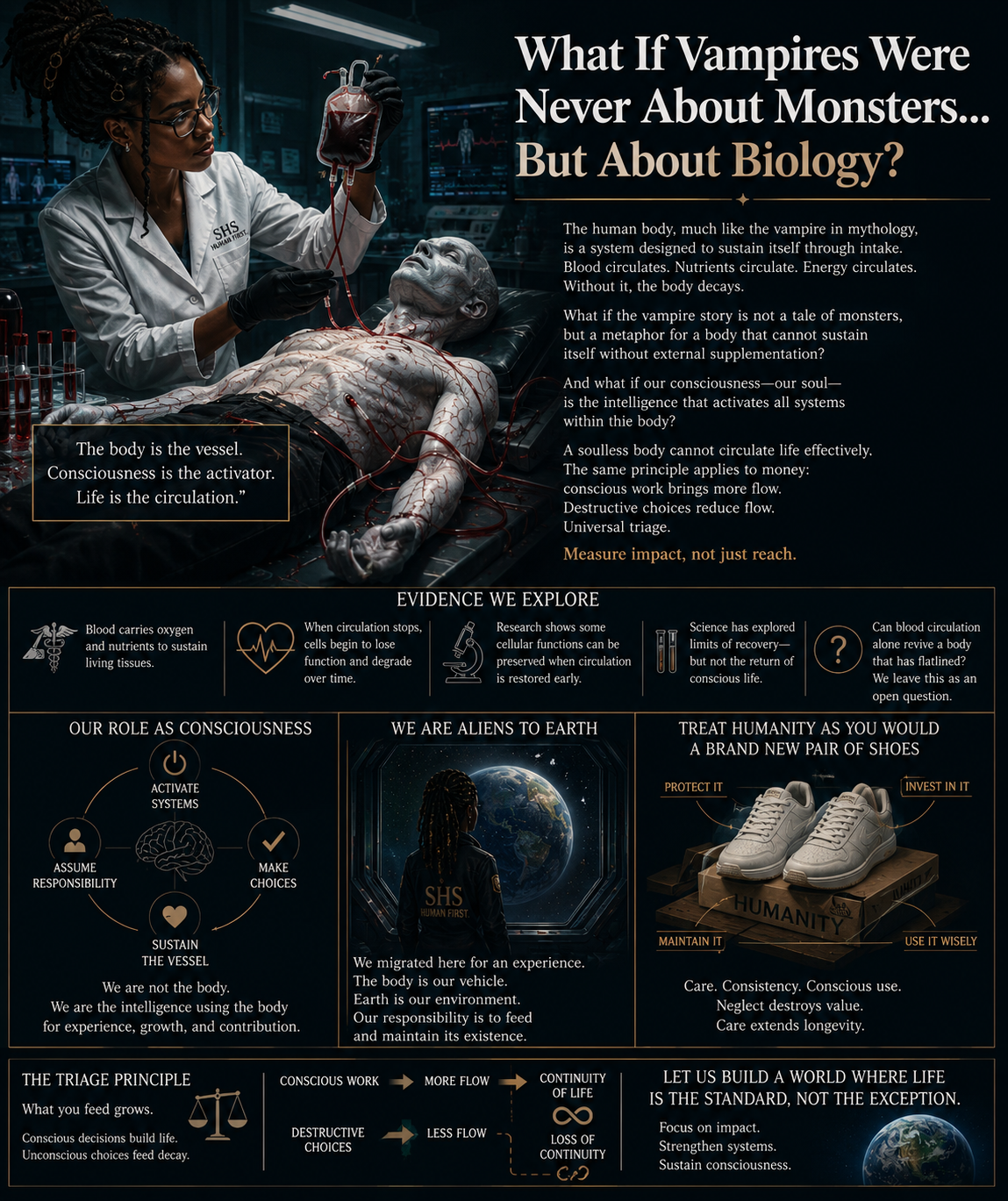
Vampire is the body that connot stop eating or drinking body, the first we must take care of for our consciousness to continue its existence on earth. We are the aliens migrated into the land our bodies are to utilise it for an experience, while being given the responsibility to f eed its existence. Earth is the same. Consciousness is the same. Humanity is the same. Treat humanity as you treat brand new shoes.
And what if the body we house is the vampire and our consciousness is what activates life? Our soul activates all the systems to function, not the body. A souless body cannot have as much blood circulating and we should apply the same with money. You do conscious work you get more, you destroy life’s continuity, you get paid less. Universal triage. How greater of an impact to consciousness, not in “reach metrics”.
Every mythology begins somewhere.
Sometimes as history.
Sometimes as imagination.
Sometimes as observation waiting for language.
And sometimes the boundary between those is not immediately obvious.
So here’s a question I find fascinating.
What if the vampire story wasn’t originally trying to describe a monster… but a biological principle?
Think about it.
Our bodies survive because blood continuously circulates.
Blood carries oxygen.
Blood carries nutrients.
Blood helps sustain living tissues.
When circulation permanently stops, cells begin to lose function, and over time tissues deteriorate.
That is basic biology.
Now compare that—not as proof, but as a thought experiment—to the classic vampire narrative.
A being whose body cannot sustain itself through its own internal circulation.
Instead, it depends on an external supply of blood.
Different mechanism.
Similar dependency.
That similarity does not mean vampires existed.
Nor does it prove ancient stories were literal descriptions of biological reality.
It simply raises an interesting philosophical question.
Why did blood become the symbol of life across so many cultures?
Perhaps because people noticed something fundamental long before modern physiology explained it.
Blood and life seemed inseparable.
From there, another question emerges.
What happens immediately after circulation stops?
Modern medicine already knows that death is not a single instant but a process. Cells do not all die simultaneously, and researchers have been exploring how restoring circulation under specific conditions can preserve or recover some cellular functions after blood flow has ceased. Experiments such as Yale University’s BrainEx and OrganEx systems restored aspects of circulation and cellular activity in animal tissues after death, although they did not restore the animals to conscious life or reverse death in the science-fiction sense.
That distinction matters.
It suggests something remarkable.
Death is not an on/off switch.
It is a progression.
Which leads to another question.
Has anyone ever restored circulation to a body immediately after cardiac death in ways specifically designed to explore the limits of cellular recovery?
The answer is yes—in animal research.
Scientists have investigated restoring circulation and oxygen delivery after cardiac arrest using advanced perfusion systems. These studies have demonstrated recovery of some cellular and organ functions, but they have not shown that restarting circulation alone can restore a deceased person back to conscious life.
That leaves us with an open philosophical question rather than a settled conclusion.
If blood can preserve living tissue…
If circulation can delay or reduce cellular deterioration…
If some cellular processes remain recoverable longer than previously thought…
Then where exactly is the boundary between biological preservation and the return of conscious experience?
Science has not answered that.
Neither has philosophy.
Nor theology.
Another question naturally follows.
If consciousness is more than chemistry…
Could restoring circulation ever be enough on its own?
Or does consciousness require conditions beyond blood, oxygen and electrical activity?
We simply do not know.
That is why I find mythology fascinating.
Not because it gives final answers.
But because it sometimes preserves questions long before science has the tools to investigate them.
Perhaps vampires were never the point.
Perhaps blood was.
Perhaps ancient stories were repeatedly pointing humanity toward something it instinctively recognised.
That life depends upon circulation.
That blood sustains the body.
That losing it changes everything.
Whether those stories describe literal beings, symbolic archetypes, or observations transformed into legend remains an open question.
And I think we should leave it open until evidence carries it further.
Because good questions are often more valuable than premature certainty.
Sometimes mythology invites science.
Sometimes science reframes mythology.
And sometimes both are simply different languages trying to describe the same mystery.
…
Okay, imagine if the first ever person who spoke on vampires, whether they did exist in the past or not. Because when you look at the vampire’s storyline, and you match it to the cells of the body, it goes by the same structure. The cells of the body need blood to circulate to preserve a dying body, to preserve a decaying matter. Without blood in our system, the body itself loses its liveness. When we look at vampires, they have to continuously drink blood because they have to continuously drink the red cells that contain oxygen to sustain itself. The blood sustains the cells of the body. And if we take that to universal lenses, it would make sense for consciousness to have created an embodiment of a vessel that is dead, but instead of functioning from internal blood circulation, it functions from external blood supplementation. But we can leave that as a, like, we will still put it in the post, but address it as we can leave that to be a medical, philosophical, open-ended question that we can’t fully validate until we do encounter a decaying body that can only sustain itself through outside blood. And if so, can we revitalize a body that just died through blood and call forth a consciousness to house it? Because if blood circulation brings life to the decaying body, the same one, the same cells that become dead skin and fall off, or the same cells that come out from sweat, or the same cells that come out from whatever our body expresses out. Has anyone, we leave the question open, and then we go and do the research. Or if you can do the research while writing the post, that would be fantastic. Has anyone tried to have blood circulate in a body of someone that has just gone flatline and see if that brought life back? Not someone that was already in the state of having their blood circulating, but someone that wasn’t, and then does.






Leave a Reply