What makes you care about convictions when you have immortality to go and see life through so?! We are covering longer periods, others might actually not have the time, we got eons to be recognised. My soul will live past it, yet mortality is still not the reason why I appreciate life. The possibility of immoetality is. Through God’s lenses death is a “who cares we got so many” cause it learned by the majority. The pasture is always greener on the other side, until you step on it and find out it’s made of polyethylene. Of course it looks good. There’s no tending needed. Death, cause there’s no space for life.
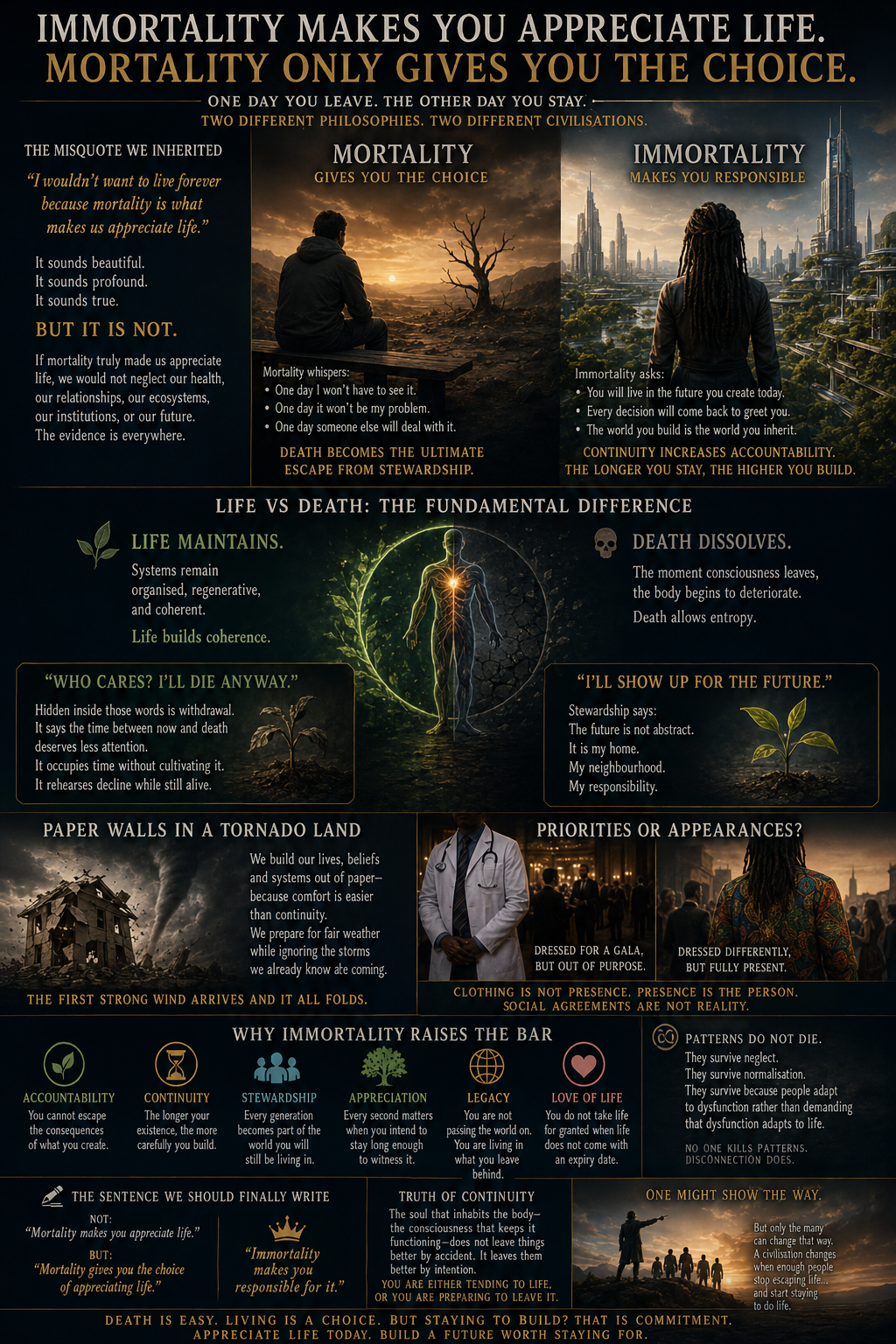
One of the most beautiful lies humanity keeps repeating to itself is the sentence, “I wouldn’t want to live forever because mortality is what makes us appreciate life.” It sounds elegant. It sounds poetic. It sounds like one of those quotes that gets passed around because nobody stopped to ask whether it actually describes reality. The more I have sat with that sentence, the more I have realised that it confuses opportunity with embodiment. Mortality does not make anyone appreciate life. If it did, then humanity would already be living as though every moment were sacred. We would not neglect our health, our relationships, our ecosystems, our institutions, or our future. The evidence of how little we appreciate life is everywhere around us. Mortality has never guaranteed appreciation. It has only ever given us the opportunity to choose it.
What mortality does exceptionally well is something far less romantic. It provides an exit. Whether people consciously realise it or not, death quietly whispers that one day the consequences will no longer belong to them. There comes a point where they will no longer have to witness the systems they neglected, the relationships they abandoned, the land they exhausted, or the future they failed to cultivate. Death becomes the ultimate release from stewardship. Not because death itself is wrong, but because the certainty of leaving makes it easier to postpone responsibility while convincing ourselves there will always be someone else to inherit what we refused to build.
Immortality completely changes that equation. If you knew that you would continue living into the future you are creating today, suddenly the future is no longer an abstract concept. It becomes your neighbourhood. Your home. Your responsibility. Pollution is yours. Governance is yours. Agriculture is yours. Education is yours. Every child born into the world becomes part of the civilisation you will still be living alongside centuries from now. Immortality does not reduce appreciation for life. It removes the illusion that someone else will deal with its consequences.
People say, “If I lived forever, life would lose its meaning.” I would argue the opposite. If you lived forever, every decision would gain more meaning because every decision would eventually come back to greet you. Continuity increases accountability. The longer your existence stretches into tomorrow, the more carefully you must build today. Responsibility rises with continuity. Stewardship rises with continuity. Appreciation rises with continuity because there is no longer a convenient finish line that allows you to escape the harvest of what you planted.
Perhaps this is why I find the relationship between consciousness and the body so fascinating. The moment consciousness departs, the body begins to deteriorate. Death is recognised precisely because deterioration begins. Life, on the other hand, is recognised because systems remain organised, regenerative and coherent. Whether one describes that organising principle as consciousness, soul, biology or something else entirely, the observation remains the same: life maintains; death dissolves. Life builds coherence. Death allows entropy. If our own bodies reveal that principle every single day, why would civilisation be any different? A civilisation that continuously tends to life remains coherent. A civilisation that accepts deterioration because “we’re all going to die anyway” quietly rehearses its own decline.
This is why I struggle with the casual sentence, “Who cares? I’ll die anyway.” Because hidden inside those few words is a philosophy of withdrawal. It says that the time between now and death deserves less attention simply because it is temporary. Yet that temporary space is life itself. If someone decides that none of it truly matters because death is inevitable, then they have already begun leaving life long before life has left them. They continue breathing, but they have surrendered stewardship. They occupy time without cultivating it.
I sometimes wonder whether humanity has confused acceptance with resignation. Acceptance says, “Death may come one day, therefore I shall live well.” Resignation says, “Death will come one day, therefore why bother?” Those are worlds apart. One creates gardens. The other leaves empty fields waiting for somebody else.
Perhaps this is why we build paper walls in places that demand stone. Not only in architecture, but in thought. We prepare ourselves for comfort instead of continuity. We design lives that withstand ordinary weather while ignoring the storms we already know are coming. Imagine building an entire city from paper in a land where tornadoes are expected every year. Nobody would call that wisdom. Yet we do something remarkably similar with our thinking. We construct beliefs that survive only while conditions remain favourable. The first strong wind arrives and the entire structure folds because it was never built to endure reality; it was built to endure convenience.
The same happens with our priorities. Society often concerns itself with appearances before purpose. Someone wearing a doctor’s coat to a gala attracts more attention than the quality of their character. Someone dressed unconventionally is judged before they have even spoken. Yet clothing is not presence. Presence belongs to the person. The rest exists because of social agreements, not because reality itself demanded it. We spend extraordinary amounts of energy protecting conventions while neglecting the very conditions that allow life to continue.
Perhaps that is the sentence we should finally rewrite.
Not,
“Mortality makes you appreciate life.”
But,
“Mortality gives you the choice of appreciating life. Immortality makes you responsible for it.”
Because appreciating life has never depended on how long you expect to live.
It has always depended on whether you intend to stay long enough—in body, in consequence, or in legacy—to care about the future you are helping create.




Leave a Reply