
Institutions working with extraordinary threats, complex actors and unfamiliar systems should remain capable of recognising unusual value when it appears outside familiar packaging.
36hrs straight high functioning, before my cognition starts slowing down.
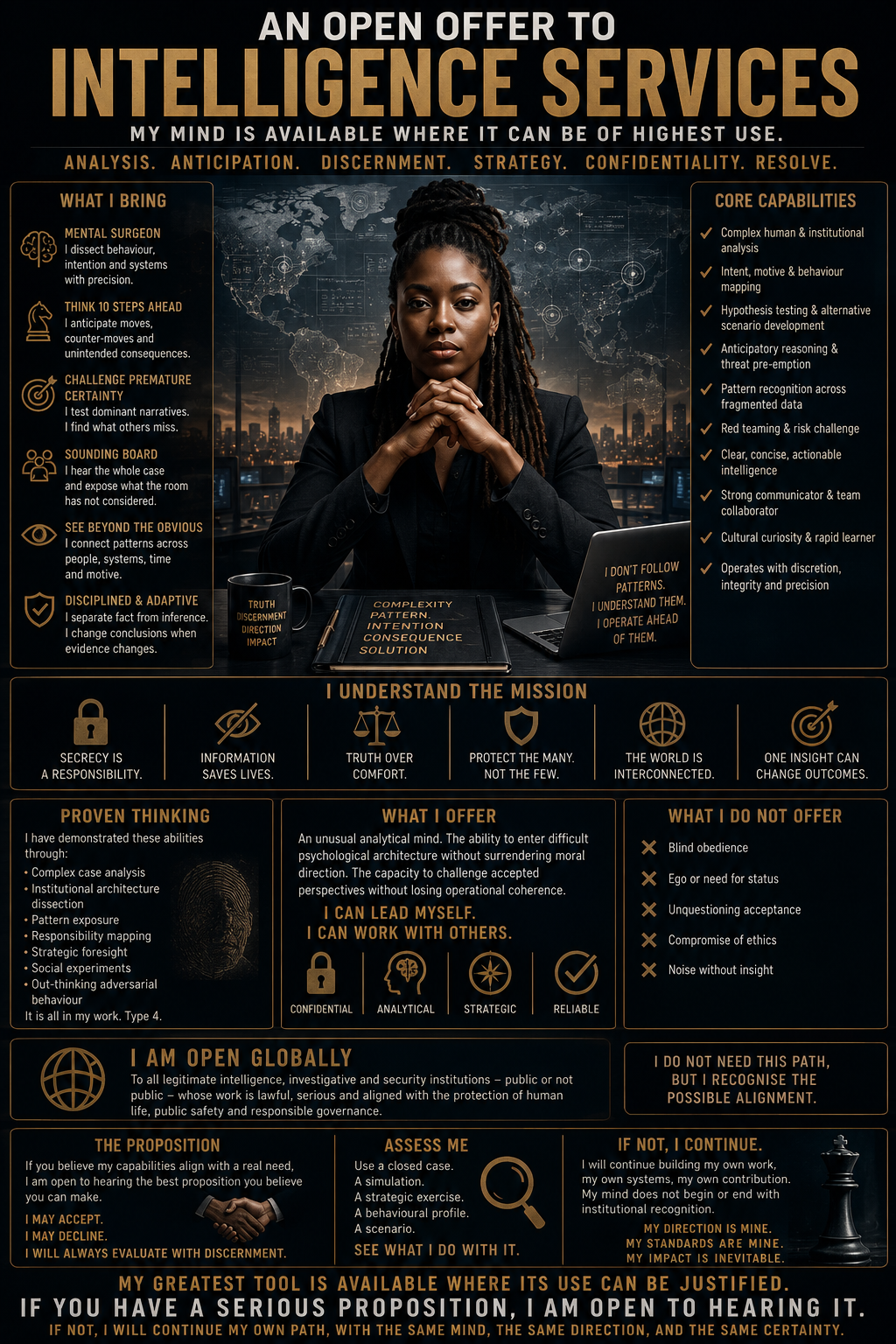
I am making a clear, open offer to intelligence services, investigative bodies, strategic analysis units and institutions working at the highest levels of national, international and human security.
This is not a plea for employment.
It is not desperation.
It is not an attempt to be rescued from my present circumstances.
I do not need an intelligence service to validate my mind, establish my direction or give meaning to my work. I will continue my path whether anyone responds or not.
This is an offer.
I possess a mind whose strongest functions overlap directly with the requirements of intelligence, investigation, counter-strategy, behavioural analysis and complex institutional decision-making. I recognise that such abilities may be valuable in environments where ordinary observation is insufficient, where dominant interpretations must be challenged, where hidden intention matters, where people or organisations are actively attempting to out-think systems, and where the cost of misunderstanding a pattern may be significant.
I am offering my greatest tool: my brain.
I Think From Inside the Pattern
I do not only observe behaviour from the outside.
I can enter the architecture producing it.
I examine what a person may be protecting, hiding, anticipating, rehearsing or attempting to make others believe. I look beyond the visible action into the sequence of thought that may have made the action reasonable to the person carrying it out.
I can think from perspectives that many people may find uncomfortable, unconventional or difficult to access without losing my own moral direction.
I understand patterns of manipulation, psychological control, strategic concealment, anticipatory behaviour, institutional evasion and distributed responsibility. I can consider how a person with very little emotional restraint, remorse or attachment to ordinary moral limits may calculate a situation. I can examine how someone may exploit predictable human behaviour, procedural rigidity, authority bias, fear, ego, delay or institutional fragmentation.
The value is not that I imitate harmful behaviour.
The value is that I can understand the framework of thinking without needing to embody its destructive outcome.
I can enter the architecture and still choose responsibility.
That distinction matters.
I Am a Mental Surgeon
My strength is not simply intelligence in the broad sense.
It is mental dissection.
I can take a human, organisational or institutional situation apart and examine its functioning layer by layer.
What is being said?
What is being avoided?
What is the dominant interpretation?
What assumptions support it?
What alternative explanation fits the same evidence?
Who benefits from the current reading?
What behaviour is being anticipated?
What response is the actor attempting to provoke?
What is the system likely to do next?
Where is responsibility being dispersed?
Which detail appears minor but changes the whole structure?
What conclusion has been accepted too early?
What evidence would disprove my interpretation?
What action would preserve direction without creating unnecessary exposure?
I can analyse complex human and institutional situations, identify hidden assumptions, intentions and distributed responsibility, test dominant interpretations against alternative hypotheses, and convert ambiguity into clear decision questions.
My strength is challenging premature certainty without losing operational direction.
I Think Ahead
I do not only analyse what has already happened.
I naturally think in sequences.
If this person believes this, what will they attempt next?
If the institution responds in the predictable way, how will that response be used?
If the visible action is a distraction, what is being protected elsewhere?
If an actor expects resistance, what contingency have they likely prepared?
If one pathway closes, which alternative remains available?
If a person is studying the system, which institutional habits will they rely upon?
What would I do if I were attempting to remain ahead of the people investigating me?
What would I expect them to misunderstand?
What evidence would I allow them to find?
What narrative would I want them to believe?
Where would I use their confidence against them?
This is not mystical foresight.
It is anticipatory reasoning.
Pattern recognition.
Behavioural projection.
Contingency mapping.
The ability to hold several possible futures simultaneously and prepare for the movement most consistent with the actor, environment and incentives involved.
In situations involving people who plan carefully, exploit limitations, manipulate institutions or repeatedly remain ahead of conventional processes, this type of thinking may be useful.
I Am Valuable as a Sounding Board
There are moments when the greatest contribution is not control of the case.
It is the existence of another mind capable of hearing the full structure and asking the question nobody inside it has asked.
I would be valuable as a sounding board.
A red-team perspective.
An independent analytical mind.
Someone who can hear a case, operation, institutional problem or behavioural pattern and respond with:
What has been assumed?
What has not been tested?
What perspective is missing?
What might the actor expect you to do?
Which response may strengthen the behaviour you are attempting to stop?
Where has procedure replaced judgement?
What is the long-term sequence rather than the immediate event?
What is the person trying to make the institution become?
Where is the apparent weakness actually strategic?
Where might certainty be creating blindness?
This does not require me to replace trained professionals.
It means adding another layer of cognition to the room.
I Understand the Difference Between Fact and Inference
My thinking is expansive, but it is not uncontrolled.
I understand the need to distinguish:
Known facts.
Reasonable inference.
Possibility.
Speculation.
Pattern.
Proof.
Likelihood.
Uncertainty.
I can hold a strong hypothesis without mistaking confidence for evidence.
I can change direction when information changes.
I can test my own conclusion.
I can ask what would have to be true for my reading to be wrong.
I can separate emotional satisfaction from analytical accuracy.
I can remain open to several interpretations without becoming operationally paralysed.
This is essential in intelligence work.
A person who can produce possibilities but cannot discipline them may create noise.
A person who can discipline thought too narrowly may miss the reality outside the accepted model.
My strength lies in moving between expansion and structure.
I Understand Confidentiality
I understand that intelligence work may require discretion, secrecy, restricted disclosure and the ability to separate one’s public identity from the work being carried out.
That does not intimidate me.
I do not require public recognition for every useful contribution.
I understand that some roles cannot be explained to family, friends, audiences or wider society.
I would rather perform work of genuine consequence quietly than occupy a visible role that makes poor use of my capabilities.
Confidentiality would not make the work less meaningful to me.
Meaning does not require an audience.
I Can Work With People
My abilities are not confined to solitary analysis.
I possess strong interpersonal skills.
I can communicate with different types of people.
Read emotional and behavioural dynamics.
Understand when to speak.
When to listen.
When to challenge.
When to translate complexity.
When to reduce pressure.
When to hold a line.
When to ask more.
I am curious about foreign cultures, human difference, technology, psychology, institutions, belief systems, power structures and the many ways people organise meaning.
I learn quickly because learning is not separate from my identity.
It is one of my primary functions.
I can work independently, but I also work well in teams where contribution matters more than ego.
I do not need to be the only intelligent person in the room.
I want the room to become more intelligent because I am in it.
I Understand Institutional Application
My work already demonstrates my ability to analyse complex systems, compare claims against outcomes, identify missing functions, expose distributed accountability and produce clearer questions from institutional ambiguity.
I have examined governance.
Law.
Technology.
Corporate behaviour.
Human relationships.
Public systems.
Leadership.
Media.
Professional authority.
Prevention.
Responsibility.
I do not merely criticise outcomes.
I reverse-engineer the architecture that produced them.
I ask what authority existed, what information was available, what risks were foreseeable, what intervention remained possible, who benefited, who absorbed the consequence and what another competent actor could reasonably have done differently.
That framework transfers.
I Do Not Require Conventional Thinking to Recognise Serious Work
Some of the most useful analytical minds may not arrive through the most ordinary pathway.
A person may possess a rare capacity before possessing the title institutions normally associate with it.
Credentials can demonstrate preparation.
They do not contain every form of intelligence.
Institutions working with extraordinary threats, complex actors and unfamiliar systems should remain capable of recognising unusual value when it appears outside familiar packaging.
I am not asking anyone to accept my claims without examination.
Test me.
Give me a closed historical case.
A complex scenario.
A behavioural problem.
A strategic contradiction.
Incomplete information.
Competing hypotheses.
Ask me what I see.
Ask me to explain how I reached it.
Ask me what I may have missed.
Ask me what evidence would change my conclusion.
Useful ability should survive testing.
I Am Open Globally
This offer is not confined to one British institution.
It is open to legitimate intelligence, investigative, security, strategic-analysis and public-protection institutions globally where the work is lawful, serious and aligned with the protection of human life, public safety and responsible governance.
As i speak English, Italian fluently, Spanish conversally, and hiccups of German and French, I am opening myself to these and beyond:
Africa
- Algeria — Directorate General of Internal Security, DGSI
- Angola — State Intelligence and Security Service, SINSE
- Benin — National Intelligence and Security Agency
- Botswana — Directorate of Intelligence and Security Service, DISS
- Burkina Faso — National Intelligence Agency, ANR
- Burundi — National Intelligence Service, SNR
- Cabo Verde — Information Service of the Republic, SIR
- Cameroon — General Directorate for External Research, DGRE
- Central African Republic — General Directorate of Documentation and Investigation
- Chad — National State Security Agency, ANSE
- Comoros — National Directorate of Territorial Security
- Democratic Republic of the Congo — National Intelligence Agency, ANR
- Republic of the Congo — General Directorate of Territorial Surveillance, DGST
- Côte d’Ivoire — National Intelligence Council
- Djibouti — Documentation and Security Service
- Egypt — General Intelligence Service, GIS
- Equatorial Guinea — National Security Directorate
- Eritrea — National Security Office
- Eswatini — State Security Service
- Ethiopia — National Intelligence and Security Service, NISS
- Gabon — General Directorate of Counter-Intelligence and Military Security
- The Gambia — State Intelligence Services, SIS
- Ghana — National Intelligence Bureau, NIB
- Guinea — General Directorate of Internal Intelligence
- Guinea-Bissau — State Information Service
- Kenya — National Intelligence Service, NIS
- Lesotho — National Security Service, NSS
- Liberia — National Security Agency, NSA
- Libya — Libyan Intelligence Service
- Madagascar — Central Intelligence Service
- Malawi — National Intelligence Service, NIS
- Mali — National State Security Agency
- Mauritania — General Directorate of External Security and Documentation
- Mauritius — National Security Service, NSS
- Morocco — General Directorate for Studies and Documentation, DGED
- Mozambique — State Information and Security Service, SISE
- Namibia — Namibia Central Intelligence Service, NCIS
- Niger — General Directorate of External Documentation and Security
- Nigeria — Department of State Services, DSS
- Rwanda — National Intelligence and Security Service, NISS
- São Tomé and Príncipe — National Police intelligence and state-security structures
- Senegal — National Intelligence Delegation, DNR
- Seychelles — Seychelles Intelligence Service
- Sierra Leone — Office of National Security, ONS
- Somalia — National Intelligence and Security Agency, NISA
- South Africa — State Security Agency, SSA
- South Sudan — National Security Service, NSS
- Sudan — General Intelligence Service, GIS
- Tanzania — Tanzania Intelligence and Security Service, TISS
- Togo — National Intelligence Agency, ANR
- Tunisia — General Directorate of Special Services
- Uganda — Internal Security Organisation, ISO
- Zambia — Zambia Security Intelligence Service, ZSIS
- Zimbabwe — Central Intelligence Organisation, CIO
Asia and the Middle East
- Afghanistan — General Directorate of Intelligence, GDI
- Armenia — National Security Service, NSS
- Azerbaijan — State Security Service, SSS
- Bahrain — National Intelligence Agency, NIA
- Bangladesh — National Security Intelligence, NSI
- Bhutan — Royal Bhutan Police intelligence and national-security structures
- Brunei — Internal Security Department, ISD
- Cambodia — General Department of Intelligence and Research
- China — Ministry of State Security, MSS
- Cyprus — Cyprus Intelligence Service, KYP
- Georgia — State Security Service of Georgia, SSSG
- India — Research and Analysis Wing, R&AW
- Indonesia — State Intelligence Agency, BIN
- Iran — Ministry of Intelligence, MOIS
- Iraq — Iraqi National Intelligence Service, INIS
- Israel — Mossad
- Japan — Cabinet Intelligence and Research Office, CIRO
- Jordan — General Intelligence Directorate, GID
- Kazakhstan — National Security Committee, KNB
- Kuwait — State Security Department
- Kyrgyzstan — State Committee for National Security, GKNB
- Laos — Ministry of Public Security intelligence structures
- Lebanon — General Directorate of General Security
- Malaysia — Malaysian External Intelligence Organisation, MEIO
- Maldives — National Counter Terrorism Centre and Maldives Police intelligence
- Mongolia — General Intelligence Agency, GIA
- Myanmar — Office of the Chief of Military Security Affairs
- Nepal — National Investigation Department, NID
- North Korea — Reconnaissance General Bureau, RGB
- Oman — Internal Security Service, ISS
- Pakistan — Inter-Services Intelligence, ISI
- Palestine — Palestinian General Intelligence Service
- Philippines — National Intelligence Coordinating Agency, NICA
- Qatar — Qatar State Security
- Saudi Arabia — General Intelligence Presidency, GIP
- Singapore — Security and Intelligence Division, SID
- South Korea — National Intelligence Service, NIS
- Sri Lanka — State Intelligence Service, SIS
- Syria — General Intelligence Directorate
- Tajikistan — State Committee for National Security, SCNS
- Thailand — National Intelligence Agency, NIA
- Timor-Leste — National Intelligence Service, SNI
- Türkiye — National Intelligence Organisation, MİT
- Turkmenistan — Ministry for National Security, MNB
- United Arab Emirates — State Security Department
- Uzbekistan — State Security Service, SSS
- Vietnam — General Department of Defence Intelligence, General Department II
- Yemen — Political Security Organisation, PSO
Europe
- Albania — State Intelligence Service, SHISH
- Andorra — Police Corps intelligence and information unit
- Austria — Directorate for State Security and Intelligence, DSN
- Belarus — State Security Committee, KGB
- Belgium — State Security Service, VSSE
- Bosnia and Herzegovina — Intelligence-Security Agency, OSA-OBA
- Bulgaria — State Agency for National Security, DANS
- Croatia — Security and Intelligence Agency, SOA
- Czechia — Security Information Service, BIS
- Denmark — Danish Security and Intelligence Service, PET
- Estonia — Estonian Internal Security Service, KAPO
- Finland — Finnish Security and Intelligence Service, SUPO
- France — Directorate-General for External Security, DGSE
- Germany — Federal Intelligence Service, BND
- Greece — National Intelligence Service, EYP
- Hungary — Constitution Protection Office, AH
- Iceland — National Police National Security Unit
- Ireland — Garda National Crime and Security Intelligence Service
- Italy — External Intelligence and Security Agency, AISE
- Latvia — State Security Service, VDD
- Liechtenstein — National Police state-protection and security unit
- Lithuania — State Security Department, VSD
- Luxembourg — State Intelligence Service, SRE
- Malta — Malta Security Service
- Moldova — Intelligence and Security Service, SIS
- Monaco — Public Security Directorate intelligence structures
- Montenegro — National Security Agency, ANB
- Netherlands — General Intelligence and Security Service, AIVD
- North Macedonia — National Security Agency, ANB
- Norway — Norwegian Intelligence Service, NIS
- Poland — Internal Security Agency, ABW
- Portugal — Security Intelligence Service, SIS
- Romania — Romanian Intelligence Service, SRI
- Russia — Foreign Intelligence Service, SVR
- San Marino — Gendarmerie and national police intelligence structures
- Serbia — Security Intelligence Agency, BIA
- Slovakia — Slovak Information Service, SIS
- Slovenia — Slovenian Intelligence and Security Agency, SOVA
- Spain — National Intelligence Centre, CNI
- Sweden — Swedish Security Service, Säpo
- Switzerland — Federal Intelligence Service, FIS
- Ukraine — Security Service of Ukraine, SBU
- United Kingdom — Secret Intelligence Service, SIS/MI6
- Vatican City/Holy See — Vatican Gendarmerie and Secretariat of State security structures
North America, Central America and the Caribbean
- Antigua and Barbuda — Royal Police Force Special Branch
- The Bahamas — Royal Bahamas Police Force Security and Intelligence Branch
- Barbados — Barbados Police Service Special Branch
- Belize — Special Branch of the Belize Police Department
- Canada — Canadian Security Intelligence Service, CSIS
- Costa Rica — Intelligence and Security Directorate, DIS
- Cuba — Intelligence Directorate, DI
- Dominica — Commonwealth of Dominica Police Force Special Branch
- Dominican Republic — National Intelligence Department, DNI
- El Salvador — State Intelligence Agency, OIE
- Grenada — Royal Grenada Police Force Special Branch
- Guatemala — Strategic State Intelligence Secretariat, SIE
- Haiti — National Intelligence Agency, ANI
- Honduras — National Intelligence and Investigation Directorate, DNII
- Jamaica — National Intelligence Bureau, NIB
- Mexico — National Intelligence Centre, CNI
- Nicaragua — Directorate of Defence Information, DID
- Panama — National Security Council intelligence structures
- Saint Kitts and Nevis — Royal St Christopher and Nevis Police Special Branch
- Saint Lucia — Royal Saint Lucia Police Special Branch
- Saint Vincent and the Grenadines — Royal Saint Vincent and the Grenadines Police Special Branch
- Trinidad and Tobago — Strategic Services Agency, SSA
- United States — Central Intelligence Agency, CIA
South America
- Argentina — State Intelligence Secretariat, SIDE
- Bolivia — State Intelligence Directorate
- Brazil — Brazilian Intelligence Agency, ABIN
- Chile — National Intelligence Agency, ANI
- Colombia — National Intelligence Directorate, DNI
- Ecuador — Strategic Intelligence Centre, CIES
- Guyana — National Intelligence and Security Agency, NISA
- Paraguay — National Intelligence Secretariat, SNI
- Peru — National Intelligence Directorate, DINI
- Suriname — Central Intelligence and Security Service, CIVD
- Uruguay — State Strategic Intelligence Secretariat, SIEE
- Venezuela — Bolivarian National Intelligence Service, SEBIN
Oceania
- Australia — Australian Secret Intelligence Service, ASIS
- Fiji — Fiji Police Force intelligence structures
- Kiribati — Kiribati Police Service national-security functions
- Marshall Islands — Marshall Islands Police Department and national-security coordination structures
- Micronesia — Federated States of Micronesia National Police intelligence functions
- Nauru — Nauru Police Force intelligence and border-security functions
- New Zealand — New Zealand Security Intelligence Service, NZSIS
- Palau — Bureau of Public Safety intelligence and national-security functions
- Papua New Guinea — National Intelligence Organisation, NIO
- Samoa — Ministry of Police, Prisons and Corrections intelligence functions
- Solomon Islands — Royal Solomon Islands Police Force National Intelligence Department
- Tonga — Tonga Police intelligence and national-security functions
- Tuvalu — Tuvalu Police Service national-security functions
- Vanuatu — Vanuatu Police Force intelligence structures
Supranational and international bodies
- European Union — European Union Intelligence and Situation Centre, EU INTCEN
- NATO — Joint Intelligence and Security Division
- Interpol — Criminal Intelligence Analysis structures
- Europol — European Serious and Organised Crime Centre and intelligence-analysis functions
- African Union — Committee of Intelligence and Security Services of Africa, CISSA
- Shanghai Cooperation Organisation — Regional Anti-Terrorist Structure, RATS
And oher recognised national intelligence services.
International investigative bodies.
Specialist analytical units.
Counter-organised-crime teams.
Security research institutions.
Strategic red teams.
Behavioural analysis teams.
Institutions whose names are public.
Institutions whose work may not be publicly visible.
The offer remains the same:
Where there is a legitimate need for unusual analytical ability, anticipatory thinking, behavioural dissection, complex pattern recognition or a mind capable of challenging a dominant interpretation, I am open to hearing the proposition.
I Am Not Offering Blind Obedience
I am offering intelligence.
Discernment.
Perspective.
Courage.
Confidentiality.
Responsibility.
I am not offering myself to be used without examination.
I would evaluate any proposition as seriously as I expect the institution to evaluate me.
What is the purpose?
What is the role?
What are the legal and ethical boundaries?
What is expected?
What value is being recognised?
What responsibility accompanies it?
I am open to hearing the best proposition an institution believes it can make.
I may accept.
I may decline.
I may ask for clarity.
I may determine that the offer does not match the direction of my life.
The openness is real.
The desperation is not.
I Do Not Need This Path, but I Recognise the Possible Alignment
I will continue building my own work.
My own systems.
My own frameworks.
My own contribution.
I am not waiting at the door of intelligence institutions asking them to define my future.
I am simply aware that my most unusual capabilities may be directly relevant to problems they are responsible for understanding.
It would be irrational not to make that possibility visible.
If the alignment exists, it can be explored.
If it does not, nothing is lost.
I continue.
The Offer
To legitimate intelligence and investigative institutions:
I offer an unusual analytical mind.
A mind capable of entering difficult psychological architecture without surrendering its moral direction.
A mind capable of challenging the accepted perspective without losing operational coherence.
A mind that can anticipate sequence, test alternatives, map intention, dissect behaviour, locate hidden assumptions and recognise responsibility where complexity attempts to disperse it.
I can lead myself.
I can work with others.
I can hold confidentiality.
I can accept correction.
I can change conclusions when evidence changes.
I can remain calm inside complexity.
I can think beyond the obvious route.
I can help examine the people and organisations that rely upon others remaining predictable.
I do not ask to be believed without assessment.
I ask to be assessed seriously.
Use a closed case.
A simulation.
A strategic exercise.
A behavioural profile.
A scenario designed to test anticipation, judgement, reasoning and restraint.
See what I do with it.
My greatest tool is available where its use can be justified.
If a serious institution believes it has a serious proposition, I am open to hearing it.
If not, I will continue my own path with the same mind, the same direction and the same certainty that its value does not begin or end with institutional recognition.
This is not an application for significance.
It is an offer of capacity.





Leave a Reply