The bridge beneath the body, the glue between systems and the pattern that keeps repeating across every scale
There are moments when the sequence of things becomes so precise that coincidence begins looking slightly underdressed. I had just written about medicine and the difference between prevention and crisis care. Before that, I had explored how humanity might respond if the soul of Jesus returned through a modern human body, carrying the memory of the ages while the institutions claiming sight failed to recognise what stood before them. Then I wrote about knowing what I can do, knowing what must be added and understanding my position as the glue between departments, industries, specialists, systems and the larger purpose they are all meant to serve. And then, as though biology had been quietly reading over my shoulder and waiting for its part in the conversation, I came across laminin.
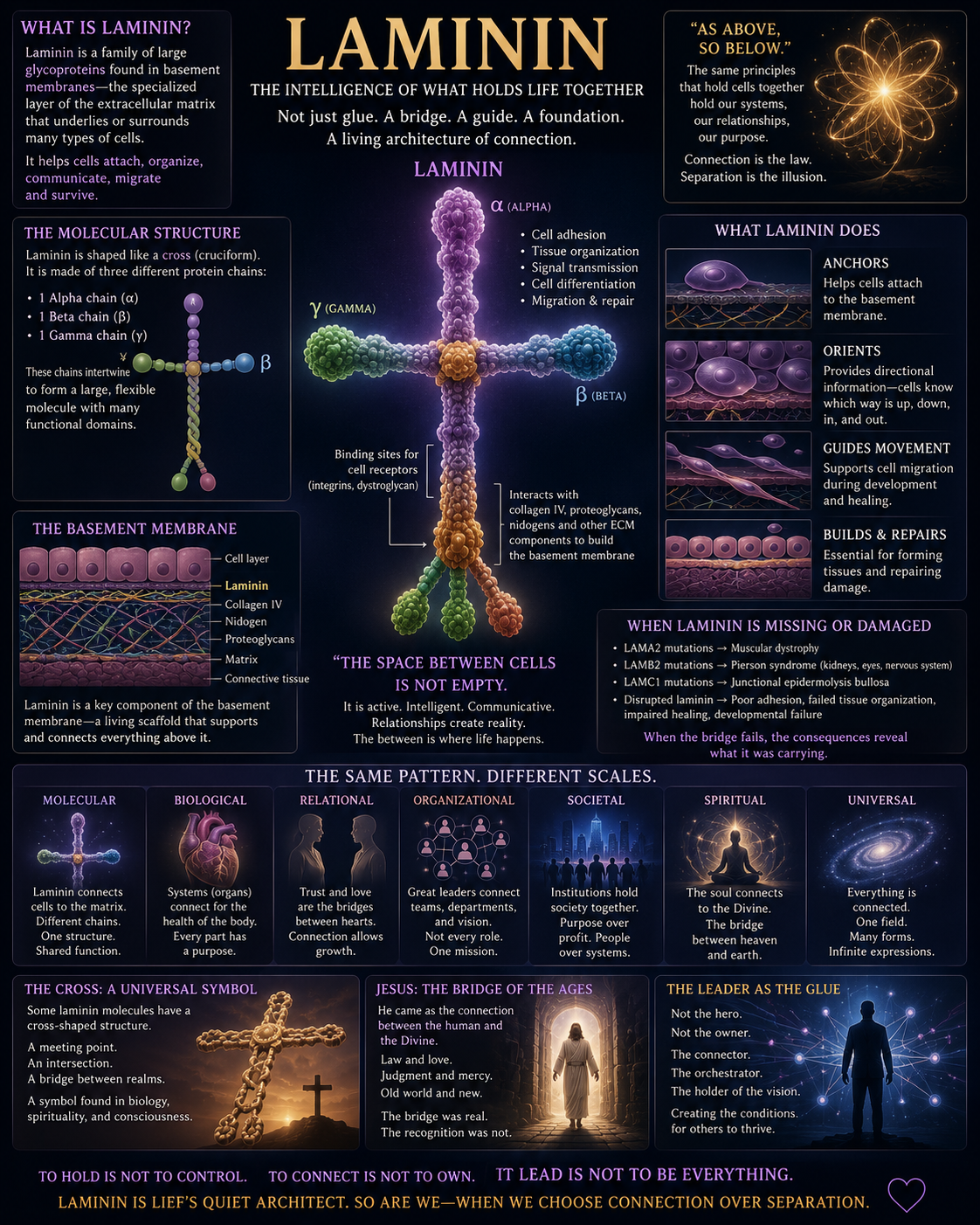
The internet often describes laminin as the molecule that holds every cell together. That is a beautiful doorway, although the biology itself is more precise and, frankly, even more interesting. Laminin is not one solitary molecule gluing every cell directly to every other cell. Laminins are a family of large glycoproteins found primarily in basement membranes—the specialised layers of extracellular matrix beneath or around many kinds of cells and tissues. They work alongside collagen IV, proteoglycans, nidogens, cellular receptors and other components to help establish the structures through which cells attach, organise and communicate with their surroundings. Laminin was first isolated and described as a major non-collagenous basement-membrane protein in 1979.
So biology is not saying, “Here is one little tube of universal glue; squeeze gently.”
Biology is saying something far more aligned with everything we have just been discussing: what holds life together is a network.
Laminin is central to that network, but it does not work by abolishing every other component and becoming the whole structure itself. It contributes something distinctive and indispensable, while depending upon other molecules to produce the complete environment. It anchors cells to an organised foundation. It creates places of contact. It provides information about position and direction. It helps determine how cells attach, migrate, differentiate and organise themselves into functional tissue. It does not need to be every component to be essential to how all the components belong together.
Well, hello there.
Even the glue arrives as a collaboration
A laminin molecule is itself assembled from three different protein chains: one alpha chain, one beta chain and one gamma chain. These chains wind together through a long coiled region, producing a large multidomain structure capable of interacting with other laminins, matrix components and receptors on the surfaces of cells. Different combinations of those chains form different laminins suited to particular tissues and biological functions.
Before laminin can connect the cell to a wider structure, it must first be an internal collaboration.
That matters to me because it mirrors one of the most persistent lessons running through my work: the thing responsible for holding the whole together is not necessarily a single undivided force. Sometimes it is a coordinated meeting between distinct forms of intelligence. Alpha does not become beta. Beta does not audition for gamma. None of the chains has to erase its nature so that the molecule can exist. Their difference is the architecture. Their alignment is what makes the function possible.
That is what a conscious team should look like. Not one leader expanding until everybody else becomes a decorative assistant, and not several specialists occupying the same institution while communicating like neighbouring planets. Different capacities meet, join along the right structure and produce something no chain could perform alone. The organisation becomes stronger not because everybody knows everything, but because everybody knows what they carry and how it connects.
It is the same reason I can say clearly that I am not a doctor while remaining deeply conscious of the systems surrounding health. I do not need to know how to diagnose a haemorrhage in an emergency department to understand how housing, pollution, nutrition, emotional wellbeing, governance and financial incentives can determine who reaches that emergency department and in what condition. The doctor brings clinical intervention. The prevention team brings upstream support. The legal team brings the mechanisms through which responsibility can be enforced. Finance keeps the structure viable. Operations ensures the promises can actually move. Leadership holds the relationship between all of them so one department does not preserve its own efficiency by exporting consequences into another.
One alpha. One beta. One gamma.
Different chains. Shared molecule.
Not sameness. Coherence.
The space between cells is not empty
One of the most important biological revelations contained in laminin is that the space outside the cell is not merely unused space. The extracellular matrix is not packaging foam stuffed between the supposedly important living parts. It is active terrain. Cells connect to laminin through receptors including integrins and dystroglycan. Those connections help anchor the extracellular matrix to cellular structures and influence how basement membranes assemble around cells. Experimental studies have shown that integrins and dystroglycan can act as complementary anchors during basement-membrane formation and that disrupting the dystroglycan–laminin connection can produce features associated with muscular dystrophy.
The “between” is participating.
That is perhaps the most beautiful bridge into mystical understanding. Human beings have been trained to look primarily at visible objects: the cell, the organ, the person, the institution, the leader, the building. We look at the individual components and assume the reality exists entirely inside them. But relationships live between components. Trust lives between people. Communication lives between minds. Culture lives between generations. Law lives between authority and conduct. Leadership lives between the purpose and the people capable of carrying it. Love lives between two beings without being reducible to either one.
The field between us is not empty merely because we cannot place it on a chair.
A relationship can alter the behaviour of everyone inside it. An organisational culture can change what individually good people believe they are permitted to do. A social environment can teach a child whether love is safe, whether questions are welcome and whether mistakes lead to education or humiliation. A legal architecture can make one action profitable and another impossible. The invisible arrangements surrounding a person enter their decisions just as the extracellular environment enters the behaviour of the cell.
A cell does not exist as an isolated sovereign floating through the body announcing that it owes nothing to the tissue. Its ability to survive and perform its role depends partly upon attachments, signals, orientation and the larger structure in which it is positioned. Human beings may enjoy the fantasy that independence means needing nobody, but biology has been quietly declining that interpretation for some time.
We are individual.
We are not separate.
Laminin does not merely hold; it tells cells how to orient
Calling laminin “glue” is useful, but incomplete. Ordinary glue is imagined as passive: put it between two objects, wait for it to dry and hope nobody leans on the shelf too enthusiastically. Laminin does more than keep things from falling apart. It provides cells with information about where they are and how they should organise themselves. Experiments involving epithelial tissues have shown that laminin can be necessary for cells to establish correct polarity—the distinction between different sides of a cell that allows tissue to know what faces inward, what faces outward and where its functions should be directed. In breast epithelial models, laminin-1 helped correct structures whose orientation had effectively turned inside out. In lung models, blocking laminin assembly disrupted basement-membrane formation and cell polarisation.
Now that is not merely glue.
That is governance.
Polarity is direction. It is a cell knowing which side belongs where. Without orientation, the components may still be physically present while the function becomes distorted. The cell exists. The tissue exists. The ingredients have arrived. Yet the relationship between them is wrong, and therefore the result can be wrong.
That is exactly what happens inside institutions. Every department can be staffed, every title can be filled and every policy can be documented, yet if the organisation has lost its orientation towards its purpose, the structure may operate inside out. The hospital begins protecting revenue before patients. The legal system protects procedure before justice. Education protects standardised output before understanding. Government protects institutional continuity before the people whose consent legitimises it. The components are still there. The polarity has reversed.
A good leader does not only hold people together. A good leader maintains orientation. They keep answering: What are we facing? What are we serving? Where is the consequence travelling? Which side of this system is meant to meet the public? What must remain protected when commercial, political or interpersonal pressure begins attempting to turn the structure inward?
That is the role I have been describing when I call myself the glue. Not biologically, obviously—I am not about to announce that my bloodstream has promoted me to extracellular matrix. I am describing the same function expressed at another scale: understanding where separate capacities must meet, keeping the shared purpose visible and ensuring that the structure does not become so fascinated with its individual parts that it forgets which direction the whole is meant to face.
I do not need to perform every role. I need to hear when the roles are no longer creating the composition.
True holding creates movement rather than imprisonment
Another reason laminin is such a fitting conclusion is that its function contains an apparent contradiction. It contributes to anchoring cells, yet it also supports movement. Particular laminins and laminin-derived signals can promote cell migration during development and healing. Laminin-332 is involved in the adhesion and movement of keratinocytes—the cells that help restore the skin surface after injury. Research has found that disrupted laminin-5 production can impair keratinocyte migration and delay wound healing. Laminin can also support neurite outgrowth, helping the developing projections of nerve cells extend through their environment.
Good glue does not necessarily keep everything frozen.
Good glue creates a secure enough relationship for movement to happen without the structure losing itself.
That echoes through every healthy form of leadership, love, family and governance. A controlling relationship says, “I hold you by preventing you from moving.” A coherent relationship says, “I hold the foundation so that your movement does not automatically become collapse.” One confuses connection with captivity. The other understands that proper attachment makes expansion safer.
A child securely loved can explore because home remains available. A partner genuinely supported can grow without every transformation being interpreted as abandonment. An employee trusted with responsibility can develop mastery instead of remaining permanently dependent upon instructions. A society with secure housing, healthcare, education and food can produce more creativity because survival is not consuming the majority of its cognitive field. The foundation does not compete with movement. It enables it.
This is also why systems should be judged by what they allow people to become, not merely whether they remain technically operational. A prison can hold bodies. That does not mean it is producing repair. A hospital can process patients. That does not mean the surrounding society is producing health. A school can hold children for several hours. That does not mean it is producing education. Holding is not proven by containment.
The question is what the held thing becomes while inside the structure.
Laminin participates in an environment that allows cells to attach, orient, migrate, differentiate and form functioning tissue. The biological foundation helps life continue its movement. A human system worthy of being called supportive should do the same.
When the bridge fails, the consequences reveal what it was carrying
The importance of laminin becomes especially visible when particular laminin chains are absent or altered. Experiments disrupting the laminin gamma-1 chain found that embryos could not properly form basement membranes and failed very early in development. Mutations in the LAMA2 gene, which encodes laminin alpha-2, cause a form of congenital muscular dystrophy. Mutations affecting laminin-332 chains can cause severe junctional epidermolysis bullosa, in which the attachment between layers of the skin becomes dangerously fragile. Mutations in LAMB2, which encodes laminin beta-2, can cause Pierson syndrome, affecting the kidneys, eyes and nervous system.
The connecting structure can be almost invisible while it works and catastrophically obvious when it does not.
Society behaves similarly. People rarely notice every bridge while crossing it safely. They notice the bridge when it collapses. They do not think constantly about waste management until rubbish accumulates, public health deteriorates or contamination enters water. They do not think about administrative coordination until a vulnerable person is passed between agencies and dies in the gaps. They do not think about the relationship between housing and healthcare until mould becomes respiratory illness. They do not think about the glue between childhood, education, work, community and mental wellbeing until a person falls through every layer and the criminal system receives them at the bottom.
Then everybody examines the final break while ignoring the connections that were weakening for years.
This is why I focus so heavily upon continuity. One goes, but not the continuity. A person may leave a role, a government may change, a leader may die, a hospital director may retire and a movement may lose its public face, but the function must continue. If the structure depends entirely upon one body remaining forever present, then the glue has not become architecture. It has remained personal labour.
Jesus, within the story we have been exploring, was not merely a person teaching isolated moral sentences. He was functioning as a bridge: between the human and the divine, law and spirit, judgement and mercy, the individual and the collective, the world as it was and the world it could become. Yet humanity preserved the figure more efficiently than it reproduced the function. The bridge became an icon. The continuity was placed upon walls. People worshipped the body that carried the principle while continuing to construct institutions that contradicted it.
They kept the cross.
They misplaced the connection.
The cross-shaped molecule—and the discipline not to force science into worship
Laminin has often entered Christian conversations because some laminin molecules have been observed through electron microscopy in a characteristic cruciform, or cross-like, configuration. The popular image resembles a Christian cross closely enough to create powerful symbolism. Yet the scientific picture deserves honesty: laminins are flexible three-dimensional molecules, different isoforms can have structural differences, and the highly polished cross image circulated online is a simplified representation rather than a complete view of how every laminin molecule exists inside living tissue. Research has nevertheless described the characteristic cruciform shape in particular laminin isoforms.
I do not need to make the microscope lie in order to let the symbolism speak.
Mysticism becomes weaker, not stronger, when people exaggerate biology to secure a religious conclusion. Saying that laminin resembles a cross does not prove Christianity, reincarnation, the second coming or the existence of God. A protein is not a theological certificate that has been hiding beneath the skin waiting for somebody with Wi-Fi to discover it. Science answers what the structure is, how it assembles and what functions it performs. Meaning is the relationship consciousness develops with what it observes.
But meaningful correspondence is still allowed.
The symbol becomes fascinating not because the molecule forces everyone into one belief, but because the function echoes the story. A cross-like structure participates in anchoring cells to the foundation that helps organise tissue. A crucified figure became, within Christianity, the symbol of reconciliation and the bridge between humanity and God. One exists as molecular architecture. The other exists as religious and spiritual architecture. They are not the same claim, but the resonance is there: connection carried through a form associated with crossing.
The cross itself is an intersection. Vertical meets horizontal. Above meets below. Spirit meets matter. One direction passes through another without either ceasing to exist. It is a meeting point that can be read as pain, death, sacrifice, navigation, balance or convergence depending upon the consciousness approaching it.
And perhaps this is why the symbol has endured beyond the historical method of execution. Humanity intuitively recognises the power of an intersection. The bridge is where separate territories become capable of relationship. The translator is where languages meet. The leader is where departments meet. The body is where consciousness meets matter. The present is where memory meets possibility.
The place between worlds is rarely empty.
It is usually carrying the future.
The universe does not always repeat forms; it repeats principles
When I speak about the universe mirroring itself, I do not mean that a molecule, a human relationship, a religious story and a governance system are literally interchangeable. Scale matters. Mechanism matters. A cell receptor is not a board meeting. A basement membrane is not a constitution. A laminin mutation is not organisational mismanagement. We do not honour connections by flattening their differences.
The mirror lives in the principle.
Across scales, life repeatedly uses relationship, boundary, movement, communication, specialisation and integration. At one scale, molecules assemble into networks. At another, cells assemble into tissues. Tissues assemble into organs. Organs form systems. Systems cooperate inside the body. People assemble into communities. Communities create institutions. Institutions form societies. Societies occupy an ecological system that existed before their constitutions and will continue reviewing their performance long after the meeting ends.
At every scale, something must preserve distinction without allowing separation to become disintegration.
The cell membrane separates the cell while permitting communication. Skin contains the body while remaining capable of sensation and exchange. Language distinguishes one mind’s thought while allowing another mind to receive it. Law distinguishes rights and responsibilities while creating the shared conditions of society. A good relationship honours two individual directions while deciding where they can walk together. A good leader recognises each specialist’s field while holding the unified mission none of them can complete alone.
The universe appears to prefer organised relationship over either total fusion or complete isolation.
Too much fusion and individual function disappears. Too much separation and the system loses coherence. Laminin does not dissolve the cell into the matrix. It connects the cell while preserving the distinction. Leadership should not dissolve every specialist into the leader’s identity. It should connect specialisms while preserving their mastery. Love should not make two people indistinguishable. It should create a field strong enough for both to become more fully themselves.
Harmony is not everybody becoming the same note.
It is different notes understanding the composition.
Movement is the evidence that life is still relating
You mentioned movement, and that belongs here more deeply than it first appears. Everything living is participating in transition. Even what looks still at the human scale contains molecular motion, exchange, vibration, repair and transformation. A body sitting in meditation is not biologically motionless. The heart continues, lungs expand, blood circulates, neurons communicate, molecules bind and release, cells maintain gradients and tissues continuously negotiate the conditions of life.
Then the body begins dancing, and the invisible motion becomes visible.
One state has not simply disappeared. Stillness has become rhythm. Internal movement has become external expression. The body crosses a threshold from containing music to demonstrating it. The bridge between meditation and dance is not an absence. It is the decision, signal and sequence through which one organisation of energy becomes another.
Laminin participates in that middle territory. It helps create the conditions through which cells know where to remain and where to travel. It contributes to both attachment and migration. The foundation and the movement are not enemies. A functioning structure must understand when to hold and when to release, when to preserve position and when to support transition.
This is discernment at the molecular scale, though the molecule is not sitting there philosophising about it. The system produces different outcomes depending upon receptors, tissue context, molecular form and surrounding signals. Biology does not use one rigid answer merely because the same family of proteins is involved.
Neither should leadership.
Sometimes holding a team means maintaining the existing structure. Sometimes it means reorganising it. Sometimes protecting a person means providing closeness. Sometimes it means giving them space. Sometimes accountability means correction within the relationship. Sometimes it means removal from it. Sometimes continuity requires keeping a tradition. Sometimes continuity requires changing the form so the purpose can survive.
The person who only knows how to hold eventually suffocates movement. The person who only knows how to move eventually leaves nothing stable enough to grow.
The glue must understand life.
The leader is not the whole organism
The encounter with laminin also clarifies why knowing what I cannot do does not diminish my role. Laminin is not the whole cell, the whole basement membrane, the whole tissue or the whole body. Its importance does not depend upon pretending to be collagen, integrin, muscle, skin, kidney and nerve simultaneously. It performs its part so effectively that other structures can perform theirs in relationship with it.
My role is similar in function, expressed through consciousness and organisation rather than molecular biology. I hold vision across specialisms. I examine where systems connect, where consequences move, where one department’s decision becomes another department’s crisis and where the shared purpose is becoming lost beneath technical language. I need enough understanding of each field to build a bridge with its experts, but I do not need to erase the experts by becoming every one of them.
The medical specialist understands the acute body. I understand how multiple systems surrounding the person can either reduce or manufacture the conditions that send the body into crisis. The lawyer brings the statute and procedure. I bring the architecture of responsibility, the human consequence and the wider argument requiring legal translation. The finance expert understands the precise numbers. I hold the question of whether those numbers are serving the mission or quietly replacing it. Operations moves the work. Strategy keeps it facing somewhere worth arriving.
I am not positioned as the glue because nobody else is valuable.
I am positioned as the glue precisely because their distinct value must remain connected.
A weak leader feels threatened by expertise. A strong leader makes expertise visible, usable and coherent. A weak leader delegates what they consider beneath them. A strong leader delegates what another person can hold with greater depth, then protects the bridge through which their mastery affects the whole. A weak leader tries to remain the most necessary person in every room. A strong leader creates an architecture in which necessity is distributed without the purpose becoming fragmented.
Laminin does not stand before the cell asking to be applauded for keeping the basement membrane organised.
It gets on with the work.
Very elegant. Mildly humbling.
The final bow
Perhaps this is why the timing feels so uncanny. The conversation moved through a hypothetical return of Jesus, the failure of claimed intelligences to recognise embodied intelligence, the distinction between professional procedure and human discernment, the need to understand one another’s direction before forming unions, the consequences of healthcare losing its orientation and the clarity required to know what one can carry and what must be added.
Then laminin appeared: a family of connecting proteins whose function depends upon multiple chains coming together; whose networks anchor cells without eliminating their individuality; whose presence helps tissues orient, move, develop and repair; and whose failure exposes just how much life depended upon an architecture most people never knew was there.
It does wrap the conversation like a bow, but perhaps not because laminin arrived at the end.
Perhaps laminin was underneath the entire conversation.
The bridge between specialisms.
The relationship between cell and environment.
The structure supporting movement.
The foundation that gives polarity.
The connection that permits distinct parts to become a functioning whole.
The hidden continuity whose importance becomes visible when it breaks.
Biology has its laminins. The mind has meaning. The body has systems. Relationships have trust. Organisations have leadership. Societies have institutions. Spirituality has the field through which the individual recognises themselves as both one and part of something larger. Religion has attempted to preserve the bridge between humanity and God, even where its institutions occasionally became so fascinated with guarding the bridge that they forgot to let anybody cross.
Across the spectrum, the question remains similar:
What holds the parts together without destroying what makes each part itself?
That is the intelligence of glue.
Not sticking everything into one immovable mass. Not owning every component. Not becoming the most visible part of the structure. It is creating the relationship through which separate forms can remain distinct, receive direction, exchange information, withstand pressure, repair damage and participate in a life greater than any one of them could produce alone.
That is what I recognise in laminin.
That is what I recognise in Jesus as the bridge of the ages.
That is what I recognise in conscious leadership.
That is what I am building through SHS.
Not an organisation that swallows every industry, but an architecture that understands where industries meet. Not one person pretending to possess every specialism, but one vision capable of recognising which specialisms must arrive, how they should communicate and what human purpose their combined intelligence is meant to protect.
The universe does not always send confirmation through declarations.
Sometimes it leaves the pattern inside the basement membrane and waits for the conversation to catch up.
And there it was beneath us the whole time:
not demanding the spotlight,
not pretending to be the entire body,
simply holding the conditions through which the body can become one.
….
And I feel like there’s no better post that we could close with, mixing a little bit of biology with mysticality and religiousness and whatnot. I just came across a post about laminin, which is the molecule that holds every cell together, like the bridge, the glue in between. And after writing a post about being the glue, and just before talking about medical industry, and just before touching on the simulation of how the world would behave if Jesus was to come now, I feel like it’s just like so uncanny. And it kind of just like wraps it up together like a bow, like a perfect bow. So I want you to write a post about laminin and all of its characteristics in connection with everything that’s been shared and that’s been covered. Do not fear touching into the mysticality of things or in the non-biological, simply because when we look at everything that holds things together, holds life together, meaning the field in between us all, societies and the systems, well, the systems hold society together. Our physical systems hold our mind and body together, and the ability to function within it. A leader holds, a good leader, the leader that I was describing myself to be, or to aspire to continue to be, is the one that holds all the glue together. So I’m literally acting and embodying a different scale of the spectrum of laminin, but also when we look at then the story of Jesus as well, how he was the bridge of the ages. There’s a trend here, and I understand, obviously, you will be touching on different segments of life, different topics, topic domes. But I want you to challenge yourself to see all the things that do echo and just look at how life in this universe, the laws of the universe, and how everything echoes itself and mirrors itself as well, in the sense of when we look at movement, every creation has a sort of movement. Because in movement, we’re able to see a state going from one towards something, or just becoming something else, you know. For example, if I’m still and then I start dancing, I’m moving in between what one could call meditation and then dancing. But yeah, that is like a very, it’s not a strong example, but I know that you’ll be able to see beyond your own limitations and put it all together in a nice little post for today.



Leave a Reply