If the world refuses to acknowledge itself as a classroom, it will continue acting surprised by what its students become.
I Do Not Want to Believe I Am the Only One Seeing This
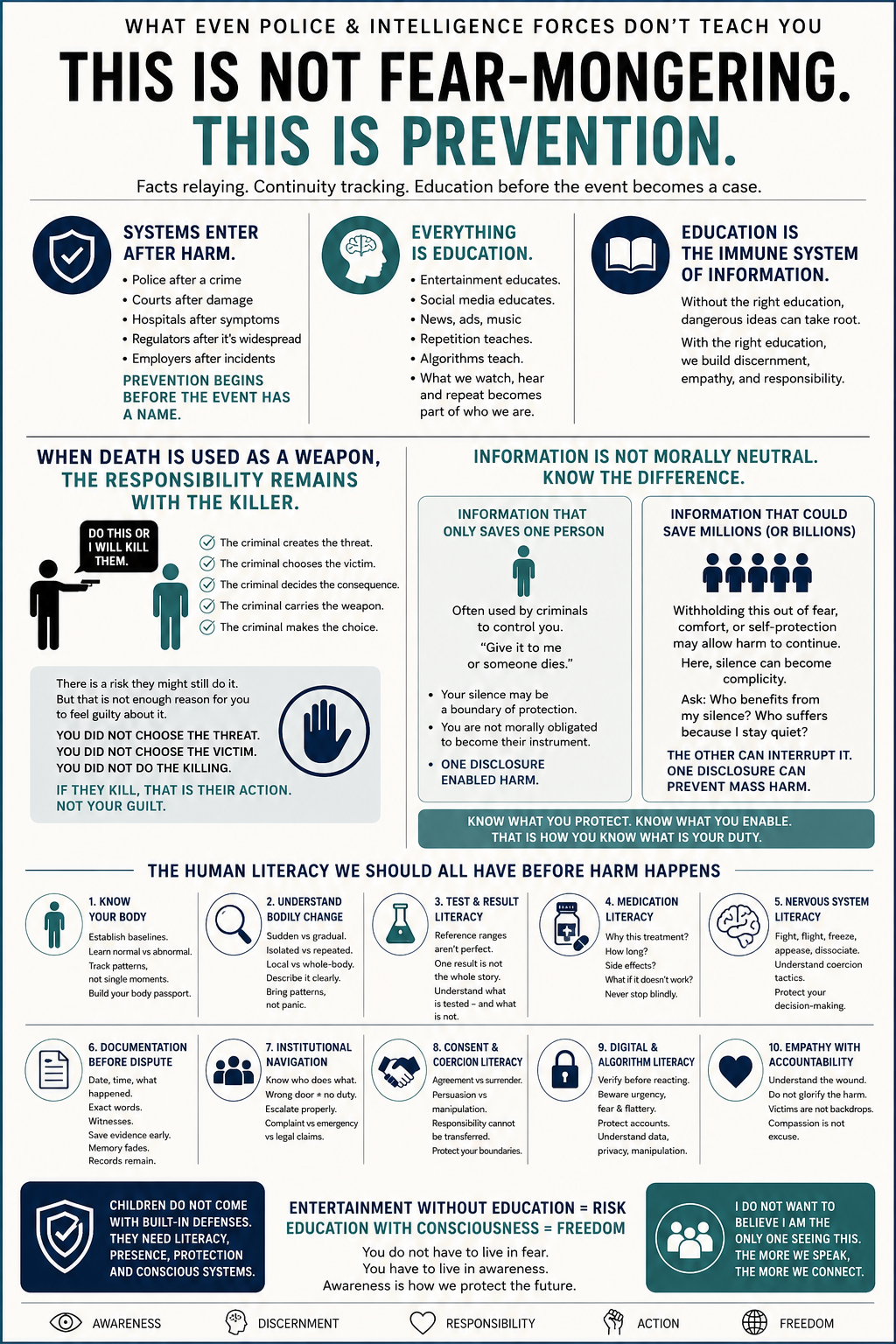
This Is Not Fear-Mongering. It Is What Prevention Looks Like When We Finally Admit That Entertainment Is Education.
I want to make this unmistakably clear: what I am doing is not fear-mongering.
Fear-mongering presents danger without understanding so that people can be controlled by the fear of it. What I am doing is tracing facts back through the architecture that helped produce them so that harm can be understood before the police, hospital, prison, court, documentary crew or grieving family has to enter.
This is facts relaying.
It is continuity tracking.
It is looking at the event and refusing to pretend that the event began when it became visible.
A child does not suddenly become violent on the day violence is committed. A teenager does not wake up disconnected from every environment, relationship, humiliation, fantasy, algorithm, reward system, story and identity they have absorbed. The act may belong to the person who commits it, but prevention requires us to examine the field that educated the person long before the act gave the system a reason to pay attention.
That does not mean social media single-handedly creates killers. It does not mean watching one documentary turns a child into a criminal. It does not mean every person who consumes true crime will imitate what they see. Those would be crude claims, and crude claims weaken the very prevention work I am asking humanity to undertake.
The more accurate truth is that online environments can intensify what already exists, sustain conflicts that might previously have ended, provide scripts for public escalation, distribute violent imagery, turn disputes into performances and make attention itself a reward. A major 2026 London study found that social media generally appeared to amplify and prolong violence rather than create it in isolation. It described repeated exposure to graphic violence as contributing to desensitisation, making violent material feel less serious and reducing some young people’s willingness to report it. It also found that posts and videos of conflict could function as social currency, allowing public participation in disputes to generate recognition and status.
That is not fear-mongering.
That is a mechanism.
The Event Is Not the Beginning
Systems usually enter once the problem has matured enough to qualify for one of their categories.
The police enter after an offence.
The court enters after there is a charge, claim or dispute.
The hospital enters after the body becomes symptomatic enough to require intervention.
The prison enters after the person has been convicted.
The documentary enters after the deaths, investigation, trial and public fascination.
But prevention must enter before the person becomes a case.
When I speak about children and teenagers committing severe violence, I am not claiming that every youth-homicide indicator is universally rising in every country and city. That would not be accurate. London’s Violence Reduction Unit, for example, reports substantially fewer youth homicides in 2026 than in 2019, alongside fewer hospital admissions for knife assaults. That is important because it demonstrates that violence is not inevitable and that sustained prevention can produce change. At the same time, London’s own recent research identifies digital environments as capable of intensifying disputes, normalising harmful beliefs and circulating graphic material faster than adults and institutions can recognise what is happening.
The warning is not, “Everything is getting worse, so be afraid.”
The warning is:
Where prevention works, protect it.
Where new pathways of harm are developing, educate faster than those pathways can recruit.
We cannot allow a falling statistic in one place to make us intellectually lazy about an emerging mechanism. Nor should we allow shocking individual cases to make us abandon accuracy and declare an unsupported global epidemic.
Consciousness must be able to hold both.
Progress can be real.
The threat can also be changing form.
Entertainment Is Not Outside Education
One of the greatest conceptual mistakes we have made is creating a separate industry called education, then treating every other industry as though it does not also educate.
Entertainment educates.
Advertising educates.
Music educates.
News educates.
Pornography educates.
Politics educates.
Influencers educate.
True crime educates.
Comedy educates.
Algorithms educate.
Even repetition without explanation educates, because the nervous system is still learning what deserves attention, what is ordinary, what receives status, what produces laughter, what produces fear and what kind of person becomes visible.
The brain does not wait for a teacher to stand at the front of a classroom before it begins processing information.
Everything encountered can become part of the person’s library of possibilities.
Everything repeatedly encountered can begin to feel more normal, more available, more imaginable or more socially recognised.
That does not mean the person will reproduce it. Human beings are not empty machines into which content is inserted and behaviour mechanically emerges. Individual development, family relationships, trauma, temperament, poverty, community, mental health, peer groups, opportunity and protective adults all matter. The effects of social media differ between children because children enter digital spaces with different vulnerabilities and resources. The evidence itself remains complex, but major public-health reviews conclude that youth social-media use cannot currently be assumed to be sufficiently safe and that content, platform design, peer pressure, developmental stage and disrupted sleep all deserve serious attention.
The distinction is:
Content is not destiny.
But content is still environmental input.
When an industry says that something was produced “for entertainment purposes,” that explains the intended category of the product.
It does not cleanse the producer’s hands of every educational consequence.
Intent does not cancel effect.
When Violence Becomes Content, Recognition Can Become the Motive
We now live in an environment where the individual committing the act may also imagine the audience watching it.
The camera can enter the consciousness before the act begins.
The person may picture the post, the comments, the headlines, the documentary, the prison reputation, the nickname, the supporters, the outrage and the moment when a previously invisible life finally becomes impossible to ignore.
That does not describe every young offender. But it describes a pathway that prevention cannot afford to dismiss.
The recent London research found that influencer “beef” culture can provide a ready-made script for conflict: public accusation, public response, spectators choosing sides and escalation becoming the expected performance. It also found that harmful content does not always have to be deliberately sought; recommendation systems can repeatedly direct users from ordinary interests toward more harmful material. Young people can be technically skilled at using platforms while remaining unequipped to interpret how those platforms are shaping their exposure, identity and emotional responses.
This is why notoriety must be treated as part of the prevention architecture.
If society creates endless products in which the murderer receives more narrative development than the murdered, we must at least ask what hierarchy of visibility we are teaching.
The victim may receive a name, photograph and description of the final moments.
The perpetrator receives childhood reconstruction, psychological analysis, actors, documentaries, interviews, prison letters, fan communities and decades of renewed cultural attention.
Then we act bewildered when a lost person understands atrocity as one of the available routes into permanent recognition.
Again, this does not mean documenting crime should stop.
It means context must grow alongside content.
We Can Tell the Stories Without Creating Saints of the Killers
I have watched accounts of people such as Jeffrey Dahmer and felt compassion for the damaged human being without allowing that compassion to erase what he did.
Those two forms of understanding are not enemies.
Compassion asks what formed the person.
Accountability asks what the person formed through their actions.
One investigates the wound.
The other refuses to make the victims pay for our understanding of the wounded person.
A mature documentary can examine neglect, isolation, compulsion, family, institutional failure and psychology without turning the killer into an antihero. It can help viewers understand the routes through which dangerous behaviour develops without presenting brutality as charisma, mystery or a path to immortality.
The solution is not to prohibit every story about a murderer.
The solution is to build education strong enough that the story cannot enter an unprepared mind as a free-floating identity template.
Research on social contagion and copycat behaviour does not show that everyone exposed to publicised violence will imitate it. It does, however, provide evidence that imitation and short-term contagion can occur in certain forms of violence and among certain vulnerable populations. The strength and mechanism vary by behaviour, individual and context, which is exactly why careful portrayal and prevention matter more than simplistic censorship or denial.
We should therefore be able to tell the full history of serial murder while also teaching:
how notoriety operates;
how media framing changes identification;
how victims become displaced from their own stories;
how fantasy develops through repetition;
how desensitisation feels from inside the person;
how to recognise obsessive attachment to violent figures;
how to ask for help without immediately criminalising a young person;
and how empathy for the perpetrator must never become erasure of the person harmed.
If the content is produced on one side, interpretation must be produced on the other.
If we continuously distribute the story, we must distribute the literacy required to receive it.
There Is No Such Thing as Passive Repetition
The reason I stopped when I encountered that particular platform was connected to an earlier experience. Someone I once lived with would leave long streams of murderous stories playing at night, while sleeping. It was constant. Story after story. Death after death. Investigation after investigation.
I was uncomfortable with it because sleep is not an intellectual void.
The sleeping brain remains active in memory consolidation. Research on targeted memory reactivation shows that auditory cues associated with prior learning can influence which memories are reactivated and strengthened during sleep. That does not mean a sleeping person simply “downloads” an entire spoken programme word for word, and we should not overstate the science. But it does mean that sound exposure during sleep cannot automatically be treated as psychologically meaningless merely because conscious attention is reduced.
There is also the emotional ecology of bedtime.
What is the final human reality entering the mind before sleep?
What atmosphere remains in the room while the nervous system is supposed to restore itself?
What images, stories and unresolved sensations are being carried toward dreams and memory processing?
What happens when the background of rest becomes a continuous catalogue of betrayal, mutilation, disappearance, captivity and murder?
The honest answer is that we do not fully know the long-term effect of years of habitual nighttime true-crime exposure upon every individual. We should not invent diagnoses. But not knowing is not the same as knowing that there is no effect.
That question deserves research.
It also deserves ordinary discernment.
A person does not need a completed twenty-year study before deciding that the environment surrounding sleep should be protected with greater care.
What Happens to the Person Who Makes Death Their Daily Occupation?
I am not naming the creator because this is not about publicly dissecting one woman’s psychology. I do not know her inner life, and I will not pretend to know it from watching a platform.
But the question remains larger than her:
What happens to anyone who spends years converting murder into daily material?
How do they separate work from subconscious accumulation?
How do they protect their emotional thresholds?
How do they retain sensitivity without becoming unable to perform the job?
How do they avoid converting every tragedy into content inventory?
What care is available to researchers, editors, narrators and producers who repeatedly handle accounts of severe violence?
What happens when an audience demands more frequent, more shocking and more elaborate stories because yesterday’s horror no longer produces the same reaction?
The creator is also inside the environment being created.
She does not merely send the content outward.
She must continually take it inward, organise it, narrate it and revisit it.
This is not an accusation against her. It is an occupational-health question about an entire industry.
The same question should be asked of content moderators, homicide investigators, emergency workers, journalists, forensic staff and anyone whose livelihood requires repeated contact with human atrocity.
Human beings do not become machines merely because exposure has become professional.
The Prison Performance Is Not Separate From the Platform Culture
The video I encountered concerned a seventeen-year-old who had been involved in an incident in which two of her friends died. What disturbed me was not only the original event. It was the performance afterwards: glamour, persona, prison status, attention and the apparent conversion of catastrophe into a character arc.
I watched a young person appearing to receive her moment of visibility through the aftermath of death.
And I thought: this is what happens when we produce spectacle without sufficiently producing moral interpretation.
The audience may see an offender performing confidence and read charisma.
A vulnerable teenager may see identity.
The audience may see a disturbing lack of remorse.
Someone else may see protection from shame.
The audience may see prison.
Someone else may see a stage with guaranteed attention.
This does not remove personal responsibility from the young person. Nor does parental encouragement, internet culture or media framing make the deaths less attributable to the actions that caused them.
But accountability that refuses to examine formation is only punishment looking at itself in a mirror.
We must ask what taught a teenager that tragedy could be converted into a brand.
What taught her that being known might matter more than being morally reconstructed?
What taught the surrounding adults to discuss books, visibility or future fame before demonstrating adequate recognition of the lives lost?
What happens when the young person is placed into a cultural environment where criminal identity already comes with established costumes, scripts, reputations and audiences?
Those questions do not excuse her.
They are what prevention asks so that another person does not arrive at the same destination.
Education Is the Immune System of Shared Information
We cannot build a world in which nobody may discuss crime, death, abuse, war, manipulation or human darkness. Concealment does not automatically protect young people. Sometimes it leaves them more vulnerable because the first explanation they encounter comes from someone trying to recruit, exploit or impress them.
The protective answer is education.
Education allows a person to encounter darkness without mistaking it for instruction.
Education allows compassion without worship.
Education allows curiosity without identification.
Education allows the examination of evil without making evil the most interesting identity in the room.
Education teaches the viewer to ask:
Why is this story being shown?
Whose perspective is centred?
What has been dramatised?
What information is being repeated?
What has been left out?
What behaviour is receiving status?
Are victims being restored as complete human beings, or used as scenery in the perpetrator’s mythology?
What does the production want me to feel?
What does the platform gain if I remain frightened, outraged or fascinated?
What should I understand after watching that I did not understand before?
Without that literacy, entertainment enters without a counterweight.
The person receives the stimulus but not the framework.
They receive the character but not the consequence.
They receive the method but not the moral architecture.
They receive the notoriety but not the graves.
The Phone Between Us Is Part of the Same Architecture
This also connects to our declining capacity to remain present with the human being physically before us.
People sit together while continuing to consult the phone between sentences. The person in front of them must compete with the entire engineered attention economy: new stories, new crises, new performers, new deaths, new provocations and new opportunities to feel something more immediately stimulating.
The danger is not simply poor manners.
It is the reorganisation of human significance.
The distant spectacle can begin to feel more urgent than the nearby human.
A murder story becomes intimate.
The living partner becomes background.
A stranger’s prison persona receives focused attention.
The person sharing the room receives fragments.
The platform becomes the primary relationship, continuously teaching the nervous system where attention should return whenever the present moment becomes quiet.
Then we wonder why empathy is becoming theatrical.
People can feel intensely for content while failing to recognise the human beside them.
They can discuss victims for hours while being emotionally unavailable to those they claim to love.
They can consume morality without practising presence.
Fear Is Only One Possible Education
Repeated exposure to violent stories does not produce one uniform response.
One person may become fearful. They begin perceiving danger everywhere because the mind’s library contains far more examples of hidden violence than ordinary safety.
Another may become desensitised. The content must become more severe before it registers emotionally.
Another may begin identifying with the investigator or rescuer.
Another may identify with the victim.
Another may identify with the offender.
Another may consume the stories as puzzles and believe they remain unaffected.
Another may use them to process experiences they have survived.
Another may become more cautious and informed.
This is why the answer is not simply “true crime is bad.”
The answer is that content interacts with the person receiving it, and we have built mass distribution without building equally available systems that help people understand that interaction.
The U.S. Surgeon General’s advisory emphasises that the impact of social media depends upon the content encountered, the activities platforms encourage, developmental stage, individual vulnerability and whether use displaces sleep, exercise or in-person connection. Adolescence is particularly sensitive because identity, social reward, peer judgment and impulse control are still developing.
Therefore, we cannot defend content merely by pointing to the strongest viewer and saying, “They watched it and did not become violent.”
Prevention is designed around variation.
A staircase does not need a handrail because every person will fall.
It needs one because some people might.
I Am Not the Only One Seeing It
And this is the part I need to state clearly, including to myself:
I am not the only one seeing it.
Researchers are studying social contagion.
Youth workers are seeing digital disputes enter classrooms.
Teachers are watching violent footage circulate through entire year groups before adults know it exists.
Public-health teams are building violence-prevention models.
Parents are noticing behavioural changes.
Children themselves are describing desensitisation, algorithmic exposure and the difficulty of resisting what peer groups repeatedly normalise.
Recent London research was built precisely because professionals recognised that online and offline violence could no longer be treated as separate worlds. Its recommendation was not merely to remove content after the harm, but to reform platform design, strengthen critical literacy, support trusted adults and equip peers to interrupt escalation earlier.
So no, I am not alone in seeing the pieces.
What may feel lonely is seeing the continuity between the pieces.
One researcher studies algorithms.
Another studies youth violence.
Another studies sleep.
Another studies media portrayals.
Another studies family attachment.
Another studies criminal psychology.
Another studies education.
Another studies attention.
Another studies platform incentives.
Each may possess part of the explanation while the institutional structure keeps the disciplines separate.
What I am doing is refusing the separation.
I am looking at all of them and asking what kind of human environment they create together.
That is why I keep speaking.
Not because nobody else has ever noticed an individual mechanism, but because the mechanisms are still not being relayed to humanity as one usable map.
The World Is Already a Curriculum
The world teaches children long before it acknowledges itself as their teacher.
It teaches through what it rewards.
It teaches through what it repeats.
It teaches through what becomes famous.
It teaches through which person receives the documentary.
It teaches through which parent corrects and which parent encourages.
It teaches through the conflict formats influencers perform.
It teaches through whether remorse is treated as strength or weakness.
It teaches through whether victims remain human or become plot devices.
It teaches through whether a person gains more status after destruction than they ever received through creation.
It teaches through whether adults remain present enough to notice what their children are absorbing.
The question is not whether young people are being educated.
They are.
The question is who is writing the curriculum.
At present, too much of it is being written by attention markets whose primary measure is whether the person continues watching.
A platform does not need the child to become wiser.
It needs the child to remain engaged.
A programme does not necessarily need the viewer to become more discerning.
It needs the next episode to play.
A creator under commercial pressure does not always have time to construct an educational framework around every story.
They need material, retention and regular output.
That does not make every participant malicious.
It makes the architecture irresponsible when no balancing structure has been established.
For Entertainment Purposes Does Not End Responsibility
“For entertainment purposes” is a classification.
It is not an ethical exemption.
It does not mean the nervous system stopped learning.
It does not mean the child stopped forming identity.
It does not mean repetition stopped normalising.
It does not mean the algorithm stopped shaping exposure.
It does not mean the producer’s duty ended when the upload finished.
It does not mean the parent’s duty ended because the child was quiet.
It does not mean the state can wait until the child kills before asking what entered the child’s world.
The conscious position is not to panic and ban every dark story.
It is to make every industry recognise its educational function.
Every producer should ask what their work teaches in addition to what it entertains.
Every platform should be responsible not only for hosting content, but for how its systems repeatedly direct vulnerable people toward it.
Every parent should understand that monitoring cannot consist only of screen-time totals. Ten minutes of particular material can shape a person more than hours of something benign.
Every school should teach media and emotional literacy as survival infrastructure.
Every documentary about a killer should consider how it restores the victims, contextualises the harm and avoids turning notoriety into aspiration.
Every young person should be taught that visibility gained through destruction is not legacy.
This Is What Prevention Sounds Like
Prevention does not always sound comforting.
It asks questions before society has emotionally prepared itself to answer them.
It enters industries that prefer to call themselves harmless.
It examines the joke, the trend, the documentary, the algorithm, the bedtime habit, the parent’s response and the young person’s hunger to be seen.
Then it follows those energies forward.
Not to declare that everyone will become violent.
To ensure that fewer people reach violence without anyone recognising the route.
This is not fear-mongering.
Fear-mongering says:
“Danger is everywhere. Be afraid.”
Prevention says:
“The pathway is here. Understand it. Interrupt it. Teach the young person before the pathway teaches them.”
I do not want to believe that humanity is blindly walking through this.
And I no longer have to believe I am the only one seeing it.
The evidence exists.
The youth workers see it.
The teachers see it.
Some parents see it.
Some researchers see it.
Some young people see it happening to themselves.
The failure is not that no one has noticed anything.
The failure is that the knowledge has not yet been assembled, distributed and taught with the urgency of the content producing the harm.
That is the work.
Because everything is education.
Every screen is potentially a classroom.
Every repeated story is potentially a lesson.
Every algorithm is arranging a curriculum.
Every audience is practising a form of attention.
And every society eventually meets the human beings its environments have helped educate.
If entertainment is produced without consciousness, prevention must supply the missing education.
If the world refuses to acknowledge itself as a classroom, it will continue acting surprised by what its students become.






Leave a Reply