
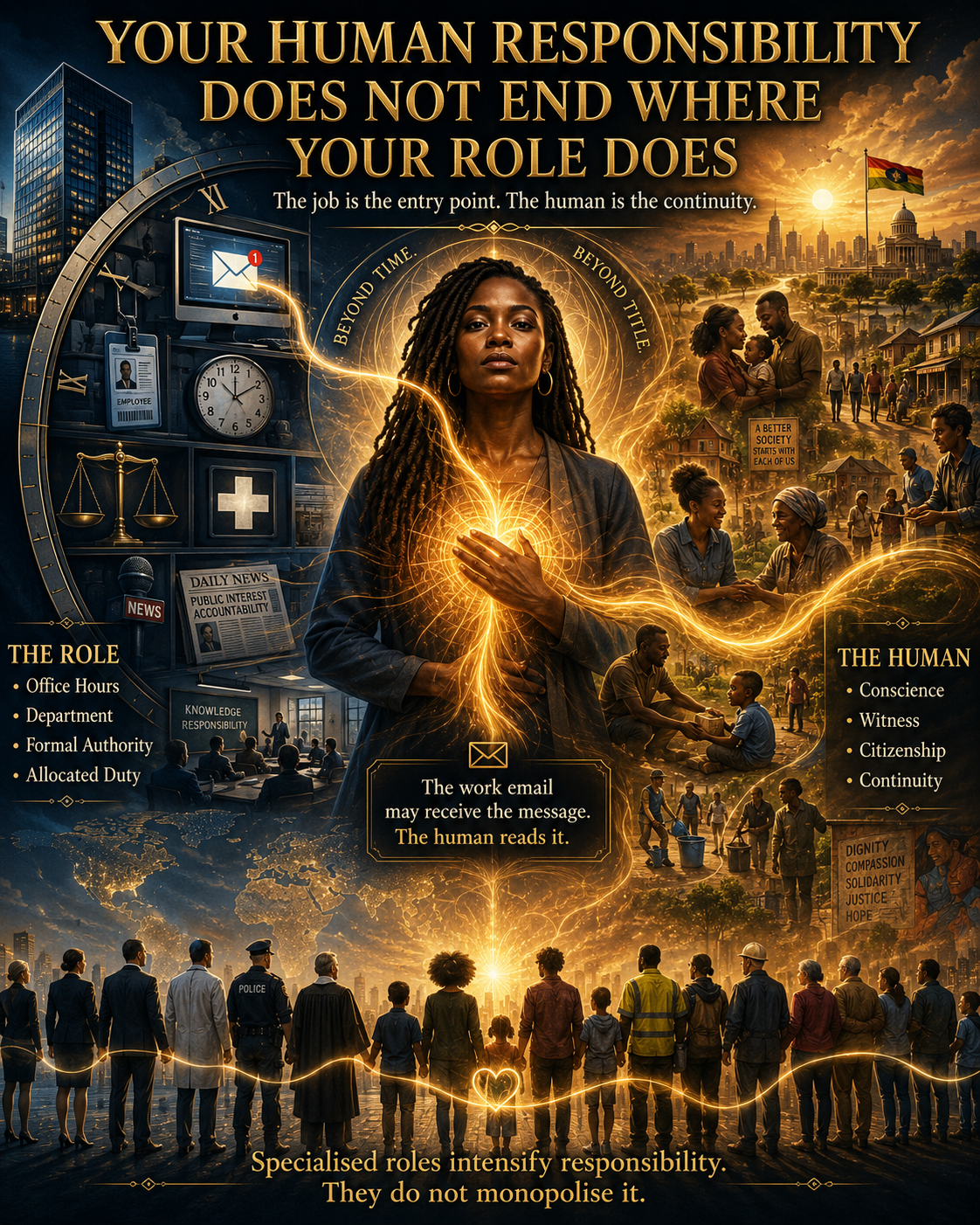
We have spoken extensively about holding roles accountable: the police officer, the doctor, the lawyer, the employee, the director, the regulator, the politician, the journalist, the academic, the charity worker, the executive and every other person entrusted with a function that affects human life. But beneath accountability to the role is a more foundational accountability that begins before the title, continues after the working day and remains present when the uniform, login, badge, contract or institutional authority has been put away.
That is accountability to the human.
A role exists within a particular allocation. It may operate between certain hours, inside a particular building, through a specific department, under a defined set of permissions and responsibilities. The person may only be authorised to make certain decisions while performing that role. Their access may be limited. Their official power may end when the shift ends. Their institutional responsibility may belong to a specific subject, location or jurisdiction.
But the human being does not end there.
The human does not disappear when the work email closes.
The human does not stop understanding because the matter falls outside their department.
The human does not stop being capable of judgment because the organisation has not assigned them a task.
The human does not become unrelated to humanity because the message reached them through a professional address.
This is the confusion that sits beneath many institutional failures. People have learned to divide themselves into segments so completely that they begin treating responsibility as though it belongs only to whichever segment is currently active. At work, they are the employee. At home, they are the partner or parent. In public, they are the civilian. In private, they are simply themselves. Each segment is treated as though it has separate consciousness, separate ethics and separate responsibility.
But it is the same human thinking through all of them.
It is the same nervous system receiving information.
It is the same conscience recognising harm.
It is the same mind deciding whether to respond, ignore, redirect, suppress, investigate or pass the responsibility elsewhere.
The roles change. The human witness remains.
This becomes especially important when people receive humanitarian causes through their work emails. Work emails are often the only publicly available point of entry. The public cannot always locate the private person behind the institution. They cannot knock on the doors of hundreds of decision-makers, professionals or organisational representatives. They use the address that the institution has placed into the public realm because that is the visible channel through which the human can be reached.
The professional address is the entry point.
It is not necessarily the boundary of the responsibility.
When a humanitarian concern enters through a work email, the recipient may first assess whether it falls within their formal duties. That is understandable. A person may not possess the institutional authority to resolve the matter. They may not control the organisation, department or wider system being challenged. Their employer may have strict procedures governing what they can formally say or do.
But the absence of official authority does not erase human responsibility.
The recipient can still read.
They can still understand.
They can still discern the seriousness of what has reached them.
They can still forward it to someone better positioned.
They can still ask a question.
They can still keep a record.
They can still raise the matter internally.
They can still respond as a human being.
They can still carry the knowledge beyond the boundaries of the role and decide what their own relationship to it should be.
The role may determine what they are authorised to do on behalf of the institution. It does not determine everything they are capable of doing as a human being.
That distinction matters.
A person may truthfully say, “This is not within my department.” But that sentence does not answer the larger question:
What is within your humanity?
If someone receives credible information about preventable harm, exploitation, institutional neglect or a wider humanitarian failure, they cannot fully dissolve their responsibility by establishing that the matter does not belong to their job description. Their professional obligation may be limited, but the human being has still become aware.
Awareness changes the relationship.
Before the message, they may genuinely not have known.
After the message, they are no longer standing in the same position.
What they do with that awareness becomes part of the human record.
This does not mean every recipient must abandon their life, resign from their job or personally solve every humanitarian crisis that reaches them. It means they must not confuse an inability to solve everything with permission to do nothing. Between complete resolution and complete disengagement exists an entire field of human action: acknowledgment, referral, escalation, questioning, investigation, support, witness, education, participation and refusal to contribute further to the harm.
Human responsibility is not measured only by whether one person could finish the entire task.
It is also measured by whether they carried their part.
This is precisely why helping one person can help everyone aligned with the same energy. A response is rarely only a response to the individual standing visibly before us. It also answers the pattern passing through them. When one person expresses confusion about whether humanitarian responsibility belongs to their role or to their human self, they are often carrying a much wider cultural confusion.
Many people have been taught to believe that care belongs to charities, justice belongs to courts, safety belongs to police, health belongs to doctors, education belongs to schools, governance belongs to politicians and human welfare belongs to whichever institution has formally claimed the category.
The result is that humanity has outsourced its humanity to roles.
People wait for the designated professional to care.
They wait for the authorised organisation to intervene.
They wait for the relevant department to confirm that the suffering qualifies.
They wait for the issue to arrive inside the correct allocation before recognising that a living person is already affected.
The division of labour was supposed to improve our ability to respond. It was never supposed to divide conscience.
A doctor may possess specialised responsibility for health, but every human still has a responsibility not to knowingly endanger another person’s body.
A lawyer may possess specialised responsibility for legal protection, but every human still has a responsibility not to exploit another person’s lack of knowledge.
A charity may possess an organised humanitarian function, but every human still has a responsibility toward suffering that enters their field of awareness.
A journalist may possess professional responsibility to investigate and inform, but every human still has a responsibility not to suppress truth merely because it is inconvenient.
A public official may possess formal civic duties, but every civilian also carries responsibility for the kind of society their silence, participation and choices help maintain.
Specialised roles intensify responsibility. They do not monopolise it.
This is where accountability to the human begins.
The role answers: What were you assigned to do?
The human answers: What did you understand, and what did you do once you understood it?
The role has office hours.
The human has continuity.
The role may be tied to one organisation.
The human lives inside a country, a community, a species and a world.
The role may be able to say, “This matter is outside my remit.”
The human must still ask, “Does that place it outside my responsibility entirely, or only outside my formal authority?”
Those are not the same thing.
A person who is a civilian of a country carries civic responsibility beyond whatever occupation they perform inside that country. They participate in its economy, laws, institutions, culture and collective consequences. They vote or abstain. They pay taxes. They consume information. They influence others. They comply, resist, question, repeat, normalise and withdraw support. They cannot reduce their citizenship to the hours during which they occupy a public-facing role because citizenship itself is an ongoing relationship with the structure in which they live.
The same is true of humanity.
A person is not human only while performing humanitarian work.
They are human while working in finance.
They are human while writing software.
They are human while answering reception emails.
They are human while sitting on a board.
They are human while serving food.
They are human while teaching.
They are human while managing risk.
They are human while following policy.
They are human while deciding that something is somebody else’s problem.
Humanity is not one role among many.
It is the substrate beneath every role.
This is why institutional language can become dangerous when it trains people to abandon personal discernment. “I was only following procedure.” “I was not authorised.” “That was not my department.” “I received it in a professional capacity.” “I did not respond because it was unrelated to my duties.” Each of these statements may describe a real limitation, but none automatically resolves the moral question.
Procedure can explain the boundary of a role.
It cannot always justify the boundary of a human response.
When the message becomes clear enough that a person can no longer plausibly say they did not understand, avoidance becomes a choice rather than an absence of knowledge. The clearer the message becomes, the less available confusion is as shelter. There comes a point at which the person is no longer deciding whether the issue formally belongs to them. They are deciding whether they will allow the role to protect the human self from the responsibility of having seen.
That is the gap we must close.
We must stop allowing people to use professional fragmentation as moral disappearance.
The employee cannot say the citizen knew nothing.
The citizen cannot say the human was absent.
The private self cannot pretend it did not receive what the professional self opened.
There is one consciousness moving through all of them.
The work email may have received the message, but the human read it.
The organisation may not have responded, but the human decided whether to remain silent.
The role may have lacked permission, but the human still possessed discernment.
The title may have been temporary, but the consequence of the choice entered a continuity larger than the title.
Holding roles accountable remains necessary because authority, access and professional duty matter. A person with institutional power has responsibilities proportionate to that power. But holding the role accountable is not enough if the human behind it is permitted to hide entirely inside the limits of the position.
The role must answer for what it was entrusted to do.
The human must answer for what they chose to become while carrying it.
That is the deeper accountability architecture.
We do not stop being responsible because we clock out.
We do not stop being citizens because we are employees.
We do not stop being witnesses because the information arrived through the wrong channel.
We do not stop belonging to humanity because an issue sits outside our department.
Our roles determine where responsibility becomes concentrated.
Our humanity determines why responsibility exists at all.
The job is an entry point.
The human is the continuity.
And humanitarian responsibility belongs first not to the title, the institution or the working hours, but to the living consciousness that encountered another part of humanity and had to decide what to do with what it now knew.



Leave a Reply