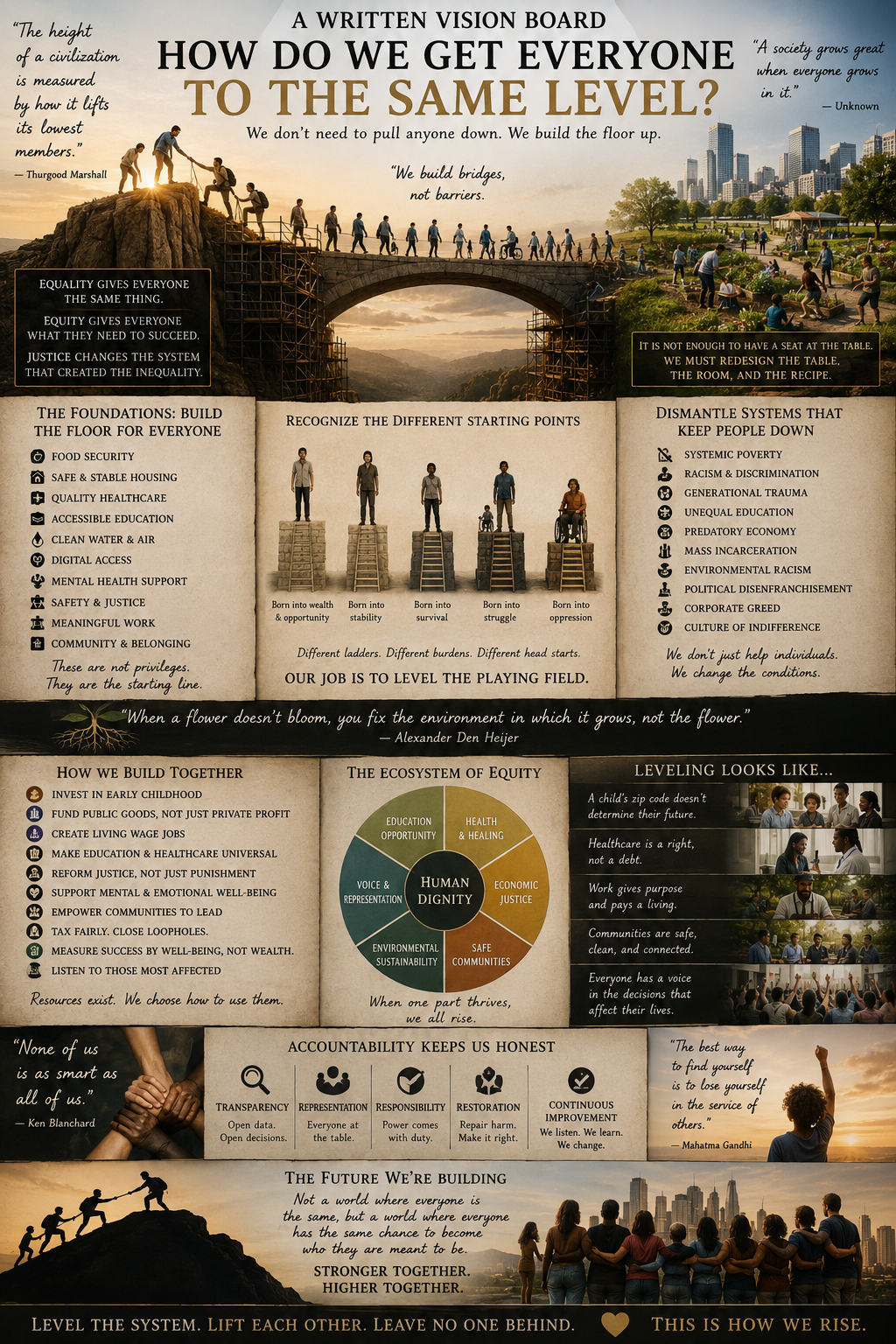
How Do We Get Everyone to the Same Level?
We do not get everyone to the same level by pulling anyone down.
We build the floor up.
The objective is not to make every person identical, force every life into the same shape or pretend that equality means distributing the same response to people standing in radically different conditions. The objective is to create a society in which no one’s preventable deprivation determines the limits of who they are allowed to become.
Equality gives everyone the same thing.
Equity gives people what they need for access to become real.
Justice changes the architecture that created such unequal starting positions in the first place.
An equal system operating inside an unjust society does not become just through consistency. It can reproduce injustice with perfect administrative order. The same fine does not create the same consequence for a wealthy person and someone deciding between food and electricity. The same school deadline does not create the same opportunity for a child with private space, reliable technology, stable housing and family support as it does for a child navigating hunger, care responsibilities, insecurity or fear. The same legal process does not provide equal justice when one person can purchase expert representation while another must decipher the system alone.
Sameness at the point of delivery preserves whatever inequality already existed before delivery.
The question is therefore not only:
What should everyone receive?
It is also:
What has each person already received?
What has been withheld?
What are they carrying?
What has been displaced onto them?
Which barriers stand between their potential and its expression?
What support would make the shared right meaningful rather than ceremonial?
A just society accounts for the difference.
Then it moves.
THE VISION
The future is not a world in which everyone has the same personality, possessions, abilities, ambitions or destination.
It is a world in which everyone has a genuine foundation from which to discover what they are capable of becoming.
A child’s postcode does not determine the quality of their education.
A person’s income does not determine whether pain is investigated.
A family does not lose shelter because one emergency interrupted an already narrow financial margin.
A disabled person does not have to spend their life repeatedly proving the reality of needs that are already known.
A worker does not have to accept humiliation, danger or instability because refusing would mean hunger.
A community does not have to become visibly ruined before public institutions recognise that prevention was required.
A person is not asked to become exceptional merely to receive what should have been foundational.
The vision is not to make everyone dependent upon one authority.
It is to make people, households and communities increasingly capable while ensuring that no one is abandoned during the stages in which support remains necessary.
Strong centres.
Responsive bonds.
Shared responsibility.
Distributed recovery capacity.
This is how society becomes equitable without becoming rigid, indulgent or coercively uniform.
THE UNIVERSAL FLOOR
The first responsibility is to create a floor beneath which no human being should be permitted to fall.
This floor includes secure housing, food, clean water, breathable air, essential energy, healthcare, education, digital access, mobility, bodily safety, meaningful legal protection, participation, community and belonging.
These are not prizes for successful participation in society.
They are the conditions through which meaningful participation becomes possible.
A person who is hungry is not standing at the same starting line as someone who is nourished. A child who cannot sleep because of insecure housing is not being offered equal education simply because they enter the same classroom. A patient who cannot afford transport is not receiving equal healthcare merely because an appointment technically exists. A citizen who cannot understand or appeal a decision is not receiving equal justice because the same form was sent to everyone.
The universal floor does not remove ambition, enterprise, personal contribution or earned expansion.
It separates the right to exist from the competition to acquire more.
No one must earn their humanity.
People may earn greater material range, luxury, influence or responsibility, but food, shelter, basic care and access to society cannot remain disciplinary weapons used to force obedience.
The floor is not the ceiling.
It is the starting line.
DIFFERENT LADDERS, DIFFERENT BURDENS, DIFFERENT HEAD STARTS
We cannot speak honestly about levelling society without recognising where people begin.
Some are born into wealth and opportunity.
Some are born into stability.
Some are born into survival.
Some are born carrying responsibilities that should have belonged to adults, institutions or systems.
Some inherit property, networks, confidence and room to make mistakes.
Others inherit debt, fear, displacement, interrupted education, untreated illness or the expectation that they must prove their worth before anyone invests in them.
These differences are not always visible.
Two people may sit in the same room while carrying completely different distances to reach it.
Equity begins by recognising position without reducing the person to that position. It does not tell someone that disadvantage is their identity. It identifies what has been withheld so that support can release the capacities already present.
The person in the pit does not need encouragement to climb the same ladder used by the person already standing at roof level.
They may need the pit filled.
They may need a longer ladder.
They may need the wall altered.
They may need someone to stop digging beneath them.
The goal is not to glorify support.
It is to remove the conditions that make extraordinary support permanently necessary.
WE DO NOT FIX PEOPLE WHILE PRESERVING THE CONDITIONS HARMING THEM
When a flower does not bloom, wisdom examines the environment in which it is growing.
Society too often does the opposite with human beings.
A child struggles, and the child is labelled.
A worker burns out, and resilience training is offered while the workload remains unchanged.
A patient develops illness, and the body is treated without examining housing, environment, food, stress or labour.
A community experiences violence, and punishment expands while prevention remains underfunded.
A family becomes homeless, and budgeting advice is offered while housing costs continue rising beyond wages.
An equitable society does not treat people as defective outputs of systems that are never required to examine themselves.
It asks:
What is happening around this person?
Which pressure is repeatedly entering their life?
Who has the power to change it?
What must be restored?
What must stop?
What must be redesigned so the same harm is not handed to the next person?
The person may still carry responsibility for choices, behaviour and repair.
But accountability cannot be used to conceal architecture.
Individual responsibility and systemic responsibility must be held together.
THE THREE SOCIAL FOUNDATIONS
An equitable society requires three living structures.
Governance
Governance establishes the principles, rights, duties, safeguards and standards through which collective power is exercised. It asks whether decisions preserve human continuity, dignity, truth, accountability, sovereignty, sustainability, freedom and development.
This is the SHS—Human First function.
It follows decisions through time.
It asks where the cost appears later.
It refuses to call a policy efficient when the human consequence has merely been exported elsewhere.
Embodiment
Principles must become tangible through housing, workplaces, education, hospitality, healthcare, media, technology, enterprise, infrastructure and daily practice.
This is the 4HONETH function.
It takes values out of the document and places them inside the room, service, contract, meal, building and lived experience.
The Public Mirror
The public must be able to see what was promised, who decided, which evidence was used, who benefited, who objected, what consequence followed and what changed after failure.
The public mirror is accountability.
It prevents institutions from grading their own conduct in private and presenting legitimacy as a completed fact.
Governance without embodiment becomes aspiration.
Embodiment without governance becomes machinery.
Both without a public mirror become unaccountable power.
Together, they create a living social Trinity:
\boxed{\text{Principle}+\text{Practice}+\text{Public Accountability}}
THE UNIVERSAL BAR
Every institution is tested against a common standard.
Continuity
Does the decision solve the present problem while creating a larger future one?
Truth
Can people understand what is happening, including uncertainty, trade-offs and failure?
Dignity
Does the process preserve the humanity of those needing assistance or lacking power?
Accountability
Can responsibility travel back towards those who possessed control?
Sustainability
Can the system continue without depleting bodies, communities, labour or Earth?
Freedom
Can people genuinely refuse, appeal and choose, or are they materially trapped?
Sovereignty
Can individuals and communities remain distinct inside shared structures?
Human Development
Does participation increase capacity, knowledge, stability and self-sustainability?
A system cannot declare itself successful because it met one target while failing the wider human relationship.
The cheapest service is not efficient when another system later pays for the damage.
The fastest process is not effective when people cannot appeal its errors.
A profitable industry is not productive when it consumes the health, environment or future of the society supporting it.
THE TWELVE SYSTEMS MUST BREATHE TOGETHER
A society is not equitable because one department performs well while the others collapse.
Law, politics, environmental and bodily ecology, security, welfare, infrastructure, innovation, economy, finance, healthcare, culture and education are organs of one living body.
Housing affects health.
Health affects education.
Education affects employment.
Employment affects housing.
Infrastructure affects access.
Media affects belief.
Finance directs what receives life.
Law determines whose relationship is protected.
Politics determines which conditions become priorities.
Security determines whether prevention or punishment receives the greater investment.
Innovation changes what human beings can do, but also what they may forget how to do.
No system should be permitted to export its consequences and call them another department’s problem.
Finance cannot move capital while denying concern for where it lands.
Technology cannot create tools while disclaiming responsibility for how dependence, exclusion or discrimination are produced.
Media cannot harvest attention while pretending repeated exposure has no educational consequence.
Law cannot interpret rules while remaining indifferent to whether justice becomes materially accessible.
The social body survives through circulation.
Every system must know what enters it, what it transforms and what it releases into the whole.
THE EQUITY CALIBRATION MATRIX
Every major public decision should be examined through the same relational questions.
Position
Where do the affected people begin?
Need
What is required for the right or opportunity to become real?
Power
Who can decide, prevent, delay, explain or appeal?
Dependency
Can the person safely refuse?
Consequence
Who carries the immediate and long-term effect?
Recovery Reserve
How much capacity remains if the decision fails?
Continuity
Does the intervention strengthen future independence and stability?
Reciprocity
Are benefits and duties distributed proportionately?
Correctability
Can the decision be reviewed, reversed and repaired?
Learning
What changes so the same imbalance is not reproduced?
This matrix prevents equal treatment from becoming a shield against unequal impact.
It also prevents equity from becoming vague goodwill. The response must be measurable, reviewable and capable of changing as the person or system moves.
HOMEOSTASIS: HOW SOCIETY STAYS ALIVE
A homeostatic society does not attempt to remain identical.
It senses pressure, interprets what the pressure means, responds proportionately, checks whether recovery is possible, receives feedback, corrects itself and learns.
Its cycle is:
\boxed{
\text{Sense}
\rightarrow
\text{Interpret}
\rightarrow
\text{Triage}
\rightarrow
\text{Intervene}
\rightarrow
\text{Measure Recovery}
\rightarrow
\text{Receive Feedback}
\rightarrow
\text{Correct}
\rightarrow
\text{Learn}
}
People experiencing harm are treated as sensors, not inconvenient complainers.
A rise in school absence is not immediately interpreted as laziness. The system investigates health, transport, safety, housing, care responsibilities and teaching conditions.
A rise in hospital admissions is not treated only as demand pressure. The system investigates environment, food, housing, prevention and access to earlier care.
A rise in crime is not answered only through arrests. The system investigates economic pressure, youth provision, trauma, opportunity, policing legitimacy and pathways out.
Homeostasis means the social body is capable of receiving the pebble, closing the local opening, carrying the ripples and becoming a new continuity without pretending nothing happened.
LEGAL AND SOCIAL TRIAGE
Urgency should not be determined primarily by wealth, publicity or procedural order.
Matters affecting housing, healthcare, food, water, bodily safety, education, liberty, family integrity, employment necessary for survival and access to justice itself require the highest priority.
The triage system asks:
Is a foundational need at risk?
Could the harm become irreversible?
How quickly is it escalating?
Who can prevent it?
Who is carrying the consequence?
Is the process itself worsening the harm?
What interim protection can be provided now?
A family should not become homeless while waiting for a later ruling that says the eviction was unlawful.
A patient should not become permanently ill while proving they deserved treatment.
A worker should not lose housing and health while waiting for a tribunal to recognise that an automated dismissal was wrong.
Remedy after destruction is not restoration.
Prevention must become infrastructure.
HOUSING IS THE MATERIAL CENTRE OF PARTICIPATION
Housing is shelter, privacy, recovery, family stability and the location from which education, employment, health and belonging become possible.
It cannot be treated primarily as an investment vehicle while people are forced to negotiate survival through speculative prices.
An equitable housing system includes secure public and community housing, cooperative ownership, long-term tenancy protection, accessible homes, transparent landlord accountability and prevention before homelessness.
Tenants must be included in the information used to determine rent, habitability and housing policy. A system cannot claim to model a complete market using only the data and interests of those profiting from higher prices.
A roof is not enough.
Housing must be safe, affordable, stable, connected and capable of supporting life.
EDUCATION IS THE SOCIAL IMMUNE SYSTEM
Education is not only preparation for employment.
It is the architecture through which people learn how to meet the world without being removed from themselves.
It includes body literacy, emotional literacy, media literacy, legal literacy, economic literacy, relationship skills, creativity, civic participation, critical thought, practical survival and accountability.
Children learn how attention is influenced.
They learn how algorithms shape exposure.
They learn how emotion affects judgement.
They learn how to recognise unreliable claims.
They learn how to disagree without converting difference into destruction.
They learn how to apologise, repair and change.
They learn to cook, budget, care, create and understand their own bodies.
School becomes one part of education.
The world becomes the curriculum.
The purpose is not to protect minds from every difficult idea.
It is to give minds enough internal organisation to receive information, alchemise it, integrate what strengthens them and release what does not belong.
HEALTHCARE BEGINS BEFORE BREAKDOWN
Healthcare should not wait until the body has become visibly unwell enough to deserve attention.
People need accessible monitoring, preventative care and knowledge of their own baselines.
Physical, emotional, environmental, hormonal, neurological and social conditions must be studied together.
The question is not only:
What diagnosis fits?
It is also:
What relationships produced this state?
What enters the body repeatedly?
What has been ignored?
What conditions must change for recovery to remain sustainable?
The body is not an isolated object carried through an external environment.
Air enters lungs.
Water enters blood.
Soil enters food.
Labour enters muscle and nervous system.
Housing enters sleep.
Media enters attention.
Healthcare must treat the whole route.
WORK IS A BOND, NOT A DEMAND FOR OBEDIENCE
A worker offers time, skill, cognition, creativity, care or physical effort.
An organisation offers income, development, safety, structure and a route through which contribution becomes socially useful.
The bond must remain reciprocal.
An equitable workplace provides transparent pay, predictable scheduling, accessible progression, meaningful training, safe reporting, human appeal against automated decisions and accountability proportional to authority.
Recognition is not decorative praise.
It is information that helps the system recalibrate around real contribution.
Employees must challenge invisibility through their effort.
Employers must not demand devotion while offering insecurity.
Authority cannot remain above while consequence continually travels downward.
PRIVILEGE IS SPACE, AND SPACE CREATES RESPONSIBILITY
Privilege does not mean a life without pain.
It means certain pressures were reduced, delayed or carried elsewhere.
It may mean stable housing, present parents, access to education, financial room, bodily safety or the freedom to make mistakes without one error destroying the future.
The greatest privilege is often space.
Space to think.
Space to recover.
Space to learn.
Space to imagine a future beyond the next emergency.
That space should not be wasted.
Those who received more stability should help build stability.
Those who received education should translate what institutions make inaccessible.
Those with financial room should support the foundations upon which others depend.
Those with institutional access should open doors.
Those with regulated nervous systems should remain present when others speak from pain.
This is not guilt.
It is stewardship.
Privilege becomes worthy of itself when it circulates.
ACCOUNTABILITY MUST GO BEYOND APOLOGY
An apology may indicate awareness.
It does not automatically provide repair.
Complete accountability includes acknowledgement, explanation, aftercare, material restoration, behavioural change, structural redesign, education, monitoring and evidence that the correction endured.
Forgiveness does not eliminate duty.
Compassion does not require the harmed person to carry the cost of another’s learning.
Institutions cannot apologise publicly while preserving the incentives that produced the harm privately.
An equitable society does not measure sincerity only through words.
It watches what changes.
ACCOUNTABILITY KEEPS THE VISION HONEST
The vision must remain publicly measurable.
Transparency
Open data, understandable decisions and visible trade-offs.
Representation
Affected people present before decisions become irreversible.
Responsibility
Power carries duty.
Restoration
Repair the harm and restore what can be restored.
Continuous Improvement
Listen, learn and change.
The public should not only be shown the finished outcome.
They should be able to see the process that produced it.
THE ECOLOGY OF EQUITY
Human dignity sits at the centre.
Around it are education and opportunity, health and healing, economic justice, safe communities, environmental sustainability, voice and representation.
These are not separate benefits competing for funding.
They are mutually reinforcing conditions.
Education improves health.
Health protects learning.
Housing stabilises work.
Work supports housing.
Safe communities allow children to develop.
Environmental vitality reduces illness.
Voice improves policy.
Economic justice reduces desperation.
When one part strengthens, the others gain capacity.
When one part is deliberately weakened, the burden appears elsewhere.
Equity is an ecosystem.
HOW WE BUILD TOGETHER
We invest early because prevention carries greater value than repair after destruction.
We fund public goods because foundational systems cannot depend entirely upon private profit.
We create living-wage work because labour should support life.
We make healthcare and education universally accessible because both are infrastructures of freedom.
We reform justice so prevention, restoration and accountability receive priority over punishment alone.
We support emotional and mental wellbeing before crisis.
We empower communities to participate in designing the systems governing them.
We tax fairly and close arrangements that allow private extraction from public foundations without reciprocal contribution.
We measure success through wellbeing, stability, human development and ecological health—not wealth alone.
We listen to those most affected because consequence produces information that distance often conceals.
Resources exist.
The question is how we choose to organise them.
THE FUTURE WE ARE BUILDING
The future is not a world in which everyone becomes the same.
It is a world in which everyone has a meaningful chance to become who they were capable of becoming before preventable deprivation began making choices on their behalf.
It is a society in which safety produces courage.
Education produces understanding.
Healthcare produces capacity.
Work produces dignity.
Technology expands human ability without erasing accountability.
Culture expands imagination without replacing identity.
Law protects relationships rather than merely processing their collapse.
Finance circulates possibility rather than concentrating control.
Politics remains exposed to consequence.
The Earth is treated as a participant, not a warehouse beneath civilisation.
No person is required to shrink so another may remain powerful.
No community is sacrificed as the hidden cost of somebody else’s comfort.
No institution is permitted to own the benefit while outsourcing the consequence.
We level the system.
We lift each other.
We leave no one behind.
Not by carrying every person in exactly the same way.
By seeing what each person is carrying already.
By building stronger foundations.
By creating different pathways towards shared rights.
By restoring what has been withheld.
By changing the conditions reproducing the same exclusions.
By ensuring that as people rise, the floor beneath everyone rises too.
The destination is not sameness.
The destination is equitable freedom.
The measure of civilisation is not how high its most powerful members can climb.
It is how deliberately it builds the conditions through which its lowest, most burdened and least protected members can stand, develop, participate and become whole.
We do not need to pull anyone down.
We build the floor up.
Stronger together.
Higher together.
This is how we rise.


Leave a Reply