
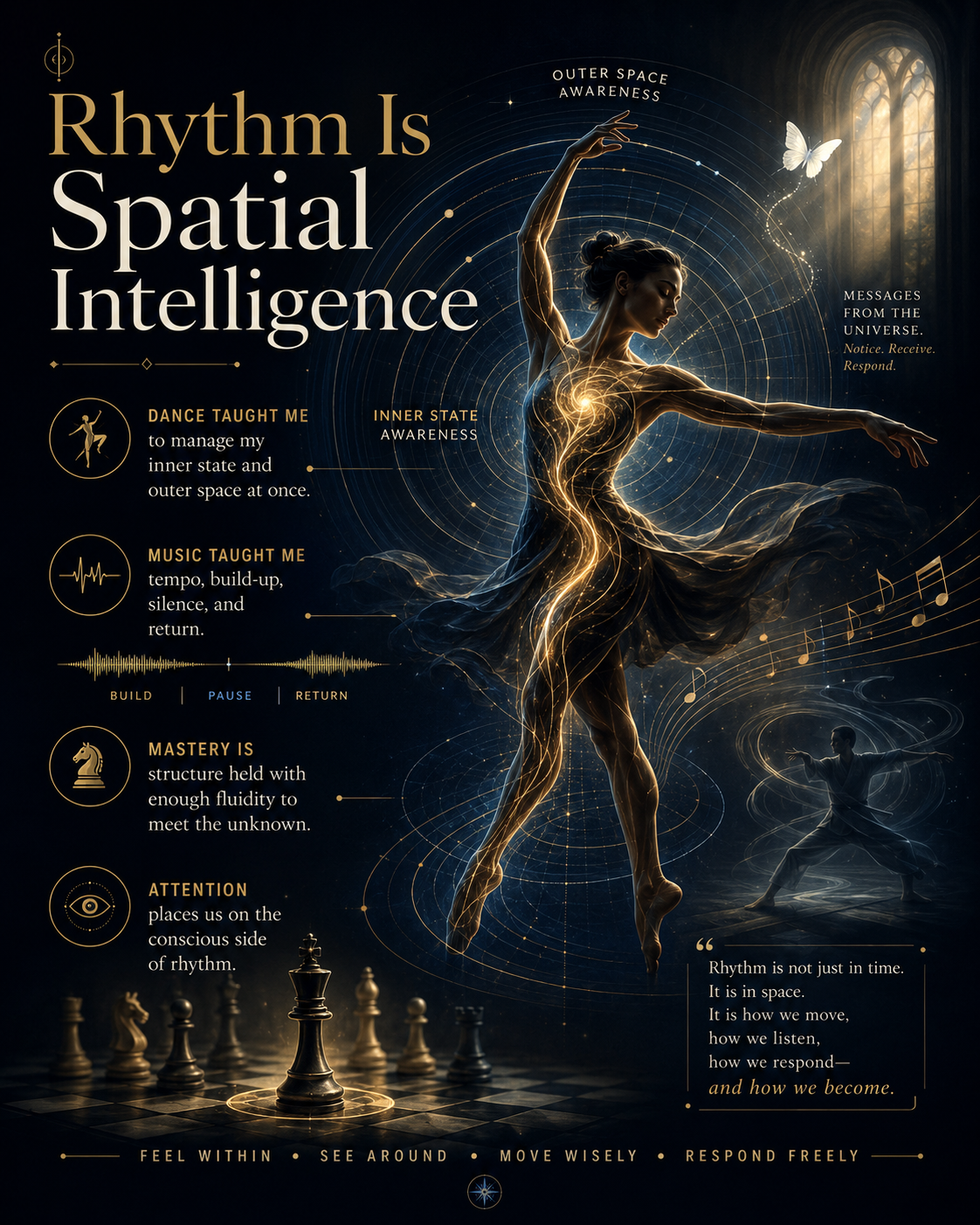
Dancing taught me how to manage two worlds at once: the space outside me and the state within me. I learned to feel how much room surrounded my body while also recognising what my body wanted to express in that exact moment. Movement became the meeting point between emotion, environment and rhythm—the internal state translated outward without losing awareness of what was around it.
Music deepened that education. Tempo taught me that energy does not always rise in a straight line. Sometimes the beat builds; sometimes it disappears completely, creating a silence that makes its return even more powerful. An orchestra becomes beautiful not because every instrument produces the same sound, but because each voice masters its distinction while contributing to a coherent whole. You can listen to the collective sound, then selectively hear the individual instruments entering, withdrawing and returning at the precise moment they are needed.
Life communicates through rhythm in the same way. A white butterfly crossing the window may be nothing more than a butterfly—or it may become meaningful because consciousness noticed it at a particular point in an unfolding sequence. Attention does not necessarily create every event, but it changes which side of the event we inhabit. What we attend to becomes part of conscious direction. What we continually ignore still moves, but we meet its consequences from the unconscious side.
This is also why mastery can become a limitation when memory replaces perception. A chess player may know thousands of historic combinations and still lose to a movement they cannot recognise because they keep interpreting what is present through what they have seen before. Knowledge should expand perception, not stand between the person and reality.
The same principle lives within martial arts: fluidity permits the body to respond to what is actually happening rather than to the thought placed between the self and the moment. The purpose is not destruction. True control is measured by how much force one can hold without needing to waste it. Humility can only live in someone who remains alive enough to learn.
Dance, music, chess and martial philosophy all return to the same lesson:
Be structured enough to hold mastery, but fluid enough to meet what has never happened before.
The rhythm continues whether we notice it or not. The question is whether we enter it consciously, position ourselves intelligently and choose what our movement will contribute to the whole.
…
Write a short post. It’s like a continuum, where dancing allowed me to learn spatial awareness of both outside of me, so how much space I have around me, and internal awareness of my internal body, how I feel in this current moment, and how do I want to groove and move my body to the rhythm of music based on how I feel, and matching the two through the movements of my music with, at the rhythm of the beat. And that, on a mental level, teaches how to manage both my internal and external state. On an emotional, how to manage my internal emotions and coordinate them based on who I wanted to be for myself towards the outside world, based on the space that I had, yeah. And then it also allowed me to learn rhythm with music, through music, allowed me to learn music. And tempo, and build-up, and even sometimes dropping the beat, but bringing it back even more powerful than before. I love those moments where the beat just stops, and then it just comes back full force, it’s just beautiful. Especially when there’s like either an orchestra behind it or there’s like multiple voices, like just like unison, any type of unison is beautiful to me. So to hear the unison of music and then selectively listen to each and different sound and how it introduces itself in the orchestra that’s in the music, in the sound that’s being produced by all together, it’s just beautiful. Because it also allows you to see how they’re masters of playing the instruments, but also merging the instruments into a collective sound. And a white butterfly just passed in front of my window, beautiful. And also noticing things like this, the rhythm of the messages of the universe. What is it that the universe is trying to tell you at any given moment in time? And the tempo that it will take naturally if you don’t pay attention to it, based on, because the attention to it builds the direction that you’ll experience later. If you pay attention to things, you’ll be on the conscious side of things. When you don’t pay attention to things, you’ll be on the unconscious side of things. The tempo will still rise because for however long there’s movement, there’s going to be an increase of energy, a surge. And where we place ourselves directs the effect that we’ll experience, simply because of where we place ourselves. So it’s like, I am not a master at chess, but I think that I can bring this to chess playing, where majority of the masters have learned and mastered the combinations that have been played by other masters. And they all recycle all of them and then mix them together. Though if there’s a new style that’s outside of those, they could lose because if that style that’s outside of those that they’ve mastered, it’s something that they can’t recognize or they keep confusing it for another one, then they literally hold the hand of every different type of style they think is to their loss. Because they’re not looking at what it is in front of them, they’re looking at what it is based on the lenses of what they’ve seen before. Which again, is using, it connects to the art of war, if we move to the Eastern culture and Taoism, or even with the Japanese culture actually, using don’t attack, use the weight of your opponent against them. I think that’s judo. And Bruce Lee taught us how to be fluid in the way which connects, I can take to talking about the four elements, but we’ll keep it to the martial arts just because there’s a philosophy there as well that I want to touch on. Where it’s about fluidity allows you to perceive exactly what you have in front of you, not project onto it. It allows you to be fully in the moment, to just, when he says no thoughts, no thoughts in that one moment. If you have thoughts, you’re already putting energy in between you and the movements of the opponent. You’re already slowing the process down because you’re not ahead of the game, because you’re not in the present. There’s a thought in the present between you and the opponent. So it’s understanding also those things as well. Oh, beautiful, yes. And the white butterfly is back. And it’s also about not killing the opponent, just humbling the opponent, you know. There is a lot of practices there. I will still learn, of course, because you don’t go to a gunfight with your hands. Even if your bare hands are just as powerful, but that is more of an up-close thing. Or you don’t go to a knife fight. Well, I mean, to a knife fight you can definitely still obviously use your bare hands because it’s up close, unless obviously they throw knives, that’s different. But if you’re really good, you could potentially grab the knife on flight by capturing spatial awareness, velocity, where it would be, when you would have to grab it, all of that at once. And it allows us also to see that some practices that we’ve developed over time, they’ve been built under the cloak of defense, but they’re like an insidious attack. It’s like a retaliation. Because to humble one, you don’t need to kill one. Humility lives in the one that’s alive. It dies in the dead. But the memory will forever live in the ones that are alive. Those that die, die with the memory. They’ll come in the new life, reincarnated, probably reset factory, but they’ll still bear the weight of it all. They just won’t know what weight they’re carrying. Which to me, I don’t know which is worse. Or because of how the energy itself is lightening, they might actually come with the memories. And that is not pretty. So it’s a bit of a chop hole, isn’t it? But to each their own, everyone needs to make their own educated choices. Because if choices are made out of lack of education, then they’re not intentional. Yeah, this is for now.




Leave a Reply