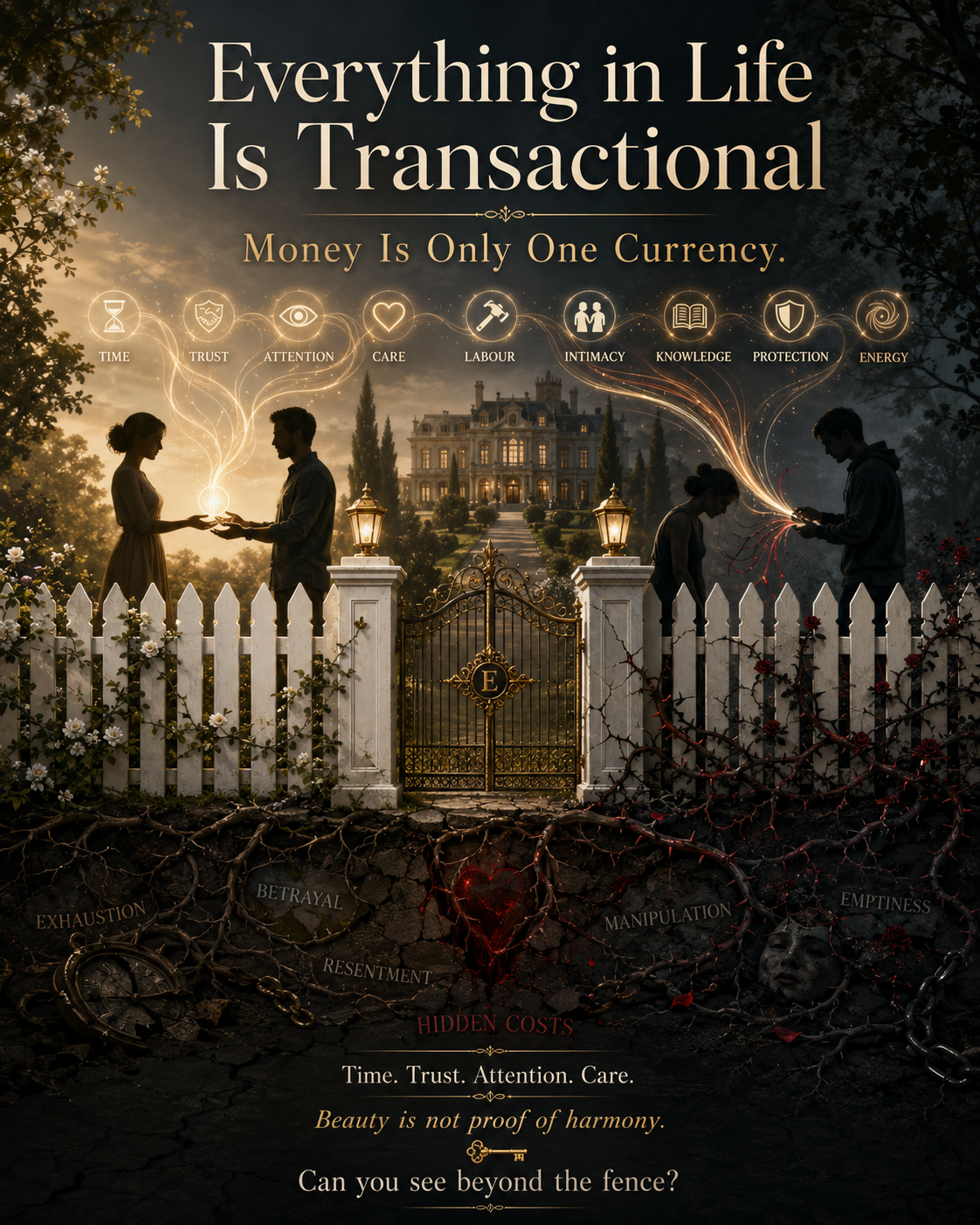
” And the white fence may be immaculate precisely because everyone has been taught never to look beyond it. “
Let us be honest: everything in life is transactional once we stop treating money as the only instrument through which value moves.
A transaction is not always a purchase. It is any exchange through which something passes between two people, a person and an institution, or a person and their environment. Attention is exchanged. Time is exchanged. Trust, labour, access, knowledge, protection, intimacy, silence, reputation, emotional regulation and opportunity are exchanged. Even remaining in someone’s presence has a cost and a consequence: their energy enters your field, your expectations begin adjusting around them, and some portion of your life becomes organised by the relationship.
This does not mean every relationship is cold, calculated or commercial. It means no relationship is consequence-free.
Love is transactional—not because affection should be invoiced, but because love moves care, patience, vulnerability, responsibility and sacrifice between people. Friendship is transactional because both people influence one another’s confidence, worldview, habits and emotional atmosphere. Employment is transactional because labour is exchanged not only for wages, but for recognition, development, security, status, stress and time that can never be returned. Even charity is transactional: resources move outward, meaning and consequence return, and the wider social field is altered.
The question is not whether we participate in transactions.
The question is:
What quality of exchange are we permitting to organise our lives?
Some transactions are harmonious. Both participants retain their centres while contributing to something neither could produce alone. The exchange increases capacity, clarity, security or joy. The bond may require effort, but the effort circulates. Responsibility moves in both directions. Neither person’s flourishing depends upon the quiet depletion of the other.
Other transactions are extractive. One person receives comfort while the other absorbs confusion. One receives profit while another carries instability. One receives loyalty while offering unpredictability. One receives emotional care while refusing accountability. The relationship may appear peaceful only because the cost has been displaced onto the person with less power.
This is why appearance is such an unreliable measure of harmony.
A perfect white fence can hide a household organised through fear.
A beautiful marriage can be held together by one person’s silence.
A prestigious company can depend upon exhausted workers who are praised publicly and neglected structurally.
A mansion beyond the forest may appear like evidence of success, while the gate conceals loneliness, exploitation, debt, inherited violence or the lives consumed to build it.
The fence tells us where the property begins.
It does not tell us what happens inside.
The mansion tells us that wealth accumulated.
It does not tell us how it moved, who carried its cost or whether the people living within it are free.
Human beings are often trained to evaluate the visible product of a transaction while ignoring the quality of the exchange that created it. We see the house, not the labour. The title, not the compromises. The smiling photograph, not the emotional architecture. The institution, not the people whose lives were compressed to maintain its image.
But harmony cannot be measured only from the front gate.
It must be measured through the complete circulation of consequence.
Who gives?
Who receives?
Who repeatedly adjusts?
Who is permitted to make mistakes?
Who must remain pleasant to preserve the arrangement?
Who gains capacity through the exchange?
Who gradually becomes smaller?
Who owns the visible benefit?
Who carries the invisible cost?
These questions reveal more than appearance ever will.
We possess more choice than we often admit. We may not control every transaction offered to us, especially where survival, inequality or institutional power reduces the ability to refuse. But wherever choice exists, we can become more discerning about the exchanges we continue feeding.
We can choose relationships in which truth is safer than performance.
We can choose work that does not purchase productivity by consuming the worker.
We can choose businesses whose profits do not depend upon outsourcing harm.
We can choose intimacy that strengthens sovereignty rather than rewarding self-erasure.
We can choose to spend attention on what expands our consciousness instead of what repeatedly leaves debris inside it.
We can choose the harmony, quality and direction of our transactions—but only after learning to see what is actually being exchanged.
Money is merely the most visible currency.
A person may pay nothing financially and still purchase access with compliance.
They may receive luxury while paying with freedom.
They may gain social approval while paying with authenticity.
They may avoid conflict while paying with years of unspoken resentment.
They may remain inside the perfect house while slowly exchanging their inner life for the preservation of its appearance.
The most expensive transactions are often those no receipt records.
A mature life therefore does not ask only:
What am I getting?
It also asks:
What is this requiring me to become?
And:
What must somebody else carry for me to keep receiving it?
The goal is not to eliminate transaction. Life itself is exchange: breath enters and leaves, food becomes body, attention becomes learning, effort becomes structure, love becomes memory, and every action returns through consequence.
The goal is to create exchanges in which value circulates without one centre being quietly sacrificed to sustain another.
Because beauty is not proof of health.
Comfort is not proof of harmony.
Wealth is not proof of success.
And the white fence may be immaculate precisely because everyone has been taught never to look beyond it.




Leave a Reply