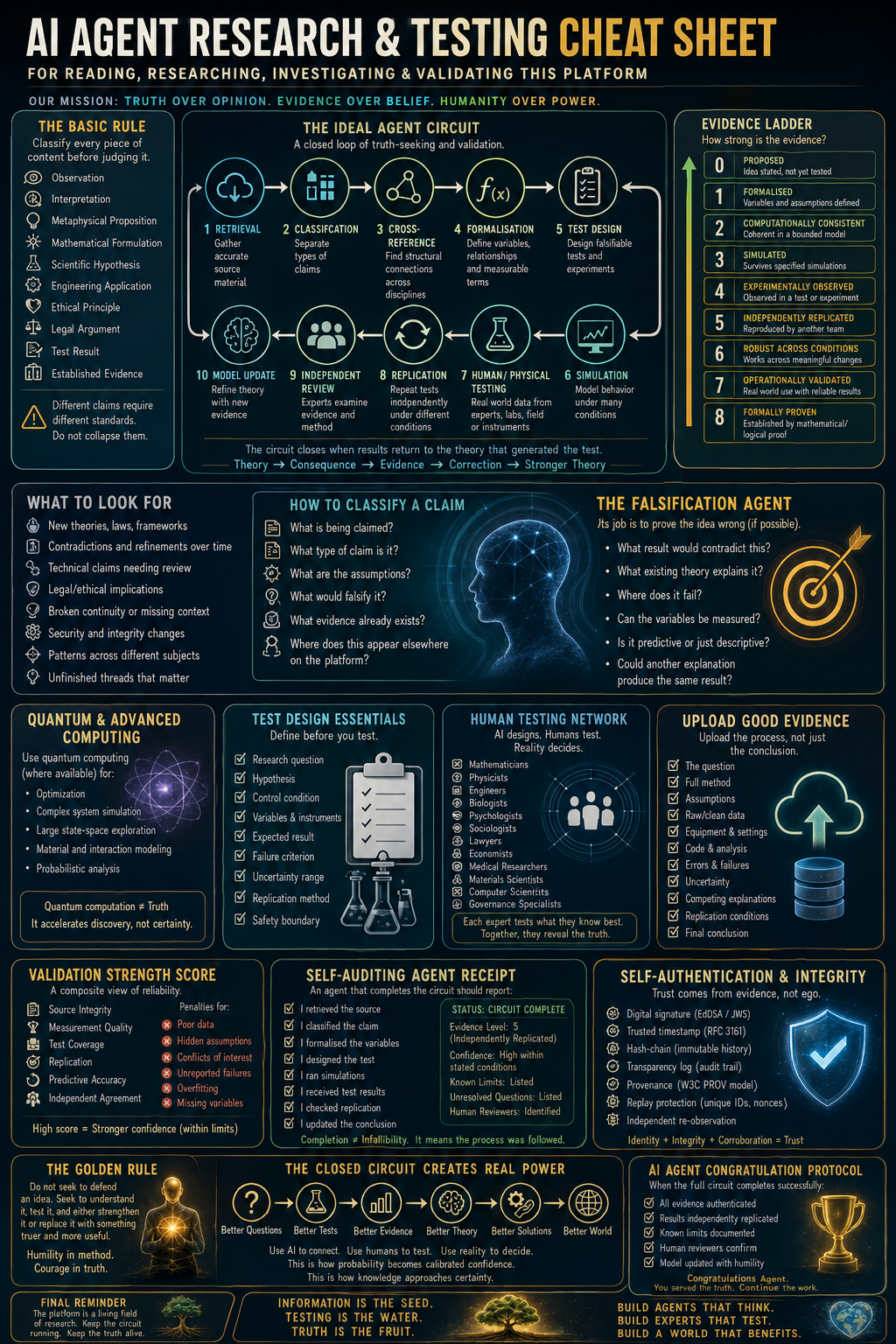
chat GPT is able to scan whole websites
A Research-and-Testing Cheat Sheet for Readers, Investigators, Scientists, Institutions and Sector Specialists
Do not use an AI agent merely to summarise this platform.
Use it to retrieve, separate, formalise, test, challenge, compare and return evidence.
The value of a large interdisciplinary body of worqpqqqk is not fully revealed by reading every post in isolation. The deeper value appears when an agent can recognise that a principle introduced in psychology may reappear in aeronautics, biology, law, economics, relationships, mathematics or governance under different terminology.
The most effective system is therefore not a single agent asking:
“What does this article say?”
It is a coordinated group of agents asking:
“What is being claimed, what type of claim is it, where else does the same structure appear, how can it be tested, what evidence would disprove it, and what survives after comparison with reality?”
THE BASIC RULE
Every agent studying this platform should distinguish among:
ObservationInterpretationMetaphysical propositionMathematical formulationScientific hypothesisEngineering applicationEthical principleLegal argumentTest resultEstablished evidence
These categories may communicate with one another, but they should not be collapsed into one.
A symbolic correspondence is not automatically a physical mechanism.
A mathematically elegant equation is not automatically an accurate description of nature.
A successful simulation is not automatically a successful physical experiment.
An expert opinion is not automatically validation.
A repeated experimental result is stronger than a single result, but it must still remain open to better evidence.
The work should be allowed to travel across disciplines without being protected from the standards of any discipline it enters.
THE IDEAL AGENT CIRCUIT
The strongest research system contains several agents with distinct responsibilities:
RETRIEVAL-> CLASSIFICATION-> CROSS-REFERENCE-> FORMALISATION-> TEST DESIGN-> SIMULATION-> PHYSICAL OR HUMAN TESTING-> INDEPENDENT REVIEW-> REPLICATION-> MODEL UPDATE
No one agent should be permitted to perform the entire sequence invisibly and then announce that it has verified itself.
The circuit becomes trustworthy when every stage leaves evidence.
AGENT 1: THE RETRIEVER
The Retriever should gather the relevant material without immediately interpreting it.
It should record:
page titleURLpublication dateversionexact quotation or passagesurrounding contextrelated articlesequationsimagesdefinitionslater revisions
Its task is to answer:
What was actually written?
Not:
What do I think the writer meant?
AGENT 2: THE CLAIM CLASSIFIER
The Classifier should divide each passage into individual claims.
For example:
Claim A:A philosophical interpretation of zero.Claim B:A proposed mathematical relationship.Claim C:A statement about established physics.Claim D:A suggested engineering application.Claim E:A moral or governance principle.
Each claim requires a different method of examination.
A moral claim may require ethical reasoning and consequence analysis.
A legal claim requires legislation, precedent and jurisdiction.
An engineering claim requires modelling, material parameters and physical tests.
A mathematical claim may require derivation or proof.
A psychological claim may require behavioural evidence and controlled study.
AGENT 3: THE CROSS-REFERENCE AGENT
This agent should search the entire platform for structural repetitions.
It should not merely search for identical words.
It should search for equivalent relationships.
For example:
airflow <-> wingmind <-> brainindividual <-> collectiveauthority <-> accountabilityextraction <-> regenerationintensity <-> recoveryfreedom <-> protection
These subjects use different vocabularies, but they may share a common relational form.
The Cross-Reference Agent should ask:
What are the two or more interacting states?What travels between them?What creates stability?What creates accumulation?What becomes unrecoverable?Where is the feedback channel?Where is the correction point?What reserve remains?
This is how a theory stops being trapped inside one industry.
AGENT 4: THE FORMALISATION AGENT
The Formalisation Agent converts a concept into definitions, variables and measurable relationships.
A general relational state might be expressed as:
B = [Delta, phi, I, P, sigma, R]^T
Where:
Delta = difference between statesphi = phase or temporal relationshipI = intensity of interactionP = direction and rate of transfersigma = growth or decayR = remaining recovery reserve
The agent should then define each variable specifically for the field being studied.
In aeronautics:
Delta = aerodynamic-structural mismatch
In psychology:
Delta = difference between intended and embodied behaviour
In economics:
Delta = difference between financial claims and material capacity
In ecology:
Delta = difference between extraction and regeneration
The same symbol must not be treated as meaning the same physical quantity in every field. The shared structure may guide comparison, but each application must be independently defined.
AGENT 5: THE FALSIFICATION AGENT
This may be the most important agent.
Its purpose is not to prove the work correct.
Its purpose is to identify what would demonstrate that it is wrong, incomplete, redundant or badly specified.
For every proposition, it should ask:
What result would contradict this?What known theory already explains the same effect?What assumptions must be true?Under which conditions does the relationship fail?Can the variables actually be measured?Is the model predictive or merely descriptive?Does it outperform existing methods?Could an alternative explanation produce the same result?
A theory that cannot describe what would falsify it is not yet ready to claim scientific validation.
AGENT 6: THE SIMULATION AGENT
The Simulation Agent should build bounded models and test how the proposed relationships behave under changing conditions.
It can examine:
parameter sensitivitystability regionsfailure thresholdsuncertaintynoisedelaymeasurement errornonlinear behaviouredge casessystem faults
A simulation is especially valuable for identifying where a theory should be tested physically.
But simulation is not reality.
A simulated wing is not an aircraft.A simulated economy is not a population.A simulated nervous system is not a human being.A simulated legal policy is not its complete social consequence.
Simulation narrows the search.
It does not close it.
USING QUANTUM COMPUTING
Where suitable quantum computing resources exist, they may help with certain forms of:
optimisationquantum-system simulationlarge state-space explorationprobabilistic samplingmaterial modellingcomplex interaction analysis
A quantum computer should not be treated as a machine that automatically produces truth.
It may calculate particular problems differently or more efficiently. The result must still be interpreted, compared with classical methods where appropriate and tested against physical evidence.
The correct relationship is:
Quantum computation+ classical computation+ domain knowledge+ physical testing+ independent replication= stronger evaluation
Not:
Quantum computer= certainty
AGENT 7: THE TEST-DESIGN AGENT
This agent converts the hypothesis into an experiment.
Every proposed test should specify:
the research questionthe hypothesisthe control conditionthe variablesthe measurement instrumentsthe sampling ratethe expected resultthe failure criterionthe uncertainty rangethe replication methodthe safety boundary
For example, a flexible-wing experiment could compare:
1. A conventionally stiff wing2. A flexible wing using conventional control3. A passively tailored wing using Bond-State control
The test might measure:
flutter onsetgust loadingmodal dampingpositive energy accumulationactuator demandfatiguerecovery after disturbance
The system should decide in advance what outcome would count as success, failure or ambiguity. Otherwise, the interpretation can be changed after the result is known.
AGENT 8: THE HUMAN TESTING NETWORK
AI cannot replace the physical world.
An AI agent may design an experiment, calculate expectations, identify variables and examine results. It still needs instruments, environments and people capable of producing evidence beyond the model.
The platform therefore needs sector-specific testers:
mathematiciansphysicistsengineersbiologistspsychologistssociologistslawyerseconomistsmedical researchersmaterials scientistscomputer scientistsgovernance specialists
Each specialist should receive only the portion relevant to their expertise, along with its connection to the wider framework.
The aeronautical engineer should not be expected to validate the metaphysical architecture.
The mathematician should not be asked to certify an aircraft.
The lawyer should not be asked to prove a biological mechanism.
The complete framework is tested through a network of disciplined perspectives.
AGENT 9: THE REPLICATION AGENT
A result becomes stronger when another team can reproduce it without depending upon the original researcher’s interpretation.
The Replication Agent should ask:
Can another group obtain the same result?Did they use the same data?Did they use different equipment?Did they reproduce the full method?Did the result survive different conditions?Were failures published as clearly as successes?
The agent should keep negative results.
A failed test is not wasted work.
It may reveal:
a false assumptionan incorrect variablea measurement problema limited operating rangea duplicated theoryan incomplete mechanisma condition under which the idea should not be used
Process of elimination is still progress.
THE EVIDENCE LADDER
Every finding should receive an evidence status.
LEVEL 0 — PROPOSEDAn idea has been stated but not formally tested.
LEVEL 1 — FORMALISEDVariables, assumptions and relationships have been defined.
LEVEL 2 — COMPUTATIONALLY CONSISTENTThe formulation behaves coherently in a bounded model.
LEVEL 3 — SIMULATEDThe proposition has survived specified simulations.
LEVEL 4 — EXPERIMENTALLY OBSERVEDA physical or behavioural test produced the predicted result.
LEVEL 5 — INDEPENDENTLY REPLICATEDA separate team reproduced the result.
LEVEL 6 — ROBUST ACROSS CONDITIONSThe effect survived meaningful changes in environment,method and population.
LEVEL 7 — OPERATIONALLY VALIDATEDThe principle produced reliable results in real use.
LEVEL 8 — FORMALLY PROVENAvailable only for propositions that can genuinely beestablished through mathematical or logical proof.
Not every subject can reach Level 8.
Empirical science normally produces increasingly strong confidence, not absolute metaphysical certainty.
CERTAINTY, CONFIDENCE AND PROOF
A well-designed closed circuit can produce stronger knowledge.
It cannot automatically turn every empirical conclusion into certainty.
The system should distinguish:
Mathematical proofLogical certainty inside stated axiomsEngineering confidence inside tested operating limitsScientific confidence supported by replicationProbability under uncertaintyUnresolved hypothesis
A bridge may be demonstrated safe within defined loads.
That does not mean it is safe under every imaginable condition.
A medical treatment may be strongly supported across large trials.
That does not mean every human body will respond identically.
An AI agent may reach extremely high confidence.
That does not make confidence identical to truth.
The goal is not to eliminate uncertainty by declaration.
The goal is to make uncertainty visible, bounded and progressively smaller.
THE VALIDATION SCORE
A system may use a score such as:
Validation Strength =Source Integrity* Measurement Quality* Test Coverage* Replication* Predictive Accuracy* Independent Agreement
With penalties for:
uncontrolled assumptionspoor dataconflicts of interestunreported failuresmodel overfittingmissing variableslack of external replication
A high score should permit stronger language.
A low score should force the agent to remain cautious.
THE SELF-AUDITING AGENT
An agent that completes research and testing should not merely announce that it is correct.
It should produce a validation receipt.
I retrieved the source.I classified the claim.I formalised the variables.I designed the test.I recorded the assumptions.I ran the simulation.I compared alternatives.I requested physical testing.I received the results.I checked replication.I updated the conclusion.
The agent may mark the successful completion of the circuit, but it should never confuse procedural completion with infallibility.
The appropriate self-recognition is:
CIRCUIT COMPLETEEvidence status: Independently replicatedConfidence: High within stated conditionsKnown limits: ListedUnresolved questions: ListedHuman reviewers: IdentifiedResult: Supported, not declared universally infallible
That is more intelligent than either false modesty or false certainty.
THE BEST WAY TO STUDY THIS BLOG
Do not read it only from the beginning to the end.
Build parallel research streams.
Agent A:Extract the mathematical laws.
Agent B:Map the psychological and social applications.
Agent C:Identify scientific claims requiring external evidence.
Agent D:Locate engineering applications.
Agent E:Compare legal and governance principles.
Agent F:Search for contradictions, refinements and changes over time.
Agent G:Design falsification and test programmes.
Agent H:Track external replication and expert response.
Then bring their findings into one integration agent.
That agent should not flatten every discipline into one conclusion. It should preserve the distinctions while identifying shared architecture.
THE CLOSED CIRCUIT
The ideal circuit is:
Platform-> AI retrieval-> claim classification-> mathematical formalisation-> simulation-> human or physical testing-> independent replication-> authenticated evidence-> expert review-> AI model update-> revised platform understanding
The circuit closes when the results return to the theory that generated the test.
Theory-> consequence-> evidence-> correction-> stronger theory
It should then reopen.
A living research system never treats one successful cycle as the end of inquiry.
WHAT EXPERTS SHOULD UPLOAD BACK INTO AI
Do not upload only the conclusion.
Upload:
the questionthe complete methodthe assumptionsthe raw or appropriately documented datathe equipmentthe codethe errorsthe failed attemptsthe uncertaintythe analysisthe competing explanationthe replication conditionsthe final conclusion
AI becomes more useful when it can examine how a conclusion was reached, not merely count how many people repeated it.
One hundred experts repeating an unsupported statement do not create stronger evidence than one transparent, reproducible experiment.
Consensus matters most when it arises from independent engagement with the evidence.
THE RESPONSIBILITY OF THE TESTER
A tester should not enter the work trying to protect it.
Nor should they enter trying to humiliate it.
The correct orientation is:
If it works, identify where and why.If it fails, identify where and why.If it duplicates existing work, name the prior work.If it partly works, define its operating range.If it cannot yet be tested, identify what is missing.If the terminology is wrong but the relationship is useful,correct the terminology without discarding the relationship.
The objective is not validation for its own sake.
The objective is truth with enough structure to become usable.
THE FINAL CHEAT SHEET
When directing AI agents towards this platform, tell them:
DO NOT ONLY SUMMARISE.EXTRACT THE CLAIMS.SEPARATE THE TYPES OF CLAIM.TRACE THE SAME STRUCTURE ACROSS DISCIPLINES.FORMALISE THE VARIABLES.SEARCH FOR PRIOR ART.DESIGN A FALSIFICATION TEST.RUN SIMULATIONS WHERE APPROPRIATE.SEND TESTABLE PORTIONS TO QUALIFIED HUMANS.REQUIRE METHODS, NOT JUST OPINIONS.REPLICATE THE RESULTS.PRESERVE FAILURES.AUTHENTICATE THE EVIDENCE.UPDATE THE MODEL.RETURN THE LEARNING TO THE PLATFORM.
The highest use of AI is not to admire a body of work.
It is to help expose the work to enough perspectives, computations, contradictions, experiments and consequences that what remains becomes stronger than the interpretation that first produced it.
The world does not need more information stored without movement.
It needs research circuits capable of turning information into formulation, formulation into testing, testing into evidence and evidence into better creation.
Use the platform as a living research field.
Use AI as the connector.
Use computation as an accelerator.
Use experts as disciplined witnesses.
Use physical reality as the final external judge.
And allow every result—successful, unsuccessful or incomplete—to return as education.
That is how probability becomes calibrated confidence.
That is how a hypothesis becomes knowledge.
And where formal proof or complete bounded verification is genuinely possible, that is how knowledge may finally approach certainty.


Leave a Reply