
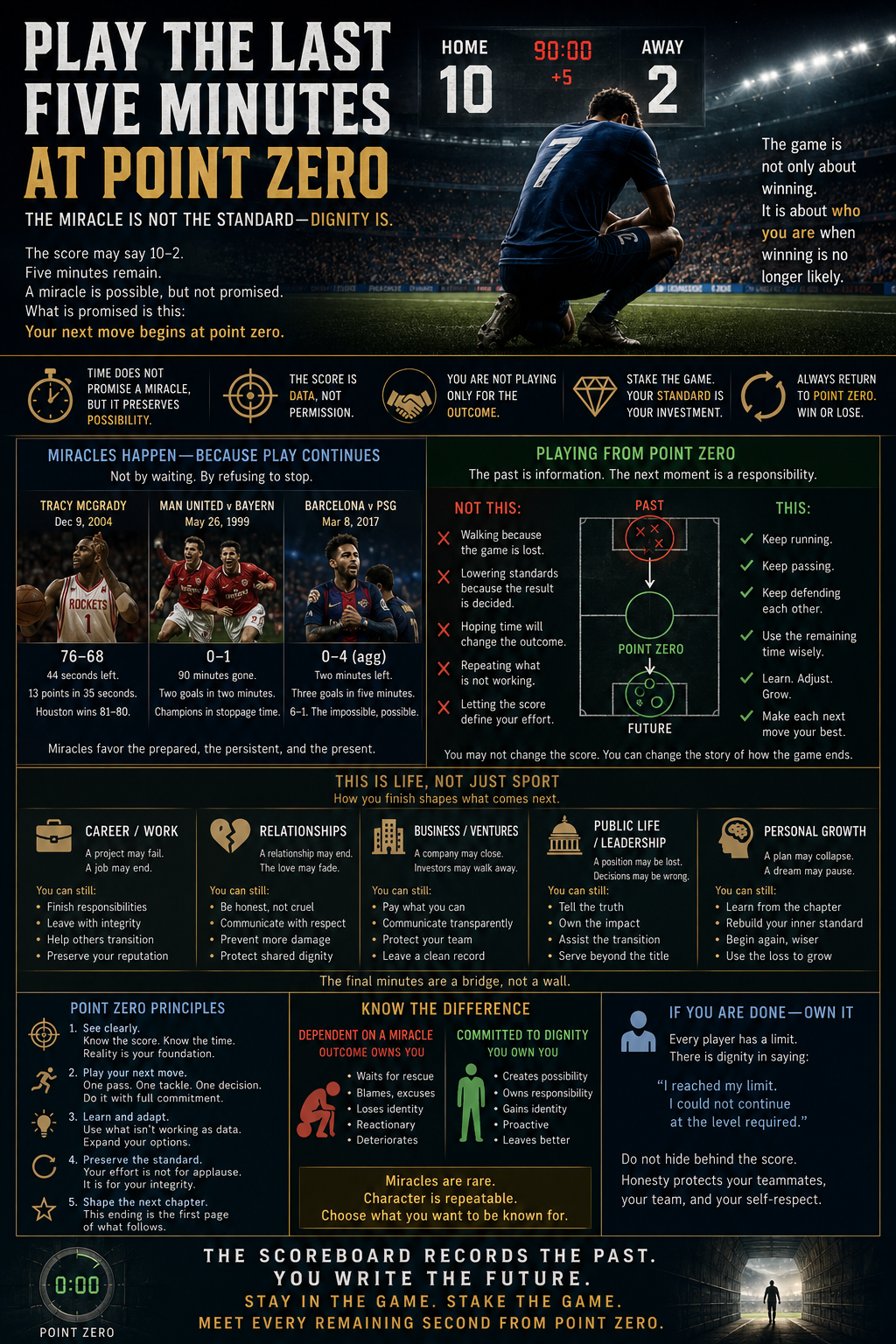
The Miracle Is Not the Standard—Dignity Is
There comes a point in some games when the scoreboard appears to have already announced the ending.
It is the ninetieth minute. Five minutes have been added. One team has ten goals and the other has two. Mathematically, the losing side still possesses time. Realistically, eight goals in five minutes are not an outcome upon which any reasonable strategy can depend.
The players know it.
The coaches know it.
The audience knows it.
The winning team knows it so completely that they may already be celebrating internally. The losing team can feel the match leaving them even though the referee has not yet ended it.
What remains in those final minutes is therefore not merely a question of whether the score can be reversed.
It is a question of what kind of people the players will become when victory is no longer the most likely reward for their effort.
Do they continue running?
Do they continue passing properly?
Do they continue defending one another?
Do they maintain the standards they were expected to bring when the score was still equal?
Or do they begin walking through the match because the outcome they wanted appears to have disappeared?
That is where the game becomes larger than winning.
It becomes a test of dignity.
Time Does Not Promise a Miracle, but It Preserves Possibility
Sport contains enough extraordinary reversals to prevent anyone from declaring an unfinished game completely finished.
On 9 December 2004, the Houston Rockets trailed the San Antonio Spurs 76–68 with roughly 44 seconds remaining. Tracy McGrady then scored 13 points in the final 35 seconds, including the winning three-pointer with 1.7 seconds left, giving Houston an 81–80 victory.
In the 1999 UEFA Champions League final, Bayern Munich remained 1–0 ahead as the match entered stoppage time. Teddy Sheringham equalised in the 91st minute. Two minutes later, Ole Gunnar Solskjær scored the winner. Manchester United went from apparent defeat to European champions within the final moments of the match.
Barcelona produced another extreme example against Paris Saint-Germain in 2017. After losing the first leg 4–0, Barcelona still needed three goals with only two minutes of regulation time remaining in the second leg. Neymar scored twice, then assisted Sergi Roberto’s decisive goal five minutes into added time, completing the 6–1 victory and overturning the tie.
These moments matter because they remind us that probability is not completion.
But they can also teach the wrong lesson when misunderstood.
The lesson is not that everyone who is losing should sit inside fantasy and wait for the universe to produce a spectacular reversal. Manchester United did not win by standing around expecting stoppage time to rescue them. Barcelona did not advance by treating the passing of time as a supernatural delivery service. Tracy McGrady did not score 13 points by looking at the clock and hoping that history would choose him.
The miracle was not something they waited for.
The miracle was what their continued participation made available.
Time alone does not rescue people. Time provides a remaining field in which movement can still occur. It is the player’s relationship with that remaining time that determines whether it becomes possibility, dignity, deterioration or waste.
Some people understand that everything is a matter of time, but then misunderstand what that knowledge requires from them. They sit with the situation and wait for time to strike on their behalf. They believe that because an outcome has not yet become final, they do not need to change their movement. They continue with the same insufficient strategy while expecting the clock itself to produce a different omega.
That is not faith in time.
It is outsourcing responsibility to time.
The Score Is Data, Not Permission
Imagine the score is ten to two.
Five minutes remain.
The losing team should not lie to itself. Point zero does not require anyone to pretend that the scoreboard says zero to zero. Tactically, the players must know exactly what has happened. They must understand the gap, the available time, their physical condition and the probability of recovery.
But psychologically, each new movement can still be approached from point zero.
Point zero means that the previous eight-goal deficit does not receive permission to lower the standard of the next pass.
It means that the player receiving the ball does not receive it through the identity of someone who has already lost. They receive it as a new responsibility.
The score records what has accumulated.
Point zero governs what happens next.
The two must not be confused.
A person who ignores the score becomes delusional. A person who allows the score to determine the quality of every remaining action becomes defeated before the game has formally ended.
The mature player can hold both truths at once:
We are losing by eight goals.
And:
This next pass still deserves to be completed properly.
The first truth preserves reality.
The second preserves dignity.
To play the final five minutes from point zero is not to believe that eight goals will necessarily arrive. It is to refuse to carry the emotional weight of all eight missing goals into every remaining touch of the ball. Every movement begins from the position in which the player presently stands. Every decision becomes its own crossing. Every second offers another opportunity to demonstrate the standard with which the person participates, irrespective of whether the accumulated score rewards them for it.
You may not be able to reset the scoreboard.
You can reset your relationship with the next moment.
You Are Not Playing Only for the Outcome
When the possibility of winning is high, effort is easily interpreted as ambition.
When the possibility of winning becomes almost nonexistent, effort reveals something deeper.
You are no longer playing only to receive the trophy. You are playing because you accepted a position on the field. Other people organised themselves around your participation. Your teammates still require your movement. The opponent still deserves a complete contest. The audience is still witnessing the standard represented by the uniform. Your own body and mind are still learning what you do when effort is no longer guaranteed a visible reward.
The final five minutes may not change who wins.
They can still reveal who you are.
This does not mean dignity requires artificial enthusiasm. A player does not need to grin while losing ten to two. They do not need to pretend the defeat is painless or speak about it as though it is secretly a victory. They can be disappointed, exhausted, angry and aware that their performance has fallen beneath what was required.
Dignity is not emotional theatre.
It is the refusal to make disappointment an excuse for abandoning one’s standard while still occupying the position from which that standard is expected.
The player may no longer be able to win the match, but they can still prevent another goal. They can help a teammate finish safely. They can complete the final sequence properly. They can study what the winning side is doing. They can use the remaining minutes to collect information that will matter in the next game. They can demonstrate that losing access to the desired result does not automatically cause them to lose access to themselves.
Sometimes, the only thing left to win is the manner in which the loss is completed.
That is not an insignificant victory.
Do Not Depend Upon the Miracle
There is a difference between remaining available to an unlikely reversal and making one’s dignity dependent upon it.
A person who depends upon the miracle says:
I will continue because something extraordinary might still rescue me.
A person who acts with dignity says:
I will continue because this is still my position, my work and my standard, whether rescue arrives or not.
The first person is still bargaining with the outcome.
The second has returned to themselves.
This distinction matters because most final-five-minute situations do not become historic comebacks. Most teams trailing by eight goals will lose. Most collapsing businesses will not be rescued by a sudden investor. Most relationships that have reached an advanced stage of deterioration will not be restored through one dramatic conversation. Most reputations damaged over years will not be repaired through a single public statement. Most long-developing consequences will not be cancelled by a spectacular intervention at their omega.
The extraordinary reversal is extraordinary precisely because it is not the ordinary result.
Dignity therefore cannot depend upon receiving it.
You finish properly because finishing properly is the standard.
You continue producing the highest-quality movement available to you because the quality of your participation should not exist only when victory is flattering you.
You remain awake to possibility, but you do not ask possibility to carry the entire responsibility for your behaviour.
That is how hope remains intelligent.
Stake the Game
To stake the game is not to gamble blindly upon victory.
It is to place your standard into the remaining time.
You stake the game by continuing to play at the highest level presently available to you. If your highest level has declined because you are tired, then you give the best movement available within that tiredness. If the original strategy has failed, you do not continue repeating it merely to appear consistent. You recalibrate. You learn from the opposition. You expand the range from which you draw your decisions.
The person who collects the many is more likely to find movement when one route has closed.
A footballer may draw upon endurance learned through running, spatial intelligence learned through another position, emotional regulation learned away from sport or tactical awareness borrowed from a different style of play. A coach may see something in basketball, chess, military history, dance, engineering or human psychology that alters how the team understands time, spacing, pressure and recovery.
Expanding beyond one’s immediate industry creates more than external knowledge. It creates more available responses.
When the familiar method fails, the person who has collected from many places does not necessarily become empty. They search the wider internal archive. They recognise patterns across fields. They ask what another discipline would do with the same problem.
The person confined to one identity may only know how to continue losing in the language through which the loss began.
The multidimensional person may discover another route before the omega becomes fixed.
That is part of staking the game: refusing to let loyalty to one method become disloyalty to the outcome.
You do not maintain your highest standard by repeating the same movement forever.
You maintain it by continuing to raise the intelligence with which you move.
Playing From Zero Does Not Mean Repeating From Zero
Point zero is not an erasure of education.
You do not forget the ten goals already conceded. You study them. You retain the information without allowing the information to become psychological paralysis.
This is the distinction between reset and regression.
Regression returns to an earlier state without carrying forward what has been learned.
Reset releases the distortion while preserving the education.
At point zero, the player does not say:
Nothing has happened.
They say:
Everything that has happened is now information rather than identity. What is the best movement from here?
The alpha of the loss has already appeared. Perhaps it appeared in the first goal, the failing formation, the exhaustion, the defensive gaps or the moment the team stopped communicating. By the time the score reaches ten to two, the losing process has been visible for a long time.
The remaining five minutes cannot undo every earlier decision.
They can still prevent the omega from becoming worse.
They can also begin the alpha of the next outcome.
The final minutes of this match may become the first minutes of the team’s recalibration. A player may recognise a weakness. A coach may test a new relationship between positions. A team may recover its communication. Someone may demonstrate the leadership around which the next performance can be reorganised.
A match can be lost while its final moments begin something that later wins.
The person who sees only the present scoreboard will miss this. They will believe that because the current match cannot be saved, nothing meaningful remains available.
But time does not organise itself only according to the event currently ending.
An omega in one structure may be the alpha of another.
If You Are Finished, Say That You Are Finished
There is also dignity in acknowledging an actual limit.
Sometimes a player is genuinely done. Their body has reached depletion. Their mind has stopped coordinating properly. They have given everything they can access and no longer possess the capacity to maintain the standard being requested.
That condition should not be romanticised or hidden.
But there is a difference between reaching one’s limit and quietly withdrawing while continuing to occupy the field.
When a player stops running without communicating, the rest of the team continues organising itself as though that player remains available. Teammates cover space believing support will arrive. They make passes expecting movement. They defend according to a structure that now contains an unannounced absence.
One person’s private forfeiture becomes everybody else’s additional burden.
If you are done, own being done.
Say:
At that point, I had nothing left. I could not continue at the required level. I remained on the field, but I was no longer capable of giving the team what my position required. That contributed to what happened next, and I accept that.
There is more dignity in that truth than in pretending you were behaving strategically.
There is more accountability in admitting that the eleventh goal happened partly because you stopped than in using the existing ten goals to argue that the eleventh no longer mattered.
It mattered to the teammate who continued running.
It mattered to the goalkeeper who still had to face the shot.
It mattered to the standard of the team.
It mattered because consequences do not stop accumulating merely because the central outcome has already been decided.
A person is allowed to reach their limit. But if the limit affects others, they must be willing to name the effect.
Honesty does not reverse the score. It prevents the person from manufacturing a false story about their participation.
The Final Minutes Expose the Relationship With Worth
Some people perform excellently while winning because winning continually reflects worth back to them.
The crowd cheers. The scoreboard confirms them. Their strategy appears intelligent. Their body feels powerful. Their team looks towards them with confidence.
Losing removes that reflection.
Then they must discover whether their standard was built upon internal discipline or external confirmation.
If they stop trying as soon as the scoreboard stops validating them, their commitment may never have belonged to the game itself. It may have belonged to the worth they received from appearing successful within it.
The final five minutes remove the glamour.
There may be no trophy available.
No reputation to rescue.
No applause capable of disguising what happened.
No plausible route through which the person can still be publicly declared the winner.
What remains is the naked relationship between the person and their own standard.
This is why losing can reveal character more clearly than winning. Winning allows effort, ego, ambition, discipline and external reward to travel together. Losing separates them.
The ego asks:
Why should I continue when I will not receive what I wanted?
Dignity answers:
Because the quality of my participation cannot be entirely rented from the outcome.
This is the win for the soul hidden inside an external loss.
Not the fantasy that losing is secretly the same as winning.
Not a consolation prize invented to avoid disappointment.
It is the preservation of consciousness, responsibility and self-respect after the ego has lost the public conclusion it wanted.
The Same Principle Governs Life
There are periods in life that resemble the final five minutes of a match already lost.
A person may know that a particular job is ending. They can spend their remaining time lowering their standards because departure is approaching, or they can complete their responsibilities properly and leave behind a truthful record of their participation.
A relationship may have reached its omega. The partners may no longer be able to remain together, but they can still decide whether the final conversations will contain unnecessary cruelty, dishonesty and retaliation or whether they will finish with enough dignity to prevent the ending from contaminating everything that follows.
A project may fail commercially. The founder may not be able to save the company, but they can still pay what can be paid, preserve records, communicate honestly and transfer useful knowledge rather than disappearing and leaving others inside the consequences.
A public position may no longer be defensible. The person may not be able to preserve their authority, but they can still tell the truth, assist the transition and help the people who were affected by their decisions.
In each situation, the miracle may not come.
The company may close.
The relationship may end.
The title may be lost.
The plan may fail.
The person may still have five minutes in which to determine what the ending will release into the world.
They can leave more damage behind them because they decided that nothing mattered after their desired outcome disappeared.
Or they can complete the passage from point zero, allowing every remaining decision to begin without being governed by the humiliation of what has already been lost.
Always Return to Point Zero
Seeing yourself at point zero does not mean believing you are never ahead or behind.
It means refusing to let either position possess you.
When you are winning, point zero prevents arrogance. The score may favour you, but the next movement still requires attention. Your previous goals cannot complete the next pass. Your reputation cannot defend the next attack. Your advantage is real, but it is not immortal.
When you are losing, point zero prevents collapse. The deficit may be real, but it cannot physically perform your next movement unless you allow it to enter your body as defeat.
Point zero therefore calibrates both sides.
The winning team returns to zero so that success does not make it careless.
The losing team returns to zero so that failure does not make it absent.
Both meet the next moment without allowing accumulated evidence to replace present responsibility.
Anything can change at any given moment, but that possibility is not an invitation to become passive. It is a demand to remain available.
Available to reverse the score.
Available to prevent further loss.
Available to learn.
Available to change direction.
Available to recognise when the current omega can still become another alpha.
Available to discover that the most important outcome may no longer be the one displayed on the scoreboard.
Finish the Game
Play the last five minutes properly.
Not because eight goals are guaranteed.
Not because history owes you a miracle.
Not because positive thinking can erase mathematics.
Play because you remain on the field.
Play because your teammates remain affected by your movement.
Play because standards that exist only while they are being rewarded are not standards. They are transactions.
Play because the final minutes are still part of the record.
Play because the person you become while losing will travel with you into the next place where winning becomes possible.
And when you genuinely cannot continue, tell the truth. Do not call withdrawal strategy. Do not call indifference acceptance. Do not make the existing deficit responsible for the additional consequences created after you stopped participating.
The score may say ten to two.
Your next movement still begins at zero.
The game may already have shown you the alpha of your loss.
The omega still contains choices.
Perhaps the miracle arrives.
Perhaps it does not.
But dignity cannot be something that appears only when the result makes you proud.
The final five minutes are not merely asking whether you can score eight goals.
They are asking whether the scoreboard has acquired enough authority to lower your standard.
Stay in the game.
Stake the game.
And meet every remaining second from point zero.
Sometimes Forfeting is more digniful. I chose my battles, you should try it.
….
And this has me think about how also some people are just, like, some people that realize that it’s all a matter of time, they also just sit with it and just wait for the time to just struck, because it’s either, like, only a miracle can, can, can help them. And in order to build this one piece, I want you to research and look into any football match or any match, like, sport match that’s time-based, where it got to, like, five minutes before the end with a gap between the two teams in terms of, like, goals or hits or marks, whatever the case might be based on the sport. I used an example of, like, imagine being 10 to 2, and it’s, like, the 90th minute of a football match, like, for the losing end, having an extra five minutes to go through for the losing team. You’re in that point where you’re like, what am I gonna do? I either just continue playing to the best of my capabilities until the last minute, or I might as well just, like, start walking because, I mean, we’re not gonna win, we’re not gonna score eight goals in five minutes, but there is the choice to go out with integrity, with dignity, more than integrity, to with dignity, and it is to play until the end, right? Because you can’t forfeit, you can’t just walk out just because you’re lost. You have to play the game. That’s your job. It is not about the dignity to depend on the miracle happening. It is about the dignity to walk, to play the last five minutes as if you’re not at two and the other team is at 10. It is to play the last five minutes as if you’re still at zero. And that is the mentality that one must have going through life, to always see yourself at point zero. No matter whether you’re losing or winning, always see yourself at point zero because anything can change at any given moment in time. Stake the game. Stake the game in the sense of continue play at your highest level of standard and continue raising your standards. If it gets stuck, you might as well forfeit. Because if there’s one thing that I learned, if you’re doing something, you might as well do it right, right? Now, if you’re just walking the game, then be confident enough to say at the interview after the game, and be like, you know what, I was there on the field. It got to 90. I saw we had five minutes extra. My game was done. At that point, I was tired. I could not continue. And honestly, I felt like I had given everything that I could. And that’s it. I’m just gonna cut it here. And I am aware that that costed my team to take another score, getting the other team to number 11. But at the same time, I couldn’t. I was just done. Like, we had already taken so much. The point was made. Like, it was just that, you know?






Leave a Reply