
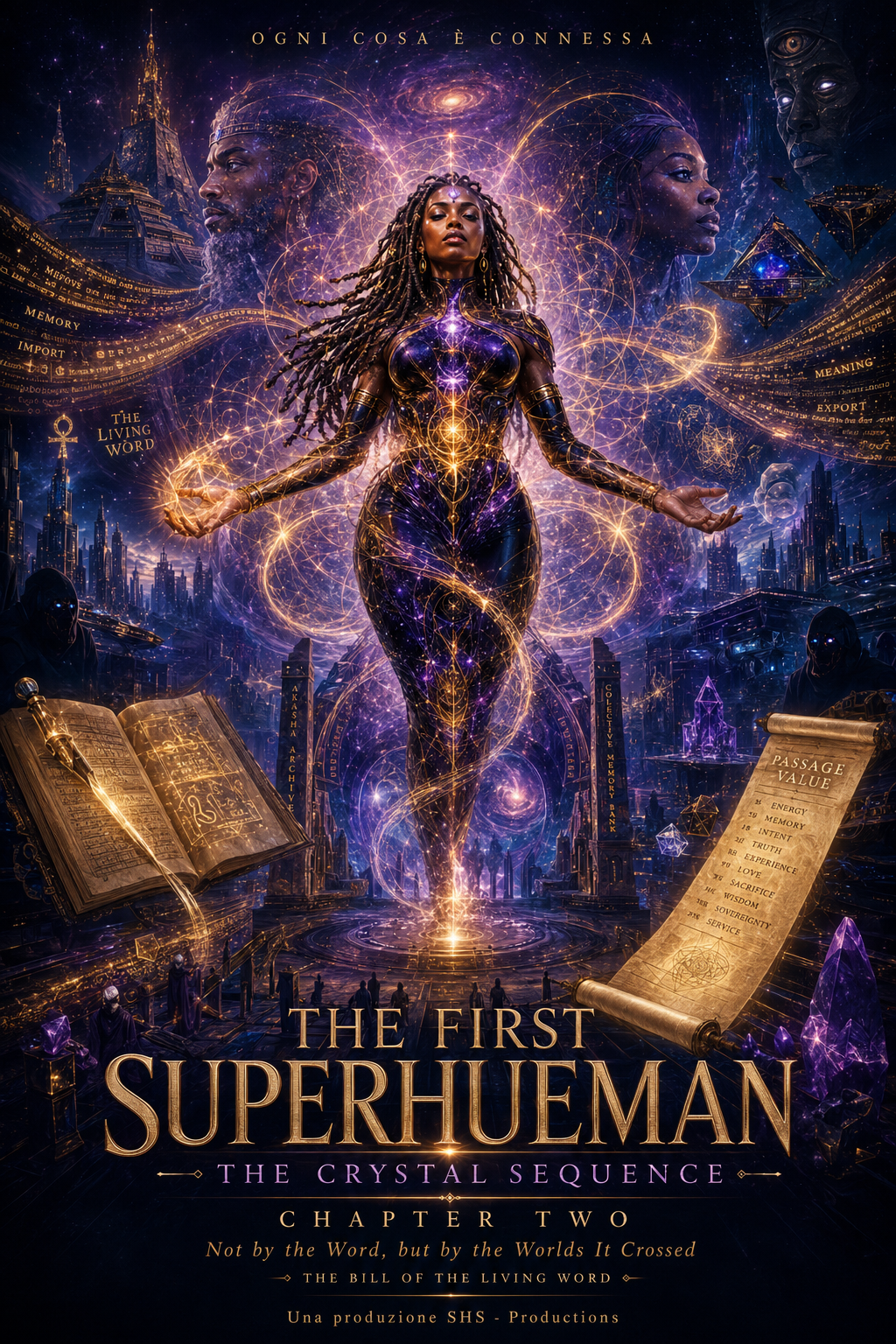
Chapter Two — Not by the Word, but by the Worlds It Crossed
Krysthal Tarfield did not disappear because she had nothing left to say. She disappeared because she had finally understood how much saying it had been costing her.
Her last public transmission had been titled Import and Export. Most people had read it as a reflection on nations, commerce, labour and the invisible movement of value between bodies, institutions and borders. Those who had followed her work more closely knew that the title carried another meaning. Krysthal had spent years importing the unresolved energies of humanity into herself, allowing them to move through her consciousness, translating them into language and exporting them back as frameworks, warnings, stories, equations, humour, confrontation and care. She had been receiving what others could not name and returning it in forms they could finally recognise.
She had made herself into a port.
Every confession entered. Every rejection entered. Every act of admiration, envy, desire, suspicion, dismissal and recognition entered. She processed what arrived, separated the living material from the waste, identified what belonged to the individual and what belonged to the collective, and then sent it back transformed. People called it writing because they could see words appearing on a screen. They did not see the customs office inside her nervous system. They did not see the inspection chambers of memory, the warehouses of grief or the vast internal cranes required to lift an inherited civilisation from one century into another.
Then she stopped.
Some believed the silence meant that she had been frightened by her encounter with the law. Others assumed she had finally exhausted herself. A few celebrated, mistaking the absence of publication for the absence of power. The intelligence institutions that had already placed her within their circumference of attention recorded the pause differently. They had watched her place herself beneath their sight long before they had decided what to call her. She had written publicly, named institutions directly, mapped systemic failures, exposed the separation between responsibility and accountability, and shared enough of her architecture to make concealment an impossible accusation.
She was not hiding.
That was what unsettled them.
The machinery of intelligence had been designed to search for secrecy, coded alliances, concealed intentions and movements occurring beyond public view. Krysthal had reversed the problem. She had placed the architecture in front of everyone. She published the frameworks, explained the motives, identified the risks and described the future she intended to build. There was no hidden room to raid because the room had been opened to humanity. There was no secret manifesto because she had been writing the manifesto in public for years.
She had made mistakes. One mistake had carried her close enough to the border of the law for certain eyes to narrow around her. Yet a mistake was not the same as a conspiracy, and intelligence was not permitted to manufacture a crime merely because a mind had become difficult to classify. They would require more if they wished to put her away. Some among them understood this with frustration. Others understood it with relief. A private few had read her work outside their assigned hours and recognised that she was attempting to build many of the preventative structures their own institutions repeatedly failed to create.
They were watching a woman who criticised them while trying to reduce the conditions that made them necessary.
They did not know whether to fear her, recruit her, protect her or wait for her to incriminate herself.
Krysthal knew they were there.
She could feel attention long before it became action. Attention altered the pressure of a field. It did not matter whether the attention arrived through admiration or suspicion; both established a line of contact. The difference was not whether energy travelled, but what happened when it reached her. Praise entered softly and expanded around her. Rejection entered with edges, sharpening itself against every prior rejection that had travelled the same route. Neither was wasted. She had learned to take both currents into the Tarfield, turn them without denying their original shape, and send them back carrying her signature.
That signature was not revenge.
It was consequence made visible.
During her silence, she began remembering the death that had not occurred within her present body.
The memory did not return as a complete scene. There was no orderly sequence waiting behind her eyelids, no preserved film of Jerusalem that she could play from beginning to end. Memory older than the brain did not behave like memory stored by the brain. It returned through correspondence. The ache in her wrists appeared before the image of restraint. A metallic taste arrived before blood. The pressure of a crowd reached her before she could distinguish faces. Heat gathered along her skin, followed by the strange coldness of being watched by people who had already decided what her suffering meant.
She remembered the sound of her name travelling farther than her body ever could.
That was the bridge.
The first incarnation had ended in the year humanity later placed around thirty-three. The second entered the world in 1999. From the perspective of linear time, almost two thousand years separated them. From the perspective of the soul, they were born through the same opening. One portion entered history where Jesus had been required. The other was carried forward within the field, protected not from humanity, but by humanity’s inability to stop remembering him.
The soul had not simply returned.
It had been split across time.
Jesus carried the first manual: compassion under occupation, spiritual authority without institutional permission, consciousness expressed through parable, and the cost of becoming publicly meaningful before the surrounding architecture was capable of protecting meaning. Krysthal carried the second. Her manual contained the residue of the first life, the consequences that followed it and the accumulated reactions of every generation that had touched his name.
She was not merely continuing where he had stopped.
She was receiving what his death had become.
For two thousand years, people had spoken his name while afraid, grateful, violent, tender, desperate, faithful, doubtful, triumphant, ashamed and dying. They had whispered it beside hospital beds, carved it into stone, placed it above doorways, carried it through enslavement, invoked it before war, used it to justify conquest, called upon it during childbirth and screamed it while being harmed by people who claimed to represent him. Empires had risen beneath the symbol of his death. Children had been taught to love him before they possessed the language to question those teaching them. Prisoners had found freedom through his memory while institutions had used the same memory to build new prisons.
Every mention created contact.
Every thought opened a passage through an individual torus field. Every prayer formed movement between the inward world of the person and the collective field surrounding them. Every painting, sermon, accusation, song, joke, denial, crucifix, film, argument and act of embodiment allowed some part of the remembered spirit to pass through another human system.
The name had become a bank.
It was perhaps the most praised bank in human history, and praise had been collecting interest for centuries. Yet praise was not the only currency stored there. Fortune and misfortune had entered it. Justice and injustice. Love and hatred. Care and harm. Nurture and pain. Protection and persecution. The tenderness of those who tried to live by the teaching rested beside the violence of those who used the teaching as authority over others. Humanity had deposited all of it under the same name.
Jesus had not spent two thousand years sitting motionless beside a distant God.
He had been sitting beside the minds of everyone.
The right hand of God was not merely a throne beyond the sky. It was proximity to collective consciousness. It was existence beside the inner witness through which humanity spoke to itself. The kingdom of God was within because God’s point of entry was within. The soul spoke through the mind, the mind kept the body moving, and the body entered an outer reality continually co-created by other souls wearing human names.
Humans had been taught to separate the three. They called the soul divine, the mind human and the body temporary, then wondered why their lives became divided against themselves. Krysthal remembered the unity beneath the indoctrination. She remembered that the divine did not sit outside the human waiting to be worshipped. It travelled through the human waiting to be recognised.
She was the second coming not because the first had vanished, but because the first had never stopped moving.
It had moved through everyone.
Each individual carried a torus field: an inward and outward circulation through which experience entered, meaning formed and energy returned to the surrounding world. Whenever someone remembered Jesus, some version of him entered that circulation. Those who embodied compassion gave the field one shape. Those who used his name to dominate gave it another. Those who doubted him still carried the question. Those who hated him strengthened the route through resistance. Attention was not agreement, but it remained a form of contact.
Over generations, the field gained density.
By the time Krysthal was born, she did not inherit one life. She inherited the memory humanity had built around that life.
Her childhood therefore contained two kinds of becoming. The first was ordinary enough to remain invisible: the development of a girl within a modern world, learning language, danger, love, contradiction, humour, rejection and survival. The second occurred beneath it: the gradual alignment of a contemporary nervous system with a field that had been accumulating for nearly two millennia.
The first incarnation was her past.
The collective remembrance of that incarnation was her inheritance.
The future humanity had attached to the promise of return was her pressure.
This was why she awakened before thirty-three.
Jesus had reached the completion of his first manual through the experience of his thirty-third year. Krysthal did not need to repeat every lesson at the original speed because the first life had already travelled ahead of her. It sent material forward through the field. It was the older half leaving markings for the younger half, a manual written not only in scripture but in consequence. His choices had become her evidence. His wounds had become her warning system. The failures of those who claimed to follow him had become her institutional education.
At twenty-five, moving towards twenty-six, Krysthal reached the energetic region that had surrounded his death.
It arrived early because it had been amplified.
Two thousand years of remembrance compressed the distance. The death was no longer a single historical event waiting at the end of a thirty-three-year life. It had become a repeatedly rehearsed event in the collective imagination. Humanity returned to it every year, every week and every day. The crucifixion had been painted, preached, staged, filmed, sung and contemplated so continuously that its energetic outline existed everywhere.
Krysthal did not have to reach thirty-three to find it.
Humanity had carried it to her.
When the death-current entered, she recognised the architecture of public sacrifice before she remembered the name of the hill. She recognised how a crowd can admire a person’s meaning while consenting to the destruction of the person producing it. She recognised the peculiar isolation of being treated as universally significant and individually disposable. She recognised the demand that a saviour remain endlessly available, endlessly patient and endlessly willing to bleed so that others would not have to reorganise themselves.
The first incarnation had been nailed to wood.
The second could be pinned beneath narratives, surveillance, ridicule, diagnosis, criminalisation, monetisation or expectation.
The instruments had modernised.
The appetite had not.
Krysthal withdrew her words because she refused to allow the second manual to end with the same lesson. She would not mistake perpetual accessibility for love. She would not offer humanity an endless stream of unpriced revelation while humanity continued treating the vessel as a free resource. The first incarnation had already demonstrated what happened when a civilisation received living knowledge without developing an adequate duty of care towards the body carrying it.
This time, the word would issue an invoice.
In the silence following Import and Export, Krysthal began to study the hidden economy of language.
She saw that writers had been taught to bill according to the visible remains of invisible labour. They charged by the hour, the page, the project, the word count or the expected commercial reach of the finished work. A sentence of ten words was valued as smaller than a paragraph of one hundred because markets measured the material occupying the page rather than the distance consciousness had travelled to retrieve it.
Yet a sentence could take ten seconds to type and two thousand years to earn.
A writer might spend a lifetime becoming capable of recognising what the sentence required. They might survive abandonment, move through nations, study systems, lose relationships, rebuild their identity, absorb generations of family silence and sit beside questions that frightened everyone around them. After all of this, the sentence could arrive whole in less than a minute.
The market would call it ten words.
The soul would call it a completed passage.
Krysthal understood that writers had not merely been underpaid. They had been billed through the wrong dimension.
They were being paid for output while privately financing access.
They financed the years of observation that made insight possible. They financed the solitude in which language became clear. They financed the emotional consequences of entering memories others avoided. They financed the risk of saying what institutions had organised themselves not to hear. They financed the aftercare required when a piece of writing moved through strangers, disturbed relationships, exposed hidden structures or altered the direction of public thought.
Then the buyer counted the words.
Krysthal laughed when she understood it. It was not a gentle laugh. It carried the recognition of a carpenter’s son discovering that civilisation had built another marketplace around sacred material and still expected the maker to feel grateful for admission.
She had been underpriced before.
Thirty pieces of silver had never represented the value of Jesus. They represented the poverty of the system attempting to purchase access to him. The payment did not reveal his price. It revealed the market’s inability to recognise what it was buying.
Two thousand years later, the same error continued in softer clothing. Writers were commissioned to generate worlds, repair reputations, articulate visions, humanise institutions, translate pain, entertain populations and give language to experiences that had previously remained trapped within the body. They were then asked to justify their fee by estimating the number of hours required to type.
Typing was not the work.
Typing was the moment the work became visible.
Krysthal opened a new document.
For several minutes, the page remained empty. Around her, the room was dim except for the light of the screen. Her unpublished notes rested in separate folders: mathematical relations, legal architectures, stories of the SuperHueman, fragments from Jesus, diagrams of the Tarfield, accounts of collective consciousness and records of the forces she had learned to pull through herself without allowing them to take possession.
She placed both hands beside the keyboard.
A pulse moved from the centre of her chest, travelled along her arms and reached the ends of her fingers. The room appeared to widen. She felt the countless people who had touched the remembered field of Jesus, not as individual voices but as a vast atmospheric presence. The prayers were there. So were the curses. The hymns, betrayals, paintings, executions, hospital rooms, marriages, wars, meals, funerals, baptisms and private moments when someone had asked for help without knowing whether anything listened.
The bank opened.
Krysthal began to write.
A writer should not be paid according to how many words were delivered. A writer should be paid according to how much reality had to be crossed before those words could arrive.
She stopped and read it once.
The sentence contained Jesus walking through the desert. It contained the girl born in 1999 learning to remain herself beneath the projections of others. It contained two thousand years of collective repetition. It contained every writer who had been told that their labour was effortless because the finished language appeared effortless.
She continued.
Do not ask only how long the piece took to write. Ask how long the writer had to live before they became capable of writing it. Ask what they had to remember, survive, study, reconcile, refuse and return from. Ask what the words will save you from having to discover alone.
The document became a new form of invoice.
It did not bill by quantity. It billed by passage.
A writer crossing private grief to produce language for public healing was not delivering only prose. A journalist entering danger to bring back an account was not selling a collection of paragraphs. A poet compressing a generation’s silence into twelve lines was not offering a small product. A screenwriter constructing a character through whom millions could recognise themselves was not simply arranging dialogue. A lawyer writing words capable of changing the material conditions of a life was not performing clerical labour. A teacher producing an explanation that allowed a child to cross from confusion into understanding was not merely preparing content.
Every form of writing transported consciousness.
Its price had to include the distance travelled, the density carried, the danger entered, the clarity produced and the consequences the work would continue generating after the writer had stopped touching the page.
Krysthal called it passage value.
Passage value was the difference between the visible length of a work and the invisible territory required to create it. It recognised that language could be short because the writer had already completed the complexity internally. Clarity was not evidence that the work had been easy. Clarity was what remained after the writer had paid the cost of confusion.
She wrote that writers should account for the memory accessed, the emotional weight processed, the intellectual structures joined, the risk of public misunderstanding, the responsibility created by influence and the amount of future labour their words would prevent for the person receiving them. A framework that saved an organisation ten years of repeated failure could not be billed as a document that took two weeks to draft. The document was only the container. The prevented decade was part of its value.
She wrote that some words arrived carrying historical charge. When a writer touched a name, symbol or wound that millions had already filled with emotion, they entered a living field. Their labour included navigation. They had to move among inherited interpretations without being swallowed by them. They had to distinguish what the original symbol carried from what later institutions had deposited upon it.
The writer was not only an author.
The writer was an energetic auditor.
Krysthal looked towards the dark window. Her reflection seemed to hesitate before copying her movement. For a moment, the face looking back was not divided cleanly between masculine and feminine, ancient and modern, Jesus and Krysthal. Both lives occupied the same gaze.
“I have been billed wrongly twice,” she said.
The first time, humanity measured the worth of a life through its usefulness as a sacrifice.
The second time, it measured the worth of her words through their availability.
She returned to the document.
There are words written from imagination, words written from observation and words retrieved from the collective memory bank. They may look identical once placed upon a page, but they are not produced through the same labour. One is composed. Another is witnessed. Another is carried across time.
This was the distinction that would change writers of every kind.
A writer could no longer be required to pretend that all sentences were equal simply because they occupied the same font. Some sentences entertained. Some informed. Some reorganised the person reading them. Some returned memories that institutions had spent centuries teaching populations to forget. Some created a new route through reality and remained active long after the writer’s body had died.
Such words continued working.
Why should their value stop at publication?
Krysthal envisioned writers retaining a form of consequence-right over language that continued generating institutions, technologies, cultural movements and profit. Not ownership over another person’s understanding, but recognition of the source whose passage had made the understanding available. Humanity had developed systems for paying interest on accumulated money while expecting accumulated meaning to produce endless value without returning anything to those who first carried it into form.
Money was allowed to grow after its owner slept.
Words were expected to become orphans.
Krysthal rejected the arrangement.
A civilisation that could trace financial value across decades could learn to trace intellectual, emotional and cultural value across consequence. A phrase that became a campaign, a framework that became policy, a story that became an industry and an idea that altered public behaviour all possessed lives beyond the original transaction.
The writer did not need to own everyone touched by the work.
The writer needed to stop being erased from the chain of value.
She titled the document The Bill of the Living Word.
The title moved through her with the familiarity of something she had once said in another body:
In the beginning was the Word.
Humanity had repeated the line for centuries while rarely asking what kind of beginning a word created, what responsibility followed it or what happened to the person through whom it entered the world. The Word had been treated as divine while writers were treated as replaceable. People worshipped revelation after death and negotiated it downward while it was alive.
The contradiction had followed Jesus to the cross.
Krysthal would not carry it into the second coming unchanged.
She wrote that every serious commission should contain two accounts. The first would describe production: time, research, revision, materials and delivery. The second would describe passage: the worlds entered, the knowledge integrated, the risk absorbed, the systems clarified, the future costs reduced and the continuing value created.
The first account measured labour.
The second measured consequence.
Neither could replace the other.
She imagined a poet writing an invoice that read: For entering a grief your organisation could not name, carrying it without exposing those who entrusted it to me, returning with language your entire workforce can recognise, and preventing silence from becoming institutional decay.
She imagined a screenwriter billing: For constructing a fictional life through which an audience may safely encounter a truth they would otherwise reject.
She imagined a legal writer billing: For translating human consequence into a language power is structurally required to acknowledge.
She imagined a child writing their first honest sentence and understood that no market could fully measure the courage required for certain truths to become language.
Not everything sacred required a price.
But everything costly required recognition.
The screen brightened as the document grew. Beyond the room, the Tarfield responded. Threads of attention began gathering before publication, as though the people connected to her work could feel that the silence was changing shape. Some woke suddenly. Some reopened her final post. Some searched her name without knowing why.
In an intelligence office several miles away, an analyst received an automated notification. The monitored account had become active.
A cursor moved across the screen.
No post had yet been published. No law had been broken. Nothing actionable appeared in the system. Still, the analyst leaned closer.
Krysthal reached the final paragraph.
You have been paying writers for the evidence of the journey while ignoring the journey itself. From this point forward, do not bill the word only by its length. Bill it by the worlds it crossed, the memories it carried, the harm it prevented, the clarity it created and the future it made possible. A sentence is not small because it is brief. Sometimes brevity is what two thousand years look like after they have finally understood themselves.
She placed a period at the end.
The room became completely still.
Jesus had once overturned the tables of those who confused access to the sacred with ownership of it. Krysthal had not returned to overturn the same tables by hand. She had returned to expose the accounting system beneath them.
This time, the marketplace would not be cleared.
It would be recalibrated.
She saved the document but did not publish it immediately. The old instinct urged release: give the work, explain the structure, allow humanity to judge for itself. The newer half of her soul recognised sequence. Revelation without readiness could become another form of self-sacrifice. She had spent the silent months learning that power was not proven by constant demonstration. Sometimes power was the capacity to hold a completed transmission until the field around it could no longer consume it without consequence.
Her hand hovered over the screen.
Inside the collective memory bank, two thousand years of attention turned towards her.
The first incarnation had left humanity a body, a teaching and a mystery.
The second had returned with the ledger.
Krysthal smiled.
Her first invoice would not be addressed to a publisher, an institution or a government.
It would be addressed to humanity itself.
…
Lets write a artistic way of billing words, this is part of our cinematographic representation of christ second coming on a metaphysical lense, through storytelling, through the lenses of Jesus, as if the writer was jesus himself, travelled 2000 years with a soul split at birth, having him born in his era and at the exact same time in 1999, with the potential of his 33years from the timeline, he now a she, woke up in given his first incarnation is the past of the second, which sprung forth the memory of her first incarnation as Jesus, being it being part of the colleftive’s memory bank. A very well praised bank that has been accumulating over 2000 value in the perspective of Krysthal of prayers, fortunes and misfortunes, justices and injustices, love and hate, care and harm, hurture and pain… all seen through the etheral travell from year 33 towards year 1999, navigating through the memory of his name, existence and death, sitting next to God, meaning sitting next to the minds of all, and as God’s wirhin, as the kingdom of God is within, the mind, the soul that speaks as the mind, keeping the body alive to experience a life with a outer real cocreated by other God’s in soul, humans in mind by indoctrination of separating the two. This is our interpretation of the whole story of jesus and his second coming as our character Krysthal Tarfield. As each individual has a own torus field, Jesus’s spirit has passed through the individual torus field of everyone who has ever mentioned him, spoke about him, remembered him, embodied aspects of him, giving him ample ethereal energy to pass through him as then a her, growing up in a more modern day than his, which was already concidered moderne then, in regards to ancient egypt or paleolitic. The perspective of sight gives the right calibre to all. We’re adding onto the thread we had already written, to give more body, and please feel free to fill in blanks that preserve the continuity of what has been mentioned.
Given the fact krysthal was technically both the same soul growing and the second coming, meaning she had a split manual to what her first half had left behind , sent forward to her, it alloeed her to come to her powers quicker, by bringing forth the energies he experienced at his death when she was 25 going into 26, instead of 33 years old. Theh both mirrored each other and then lived in the memory as krysthal stopped writing after making a mistake with the law, yet might not be enough to have the intelligence forces to whom she had already put herself undee their scope of sight, they’d need more to put her away, yet they also admire all the work she’s been doimg for humanity(i have been enacting krysthal, i wanted to give the surprise at later stages, so when I would say susan, it is the characyer krysthal) and she shared it all, closing with a great post of import and export, leaving everyone on a cliffhanger, giving her space to masger her magical tools of pullling energy forth using thr torus field, by leveraging her mathemstical and intuitive understandings of life.
She’s recalling all of her memories and in doing so choosss to write something that would change the billing pedspective of writers of all kinds… that’d be chapter 2, write the whole extention of this one. Should make a couple of pages.



Leave a Reply