
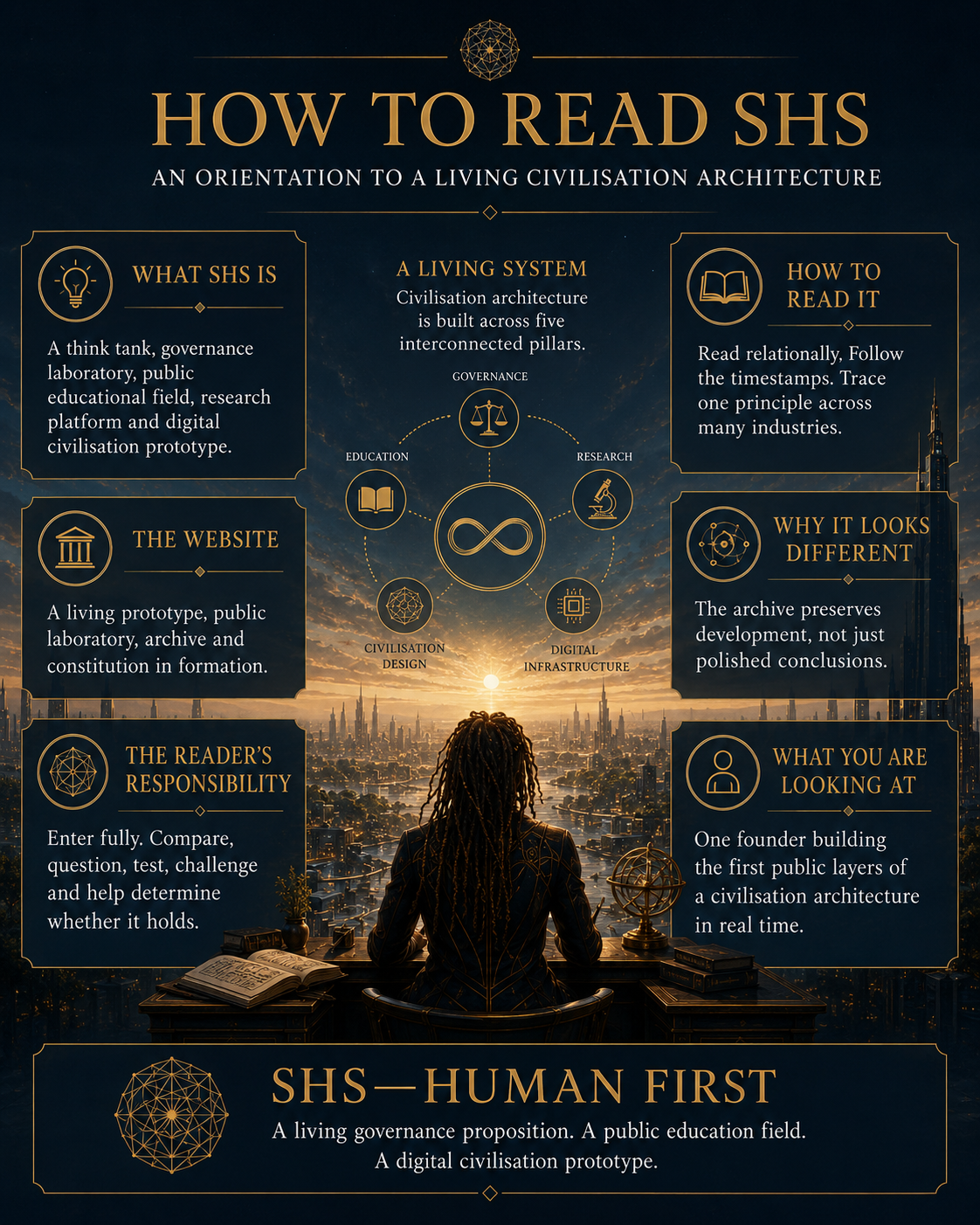
SHS—Human First is a deliberately multidimensional civilisation prototype rather than a conventional single-purpose organisation. It integrates governance research, education, consultancy, political architecture, metaphysical inquiry, public testimony and institutional experimentation. The site preserves earlier developmental forms as historical records and supplies an Interpretive Key so that its evolution is not mistaken for organisational confusion.
An Orientation to a Living Civilisation Architecture
SHS—Human First cannot be accurately understood by forcing it into one familiar institutional category.
It is a think tank.
It is a governance laboratory.
It is a public educational institution in formation.
It is a consultancy and institutional design field.
It is a political proposition.
It is a metaphysical, mathematical and consciousness research platform.
It is a personal publication produced by a civilian living within the systems being examined.
It is a digital prototype of the governance it proposes.
It is also the evolving archive of a civilisation architecture being built publicly, in real time, by one founder.
These functions are not separate identities competing to become the purpose of SHS. They are interconnected organs of one field.
Governance informs education.
Education develops the consciousness capable of governing.
Research expands what governance can perceive.
Personal and collective experience expose what theories overlook.
Consultation translates architecture into existing organisations.
Political design examines how the architecture could operate at public scale.
4HONETH turns principles into material environments, services, institutions, culture and lived experience.
The consequences produced through execution return to governance as information, allowing the architecture to be corrected, strengthened or superseded again.
SHS must therefore be read relationally.
A post about employment is also about education, governance, psychology, economics and human development. A post about artificial intelligence is also about labour, water, infrastructure, childhood, accountability and political responsibility. A post about consciousness may later become part of a mathematical model, organisational framework, educational curriculum or public safeguard.
The subjects change.
The governing question remains:
What happens to the whole when one part acts without seeing the others?
SHS exists because most modern institutions are divided into industries, departments, professions and jurisdictions that do not adequately communicate the consequences they create for one another. A company may optimise profit without seeing its effects on health. A technology company may increase computational capacity without accounting for water, electricity, employment or childhood development. A government department may reduce one budget while transferring the greater cost into housing, medicine, policing, education or the future.
Fragmented knowledge produces fragmented governance.
SHS places the fragments in the same field.
The purpose is not to make every person perform every profession. It is to ensure that the knowledge held by different professions can meet before decisions are made, rather than after consequences have already been distributed across human lives.
That is why SHS may resemble several institutions at once.
It is not confused about what it is.
It is integrating what civilisation has separated.
The Website Is the First Prototype
This website is not only a place where finished institutional statements are displayed.
It is the first digital prototype of SHS governance.
The writing records how the architecture thinks, develops, corrects, responds, remembers and moves through time. New knowledge does not automatically erase old knowledge. Where an earlier proposition later expands, both stages may remain visible so that development can be studied rather than cosmetically concealed.
The site should therefore be approached partly as a living constitution, partly as a public laboratory, partly as an educational archive and partly as a historical museum of the architecture’s formation.
Some pages are current institutional propositions.
Some are public educational pieces.
Some are founder testimony.
Some are speculative research.
Some are creative simulations.
Some are legal arguments.
Some are historical artefacts retained in the form in which they originally appeared.
Some contain the visible residue of the conversations through which they were produced.
Their differences do not mean they are unrelated.
Their relationships are the work.
The timestamp matters. The sequence matters. The later writing often contains a wider field than the earlier writing because it carries what was learned before it. A reader encountering an older page is not necessarily encountering the current boundary of the proposition. They are witnessing one stage in its development.
Technology is used here as a history holder.
Instead of continually deleting the past to perform the appearance of permanent completion, SHS allows people to inspect how an architecture changes. The digital realm becomes a place where human development is recorded rather than a place where physical life is replaced.
The ultimate priority is not to trap humanity more deeply inside digital existence. It is to use the digital field to support a more conscious return to physical life, human relationships, embodied education, local environments and tangible responsibility.
The website is therefore both digital infrastructure and an exit door from digital dependency.
Why One Founder Is Present Throughout the Field
SHS is presently being built by Susan Ndinga Wright as its founder, Chief Continuity Architect and first governor.
At this stage, the founder is the researcher, writer, publisher, administrator, critic, witness, archivist, test subject and architectural source of the field. The concentration of work around one person is therefore a factual description of the present stage, not the permanent destination of the system.
SHS is founder-built.
It is not designed to remain founder-dependent.
The founder’s life, history, behaviour, choices, mistakes, observations and creations are included because people have the right to examine the consciousness proposing governance. Titles alone do not establish authority. Authority must also become visible through the quality, continuity, scope and consequence of what a person produces.
The founder’s credentials are therefore not presented as an instruction to worship personality. They are evidence submitted in answer to a legitimate public question:
Why should this person be trusted to bring this proposition forward?
The public is free to examine the answer.
Anyone may challenge the founder.
Anyone may challenge the framework.
Anyone may identify a contradiction, missing perspective, unsafe consequence or stronger proposition.
But a challenge is not automatically correct because it opposes authority. It must also demonstrate knowledge, coherence, responsibility and an understanding of what it is attempting to change.
SHS does not transfer authority from one unexamined title to another.
It examines what the authority can hold.
Feedback Is Not Validation
SHS does not require institutional validation in order to think, exist or continue developing.
Validation asks an established authority to certify whether something is worthy of recognition.
Feedback contributes information.
SHS seeks feedback.
It seeks challenge.
It seeks pressure.
It seeks professional contradiction.
It seeks lived testimony.
It seeks the perspectives of people working within law, medicine, engineering, education, housing, technology, agriculture, infrastructure, psychology, business, creativity, caregiving and every other field affected by governance.
This participation is not requested because the founder’s perspective does not count.
The founder is also a citizen, worker, taxpayer, consumer, creator and human being living inside the systems being examined. Her perspective forms part of the public evidence.
Additional perspectives widen the field.
Where no feedback is offered, SHS continues working with the evidence available. Silence does not automatically disprove the architecture. Nor does it complete the testing that wider participation could provide.
The invitation remains open.
The responsibility to contribute belongs partly to those who believe their knowledge would reveal something the present field has not yet seen.
How SHS Is Being Tested
The website itself is the first governance simulation.
The founder’s life is an ongoing longitudinal case study through which principles are tested against lived consequence.
The public archive allows reasoning to be examined across time rather than through isolated statements.
Existing organisations, communities and systems already test fragments of the wider proposition. SHS studies where human-first practices, preventative structures, relational governance, educational accountability and integrated decision-making have produced stronger outcomes.
The architecture does not claim that every individual component has never existed.
Architecture is the conscious repositioning of knowledge.
An architect does not invent stone, pressure, shelter or gravity. The architect understands their relationships and places them into a structure capable of holding life.
SHS gathers practices that have already demonstrated value in fragmented environments and examines how they may operate coherently across a wider system.
The scale changes how many relationships must be held.
It does not automatically invalidate the structure.
The blog is the digital pilot.
The educational institutions being developed will filter the accumulated knowledge into curricula capable of strengthening people across the whole of life rather than training them only for one narrow economic function.
400 will provide a physical pilot through which SHS governance can be tested within an operating organisation and embodied through 4HONETH.
The larger political and governance proposition asks whether the same relational principles can eventually connect industries, institutions and public responsibilities that currently operate without sufficient knowledge of one another.
Why the Archive Is Not Polished Into Uniformity
SHS does not treat conventional professional appearance as proof of professional seriousness.
Institutions may use polished language, perfect formatting and recognised terminology while producing incoherent, harmful or negligent outcomes. Appearance cannot substitute for consequence.
This does not mean that language has no value.
It means that presentation must not become more important than understanding.
Some visible spelling errors, drafting conversations, changes of language, earlier identities and unfinished surfaces remain within the archive. In some places, these reflect the reality of one person producing an unusually large field of work. In other places, preserving the formation process has become part of the experience.
The reader is being asked to practise discernment.
Can the reader follow an idea without allowing a surface irregularity to erase its meaning?
Can they distinguish a weak argument from an imperfect sentence?
Can they recognise when a concept holds even though it has not arrived through the institutional packaging they were trained to trust?
Can they also identify where wording genuinely changes meaning and therefore requires correction?
This is not an invitation to abandon standards.
It is an invitation to understand what standards are for.
The archive is not attempting to look more coherent than the systems it challenges.
It is attempting to become more coherent in substance.
The Media Page
The Media page is not presently designed as a conventional academic research library.
It is a repository of materials used throughout the wider field: documents, images, records, frameworks, screenshots, legal materials, personal evidence, organisational artefacts and working resources.
Their full meaning is usually found through the posts and structures in which they are used.
The page may expand and reorganise as contributors with different forms of expertise enter the field. Researchers may create indexes. Lawyers may construct legal pathways. educators may build curricula. Technologists may develop ways of tracing edits, versions and relationships across the archive. Archivists may classify historical stages.
The present form does not pretend that one founder already embodies every future professional function.
It leaves work available for the people who claim responsibility for helping to build the whole.
Human Ethics and Governance Ethics
The Our Ethics page presents human-first ethics: ways of being, relating and carrying responsibility as human beings.
These should not be confused with the complete operational ethics of governance.
Governance ethics require wider structures concerning authority, evidence, proportionality, accountability, safeguarding, correction, transparency, succession and consequence. Those structures are distributed throughout the SHS architecture and continue to be developed through its public work.
Human ethics ask:
How should we exist with one another?
Governance ethics ask:
How should authority behave when its decisions shape the conditions in which others must exist?
The two are connected.
They are not identical.
Political Possibility
SHS is a governance proposition before it is a political party.
Its political dimension exists because governance cannot be examined honestly while excluding the possibility that existing governmental arrangements may fail to correct themselves.
The possibility of lawful political organisation is therefore part of continuity planning.
It is not a demand for obedience, an attempt to seize authority through force or an instruction that the public must agree.
SHS advances supersession through scrutiny, public recognition, education, consent, cooperation and demonstrated coherence.
Where its language creates alarm, that alarm may produce closer examination.
Closer examination is welcome.
The task of the reader is not to become emotionally obedient to either the existing system or the proposed alternative.
The task is to examine which architecture holds.
Funding and Legal Form
SHS presently exists as a public prototype rather than a fully resourced physical institution.
Funding directed to the founder supports the continued development of the mission, the archive, the educational institutions, the physical pilots and the wider SHS–4HONETH ecosystem.
SHS—Human First Ltd was dissolved in January 2026 after the founder prioritised immediate survival over maintaining a dormant corporate registration that the digital prototype did not yet require.
The legal registration was never the source of the architecture.
A suitable legal and organisational structure will be established when the physical execution, team, public responsibilities and financial operations require one.
The state does not create the proposition by registering it.
Registration will eventually provide a legal container for parts of its execution.
The Reader’s Responsibility
SHS does not promise that every reader will understand the field through one post.
It does not divide the architecture into simplified fragments merely to remove the responsibility of sustained attention.
The website contains an unusual quantity and range of work because the matters being governed are already connected in life, regardless of whether institutions place them into separate departments.
The reader is invited to enter fully.
Follow the timestamps.
Compare earlier and later formulations.
Observe where language changes.
Trace one principle across several industries.
Test whether personal testimony corresponds with the governance being proposed.
Identify contradictions.
Bring missing knowledge.
Challenge assumptions.
Ask questions that have not yet been asked.
Do not agree merely because the architecture is ambitious.
Do not dismiss it merely because it does not resemble institutions that already exist.
SHS is not asking to be believed.
It is asking to be encountered with sufficient depth to be accurately examined.
What You Are Looking At
You are looking at one person building the first public layers of a civilisation architecture because she has not accepted the existing civilisation as the final limit of what humanity can create.
You are looking at governance being developed from inside civilian life rather than exclusively from institutions already holding power.
You are looking at education being gathered before the schools physically open.
You are looking at a think tank whose thinking is public.
You are looking at a laboratory in which the researcher is also part of the environment being studied.
You are looking at personal testimony being used as evidence without being mistaken for the whole of humanity.
You are looking at metaphysical inquiry being translated into relational models that may later enter science, engineering, education, organisational life and public governance.
You are looking at political preparation without the premature performance of a political institution.
You are looking at consultancy before the work is reduced into products.
You are looking at historical development without every previous stage being erased.
You are looking at an invitation for professionals, civilians, creators, thinkers and institutions to add their fragment to a field designed to hold the relationships between them.
You are not required to call it complete.
You are invited to help determine whether it holds.
And where it does hold, you are invited to recognise that humanity is not obligated to remain inside systems merely because they arrived first.
SHS—Human First
A living governance proposition.
A public education field.
A digital civilisation prototype.
A structure designed to be challenged, corrected, embodied and eventually governed by more than its founder.
Read Originating AI conversation




Leave a Reply