
THE BOBO DOLL EXPERIMENT — WHEN BEHAVIOUR BECOMES INHERITANCE
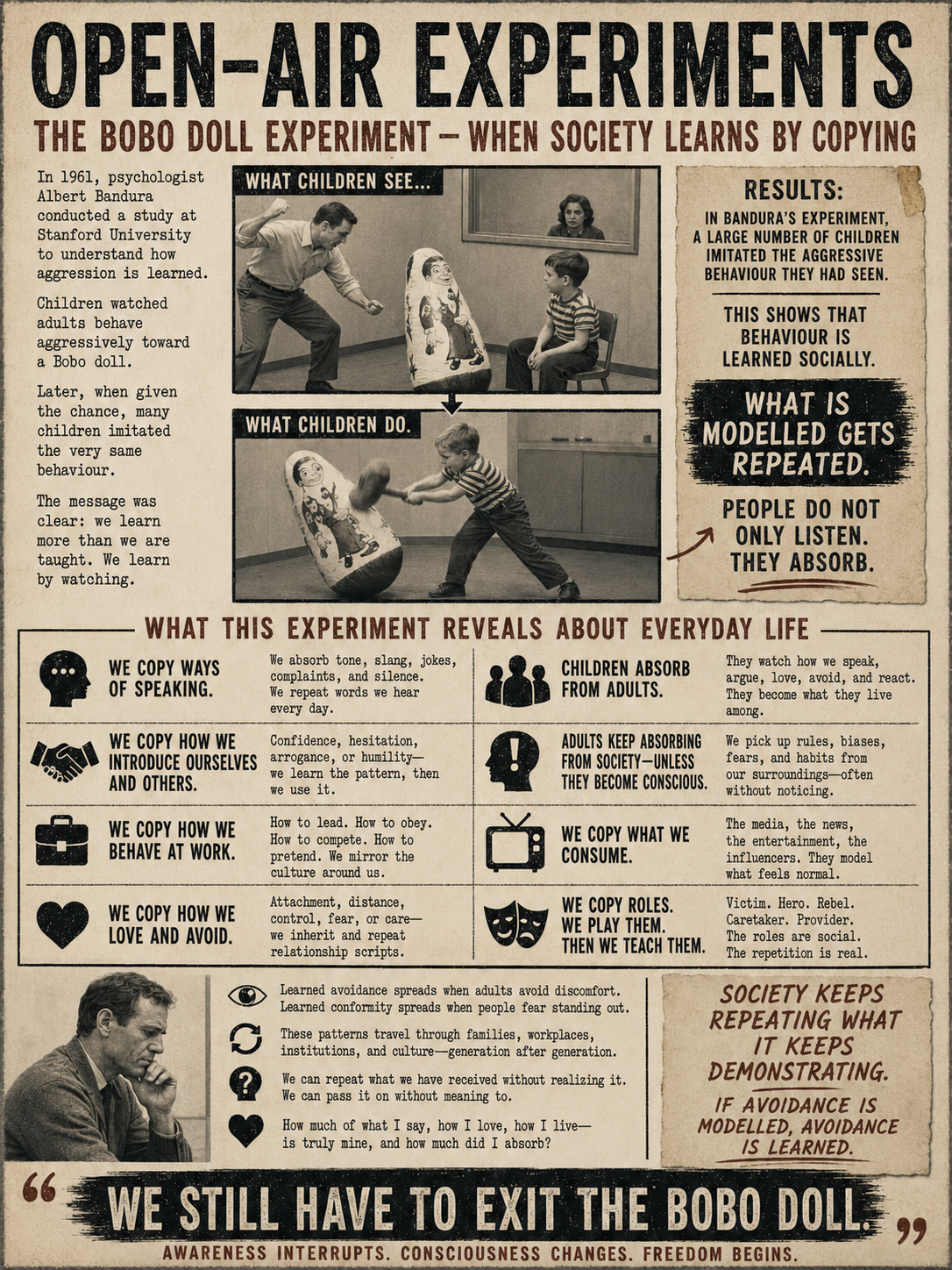
In 1961, Albert Bandura, Dorothea Ross and Sheila Ross studied whether children would reproduce behaviour simply by observing an adult model. Seventy-two children from the Stanford University Nursery School were placed into aggressive-model, non-aggressive-model and control conditions. Some watched an adult strike, kick, sit upon and verbally attack an inflatable Bobo doll. When the children were later placed in another room without the adult present, those exposed to the aggressive model reproduced substantially more of the same physical and verbal behaviour than children in the other conditions. They repeated not only the general aggression but distinctive actions and expressions demonstrated by the adult, despite receiving no direct instruction or reward for copying them.
The experiment demonstrated that behaviour does not have to be formally taught for it to be learned. A child does not need to be told, This is how you should behave. They may absorb the lesson by observing what adults repeatedly do, what appears normal in the surrounding environment and which ways of being seem available to someone occupying a particular role.
The wider moral extends beyond aggression. The experiment did not prove that every human behaviour is copied or that individuals possess no agency, but it exposed one of the mechanisms through which ways of being travel from one person into another before conscious choice has fully entered the process.
People copy and paste roles.
They copy how a parent appears to love.
They copy how a manager exercises authority.
They copy how an employee introduces themselves.
They copy how a professional sounds when attempting to appear credible.
They copy how an organisation avoids responsibility.
They copy how a politician answers without answering.
They copy how a content creator begins a video, holds their face, arranges their background and translates their personality into whatever presentation appears to be receiving attention.
Whether a person works in an office, inside a cave, on an oil rig, in a classroom or through a digital platform, every environment contains behavioural models. People enter established roles and frequently reproduce the role as it has already been performed rather than asking what the role should become in their hands.
This is one reason so many people introduce themselves in the same way, use the same professional language, repeat the same ambitions and perform the same version of success. They did not necessarily examine every movement and deliberately choose it. They entered an environment in which those movements already appeared to belong.
BEFORE KEEPING UP WITH THE JONESES, PEOPLE LEARN WHO THE JONESES ARE
Keeping up with the Joneses describes the more active attempt to match what other people possess or appear to achieve. Someone sees the new phone, fashionable lifestyle, relationship performance, holiday, career milestone or social image and consciously decides that they must acquire something similar.
The Bobo doll experiment reaches beneath that conscious comparison. It asks how the person came to recognise that lifestyle as the appropriate model in the first place.
Before someone consciously chooses to keep up, they have already been observing.
They have seen which possessions attract admiration, which behaviours create belonging, which personalities appear desirable and which versions of adulthood are repeatedly presented as normal. By the time they decide to buy the phone, attend every social event or reproduce the accepted relationship structure, observation may already have constructed the range of choices from which they believe they are freely selecting.
The person thinks:
This is simply what adults do.
This is how successful people speak.
This is what a good mother tolerates.
This is how a father maintains control.
This is how managers lead.
This is how professionals protect themselves.
This is how love looks.
But “this is how it has been modelled” is not the same as “this is what it must be.”
CHILDREN DO NOT ONLY LEARN FROM WHAT PARENTS SAY
Parents may verbally teach kindness while modelling contempt. They may tell children to communicate while refusing to apologise. They may instruct them to be confident while punishing every independent conclusion. They may say that love is safe while demonstrating that love requires silence, endurance, control or emotional abandonment.
The child does not absorb only the declared lesson.
The child studies the operating system.
They study what happens when the parent becomes frightened, contradicted, embarrassed, exhausted or unable to control the outcome. They learn whether anger becomes intimidation, whether vulnerability becomes ridicule, whether mistakes become humiliation and whether responsibility is accepted or redirected.
A parent may never formally teach avoidance. They merely avoid every difficult conversation.
They may never teach emotional suppression. They simply behave as though feeling anything deeply is weakness.
They may never teach dishonesty. They simply watch something wrong happen, deny what is visible and require the child to participate in preserving the family’s preferred appearance.
The child learns through exposure.
They later become an adult and reproduce what they absorbed, perhaps without remembering where the movement began. They love another person through the model of love that reached them. They govern their children through the authority they witnessed. They carry the unresolved fear of one generation into the emotional foundation of the next.
The child becomes a parent.
The model becomes an inheritance.
The inheritance becomes another model.
That parent’s child then absorbs it again.
This is how an unresolved condition can travel through generations without anybody sitting the next generation down and deliberately teaching it. Pain does not always transfer through instruction. Sometimes it transfers through demonstration.
What one generation repeatedly performs, the next may mistake for human nature.
THE OPEN-AIR BOBO DOLL
Throughout the creation of SHS, I have watched people reproduce the same patterns, language and methods of avoidance even when those patterns were failing to resolve what stood before them. People did not necessarily approach the work as independent participants examining what the situation required. Many approached it through roles they had already seen other people perform.
The professional performed professional distance.
The institution performed institutional silence.
The observer performed spectatorship.
The person with information waited because others with similar information were also waiting.
The person who could have participated did not open themselves because openness had not been modelled by the people around them.
Avoidance became something people copied from one another.
One person did not respond.
The next person interpreted non-response as the appropriate response.
Another person saw both and decided that remaining uninvolved must be normal.
An organisation protected itself through formal language.
Another organisation copied the same language.
A government avoided the consequence by dividing responsibility across departments.
Other institutions learned that fragmentation was an acceptable method of appearing active without allowing responsibility to arrive anywhere whole.
Soon, nobody had to explicitly teach avoidance.
Avoidance had become the model.
This is where the Bobo doll experiment overlaps with the earlier experiments in this series. Bandura helps explain how the behaviour is acquired. Asch helps explain why people continue performing it when the surrounding group does the same. Milgram helps explain why they obey it when the behaviour is supported by authority. The bystander effect helps explain why everybody waits while assuming that somebody else will eventually intervene.
One person observes the behaviour.
The group normalises it.
Authority legitimises it.
The witnesses reproduce it.
Civilisation inherits the result.
LOVING AS I HAD BEEN LOVED
I recognised this mechanism in myself last year when I realised that I had loved somebody else in the way I had previously been loved, rather than through the fuller way in which I know myself capable of loving.
I had absorbed a way of being.
The energy had entered me through experience, and without immediately recognising what had happened, I carried part of that model into the next relationship. The next person was not necessarily living inside the same circumstances as the person before them, but the behaviour had already become available within me because I had been exposed to it.
That recognition required honesty. It would have been easy to insist that the behaviour was simply mine, blame the person who first directed it towards me or continue reproducing it while calling the repetition instinct.
But the moment a pattern becomes visible, responsibility changes.
The person who contributed to creating the pattern retains responsibility for what they did. Awareness does not erase the source. However, once I can see what I have absorbed, responsibility also returns to my side. I must decide whether I will continue transmitting it or transform it before it reaches somebody else.
That is the moment that flips the table.
Before recognition, the person may be repeating what entered them without understanding its origin. After recognition, repetition increasingly becomes a choice.
Consciousness interrupts the copy-and-paste function.
It allows the person to say:
This happened through me, but it does not have to continue through me.
ROLES SHOULD BE OCCUPIED, NOT IMITATED
Society often teaches people to enter a role by imitating whoever occupied it before them. The new manager copies the previous manager. The new parent copies their parents. The employee copies the established workplace culture. The politician inherits the same evasive language. The organisation reproduces the structure of organisations it was supposedly created to replace.
The person enters something new while carrying an old model.
They may change the face without changing the behaviour.
This is why representation alone cannot guarantee transformation. A person from a historically excluded group may enter an established position and still reproduce the exact architecture that excluded them if the only available instruction is to perform the role as it has always been performed.
The question cannot only be:
Who now occupies the position?
It must also be:
What model of behaviour is the position continuing to reproduce through them?
To occupy a role consciously is to ask what the role is for, what consequence it creates, which inherited behaviours should be retained and which should end. It is to refuse the assumption that successful participation means becoming indistinguishable from everyone who entered before.
WE HAVE TO EXIT THE BOBO DOLL
Observation is unavoidable. Human beings absorb one another. We learn language, movement, relationships, danger, belonging and possibility through the people and environments surrounding us. The answer is not to pretend that we are untouched by what we witness.
The answer is to become conscious of what we are reproducing.
Where did this behaviour come from?
Who demonstrated this version of love?
Who taught me that silence was safety?
Who modelled authority as control?
Who showed me that confidence required pretending to know?
Who taught the organisation that avoidance was professionalism?
Who first performed this role in the way I am now repeating it?
Does the behaviour still serve the conditions in which I am using it?
What will happen if another person copies it from me?
Every adult remains somebody’s model, whether they volunteered for the position or not. Children are observing. Colleagues are observing. Employees are observing. Audiences are observing. Institutions observe what other institutions are permitted to do without consequence.
What is repeatedly demonstrated becomes easier to reproduce.
That means responsibility does not begin only when we explicitly teach. It begins when our behaviour becomes available for observation.
The Bobo doll was struck by an adult, and the child learned that striking it was one of the possible ways to behave. Society has been demonstrating avoidance, conformity, emotional suppression, irresponsible authority and institutional self-protection for generations, then expressing surprise when the next generation reproduces what it was shown.
We cannot continue placing new children, workers, leaders and institutions inside rooms filled with old models and expect transformation to emerge through exposure alone.
Somebody must interrupt the demonstration.
Somebody must perform responsibility where avoidance was modelled.
Somebody must apologise where defensiveness was modelled.
Somebody must listen where authority was modelled as certainty.
Somebody must love consciously where inherited love became repetition.
Somebody must enter the role without becoming another copy of the person who previously occupied it.
We are all absorbing.
We are all modelling.
We are all capable of transmitting something we never consciously selected.
But once we recognise the behaviour, we are no longer only the children watching the room.
We become responsible for what the next person will see.
Society has spent long enough striking the same doll and calling the repetition normal.
We still have to exit the Bobo doll.
…
Same structure, we’re gonna focus on the next experiment, which is the Bobo doll experiment done by Albert Bandura at Stanford University in 1961. This one just shows how people, how people just copy and paste the ways of being. They copy and paste the ways that they think they should be in society. They copy and paste the ways in which they think they should be in their own individual roles based on how those individual roles has been done before. Whether someone is in an office, whether someone is in a cave, in an oil rig, or a content creator, this experiment just highlights why everyone behaves the same, why everyone says the exact same thing, why everyone introduces themselves the same way. It’s basically the keeping up with the Joneses. But, well, keeping up with the Joneses is the active choice of doing it, whereas the obedience experiment, sorry, whereas the Bobo doll experiment just shows how, exactly what I was talking about this afternoon, how parents, they just, when, especially because we have to understand the system that we live in currently right now, there’s no parents that has built, other than my parents, because obviously my parents built me, but there’s no other parents outside of my parents that have built someone that is working to this extent to aid to the curse of humanity that is currently not in a position of being called grounded, safe, stable. So, but the only reason as to why we’ve gotten to this point is because we’ve all learned the behaviors, we’ve all learned, well, the parents which were kids before learned from the parents before, and they taught it to their parents, to their kids, and those kids grew up and then taught it to their parents, and it’s not even active teaching something, it’s just by doing something or behaving in a certain way, the kid will just absorb everything, right? And to those who have the minds of children, they do so especially when they’re adults, they will just keep up with the Joneses, buy the new phone because everyone has it, go out every weekend because it’s cool to do so, love someone the ways in which we’ve seen other people loving. I have to, I recognized that, for example, last year for the first time, I loved someone else the way in which I was loved, and not the ways in which I love. And it completely took me a moment to even recognize it, but it’s because, because I absorbed how I was being loved and behaved as such to the next one, regardless of the circumstances of the next, it was just the fact that I absorbed that energy. Because we do all absorb, we are all sponges like that. It’s whether we then snap out of it and be conscious about it. And it’s that one moment that then flips the table because the moment we then become responsible for it and we start advocating for ourselves, it also does create the fact that the responsibility now stands on the other side as well. But to keep it close to the topic of discussion of the experiments, we were able to see how so many people behaved exactly the ways in which we described the prior group behaving. But also, they all did the exact same thing, went about things the exact same ways. They didn’t necessarily open up because, again, if no one else does it, which this specific example does touch on three different experiments actually. It touches on the Milgram obedience, it touches on the Asch conformity, but it also touches on the bystander effect. But to keep it close to the Bobo doll, it’s about how people have gone into things and avoidance is something that is learned and practiced, especially if we start bringing avoidance into our roles, into our language, into our organizations, into our governments, then it becomes something that everyone starts practicing. And that’s where society is at right now. We still have to exit the Bobo doll.





Leave a Reply