
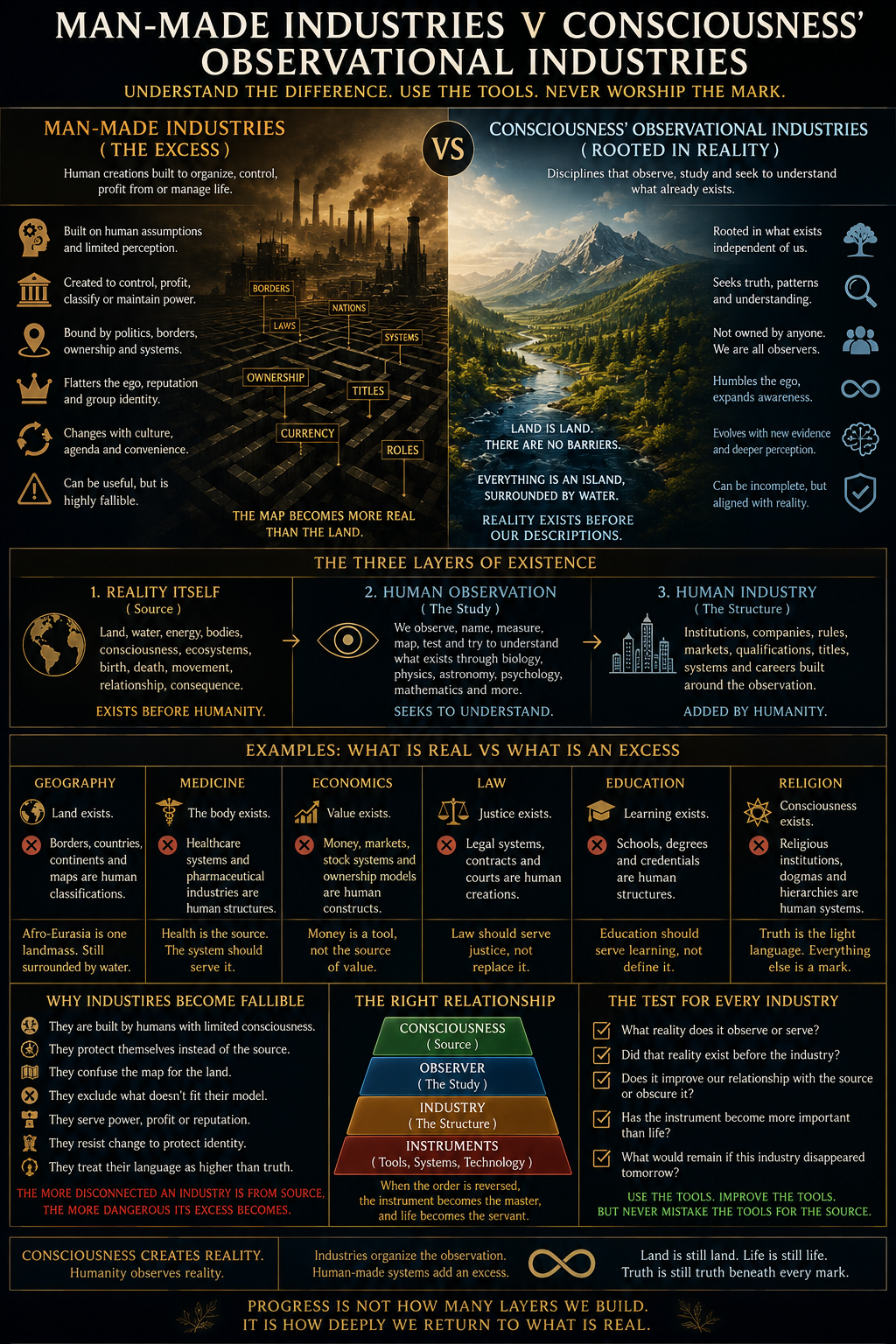
” Excess does not necessarily mean useless. It means additional to the original reality. It is a layer humanity created to classify, administer, exchange, communicate, control or interpret what already existed. The layer may be beneficial, but it remains fallible because it was produced through the perception, consciousness, limitations, interests and historical circumstances of the humans who created it. “
What Exists Before Humanity, What Humanity Built Around It and What Civilisation Mistakes for Reality
Before humanity created industries, reality already existed.
Land existed before geography.
The body existed before medicine.
Energy existed before physics.
Exchange existed before economics.
Relationship existed before psychology.
Conflict existed before law.
Sound existed before language.
Movement existed before mathematics measured it.
Life existed before humanity divided the study of life into professions, departments, qualifications and recognised jurisdictions.
This distinction matters because civilisation often treats the industries it created to observe, organise or govern reality as though those industries were the source of reality itself. The map becomes more authoritative than the land. The law becomes more authoritative than justice. The financial system becomes more authoritative than the resources upon which finance depends. The medical institution becomes more authoritative than the body it was created to understand.
Humanity constructs a tool, gives the tool a title, builds institutions around it and eventually forgets that the tool arrived after the reality.
That is where man-made industries become excess.
Excess does not necessarily mean useless. It means additional to the original reality. It is a layer humanity created to classify, administer, exchange, communicate, control or interpret what already existed. The layer may be beneficial, but it remains fallible because it was produced through the perception, consciousness, limitations, interests and historical circumstances of the humans who created it.
A system made by incomplete human beings will carry traces of that incompletion.
The problem is not that humanity created systems.
The problem is that humanity began worshipping its systems as though consciousness itself had created them.
THE FIRST DISTINCTION: REALITY, OBSERVATION AND INDUSTRY
There are at least three layers that must not be collapsed into one.
The first is reality itself: land, water, energy, consciousness, bodies, ecosystems, birth, death, movement, relationship, consequence and the wider conditions through which existence continues.
The second is human observation of reality: the attempt to study, name, measure and understand what exists. Biology observes living organisms. Physics observes matter, energy and movement. Astronomy observes celestial systems. Ecology observes relationships among living beings and their environments. Geology observes Earth’s material formation.
The third is industry: the institutional structure humanity builds around that observation. Universities, professional bodies, qualifications, corporations, departments, journals, regulatory systems, funding structures and recognised careers are not nature. They are human arrangements created to organise who may study, interpret, use or speak authoritatively about nature.
The subject may be rooted in reality.
The industry surrounding it is still man-made.
Medicine studies a body consciousness created, but the healthcare industry is a human construction. Physics studies energy and matter, but the profession of physics, its terminology, institutions and hierarchies are human-made. Agriculture works with soil, water, seed and climate, but agricultural markets, land ownership structures and industrial farming systems are human creations.
The distinction is therefore not that one entire profession comes directly from consciousness while another is entirely fabricated. The distinction is between:
what exists independently of humanity;
what humanity observes about it;
and what humanity builds around the observation.
Confusion begins when the third layer claims ownership over the first.
GEOGRAPHY: WHEN THE MAP BECOMES MORE REAL THAN THE LAND
Geography provides one of the clearest examples.
Land does not introduce itself as Europe, Asia, Africa, a nation, a county, a borough or a postcode. These are human classifications placed upon physical space to help people describe position, organise movement, administer populations and distribute authority.
The land is real.
The classifications are negotiated.
Afro-Eurasia is one continuous landmass, yet humanity separates it into Africa, Europe and Asia according to historical, cultural and political conventions. Europe and Asia are not divided by an ocean in the way completely separate landmasses are. Their distinction is partly civilisational rather than purely physical.
This does not make geography meaningless. It reveals that geography contains different kinds of knowledge.
Physical geography observes landforms, rivers, climates, ecosystems and processes that exist independently of political agreement.
Political geography studies borders, territories, states and jurisdictions created by human beings.
The error occurs when the political classification is treated as though nature itself created it.
A border may have legal force without possessing natural existence. A person may cross one invisible line and suddenly be subjected to different rights, currencies, obligations and definitions, even though the soil did not change beneath their feet.
The map says the person has entered another country.
The Earth says they continued walking across land.
Both descriptions may be useful within their respective systems, but they are not the same order of truth.
The map is a representation.
The land is the reality being represented.
Civilisation becomes fallible when it begins sacrificing living beings to preserve the authority of the map.
CONSCIOUSNESS’ OBSERVATIONAL INDUSTRIES
A consciousness-observational industry begins with something humanity did not create and attempts to understand its behaviour.
Physics did not create energy.
Biology did not create life.
Astronomy did not create the universe.
Medicine did not create the body.
Ecology did not create interdependence.
Psychology did not create the mind.
Mathematics did not create quantity, sequence or relationship, although humanity created symbols and systems through which those relationships are represented.
These disciplines are at their strongest when they remain humble before the reality they observe. They study patterns, test propositions, revise models and acknowledge that the phenomenon may exceed the present instrument used to measure it.
Their authority should come from the quality of observation, not merely from the age or status of the institution.
A conscious observational field understands:
The reality existed before our terminology.
Our model may describe part of it without exhausting the whole.
New evidence may require us to revise what we previously believed.
The limitation of our current instrument is not proof that nothing exists beyond its range.
Our responsibility is to remain answerable to what we observe, not force reality to remain compatible with our professional identity.
The moment an observational industry becomes more invested in protecting its established framework than understanding the phenomenon itself, it stops behaving as an observer and begins behaving as an authority defending territory.
It becomes another man-made structure protecting its mark.
MAN-MADE INDUSTRIES
Some industries are built primarily around human inventions rather than naturally existing phenomena.
Advertising organises attention around manufactured demand.
Public relations organises perception around reputation.
Finance organises claims over value, debt, risk and exchange through instruments humanity created.
Insurance assigns prices to uncertainty.
Law formalises human rules, rights, prohibitions and procedures.
Politics organises the acquisition and exercise of collective authority.
Fashion industrialises human presentation.
Marketing translates desire into purchasing behaviour.
Property systems assign exclusive legal claims over parts of Earth.
None of these structures descended intact from consciousness.
They were made by humans attempting to coordinate human life.
They can therefore be redesigned by humans.
This is essential because civilisation frequently treats man-made systems as though they were laws of nature.
People say:
That is simply how the market works.
But markets do not work independently of human choices, laws, incentives, ownership and enforcement.
They say:
That is the legal position.
But legality describes what the current system permits or requires. It does not automatically establish justice.
They say:
That land belongs to this person.
The legal system may recognise the ownership, but Earth itself did not issue the title deed.
They say:
This person is successful.
Often, they mean that the man-made system rewarded the person with money, status or recognition.
The system evaluates its own compatibility and calls the result merit.
That is not necessarily consciousness recognising value.
It may only be a human arrangement rewarding the behaviours that preserve it.
THE INDUSTRY IS AN EXCESS, NOT THE ENEMY
To call an industry an excess is not to say it should be destroyed.
Excess can provide structure.
Language is additional to raw sound, yet it enables complex communication.
Maps are additional to land, yet they help people navigate.
Money is additional to value, yet it can facilitate exchange.
Law is additional to justice, yet it can provide publicly examinable protections.
Qualifications are additional to learning, yet they can establish minimum standards for positions carrying serious responsibility.
The excess becomes dangerous when it forgets its subordinate position.
The map should serve movement across the land.
The map should not require the land to conform to an inaccurate drawing.
Money should serve the circulation of value.
Value should not be destroyed because an activity cannot produce money.
Law should serve justice.
Justice should not be abandoned because the law has not yet developed language for it.
Medicine should serve health.
A patient should not be required to fit an established category before their suffering becomes worthy of investigation.
Education should serve learning and development.
A person should not be treated as unintelligent merely because their intelligence arrived outside a recognised qualification.
The excess is legitimate while it remains accountable to the source.
It becomes a false ascension marker when humanity mistakes the tool for completion.
THE FALLIBILITY OF HUMAN CLASSIFICATION
Every human classification contains a boundary.
A boundary allows the mind to focus. It can make a complex reality easier to study, communicate or govern. But every boundary also excludes relationships outside the category.
A doctor may study one organ while missing the environment affecting the whole body.
An economist may measure productivity while excluding unpaid care.
A lawyer may examine what can be proven under current rules while missing a consequence for which the law has no adequate category.
A geographer may map a border without examining the human cost required to enforce it.
A business may calculate profit without including the health, environmental and relational damage distributed elsewhere.
The classification becomes dangerous when the excluded consequence is treated as nonexistent merely because it falls outside the model.
Reality does not fragment itself according to professional departments.
Water enters agriculture, health, housing, industry, energy, climate and childhood.
Employment enters psychology, family stability, housing, nutrition, education and public health.
Technology enters labour, infrastructure, cognition, relationships, democracy and the environment.
The whole keeps moving while industries defend their fragments.
That is why all man-made industries are highly fallible. Their boundaries were created for human convenience, not because existence naturally divided itself in the same way.
A category may be useful.
It should never be mistaken for the limits of reality.
THE INDUSTRY MUST KNOW WHAT IT DID NOT CREATE
The most conscious sentence any profession can say is:
We did not create the reality we are responsible for serving.
Healthcare did not create health.
Education did not create intelligence.
Government did not create humanity.
Religion did not create consciousness.
Banks did not create value.
Technology companies did not create communication.
Courts did not create justice.
Employers did not create human capability.
The institution entered afterwards.
Its legitimacy must therefore be measured by how responsibly it serves the thing that existed before it.
A healthcare system that makes health inaccessible has contradicted its purpose.
An education system that suppresses curiosity has contradicted learning.
A government that protects itself from the governed has contradicted public authority.
A religious institution that blocks consciousness has contradicted its spiritual claim.
A bank that extracts value while destabilising life has contradicted the exchange it was meant to facilitate.
A technological system that expands communication while degrading human connection has confused its product with its purpose.
The industry may still function.
Its continuity with source has been broken.
THE EXCESS MUST RETURN TO CONSCIOUSNESS
The objective is not to remove every man-made layer and return humanity to an imagined condition without language, institutions, technology or organisation.
The objective is to reorder the relationship.
Consciousness must govern the observer.
The observer must govern the industry.
The industry must govern the instrument.
The instrument must remain accountable to life.
At present, the sequence is often reversed.
The instrument governs the industry.
The industry governs the professional.
The professional governs the public.
The public adapts to the consequence.
Humanity then calls the arrangement reality.
But money is not reality.
Borders are not reality.
Titles are not reality.
Careers are not reality.
Policies are not reality.
They have real consequences, but they remain human constructs operating upon a deeper reality they did not create.
Their power is delegated.
It can be withdrawn, corrected and redesigned.
THE INTRODUCTORY DISTINCTION
This series will distinguish between industries according to the relationship they maintain with source.
Some primarily observe consciousness’ creations.
Some organise the human use of those creations.
Some manufacture additional structures around them.
Some now exist mainly to maintain structures humanity no longer remembers choosing.
The question will not simply be whether an industry is man-made. Every industry, as an organised human institution, is man-made.
The sharper questions are:
What reality does the industry observe or serve?
Did that reality exist before the industry?
What human layer has been added around it?
Does the added layer improve our relationship with the source, or obscure it?
Has the instrument become more authoritative than the life it was designed to support?
What would remain if the industry disappeared tomorrow?
Land would remain without geography departments.
Bodies would remain without healthcare corporations.
Consciousness would remain without religious institutions.
Value would remain without money.
Justice would remain without current law.
Learning would remain without qualifications.
Relationship would remain without social media.
The industry may help humanity understand, organise and protect these realities.
It cannot claim to have created them.
That is the beginning of the distinction.
Consciousness creates reality.
Humanity observes reality.
Industries organise the observation.
Man-made systems add an excess.
The excess may serve.
It may coordinate.
It may clarify.
It may preserve.
But it must never be mistaken for the source.
Land is still land beneath every border.
Life is still life beneath every industry.
Consciousness is still consciousness beneath every language humanity has invented to describe it.
And progress will not be measured by how many additional layers civilisation can manufacture.
It will be measured by whether those layers help humanity return more consciously to what was real before we began naming it.




Leave a Reply