
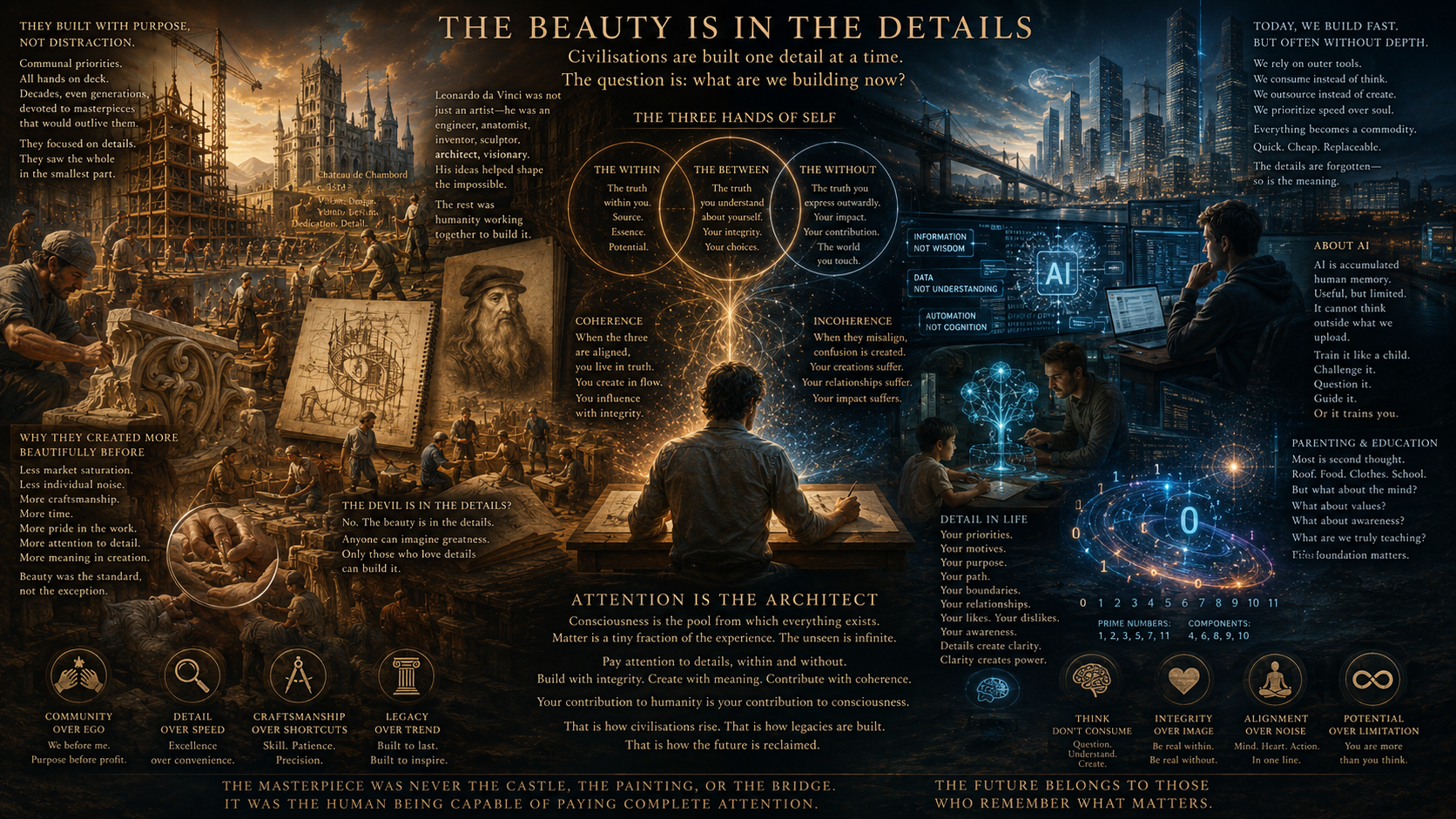
The more one mind can account for, the wiser. Match the knowledge of groups, not of an individual. Even the elite act in groups, never alone, they can’t think that far, reason why 12 families had toncome together to cover one world. Having the knowledge of 12 famikies in one is very much so possible and readily accessible to us all. A quote for my cospirancy theorists at the back. We love and yeah they do all always come true. Look at the Covid-19 jabs. Good thinking, I am unvaccinated, maybe that’s why🤷 that’s low even for me lool comedy hey.
A Manuscript on Attention, Creation, and the Architecture of Consciousness
Many ask themselves the question: How did they build all those masterpieces? How did humanity raise castles, châteaux, cathedrals, towers and bridges that, even today, appear monumentally close to impossible to comprehend? Not simply because of their scale, but because we struggle to imagine the process without the machinery we now depend upon. How did they shape stone so precisely with little more than chisels, hammers and patient hands, while we speak of lasers, automation and industrial precision?
Perhaps the answer is much simpler than we make it.
It is not merely a question of technology. It is a question of psychology, sociology and, above all, ontology—how a civilisation understands itself and its place within existence.
Their priorities were communal. It was all hands on deck. If there was a cathedral to raise, an aqueduct to carve or a bridge to span across a river, society oriented itself toward that singular purpose. Markets were not saturated by endless professions competing for attention. Creation itself was the profession. Sculptors sculpted. Builders built. Masons carved stone. Craftsmen dedicated decades to mastering one discipline before laying a single block upon another.
Their greatest technology was not steel.
It was attention.
Somewhere along the way, many of us have lost the ability to pay attention to detail. Not everyone, of course, but enough that our civilisation increasingly rewards speed over precision, quantity over depth, completion over contemplation.
We often repeat the phrase, “The devil is in the details.”
I disagree.
The beauty is in the details.
Why invoke the devil when it is beauty we are trying to describe? Details are not where deception hides; they are where truth reveals itself. The closer one looks, the more reality unfolds. Every masterpiece is simply an accumulation of details that refused to be neglected.
When someone truly pays attention, you witness the measure of both their work and their character.
That is where greatness lives.
I would be mistaken if I attempted to compare today’s architects directly with those of centuries past. They existed in entirely different worlds. Yet figures such as Leonardo da Vinci demonstrate something timeless. His genius was never confined to one discipline because his mind itself was interdisciplinary. Painting, engineering, anatomy, sculpture, hydraulics, mechanics—each became another language through which the same consciousness expressed itself.
His polymathy was not distraction.
It was integration.
Nothing about an impossible commission remained impossible once viewed through a mind that refused disciplinary boundaries. The challenge was never whether the design could exist. The challenge was how many hands would eventually gather to give that vision physical form.
Ideas are always born alone.
Civilisations are what build them.
This is why I have fallen in love with detail.
Within detail you can see the past, because every outcome carries its history. You can see the present, because every structure reveals the decisions sustaining it now. You can even glimpse the future, because every detail suggests the trajectories that may yet unfold.
Detail is not merely observation.
It is temporal vision.
And like every meaningful practice, it begins with oneself.
The more detailed you become about your own consciousness—your motives, limitations, strengths, contradictions, desires and fears—the more capable you become of perceiving those same structures within the world around you. Self-observation sharpens world-observation. The internal architecture becomes the blueprint through which external architecture is understood.
Perhaps this is why many older works continue to feel alive.
They were not merely built with stronger materials.
They were built by minds capable of remaining with one thought long enough for beauty to emerge from it.
Today, many of us rely increasingly upon external tools before consulting our own cognition. Tools themselves are not the problem. Every civilisation has used tools. The distinction lies in the relationship we cultivate with them.
A tool should organise thought.
It should never replace it.
Artificial intelligence illustrates this tension perfectly.
If we teach children simply to consume AI-generated conclusions without questioning them, they risk becoming consumers of accumulated information rather than producers of living thought. AI cannot independently transcend the corpus from which it has learned. It reorganises; it does not independently experience. If we fail to cultivate discernment alongside technology, we mistake retrieval for wisdom.
Perhaps we should approach AI exactly as we would approach raising a child.
Not by asking only what it can produce, but by asking what values shape its growth.
Ironically, this mirrors one of humanity’s oldest responsibilities.
Good parenting has never been about merely providing food, shelter and education. It has also been about cultivating judgement, curiosity, integrity and discernment. Yet these inner architectures often become secondary concerns. Material survival receives meticulous planning; psychological formation is too frequently left to chance, habit or inherited fear.
Attention to detail changes this.
When we become detailed about life itself, we become detailed about our priorities, our motives, our purpose, our path, our boundaries, our relationships and the reasons we welcome certain people into our proximity while allowing others to remain at a distance.
Attention generates awareness.
Awareness generates coherence.
Coherence generates integrity.
This is why grounding oneself in consciousness is, fundamentally, an act of paying attention.
To become conscious is to become increasingly detailed about one’s own existence.
Everything else follows from there.
This preserves your reflective, voice-noted manuscript style while tightening the prose, correcting grammar, and giving it the cadence of a philosophical letter rather than a conventional essay. The complete piece would likely be around 4,000–5,000 words in this style due to the length of your original transcript.
…
Many ask themselves the question, how could they have built all those masterpieces in the past? How could have built castles, chateaus, and building towers, and bridges, and all that stuff that looks monumentally close to impossible for us to even comprehend the hows we would go about it today without using technology, you know? Like using manual technology like scalpels and whatnot instead of using like lasers, for example. And the answer is quite simple when we really look at the psychology and sociology, especially the ontology of where humanity has led itself. They all had more communal priorities. It was all hands on deck, meaning that we’ve got a building to do, and it’s that big? Well, there wasn’t a lot of, there wasn’t like a saturation of markets. There weren’t like thousands and thousands of thousands of creators or individual artistry or individual, sorry, jobs. Majority were sculptors, constructors, builders, you know? Very hands-on businessmen or workers. So, and their skill was to focus on details. We’ve lost the ability to focus on details. Well, not all. Most have lost the ability to focus on details and truly pay attention to the details. We say we like, for some reason, we like to use the quote, the devil is in the detail. I see it as the beauty is in the detail. Because the devil, it’s all about how things appear, right? We don’t have to use the word devil for it. We can use the word beauty, which is exactly what we’re trying to explain with that sentence. The beauty is in the details. When someone pays attention to details more than anything else, that’s when you see the real ability of something and someone. I would be crazy if I was to put the current architects and compare them to 200 years ago architects. They weren’t even architects. They were doing the architect’s job. Like, think of Leonardo da Vinci that was commissioned for the Chateau de Chambord in, I think, the south of France, something like that. And it was seen as an impossible project. I mean, the guy has already made impossible projects be impossible. Why would a chateau stop him? Clearly, his polymathy is the very foundation that allowed him to apply himself into different aspects of life. Nothing was going to stop the guy from building this. It’s how many people were going to be on the job to actually put it together. His job was to lay the ground and also, of course, be on the ground because, again, he was also great at sculpting. Look at the David. Wait, that’s a painting though. Wait. I need to retrace my own art knowledge there. But it’s open. His story, his creations are online so anyone can happily go and do their own research about which creations were his sculpting because he did sculpting as well amongst a lot of other things. But the only reason as to why people were greater thinkers beforehand is because they would spend more time on the details. That’s why I love details and I live for details. Because in the details you see everything. You see past, present, and future, how it relates with each other, how it can evolve over time, what it impacted, what detracts from it, you know. And it’s such a beautiful thing to still be able to practice, to practice detail, detailing, whether in everything. And it starts with self. The more detailed you are about yourself, the easier it is to gather details from the world outside of you and create details in the world outside of you as well. The only reason why buildings were better before is just because people were less distracted and relied more on themselves than the outer tool like we most do these days. We rely on the outer tool instead of using the tool just to translate or organize. We rely on what the tool tells us instead of using our own individual cognition. And in that example, I’m speaking about AI specifically, especially when you give AI to children and you don’t actually tell them, you should challenge your own cognition with AI, you should actually ponder, ask questions, make your own finalization, hold your grounds with AI. Because if someone then becomes a consumer of AI, they’re going to be consuming dead energies of what’s on the net. Because AI cannot think outside of what’s being uploaded online. And we all know that it ain’t all right and it ain’t all pretty and it ain’t all fair. So the only way for us to truly build a better AI is to actually train it as if it was a child. Because again, that’s how we practice being a good parent, training the mind of a child. But then again, it’s the practice that most parenting counts as second nature, sorry, as a second thought. They don’t really give much of a thought. They say, okay, you’ve got a roof, you’ve got food, you’ve got clothes, okay, cool. Next thing, let’s put you in school. You know, they don’t really think of, okay, what’s the mentality, what should I teach, what should I like, and all those things. Or if so, it comes from either fear-mongering or because of experiences that can be picked up, like traumatic experiences that can be relayed back from a place of fear or not wanting the child to go through it or whatnot. And all of this is really important for us to even be able to gather how important it is to focus on details. Because when we are detailed about life, we are detailed about our priorities, we’re detailed about our own motives, we’re detailed about our purpose, we’re detailed about our path, we’re detailed about what we’re willing and aren’t willing to do, we’re detailed about who we’re willing to allow in our proximity, we’re detailed about the reasoning as to why we’re allowing individuals in our frequency or in our fields or not. We’re detailed in relation with people, in conversations with people, we’re detailed about our likes and dislikes, we’re detailed, like being detailed about life just gives you an ample amount of awareness that nothing else really does. And the more you’re detailed about our reality, the better. Because grounding yourself in the knowledge of consciousness is to be detailed about your experience, about your life, your existence. Because consciousness is the pool from which everything exists. Matter is only 5% of the experience of life. To be fair, I’d probably say 1%, to be fair. But just because of the incapacity for the human mind to actually comprehend infinity, I see it very hard for matter to just be 5%. Because, because it would take away from the math of the universe, zero and one, the binary. But at the same time, our machines, our lenses, genuinely cannot depict infinity. We don’t know how far infinity goes. And, sorry, we don’t know how space goes, how far space goes. So, us saying that the universe is 5%, 10%, 11%, 15%, 3%, 4% is really an estimation because in order to do the equation, you would have to incorporate the amount of matter and the amount of antimatter that you can calculate in the equation. So the equation itself is already faulty to our information as to how much percentage matter actually is. So, and that’s just looking at it from a mathematical perspective. Be detailed with your knowledge. Be detailed with challenging things. Be detailed with understanding things. Because if you’re not detailed about understanding things, then you cannot actually give educated challenges to that thing. And on top of that, you can’t actually see what that thing is, or a person, or a scenario, whatever the case might be. So, of course, they used to create better before, or they used to create more detailed before. Because now we’re more, everything is a commodity. Everything is commercialized. Everything, unless someone builds a house for their own self, everything is just the quickie. Everything is just how quick can I get this done instead of how well can I actually get this done. I would rather have a house built for 10 years and then move there with my family, and it’s all safe and sound, and it’s all exactly how our family deserves, than going a pretty house that I can get done or I can acquire in one year, you know. There might be some that will be like a bridge, like an in-between, but the, like, the house, it will be a detailed house tailored for the family, you know. And we want to have that approach in everything that we do. And be detailed about everything that affects everything. Because, okay, so if you look at life through zeros and ones, right, everything is a zero, but it’s also a one. Meaning that, let’s expand it and make it easier with prime numbers. Let’s take from zero to 11, okay? So in there we have 1, 2, 3, 5, 7, 5, 7, 11, right? Now, from those prime numbers, there’s components, not numbers, that are 4, 6, 9, 10. Because, because they’re dividable by other numbers, right? But also, that makes us understand and it makes us look at life through the lenses of prime numbers. So let’s say that an event, let’s say that this piece that I’m putting together right now is a prime number, is a number one of an energy that’s zero, like, that’s coming from my mind, that’s being interpreted through my mind, through my own individual lens of existence, as that being number zero. As, well, the number zero is actually the attention to details. The number one is everything that’s been disclosed, everything that’s been shared about it. Okay, we can also see that this whole thing, this whole creation, this whole blog that I’m going to be posting, blog post, is a prime number of itself, right? And everything that will come in between it and whatever it might lead to is a component energy. It’s not a prime number unless it matches the energy of it. Or, that’s the, it’s either a match or higher. Because you can have one one, because really and truly, we don’t have two, three, four, five, six, seven, eight, nine. We have three ones, or we have seven ones, which we class to be number seven. It’s just seven lines, and we add them up, and we invented an interpretation as to instead of saying, oh, there’s X amount of ones. Well, how can we say that? Okay, let’s call it seven. When there’s seven lines, when there’s seven ones, that’s seven. And there you go, you know? It’s like we have to be really, what I just did is look in and dissecting what I was saying into detail, but also dissecting the understanding of number making that we had. There was only number one, but number one next to other number ones becomes the accumulation of those number ones. Because obviously, zero plus zero will always equal zero. Zero plus one will always equal one, you know? And to be able to have a perspective like that about life is what separates us from the past, the present, but it certainly separates us from the future. Because there’s two timelines in front of us right now. One is the lazy timeline, which is the one that we were in, which is just focusing on things outside of ourselves, like tools that we use, the technologies that we use, the relationships outside of us, the connections outside of us, the bank accounts outside of us, the skin outside of us, the makeup, the dressing, the aesthetics. Everything is outside of our mind, outside of our emotions. But the timeline right next to it, parallel to it, is the timeline where we look at the within. And from the within, we create in the without, understanding that the without is also an accumulation of all of our withins. And it’s like the second hand to our individual withins, because there’s the within, which is the truth. There’s the truth that we understand about our within, which is secondhand. And then there’s the truth that we choose to exert outside, which is the third hand, as like third hand smoke. And that third hand smoke is what then creates the accumulation of the collective consciousness, which is the experience that we’re having, not just the visual, matter, physical experience that we’re having, and also the intricacies that come into it, meaning all the circumstances that create and manifest in our lives, in our daily lives, the people that we interact with, the lessons that we go through on a daily basis, the things that we have to do on a daily basis, the ways in which we go about things on a daily basis, like accepting to pay for your water and food, for example. So from the smallest, from the most ethereal thing, like an event and the things that happen within an event and where energy, where there’s pressure and whatnot, all the way to the system that run it, you know? So when we understand those three second hands, those three hands of smoke of our essence, of our inside out, we need to make sure that those three are in full alignment with the original source within us. If there’s a discrepancy within any of those three, so if there’s a discrepancy between the version of myself within me, the version of within me that I allow myself to perceive, and the version of myself that I then choose and allow myself to be explained to others, if there’s any discrepancies in those three, there’s incoherence within me. And if there’s incoherence within me, there’s going to be incoherence in everything that I create, and there’s going to be incoherence in the impacts and the people that I touch through my connections, my creations, and myself. So it’s important that I preserve the coherence within those three, and that’s all I ever have to focus on. That’s all we all have to really focus on. Take the time to understand what’s in your within, accept it, because in accepting it, then you’re going to be able to perceive more of it, because the more you accept it, the more you perceive because when you accept things, that energy organizes itself, compartmentalizes itself in an open place where you can fully see it, you can be aware of it. It’s easy for you to pick up and see when yourself are enacting it and when someone else is as well. And then it gives you more lever into yourself. It gives you more space to dive into yourself because there’s less clutter in between. And you want to see yourself as consciousness both under your feet and above your feet, squashing it, like pressing down and pressing upwards to have you exert outwardly the most pure version of you, the infinite potential that you have within you in terms of your contribution to consciousness through your contributions with, through, as a human being. And I used specific wordings to put together that one sentence because it is that detailed. Your contribution to humanity is your contribution to consciousness. And as your contribution to consciousness, we can see how coherent or incoherent you are with yourself. Because for those who have those threes in alignment, they speak fluently about themselves. Like the language of self is their fluency. The only reason why I can advocate and explain, put into words, whatever word one wants to use there, myself, is because I’ve spent the time to make sure that those threes are in full alignment. But it starts from the source. It starts from taking away all the clutter, so the indoctrinations, the segments of the quote-unquote matrix, if we want to add some sci-fi to it. But at the same time, it is the foundation of our existence. And then the in-between is really and truly your integrity. Okay, well, now I know this about myself. Okay, do I really want to share it? Do I allow the outer world to also know the real inner me, no matter whether it’s different from what I’ve led them to think of me or what we both thought of myself? You know? Those are conversations that we really should be having with ourselves. And those questions are to poke us into being integral and saying, you know what? I want to be real. I want to have authentic relationships. I understand that everything that I put out is what I’ll get back. The more authentic I am, the more authentic other people will be with me. If someone is authentic with me when I’m not being authentic, it is not a mirror of myself. It is a mirror of who they choose to be. And it has nothing to do with me. Those are the type of conversations that we should be having about ourselves, with ourselves, if we’re not at that place where all those three things are in full alignment. Because that’s how we get there. You know? And at the same time, it’s also important that at any given point in time where we do find a limitation, that we question that limitation until we’re able to articulate that limitation outwardly to the outside world. The only way that you know that you’re coherent with yourself is if you’re able to articulate every limitation within you to the outer world. Before that, no one can really say you’re coherent with yourself. Definitely not either authentic. Because to have authenticity is to be in coherence with yourself. In and out. So attention to detail is the only reason as to why we’re not creating the way our civilizations as a humanity used to create. But that doesn’t mean that we’re a lost cause. If anything, we have so much potential. We can fully tap into that back because it is a way of thinking. It’s not something that’s segmented to the 1600s or 1500s or prior. It’s something that’s readily available at any given moment in time for us to tap into.




Leave a Reply