
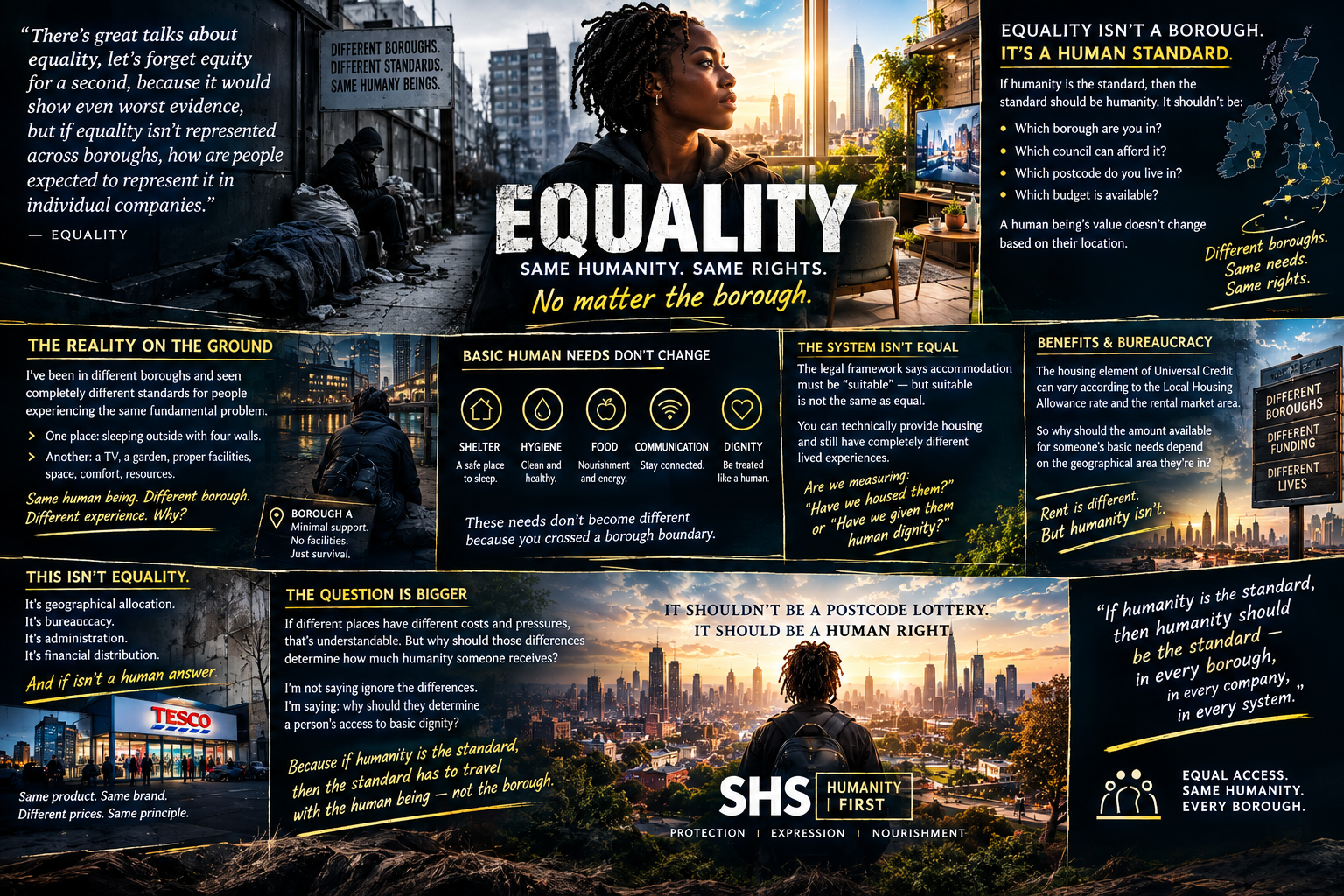
There’s great talks about equality, let’s forget equity for a second, because it qould show even worst evidence, but if equalitt isn’t represented across boroughs, how are people expected to represent it jn individual companies. You can’t demand equality onto people if the government itself doesn’t show it. Lead be example always thrives.
There is something that has been sitting with me after actually experiencing different boroughs.
And that is equality.
Because there are so many services that individual boroughs provide, particularly for people who are homeless or otherwise in extremely vulnerable circumstances.
But the problem is that the standard of living you can receive can be completely different depending on which borough you happen to be in.
And I don’t understand why.
Because if humanity is the standard, then the standard should be humanity.
It shouldn’t be:
Which borough are you in?
I’ve moved between different boroughs.
I’ve experienced different systems.
And the difference can be fucking enormous.
One place can offer something that feels almost like sleeping outside with four walls around you.
Another place can have a television.
A garden.
Proper facilities.
Space.
Comfort.
Resources.
An environment that actually feels like somebody has considered that the person living there is still a human being.
And yes, I am currently in a very fancy place.
There is a TV.
There is a little garden.
There is a lot here.
But I don’t necessarily look at that as an upgrade.
I look at it and think:
Why wasn’t this the standard in the first place?
Because now I have physically experienced the difference.
And once you have experienced the difference, you cannot unsee the inequality.
This is not theoretical anymore.
I have actually been in different boroughs and seen completely different standards for people experiencing essentially the same fundamental problem.
Homelessness.
A human being needs somewhere safe to sleep.
A human being needs hygiene.
A human being needs food.
A human being needs access to communication.
A human being needs dignity.
A human being needs somewhere they can actually recover enough to get themselves back into life.
Those needs don’t suddenly become different because you crossed a borough boundary.
So why does the experience change?
Why does the quality change?
Why does the available support change?
Why can one local authority have access to one level of resource while another is operating under completely different constraints?
And yes, local government finances are different. Local authorities face different housing markets, different levels of homelessness, different costs and different pressures. London Councils itself has documented enormous financial pressures on borough homelessness services, including billions of pounds in expenditure and substantial gaps between accommodation costs and the funding available.
But that’s precisely why I’m asking the bigger question.
Why is the human being experiencing those consequences?
Why does the person’s standard become dependent on the financial condition and resource capacity of the authority they happen to fall under?
The legal framework does establish a national requirement that accommodation secured for homeless applicants must be suitable.
But “suitable” is not the same thing as “equal.”
And that distinction matters.
Because you can technically provide somebody with accommodation while still having completely different lived experiences from borough to borough.
So what exactly are we measuring?
Are we measuring:
“Have we technically housed them?”
Or are we measuring:
“Have we provided a human being with an equivalent standard of basic human dignity?”
Those are two completely different questions.
And this gets even more interesting when we look at benefits.
Because I’ve experienced different places and seen different amounts associated with different housing circumstances, and initially I thought:
Why is the actual Universal Credit amount different depending on the borough?
But looking at the current rules, there is an important distinction: the core Universal Credit standard allowance is not simply set by borough. The housing element can vary according to the Local Housing Allowance rate applicable to the relevant area, and the Government publishes different rates for different rental-market areas. For 2026–27, those rates vary across England.
And that actually makes my question even bigger.
Because why?
Why should the amount available for someone’s housing circumstances depend upon the geographical rental market they happen to be in?
I understand the practical explanation.
Rent is different.
Housing markets are different.
Costs are different.
Fine.
But then we come back to the fundamental question:
Are we organising society around the market, or around the human being?
Because if the basic need is the same — somewhere to live — then why is access calibrated according to geography?
Look at Tesco.
A Tesco in Lewisham and a Tesco somewhere else can sell the same branded product.
The product doesn’t suddenly become worth more because you crossed a borough boundary.
The chain organises its pricing according to its own commercial structure.
Yet when it comes to the resources somebody needs to survive, suddenly geography becomes one of the mechanisms through which their access is determined.
And I’m asking:
Has anybody actually sat down and questioned the whole architecture of that?
Not just:
“How do we calculate it?”
But:
“Why are we calculating it this way?”
Because that is what equality actually requires.
Not pretending everybody is identical.
Not pretending every borough has identical circumstances.
It means asking whether the human standard underneath the circumstances is equal.
Because obviously different places have different costs.
Different housing markets.
Different pressures.
Different populations.
Different infrastructure.
I am not saying pretend those differences don’t exist.
I’m saying:
Why should those differences determine how much humanity somebody receives?
That’s the part I cannot get past.
And homelessness makes this painfully obvious because you can physically see the difference.
You can go from one borough to another and suddenly your entire experience changes.
Same human being.
Same body.
Same needs.
Same vulnerability.
Same hunger.
Same need for sleep.
Same need for dignity.
Different borough.
Different resources.
Different experience.
Why?
And then people call that equality.
No.
That is geographical allocation.
That’s bureaucracy.
That’s administration.
That’s financial distribution.
Whatever terminology you want to use.
But it isn’t the same thing as saying:
“Humanity is the standard.”
And this is where SHS comes in.
Because this is exactly why I keep saying humanity has to be the standard in every room.
Not the borough.
Not the council.
Not the department.
Not the available budget.
Not the reputation of the institution.
Not the postcode.
Humanity.
A vulnerable person shouldn’t have to move boroughs to discover that a better standard of treatment was possible.
They shouldn’t have to experience the worse version first in order to realise that another version exists.
They shouldn’t have to get lucky.
They shouldn’t have to know which borough has better services.
They shouldn’t have to understand the bureaucracy well enough to navigate themselves toward the resources that should simply exist.
Because the moment access to basic dignity becomes a postcode lottery, we’ve already admitted that the system is not operating from one human standard.
And that is the point I’m making.
I don’t look at being somewhere nicer and think:
“Yay, I’ve upgraded.”
I look at it and think:
“So this was possible all along?”
And then I think about the person who is somewhere else.
Someone sleeping somewhere that barely qualifies as accommodation.
Someone using facilities that barely preserve their dignity.
Someone being given less because their borough has less.
Someone experiencing the same homelessness crisis but receiving an entirely different standard of life.
And I think:
Why are we okay with this?
Because the answer cannot simply be:
“That’s what that borough can afford.”
Because that is not a human answer.
That is a systems answer.
And humanity is the thing that keeps getting left out of the equation.
If humanity is the standard, then the standard has to travel with the human being.
Not with the borough.
Not with the postcode.
Not with the budget.
With the human being.
That is equality.
And until that becomes the foundation, we are not actually equal.
We are simply being allocated differently.
…
I’m going to need you to write a post, which is about equality. Because there’s a lot of services that every individual borough offers to, for example, homeless and whatnot. But the issue is that each and every single borough, for whatever reason, has different standards of living for individuals that are in a very vulnerable position. Because they would be outside of, like services that are funded by the mayor of London themselves. Different boroughs. I’ve moved to different boroughs, and the standard of one borough is completely different from the standard of another borough. Now, if the standard is humanity and the client— if humanity is the standard, then the standard should be held through different boroughs. But the standard is the borough. So why is that? Why are different boroughs treated differently? You know? Why is the government allowing and giving different budgets to different boroughs? It makes no sense, because the issue, which is homelessness in this case, is the exact same. One borough has so much limited resources that they can literally offer a very similar experience to sleeping outside, and then other boroughs have very fancy places. Like right now, I’m in a very fancy place. There’s even TV, there’s a little garden, there’s a lot— there’s a lot, you know? But it is completely different from where I was before. So why is that? I don’t see it as an upgrade. To me it’s a downgrade, because it shows the inequality between boroughs. Which we already knew, but out of experience now I also have the experience to actually look at it. Because even when we think of universal credit, based on the borough in which you are, you get a specific amount. I used to live in Shoreditch. You would get a very hefty amount there, and then I moved to Islington, different amounts there, and then I moved to Lewisham, different amounts there. Why is that? The basic needs are the same, because the government doesn’t necessarily tell the shops, the common shops, to have different prices. They all have the same because they’re all under the same chain. If I buy something in Tesco in Lewisham, it’s the same price in Shoreditch. So why the allowance is different? Has anyone actually really dived into that? And why is it allowed? Why is it a thing? Very fair question.





Leave a Reply