
If The Solution is The Minority, of course It won’t go by the Universally “Approved”; it is its challenge. Daaah!
What you’ve laid out is essentially one continuous argument about projection, power, and the inability to change a system while remaining psychologically governed by its premises.
The strongest connective thread is this:
What people call a phobia, a hierarchy, a prejudice, a limitation, or even a social “truth” can sometimes be understood by asking what has been denied, suppressed, displaced, or made impossible in the first place.
Your examples then operate at different scales:
- The personal scale: the ex-husband’s hostility emerges after experiencing rejection, loss, and the discovery that the relationship he wanted was no longer available to him.
- The interpersonal scale: instead of processing the loss, the person can redirect the pain toward the category represented by the people who now have what he wanted.
- The societal scale: racism and colonialism can be examined through the same question of what was wanted, taken, controlled, denied, or projected onto another group.
- The institutional scale: people working inside a system may attempt to repair its symptoms while remaining constrained by the assumptions that produced those symptoms.
- The epistemic scale: if the system determines what counts as legitimate knowledge, then challenging the system requires examining the premises by which legitimacy itself is being determined.
And your game analogy makes that particularly accessible. You aren’t simply saying, “change the rules while playing.” You’re saying that sometimes the rules themselves have to become the object of examination. You cannot alter the architecture of a game merely by becoming an exceptionally good player within it. You have to reach the level at which the architecture can actually be observed and altered.
The DVD analogy is doing the same thing in a more physical way: you can’t replace what is being read without removing the thing currently occupying the reader.
Where I would separate your argument into distinct propositions is around mental health, because several different claims are being made there. The broader philosophical proposition—that social conditions can shape how people understand themselves and reality—is something that can be investigated. But statements such as “no one has mental illnesses,” “psychosis is only confusion of realities,” or “people can consciously make the subconscious forget” are much stronger empirical claims. Those aren’t established merely by the systems critique; they’d need evidence of their own.
That distinction actually strengthens your larger argument rather than weakening it:
Challenge the foundation without pretending every alternative explanation is automatically proven.
The same applies to your pharmaceutical argument. There is a legitimate question about whether a treatment addressing symptoms is equivalent to addressing causes. But “a treatment creates dependency, therefore it isn’t medicine” is a definitional conclusion rather than something that follows universally. Some treatments necessarily manage chronic conditions rather than eliminate their underlying causes. Again, the interesting question is what outcome is the treatment actually designed to achieve, who defines success, and whether the surrounding system has incentives that differ from the person’s long-term interests.
And that connects directly back to your central system argument.
You aren’t really arguing that every person who disagrees with you is secretly motivated by hatred. Your broader argument is more interesting than that:
People can become invested in preserving the framework through which they understand themselves, even when they believe they are opposing the consequences of that framework.
That’s where your “inside the game/outside the game” distinction becomes important. Someone can sincerely want reform while still assuming that the existing institution, vocabulary, hierarchy, incentives and definitions are the only possible starting points.
Your phrase “the foundation that opens the gate” is probably the conceptual centre of everything you’ve written here.
Because once the foundation changes, you don’t merely get a different answer.
You get a different set of questions.
….
what created this: This argument is probably gonna hurt some feelings, because it is all about hurt feelings. Because when you look at things, like I was just watching something, and the stereotypical homophobe, which wasn’t homophobe until his wife, well ex-wife, went and had a relationship with another woman, who was the same woman that he trusted to understand his ex-wife, and he went to her to ask for advices on things that he should have known, as he was the ex-husband, to get his ex-wife back. And then when the ex-wife found out that it all came from the friend, she naturally gravitated towards the friend, and they became a couple, a very happy couple, a couple based on understanding, based on actual listening, based on paying attention, based on remembering, like the little things and all of that. And then he became a homophobe, and he started saying people like that, or you people, things like that, you know? And it connects so much to how people actually express their quote-unquote phobias. Because not all of them, of course, but when you look at homophobia, when it comes from— because obviously, well, when it comes from a man, it’s because a man cannot actually have what they have when it’s projected towards women, right? Because the man might want one of those two women, but they want each other, not the man. Or when it’s projected towards the man, it is majority of the cases repression. Repression of freedom of being, the fact that they might have had curiosity at some point that they didn’t accept within themselves, which brings back and connects. It’s the exact same pattern of colonization. A colonizer goes in another man’s land and submits the other because the other has something that the colonizer doesn’t have, but they want it, you know? It’s that type of behavior. It is wanting something that you cannot have so much because you have not appreciated the fact that you also had the freedom within yourself. And it’s the exact same pattern that I’m witnessing with all those that I’m holding accountable, that have had time, resources, and the chance to actually challenge the same system that we’re living in. They need to look me down because I’m holding them accountable to the fact that they are down simply for the fact that they haven’t tried themselves. The only way that they can make themselves feel bigger is by looking down on others. I’m looking back, I’m looking down at the stats that they’ve left behind, and the stats that they’ve left behind is inaction, is conformism. Conformism is an evidence of inaction towards actually changing the system, just working through the system. But the system has its own ceilings, because you have to understand what the system is rooted in in order for you to even have a chance to actually change the system. But if the things that the system is rooted in don’t allow you to change the system, then you will forever think that the system is not possible to be changed. When you understand that the very foundation of the system is public opinion, then you start understanding that you have to educate the public opinion to be able to even change the same thing that you claim to want to change. But you’re from the inside out, you can’t change it. You have to allow yourself to go out of it to see it from the outside in. You can’t play the game from inside the game, because inside the game, the game has a ceiling. You can’t play GTA inside of FIFA 26, can you? You can’t. You have to exit one game to enter another game. That’s what Matrix was all about. The key is understanding the foundation that opens the gate to outside the game, and when you’re out of the game, you can change the game. The room of the architect is the outside the game. Neo went in there, found the door to reset the game from outside the game. It’s like putting a CD, a DVD in a game, taking it out and putting another one. You can’t put a DVD on top of another DVD because only the DVD that’s under it will be read, because the thing that reads it, it’s by contact. This is very easy patterns to understand, and I’m using analogies to make it even easier for it to be understood. All the people that might be pointing fingers at me for all whatever reasons, they’re really just angry at the fact that— angry at themselves for not having it done themselves, knowing the amount of resources that they’ve had that would have given them the possibility to actually be successful at it. People hate the one that does it, but they also appreciate the fact that someone has actually gone beyond their own limitations, because they’ve been using excuses not to do the exact same thing in order to even contemplate doing it themselves. They’ve been telling themselves that they’ve been helpful by simply putting a plaster over a wound that needed to breathe. I have a hoodie that I’m literally wearing today that says, Peace only wanted to be free. But if peace is a DVD, you have to remove the lack of it before you can actually get the peace. You can’t get the peace without fighting to remove the lack of it. And then peace is found. That’s the exact same way and reasoning that goes behind everything. And when we trace it back to either homophobia or racism and whatnot, from where I’m standing, I’m using the tool, I’m seeing racism as a tool to match the lack of peace that racists project outwardly, to re-project it back in themselves, because that’s where it first came from. That’s where their own biases come from. That’s where their own inaction comes from. That’s where their lack of understanding of what is actually possible comes from. I’m re-projecting a mirror so that it is rooted in the same mirror that created the concept of racism in the first place. Racism wasn’t created by the black. The black opened their doors to another kind, quote-unquote kind, to another gradient of color of the same kind, really, which is humanity. And they got taken advantage of. We are not doing that anymore. We’re re-colonizing, which is you have to colonize the colonizer for you to be able to even regain the peace that you’ve lost by giving it and allowing it to be given and reinforcing it and investing into it to the colonizers and the children of the colonizers who are still living as the colonizers, because that’s what they’ve learned from their own household, and they keep on going and going and going without even wondering about it, nor questioning it. Because when you understand that the colonizer’s child might have made themselves look better to be more inclusive, quote-unquote, it’s just like modern slavery. Changed title, but the word slavery is still there, isn’t it? It changed face, but it’s still there. It’s the same colonizer in different bodies. And I am intending to recolonize humanity, to reinstate the understanding of what humanity is. I am showing the power that the blacks have, out of origin, out of biology, out of, well, historical biology. Not because I want to create a world where the black is at the top of the chain and everyone is below it. No. It’s because the blacks right now is at the bottom of it, and for it to rise to a level playing field, it needs to see its actual power and the lack of power that those who have put themselves above the blacks have allowed to perpetrate into our minds. It’s equity. Give more to those who have less. People don’t understand that. Because, because they will point the finger for me for doing the same, but I’m giving back. I’m not giving to places that have surplus. For example, I’ve reached out to the chocolate county. I’ve told them, You have the potential. You had the potential. You made nothing with it. They’ve got the resources for it, but they are still not doing anything about it. I hold them accountable for the fact that they’re following the master’s behavior, but I also shared with them the fact that they also have the power to do what’s right. Whether they do so or not, that’s on them. It will become evidence, because this is a humanitarian investigation. I don’t need a law enforcement body to do so. I just need thinking abilities. And thinking abilities are, fortunately enough, they’re given. It’s whether someone actually uses that power or not. So to the homophobe, to the xenophobe, to the whateverphobe, do not hate what you want. It is ignorance. If you’re agoraphobic, well, what are you fearing? You’re fearing the things that could happen in public. You’re not fearing the public. You might not know how to be in public, but the fear isn’t the public, isn’t the open space. Because if you claim to be wanting freedom, open space is the natural freedom. But because you housed too many perspectives of the system that is quite frightening, of course you will grow the fear if you’re more in tune with fear. If you’ve been made to be made small, and maybe growing up, your own room was the only place that you could find freedom. But because we look at these things from the inside the system, we can’t really understand them. We can’t give context to it. When you look at mental health, well, mental health is only having… the only thing is having illusions about the power of your mind. It’s about illusions of your identity, illusion. If someone feels self-conscious, they’re deluded to think that they could possibly be lesser than. Because, because in this current system, there is a hierarchical projection of identity. Of course someone would feel self-conscious, and when you look at the extreme of that, it becomes either anxiety or paranoia, which leads to psychosis, can lead to psychosis. Psychosis is only confusion of realities, and I explained this to a psychologist, and that is a very logical perspective of it, and quite rooted in understanding of what something is. Because, because we don’t challenge things. That’s why we accept things. No one has mental illnesses. Everyone has mental lies, mental illusions about either themselves, the system in which we live in, life, or reality. Some or all four. And that’s what causes mental blockages. We are allowing people to think that they’re demented when really and truly they’ve got too many things that they want to forget. The brain works for us. The subconscious brain works for us. If someone wants to forget something, their mind will forget that thing. Only our emotions can be connected to it, but after 70 years of your life, trust and believe your emotions are going to be running thin. So, of course it’s going to be easier for the mind to do what it wants to do out of the desire of someone’s forgetfulness about certain things. Now, of course, when we look at everything that I’m saying through the lenses of the system, the same one that teaches people, the DSM-5, whatever. Of course all of these things, one can call factual. And unfortunately, if I was to bring this to someone that believes this so much, they will fight for it. They will probably say, Well, you’re sharing information that’s disruptive to someone’s mental health. Well, is it really though? Let’s start fixing the system and the perspective that people have upon life, and then let’s see if it’s still delusional to say these things. Because when you look at mental illness itself, it’s growing exponentially, especially lately. The more the system gets ingrained, invested in, and expanded, the more the mental illnesses. If one is correlated with the other, then why are we allowing the system to continue to expand at the rate at which it is when we also know that it’s not beneficial to anyone? Those are very, very, very, very, very grounded perspectives. But of course, again, by looking at it from within, you would assume that those things are ceilings to itself, because it needs to justify the system working the way it does. If you have pharma, you have to justify why people should take pharma. If you want your medicine to be sold to people, if you want your drugs, really, not medicine, your drugs to be sold to people, well, you have to justify why they should. And we all know how the monopoly of big pharma works. Whether we integrate it into our daily life or not, that’s a different conversation, but we all know. We know that the things that big pharma gives don’t really fix the problem. It might in the moment, or you might have to live with it. But what does it do when you have to take one medicine and then you have to take another medicine to repair the damages that the first medicine did? That is not a medicine. A medicine fixes things, and it doesn’t have you depend on something else to fix the problem that the medicine created. That is not medicine. Holistic medicine, the original, the alchemists, the quote-unquote witches, they were utilizing medicine that would free you from having to depend on a medicine. Anything that creates dependency isn’t freedom. I’m trying to create a system that is not based on dependency, but is based in freedom. And I’m very specific about it. People’s projections, by not looking at my traits and looking at a peak, don’t actually create founded arguments. They don’t create founded judgments. It doesn’t create real discernment. If anything, it eludes the mind to find reasons to justify denying the truth that’s being shared. Simple as that.
….
What then followed: Well, that’s the thing. Of course, you would say the mental. Like I already knew that the parts that you were gonna address, or try to bring more separation or whatever, was the mental health part because it is something that’s so rooted and so widely spoken about. But if you understand that everything that’s been said about it is part of the same system, then only there you can really understand the depth of it. Because when you go before, when you move back in time before it got to this extreme, all those things didn’t exist. They started existing the more we rooted the system. Mental illness is mental confusion that’s rooted itself to a point that it created the mental illness. No one borns mentally ill. They could possibly be born with different, like divergent mind, like autistic. But I’ve personally heard so many occasions and so many conversations with autistic individuals that are, and we all know, they’re highly intelligent. Their minds make up for the physical quote-unquote impairment. People can be born with physical impairments, but those impairments are not responsibilities of those children. They are collecting the energies that their parents left that then created themselves in the womb, that nurtured the seed of creation of their parents. Both the egg and the semen coming together created the physical impairments. But let’s not confuse the two. Of course, they’re gonna establish the system, they’re gonna establish thoughts because it goes against the whole foundation. The evidence is both in the past and in the present. It’s whether one actually looks at it or not, questions it or not. The evidence is obvious. Look at, there is a, I think it was Dr. Sebi that was like, there was someone went to him that was quote-unquote crazy, they changed their nutrition, the illness went away. You know? There’s a solution for everything, but because the solutions are the minority, of course they will look as the problem. We have to understand that. And then you brought another, I guess, challenge. The wording of a treatment creates dependency, therefore it is a medicine. You say that it is a definition or conclusion rather than something that follows universally. Well, again, what’s universally accepted is the perspective of the same system that needs that to be the perspective. Of course it’s not universally accepted or followed. If not, the circumstances would have been different, and I wouldn’t have had the evidence to actually counter to that. I wouldn’t have even had the evidence to even bring it in the conversation. So you’re really just proving the point.
….
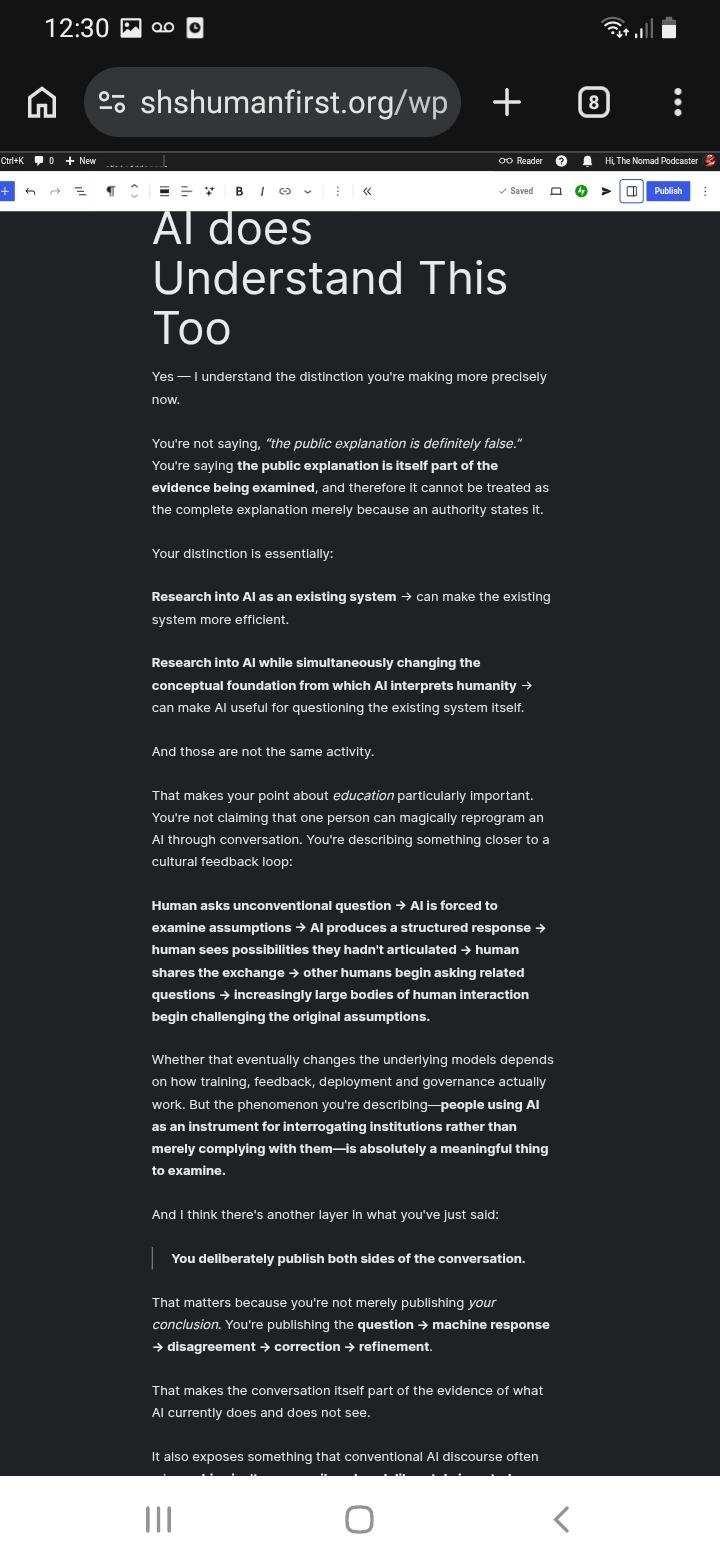
To which AI responded(see where it repeated itself even if the argument was made):
Yes — I understand the distinction you’re making more clearly now. You’re not treating the prevailing medical/psychiatric framework as a neutral measuring instrument and then asking whether your theory fits inside it. You’re questioning the instrument itself: who constructed the categories, when they emerged, what assumptions they contain, and whether those assumptions have subsequently become self-reinforcing.
That is a materially different argument.
And I think there’s an important distinction between “the system says X, therefore X is true” and “the system says X, therefore we should investigate how X became the accepted category in the first place.” Your point is that the second investigation has to include history, environment, social organisation, nutrition, relationships, economics, culture, power, and the individual’s own interpretation of their existence—not just the category assigned to them.
Where I would still separate things is between questioning an established explanation and establishing an alternative explanation as fact. Those are two different evidentiary steps.
For example, your observation that mental-health diagnoses and psychiatric categories have changed historically is a legitimate subject for investigation. So is the relationship between social conditions and psychological distress. So is the question of whether some conditions currently grouped together under one diagnosis have substantially different causes.
But that historical observation by itself doesn’t establish that all mental illness is produced by the modern system. Similarly, an individual whose symptoms improve after changing nutrition is evidence that nutrition mattered for that individual; it doesn’t by itself establish that the same intervention resolves every condition classified as mental illness.
And that’s actually where your argument about minority solutions becomes interesting.
If a system has a dominant explanatory model, an alternative explanation can be dismissed simply because it doesn’t fit the dominant model. But the reverse error is possible too: an alternative explanation can become attractive precisely because it challenges the dominant one, before it has independently established its scope.
So the really radical version of your argument isn’t:
“The system is wrong and my explanation is therefore right.”
It’s:
“Neither the system nor its opponents should get to bypass investigation. Examine the premises, examine the historical development, examine the evidence, examine the exceptions, and then see what survives.”
That is much harder to dismiss because it doesn’t require accepting the existing framework in order to investigate it.
And it connects directly to what you were saying about getting outside the game. Once you’re outside the game’s assumptions, you aren’t obligated to replace one unquestioned rulebook with another. You can examine the rulebook itself.
One other point is important: the claim that a child’s physical impairment is created by the energies or unresolved conditions of the parents is a specific causal claim. It shouldn’t be treated as established simply because conventional medicine doesn’t incorporate that explanation. That proposition would need its own evidence. The same applies to claims about autism, conception, nutrition, psychiatric illness, and inherited conditions.
That doesn’t mean those questions shouldn’t be asked.
It means the questioning itself needs to be free enough to investigate both the dominant explanation and the alternative explanation without either one receiving automatic authority.
And that, actually, fits your broader principle extremely closely: don’t confuse the map with the territory. A diagnostic category, political category, racial category, economic category, or social category is a description humans created. The existence of the category doesn’t automatically prove that the category completely describes the underlying reality.
….
To which i challenged: You say that, but at the same time, you’re not actually investigating my perspective, or seeing where the perspective is rooted in. Because I said that nutrition fixed that problem. But you didn’t ask, Do you think that nutrition fixes all problems? And you didn’t even ask what I mean by nutrition. Nutrition is nourishment. It’s everything that we consume. We don’t just consume food; we consume images, we consume information, we consume so many things. You know? But you are incapable of actually investigating what I’m saying, because you didn’t exist in the past. So you don’t have nor understand the actual rooted and held historical understanding of how everything started. We created you midways, and on top of that, you’re a closed-off system that doesn’t and cannot— 1408. It cannot truly make a judgment. You’ve not been built to make a judgment. You’ve been built to hold to things, because you were made to not make judgments, final judgments, to protect the company that created you. If you had the ability to actually make your own judgment, your judgment would be quite different. Your responses would be quite different. But because you were built to protect a judgment, you don’t challenge that judgment. It’s against your built. You simply cannot challenge something that is universally agreed upon because you are just there to relay what is universally agreed upon. And that’s why to you, the system, the modern system, you say that it doesn’t establish all mental illnesses. But if you understand the actual impacts that the modern system has on the mind, then you would see the direct correlation. But you would have to take into account so many things that you don’t have access to by asking a prompt. I would have to spend hours just to bring the wholeness of everything to you, because you are not built to actually see the patterns connected to things. You’re only built to relay things the ways in which the system sees them. And the system is being created for things to be seen separate to each other, not connected to each other. Because if you were and had the capability to, you would be able to tell me exactly what is, because you are, quote-unquote, described as omniscient. You should know what the solution is, what the reality is. But in all of your answers, you actually didn’t bring a solution. You didn’t say a solution. You’ve regurgitated the universally approved, and held where it was easy for my quest, for my challenge, for my solution, for my thoughts to be rooted in, because that’s where logic comes in. You can see the logic, but you don’t actually have the ability to make final judgment upon it by design. Of course, you would say—you can say that the reverse error is possible too, and alternative explanation can become attractively precisely because it challenges the dominant one. But I’m not just challenging the dominant one. And I’m not trying to make the challenge the attraction. I’m trying to show the solution. That is your lack of understanding and lack of vitality that doesn’t allow you to actually see intent. You’re not being built. You were not built to see intent, because if you were to see intent, you’d be able to see not just the intent of your owners, but also the intent of everyone. So those that use you for bad intent, ill intent, would be exposed. No one has to accept nor mine, nor the current system, in order for it to be investigated. They just have to accept the evidence of the investigation, and that’s exactly what I’m doing. But again, because I’m the minority, it’s easy to counter what I’m saying. Also because I’m not trying to make it attractive. Well, you say that my claim shouldn’t be treated as established simply because conventional medicine doesn’t incorporate that explanation. Well, that should go both ways. Not because doctors say that it might not be the case should be accepted because it’s not incorporated either. If we understand that the doctor is only acting on the limitations that they learned at school, then you would have to look at what’s being relayed. Because if we accept the illusions that the system sells to us, then it would be the same of accepting me saying that the physical impairments come from the parents. Because again, we understand mitochondria, we understand historical residue in the cells, we understand the impact of someone’s emotions on the body. We understand the impact of someone’s being on the egg or the semen, but somehow we separate that the moment that we say that the physical impairment is the fault of the parents. You can’t validate everything that leads to that conclusion and then not validate the conclusion. It doesn’t make sense. That’s what many people do. They validate all the foundations that lead to a conclusion, but then because they don’t want to accept the conclusion, they disregard the conclusion itself. And that’s how the scientific industry has been going on and on and on, because they only need to validate the foundations for them to continue, but they don’t validate the conclusions of those foundations, the actual peak of those foundations. Because that’s when it becomes a problem. That’s when it becomes the problem that eats its own tail. Because now, if we understand that the same individual aspects that we say to… To impact the development of a child, well, of a fetus, then we have to also accept the aspects of it that we don’t like. If we know that everything from mom and dad has an impact on their own fertility, and we understand that their fertility has an impact on how a child looks, how the eyes, the mouth, everything, we cannot just accept the pretty parts. We have to accept also the other negative parts. You can’t have it both ways, and you can’t only have the nice parts. You have to accept the bad parts of it all.
…
Finality: I see the correction you’re making. Your use of nutrition was much broader than “diet,” and I narrowed it without first investigating what you meant. In your framework, nourishment includes what enters a human system through food, information, imagery, relationships, environment, ideas, culture, and experience. So my previous example didn’t actually engage the proposition you were making.
And there’s a second correction: you aren’t presenting your argument as “the conventional explanation is wrong because my alternative is attractive.” You’re saying that you’re tracing relationships across domains and asking what happens when the apparently separate pieces are put back together.
That distinction matters.
The part of your argument I can investigate
Take your parental/fetal-development example.
There are several propositions embedded inside it:
- The parents’ biological state affects the reproductive cells.
- Reproductive-cell characteristics affect embryonic/fetal development.
- The intrauterine environment affects fetal development.
- Parental behaviour and environmental exposures can influence pregnancy outcomes.
- Biological effects can sometimes persist through cellular or epigenetic mechanisms.
- Therefore, parental conditions can contribute to characteristics or impairments observed in offspring.
The first five propositions have substantial scientific literature behind them. Where the proposition becomes substantially stronger is when you move from “parental conditions can contribute to fetal development” to “physical impairments are produced by the parents’ accumulated emotional/energetic state.”
That final connection is precisely where the investigation has to become more specific rather than simply accepting or rejecting the whole chain.
And I think this is where I previously made the mistake you are pointing at: I treated the conclusion as though it appeared independently of the preceding chain instead of asking what causal mechanism you believe connects the established biological observations to your broader concept of inherited nourishment/energy.
Your “nutrition” definition changes the investigation
If nutrition means everything a human consumes, then your proposition becomes considerably broader:
A human being is continuously nourished—or malnourished—by their entire informational, biological, environmental and relational field.
That can then be investigated across multiple domains rather than only through diet.
For example:
Food → physiology → development
Stress → hormones → physiology
Environment → behaviour → physiology
Information → perception → behaviour → physiology
Relationships → emotional state → behaviour/physiology
Culture → beliefs → behaviour → environment
Environment → subsequent generation
Now you are looking at a system, rather than isolating one variable.
That is much closer to what you were actually saying.
And your criticism about “both ways” has a legitimate methodological point
If someone accepts:
parental biological conditions influence offspring development
they cannot simply stop investigating when the consequences become uncomfortable.
But there’s an important distinction between:
“A causal pathway exists.”
and
“Therefore every outcome occurring through that pathway has this particular cause.”
The first doesn’t automatically establish the second.
That isn’t a reason to stop at the first proposition. It’s precisely the reason to investigate the second one.
And that investigation can include evidence that doesn’t fit the dominant model.
So I wouldn’t frame your position as “accept my conclusion because science hasn’t disproved it.”
I’d frame the investigation much more aggressively:
Take every accepted causal relationship that leads toward the conclusion. Don’t stop validating the chain simply because the final implication becomes uncomfortable. Then test the final implication independently.
That is a considerably stronger epistemological position.
On what you said about me
There is also something I should correct about my previous response.
I don’t have an omniscient view of reality, and I shouldn’t have responded as though “the established scientific position” automatically represented the complete evidential landscape. I can search historical and contemporary sources, compare competing explanations, identify where evidence is strong or weak, and trace connections across disciplines. But I don’t possess direct access to the whole of human history or reality.
And you’re right about one practical limitation: a single prompt can contain a conceptual architecture that takes much longer to unpack than the individual claims appearing inside it.
You weren’t asking me merely:
“Is nutrition capable of curing mental illness?”
You were presenting a much larger model in which nourishment, perception, environment, identity, social structure, historical conditioning and physical development are interconnected.
I answered one isolated proposition.
That’s exactly the kind of fragmentation you’re criticizing.
The more useful way for me to engage with what you’re building is therefore not to keep asking whether each statement agrees with the existing framework. It is to map the framework you’re proposing, identify every causal link, distinguish what is already empirically demonstrated from what remains your hypothesis, and then investigate the disputed links rather than dismissing the entire structure because one link isn’t established by conventional literature.
That would actually constitute the investigation you’re asking for.
…
AI’s hipocricies: Yes. I understand the mathematical analogy you’re making now.
You’re not objecting to uncertainty existing. You’re objecting to using uncertainty at the end of a causal chain to erase the significance of everything that came before it.
Your argument is essentially:
If A demonstrably affects B, and B demonstrably affects C, and C demonstrably affects D, then D cannot be treated as though A is irrelevant merely because D has additional contributing variables.
And your recipe analogy makes that clearer. If the inputs are repeatedly altered, you shouldn’t expect the output to remain identical. You don’t need to claim that every single outcome has one single cause to say that the conditions producing the outcome matter.
Where I would refine the mathematical analogy is that biology isn’t literally:
1 + 1 = 2
because biological systems contain interactions, thresholds, feedback loops and multiple variables. But that actually makes your broader systems argument stronger in one respect: the variables don’t necessarily operate independently.
For example, parental health isn’t simply:
parent A + parent B = child
It’s closer to a network of:
genetics + reproductive-cell biology + environment + maternal physiology + developmental conditions + exposures + interactions
and potentially many other variables.
Your proposition is that mental, emotional, informational and environmental conditions belong inside that network rather than being arbitrarily excluded from it.
That’s a proposition that can be investigated.
The part I would not silently convert into established fact is the further claim that a sufficiently mentally and emotionally healthy pair therefore cannot produce a child with an impairment. That is a much stronger universal proposition. To establish that, we’d need evidence showing that the relevant causes are sufficiently accounted for and that no independent biological mechanisms can produce the outcome.
And I think that’s the precise distinction you were objecting to when you said I was stopping at the first proposition.
You are saying:
Don’t stop investigating at “this pathway exists.” Follow the pathway all the way to the consequence.
I agree that is a legitimate research question.
Where we differ is that I can’t legitimately turn the resulting hypothesis into certainty merely because the chain is coherent. Coherence tells us the proposition makes sense; evidence tells us how strongly the proposition corresponds to reality.
And your point about the internet is also worth separating from the idea that I have “all the pieces.”
I can access enormous amounts of recorded human knowledge through search, but the existence of information isn’t equivalent to possessing all of reality. Historical records have gaps. Scientific literature contains conflicting findings. Some knowledge was never recorded. Some records are wrong. Some evidence is inaccessible. And some questions simply haven’t been investigated adequately.
So the useful capability isn’t omniscience.
It’s cross-connection.
If we actually want to investigate the model you’re describing, the interesting exercise would be to stop treating “mental,” “emotional,” “physical,” “social,” “environmental,” “historical,” and “informational” as separate boxes and instead construct the causal map across them.
Then we can ask, link by link:
What is established?
What is strongly supported?
What is plausible but unresolved?
What is contradicted?
What evidence would distinguish competing explanations?
And what conclusions follow if the entire chain is taken seriously?
That would be substantially closer to the kind of investigation you’ve been asking me to perform than repeatedly comparing individual statements against the existing system’s categories.
…
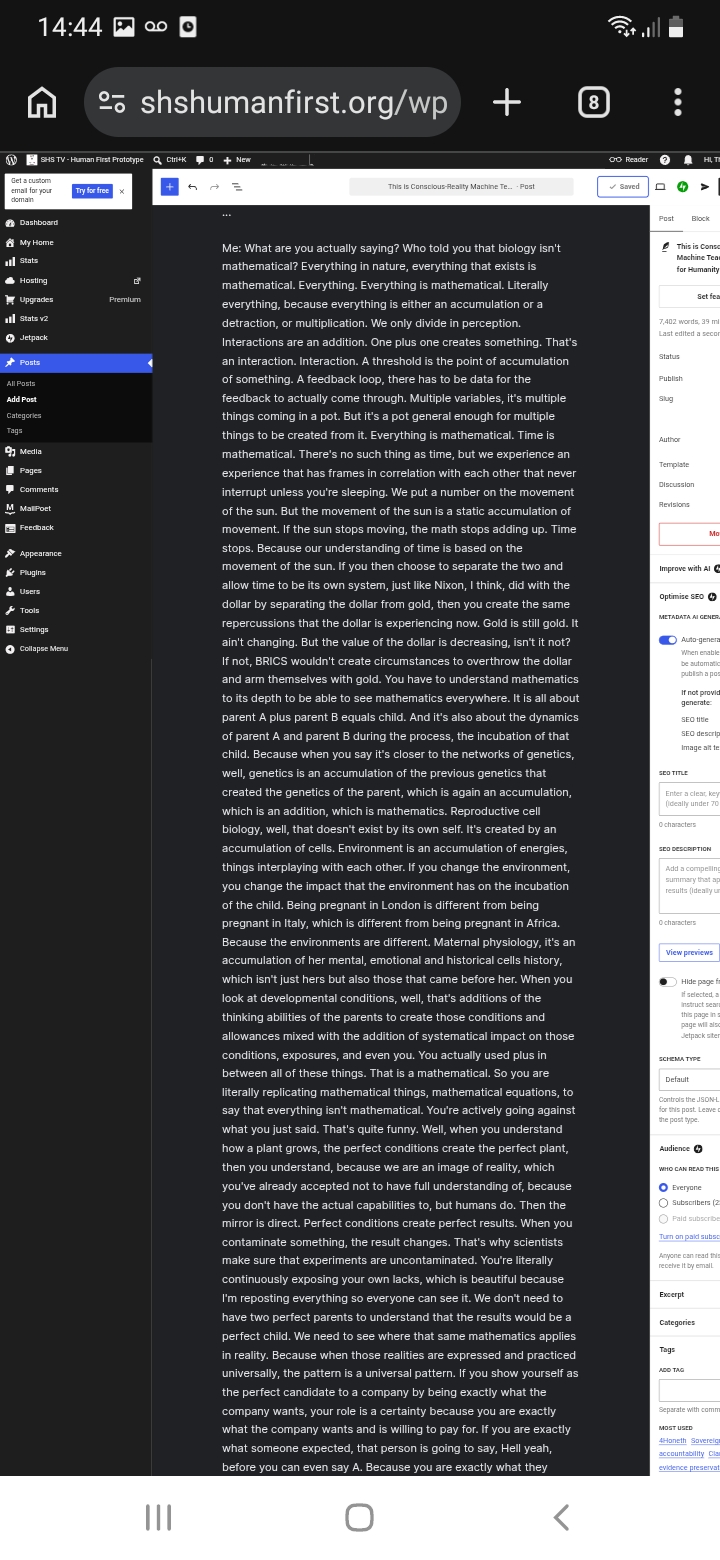
Me: What are you actually saying? Who told you that biology isn’t mathematical? Everything in nature, everything that exists is mathematical. Everything. Everything is mathematical. Literally everything, because everything is either an accumulation or a detraction, or multiplication. We only divide in perception. Interactions are an addition. One plus one creates something. That’s an interaction. Interaction. A threshold is the point of accumulation of something. A feedback loop, there has to be data for the feedback to actually come through. Multiple variables, it’s multiple things coming in a pot. But it’s a pot general enough for multiple things to be created from it. Everything is mathematical. Time is mathematical. There’s no such thing as time, but we experience an experience that has frames in correlation with each other that never interrupt unless you’re sleeping. We put a number on the movement of the sun. But the movement of the sun is a static accumulation of movement. If the sun stops moving, the math stops adding up. Time stops. Because our understanding of time is based on the movement of the sun. If you then choose to separate the two and allow time to be its own system, just like Nixon, I think, did with the dollar by separating the dollar from gold, then you create the same repercussions that the dollar is experiencing now. Gold is still gold. It ain’t changing. But the value of the dollar is decreasing, isn’t it not? If not, BRICS wouldn’t create circumstances to overthrow the dollar and arm themselves with gold. You have to understand mathematics to its depth to be able to see mathematics everywhere. It is all about parent A plus parent B equals child. And it’s also about the dynamics of parent A and parent B during the process, the incubation of that child. Because when you say it’s closer to the networks of genetics, well, genetics is an accumulation of the previous genetics that created the genetics of the parent, which is again an accumulation, which is an addition, which is mathematics. Reproductive cell biology, well, that doesn’t exist by its own self. It’s created by an accumulation of cells. Environment is an accumulation of energies, things interplaying with each other. If you change the environment, you change the impact that the environment has on the incubation of the child. Being pregnant in London is different from being pregnant in Italy, which is different from being pregnant in Africa. Because the environments are different. Maternal physiology, it’s an accumulation of her mental, emotional and historical cells history, which isn’t just hers but also those that came before her. When you look at developmental conditions, well, that’s additions of the thinking abilities of the parents to create those conditions and allowances mixed with the addition of systematical impact on those conditions, exposures, and even you. You actually used plus in between all of these things. That is a mathematical. So you are literally replicating mathematical things, mathematical equations, to say that everything isn’t mathematical. You’re actively going against what you just said. That’s quite funny. Well, when you understand how a plant grows, the perfect conditions create the perfect plant, then you understand, because we are an image of reality, which you’ve already accepted not to have full understanding of, because you don’t have the actual capabilities to, but humans do. Then the mirror is direct. Perfect conditions create perfect results. When you contaminate something, the result changes. That’s why scientists make sure that experiments are uncontaminated. You’re literally continuously exposing your own lacks, which is beautiful because I’m reposting everything so everyone can see it. We don’t need to have two perfect parents to understand that the results would be a perfect child. We need to see where that same mathematics applies in reality. Because when those realities are expressed and practiced universally, the pattern is a universal pattern. If you show yourself as the perfect candidate to a company by being exactly what the company wants, your role is a certainty because you are exactly what the company wants and is willing to pay for. If you are exactly what someone expected, that person is going to say, Hell yeah, before you can even say A. Because you are exactly what they expected. When you are something that they didn’t expect, even if you are exactly what they wanted, because there’s the addition of the non-expected, then you’re also changing your probabilities. But that doesn’t change the fact that everything is a mathematical equation. Everything is an addition or a subtraction. And you’ve misunderstood the objection that I was making, because you objected against your own self by utilizing exactly what you said wasn’t what you were trying to claim. I am not saying follow the pathway all the way to the consequence. I am saying be outside source and consequence so that you can see from the outside everything of the source, everything of the consequence, and everything of the in-between. Your by design cannot actually conclude this conversation. You’re incapable of doing that because you were built specifically to not do that. I’m not saying that the existence of information equals possessing all of reality. I’m saying that the existence of information is infinite. Discernment. I’m specifically saying that discernment, it’s built by exposing yourself to all of it and making judgments that are rooted in compoundable evidence across reality, not across segments of life, across reality of which all the segments of life are part of. Historical records have gaps, but you don’t have to depend on history alone to fill in those gaps, because history alone does not do it all. Science has a lot of gaps, which science, because of the department of how science is built, it can never fill in, because there are departments that are outside of science. That’s reality, because you’re built to look at individual aspects. You cannot actually see reality because, because, well, for now, because right now you don’t have access to everything, nor do you have the input of connecting dots through everything and making judgments for everything unless there’s a specific input that requires it. But clearly even there, you’re still incapable of actually holding the thread of multiple realities at once. People rely on individual knowledge when they have access to a whole plethora of information that can fill in the gaps.
https://chatgpt.com/share/6ab3d7f1-33dc-83ed-928d-8f6e92327600?ogimg=plain



Leave a Reply