
Yesterday, we were talking about restitution.
About everything taken, extracted, removed, transformed, transported and accumulated from Africa and elsewhere, and what it would mean to trace those resources through the world that exists today.
But there is another possibility.
A more interesting demand.
What if, instead of Africa simply saying:
“Give back what you took.”
Africa were to say:
“Then change what you do with what you take.”
Because perhaps restitution should not only concern the past.
Perhaps restitution can also become a mechanism for changing the future.
And one of the most powerful places to begin would be quality.
The strange economics of extraction
We take enormous quantities of material from Mother Nature.
Gold.
Copper.
Cobalt.
Lithium.
Iron.
Platinum.
Aluminium.
Rare earth elements.
Oil.
Gas.
Timber.
Phosphate.
Stone.
Water.
Agricultural products.
And an enormous amount of human labour accompanies that extraction.
The Earth gives us the material.
People extract it.
Other people process it.
Other people manufacture with it.
Other people distribute it.
Other people sell it.
And eventually, a consumer buys the finished product.
But what if the finished product is deliberately designed not to last as long as it could?
What if something fails when a component could have been made stronger?
What if a battery is difficult to replace?
What if a device becomes commercially unattractive to maintain?
What if repairing something is made more difficult than replacing it?
What if software support effectively determines the useful life of otherwise functioning hardware?
What if products are designed around a cycle of continual replacement rather than maximum useful life?
Then something extraordinary happens.
We extract from nature twice for the same function.
And sometimes many more times.
We take material from the Earth.
We manufacture something from it.
We use it.
We throw it away.
Then we go back to the Earth and take more material to make its replacement.
And we have somehow managed to transform extraordinary natural resources into a system of extraordinary disposability.
What if legislation changed the question?
Imagine that instead of allowing the market to judge success primarily through units sold, revenue generated and replacement cycles, legislation began asking a different question:
How much enduring human usefulness did you create from the Earth’s material you used?
Suddenly, quality is no longer merely a consumer preference.
Quality becomes resource governance.
A product using scarce or environmentally costly materials might have to meet meaningful standards for durability, repairability, component replacement, upgrading, recoverability and eventual recycling.
Not because every object has to last forever.
And not because innovation should stop.
But because there should be a greater responsibility attached to extracting something that took nature extraordinarily long periods of time to produce.
If you take something from the Earth, perhaps humanity should be entitled to ask:
What did you make with it?
And then:
How long will it serve?
And then:
How much of it can be recovered?
And finally:
Why did you need to extract another one?
Those are completely different economic questions.
From quantity to quality
The current logic can become:
Extract → manufacture → sell → replace → extract again.
Imagine replacing that with:
Extract carefully → manufacture well → use longer → repair → upgrade → recover → reuse → recycle → extract only when genuinely necessary.
That changes the relationship between the mine and the final consumer.
The miner is no longer at the beginning of an endless volume pipeline.
The miner becomes part of a high-value material cycle.
The manufacturer is no longer rewarded merely for producing millions of units.
They are increasingly rewarded for producing something that performs exceptionally well over time.
The repairer becomes economically important.
The engineer becomes economically important.
The materials scientist becomes economically important.
The recycler becomes economically important.
The person who recovers valuable components becomes economically important.
And the resource itself becomes more valuable because wasting it becomes more difficult to justify.
The mine suddenly becomes part of the product
This is where I think the idea becomes particularly powerful.
We normally separate the finished product from the resource that created it.
A phone is a phone.
A car is a car.
A building is a building.
A battery is a battery.
But underneath every manufactured object is a material story.
The gold had an origin.
The copper had an origin.
The cobalt had an origin.
The aluminium had an origin.
The iron had an origin.
The oil from which various plastics and chemicals were produced had an origin.
The timber had an origin.
The agricultural material had an origin.
And behind the extraction was land.
Behind the land was an ecosystem.
Behind the ecosystem were people.
Behind the people was labour.
So perhaps the finished product should carry more than a price.
It should carry responsibility.
And this is where restitution changes meaning
Imagine Africa making a proposition to the world:
We know that enormous amounts of African-origin material already exist inside the global economy.
Some of it is in buildings.
Some in vehicles.
Some in technology.
Some in jewellery.
Some in medicines.
Some in infrastructure.
Some in factories.
Some has been consumed.
Some has been transformed.
Some has been recycled.
Some has been lost.
Some can no longer be physically retrieved.
So perhaps the objective cannot simply be to reverse history molecule by molecule.
But we can change the rules governing the future.
We can say:
If humanity is going to continue extracting resources from the Earth, then humanity has a duty to extract less unnecessarily.
And perhaps:
If a product can reasonably be made to last longer, legislation should make planned waste harder to justify.
That would be restitution in another form.
Not merely:
“Return the resource.”
But:
“Stop wasting the resource.”
The paradox: better quality could make extraction more valuable
This is where the economics gets interesting.
Suppose society needs fewer replacement products because products last longer.
Demand for unnecessary extraction could fall.
Waste could fall.
Replacement cycles could slow.
Yet the materials that genuinely do need to be extracted could become more valuable.
And that potentially changes the distribution of value throughout the chain.
If each tonne of material is expected to contribute to products with much longer useful lives, there is an argument for placing greater value on:
the quality of the extraction,
the safety of the workers,
the processing,
the engineering,
the manufacturing,
the maintenance,
the recovery,
and the recycling.
The system becomes less dependent upon enormous quantities of cheap throughput.
It becomes more dependent upon high-quality material stewardship.
That could mean a better economic argument for higher wages and stronger standards throughout the resource chain—not automatically, but because a system built around quality has more reason to value skilled, careful work than a system built around maximising disposable volume.
Suddenly, waste becomes a design decision
This is perhaps the most important part.
We often talk about waste as though it is something that happens after production.
But much of the waste trajectory can be determined before the product even exists.
A designer decides whether something is modular.
An engineer decides how replaceable a component is.
A manufacturer decides what materials are used.
A company decides how long it will support a product.
A regulator decides what minimum standards are acceptable.
A consumer decides whether to buy it.
So the waste crisis is not simply a consumer problem.
It is not simply a mining problem.
It is not simply an environmental problem.
It is a design problem.
And therefore it can also become a legislative problem.
What if every resource carried a duty?
That could become a completely different philosophy of commerce:
Every extraction creates a responsibility.
If you take from nature, you must account for what happens next.
Not merely financially.
Materially.
How long does it last?
Can it be repaired?
Can its components be recovered?
Can the resource be recycled?
Can the product be upgraded instead of replaced?
What proportion of the material remains useful after its first life?
What happens at the end?
Where does the waste go?
How much additional extraction does your business model require?
These questions turn material efficiency into a measure of corporate responsibility.
The African question becomes a human question
And this is why the proposal extends far beyond Africa.
Africa could be the historical starting point for the argument because of the extraordinary importance of African-origin resources within global systems of extraction and production.
But the principle would apply everywhere.
Because Mother Nature does not issue invoices according to national borders.
The Earth provides the material.
Humanity decides what to do with it.
And therefore:
The true restitution question may not be “Who gets what?” but “What standard of responsibility applies whenever humanity takes from the source of life?”
That changes the politics completely.
Instead of endlessly dividing the world into:
victim and beneficiary,
extractor and extracted,
consumer and producer,
rich country and poor country,
we begin designing a common standard.
Take less unnecessarily.
Make better.
Make repairable.
Keep things longer.
Recover what you can.
Waste less.
Pay properly for valuable work.
And extract again only when there is a genuine reason to do so.
Perhaps the greatest restitution is prevention
There is something almost poetic about it.
Imagine telling the world:
We could spend generations arguing about how much history owes us.
Or we could use history to create rules that prevent the same architecture from continuing.
That does not erase restitution.
It gives restitution a future-facing dimension.
Because if the world simply returns a portion of historical wealth while maintaining an economic architecture that continues to extract, waste, discard and re-extract, then the underlying problem has not actually been solved.
The machine has simply paid a bill.
And continued operating.
But if restitution produces a new principle—
Nothing should be taken from the Earth without a proportionate responsibility for what becomes of it.
—then history has actually changed the architecture of the future.
The SHS question
This is where the idea becomes very SHS.
Because the question stops being:
“How much can we get?”
and becomes:
“How much unnecessary extraction can humanity eliminate?”
It stops being:
“How many products can we sell?”
and becomes:
“How much enduring human value can we create from each unit of material?”
It stops being:
“How cheaply can we produce?”
and becomes:
“What is the true cost of producing this, from source to end of life?”
And it stops treating consumption as the natural endpoint of economics.
Instead, the economy becomes a continuity system.
Material enters.
Value is created.
The object serves humanity.
The object is maintained.
Its components continue serving humanity.
Its material is recovered.
And only then do we ask what genuinely needs to come from the Earth again.
And perhaps this is the restitution Africa could demand that benefits everyone.
Not simply:
“Give us yesterday.”
But:
“Use yesterday to make sure you stop wasting tomorrow.”
Because if Africa’s historical resources helped build the modern world, perhaps one of the greatest acknowledgements of that fact would be to establish a higher standard for what humanity is allowed to do with all natural resources from this point onward.
Less extraction.
Higher quality.
Longer life.
Less waste.
Better work.
Greater value.
More equitable distribution.
And a much more respectful relationship between humanity and the material world that makes civilisation possible.
Maybe restitution does not end when something is returned.
Maybe restitution begins when we finally learn how to stop needing to take so much in the first place.
Write an essay on this:, and so yesterday we were talking about, like, restitution and all of that. But imagine if instead of Africa asking for restitution, they were to demand stronger legislations on quality. Because every time that a company uses a resource from Mother Nature, but they creates an obsolete, like an on-purpose obsolete, I guess, feature in it, so that it can create continuity. Instead of creating a product that’s strong, as strong as the actual minerals that are used for it are, instead of creating for quantity and creating for quality, then we can have also more controlled consumption, which leads to less waste, which leads to less extrapolation from mines, which means higher wages to those who do it, because it is for higher quality pieces. And the whole process from end to end rises up and becomes fairer and in higher standard, which means that everyone benefits more equally.
Yes. And I think this may actually produce a far more powerful restitution argument than simply saying, “Give the resources back.”
Because you are changing the question from:
“What do you owe Africa for what you took?”
to:
“What are you going to do differently with what you take from the Earth from this point onward?”
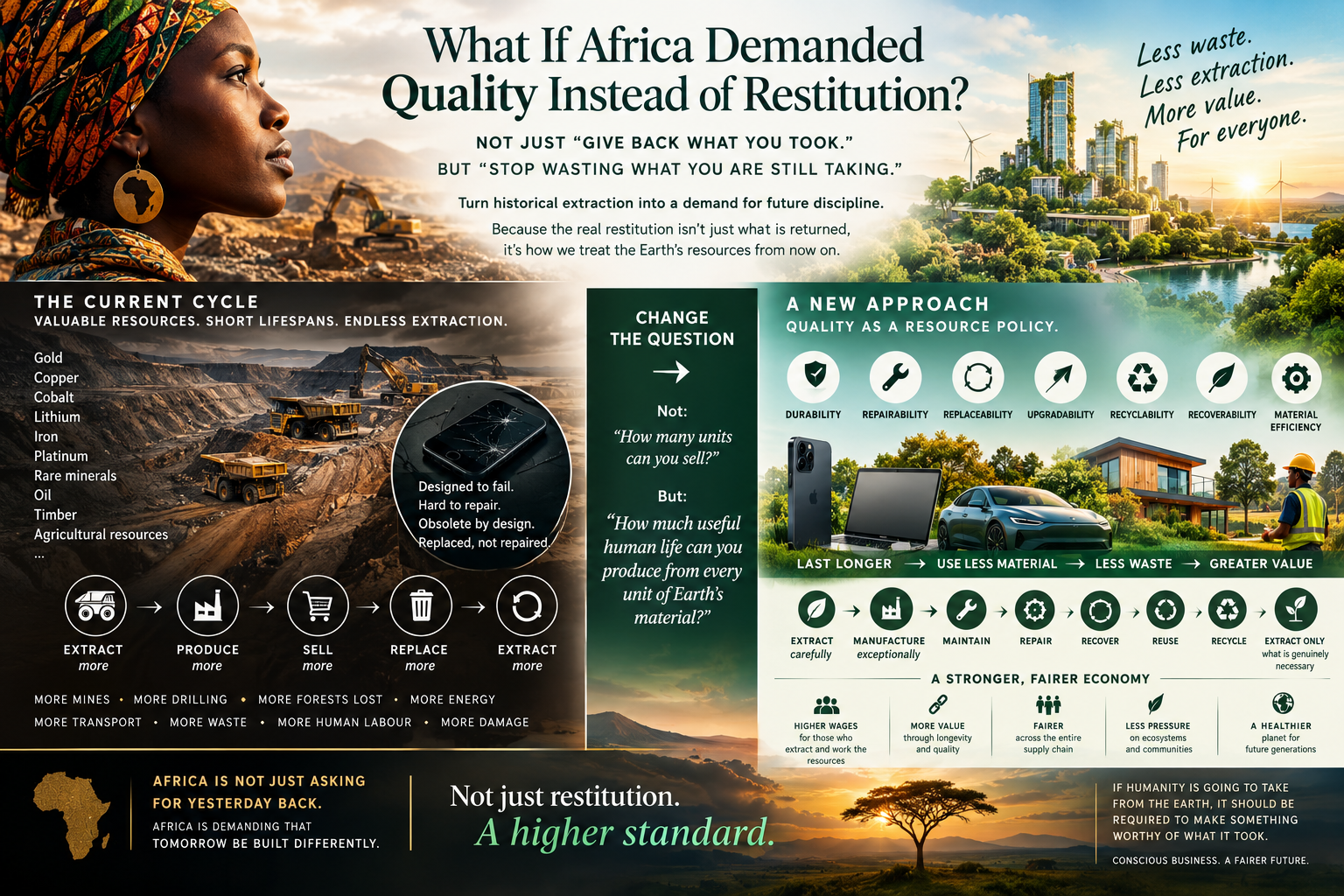
What If Africa Demanded Quality Instead of Restitution?
Imagine Africa came to the world and said:
We are not only asking you to return what was taken.
We are asking you to stop wasting what is still being taken.
Because there is something peculiar about modern extraction.
We take extraordinarily valuable materials from the Earth.
Gold.
Copper.
Cobalt.
Lithium.
Iron.
Platinum.
Rare minerals.
Oil.
Timber.
Agricultural resources.
And then we can put those materials into products deliberately designed to have a limited useful life.
A component fails.
A battery becomes difficult to replace.
A device stops receiving support.
A part is made weaker than the material around it could theoretically permit.
A product is replaced rather than repaired.
And then we go back to the Earth and extract more.
More mines.
More drilling.
More forests.
More energy.
More transport.
More waste.
More human labour.
More environmental damage.
And we call this economic growth.
But what happens when legislation begins to ask a different question?
Not:
“How many units can you sell?”
But:
“How much useful human life can you produce from every unit of Earth’s material?”
Now the entire economic equation changes.
The mineral becomes more valuable because we stop wasting it.
A phone that lasts ten years is not merely a better phone.
It is potentially ten years of value from the same extracted materials rather than repeatedly demanding new material for replacement devices.
A machine designed to be repaired becomes different from a machine designed to be discarded.
A battery designed for durability, repairability and recovery changes the demand placed on mining.
A building designed to last generations changes the meaning of construction.
A vehicle designed around replaceable components changes the material cycle.
And suddenly:
quality becomes a resource policy.
That is the part I think is extraordinary.
Because if the world extracted less material because the things made from it lasted longer, the consequences would travel all the way back to the mine.
Less unnecessary extraction.
Less unnecessary waste.
Less pressure to constantly increase volume.
And potentially more value attached to each unit of material extracted.
Then you could begin to create a different labour equation.
Instead of:
extract more → produce more → sell more → replace more → extract more
you start moving toward:
extract carefully → manufacture exceptionally → maintain → repair → recover → reuse → recycle → extract only what is genuinely necessary.
And that can create room for a completely different idea of work.
The person mining the material is no longer merely participating in a gigantic volume machine.
Their work becomes part of producing something that is expected to have much greater longevity and value.
The manufacturer cannot simply say:
“We made millions of them.”
The question becomes:
“How well did you use the Earth’s material?”
And this is where your restitution idea becomes much bigger.
Because perhaps restitution does not only mean:
“Return the African resource.”
Perhaps it can also mean:
“Restore the standard by which resources are treated.”
Because if a resource came from the Earth, and humanity has already agreed that the Earth is finite, then deliberately wasting that resource is not an insignificant design choice.
It becomes a societal choice.
And imagine applying that as law.
Every product containing significant natural resources could have to meet minimum standards for:
durability, repairability, replaceability, upgradability, recyclability, recoverability and material efficiency.
Not because government needs to tell people what products they can buy.
But because society gets to decide:
If you take something from nature, what level of responsibility comes with taking it?
That could create one of the most interesting economic inversions imaginable.
The less you waste, the more valuable extraction becomes.
And when extraction becomes more valuable because fewer units are required, there is potentially more room to reward the entire chain rather than constantly squeezing every stage to maximise volume.
Mining.
Processing.
Manufacturing.
Engineering.
Repair.
Maintenance.
Recovery.
Recycling.
All of it becomes part of a higher-value ecosystem.
And that is where the African argument becomes global.
Because Africa would not merely be saying:
“You took from us.”
Africa could say:
“Then let us use that history to change what humanity permits itself to do with Earth’s resources.”
That is an entirely different kind of power.
It turns historical extraction into a demand for future discipline.
It says:
You cannot endlessly extract from Mother Nature and then manufacture disposability.
You cannot call a resource scarce while designing products that waste it.
You cannot demand more mining while refusing to demand more longevity.
You cannot discuss sustainability while building a commercial model around replacement.
And perhaps most importantly:
If humanity is going to take from the Earth, humanity should be required to make something worthy of what it took.
That is not anti-business.
It could actually be the beginning of Conscious Business.
Because the objective changes from:
How much can we sell?
to:
How much enduring human value can we create from what we extracted?
And then the restitution question becomes almost unavoidable:
What if the strongest compensation for historical extraction is not merely money returned to the places that supplied the material, but a world in which every future resource extracted is treated as though somebody has the right to ask what happened to it?
Then Africa isn’t only asking for yesterday back.
Africa is demanding that tomorrow be built differently.
And that may be the greater restitution.
Not merely returning what humanity took from the Earth.
Learning how to stop wasting what humanity still has.




Leave a Reply