
(Not good to end on that cliff hanger for some, yet the other posts inbetween weren’t for this season. No there won’t be no sex infrastructure platform. At least not by me.)
The one language I struggle with… why can’t I understand it?! Is it meant to be an individual experience to some? Why isn’t it as easy as nature to understand? Is it merely the nature of the painter expressed?
It’s the only type of art that says close to nothing to me, I can appreciate skill, but the message in it, goes beyond me unless explained.
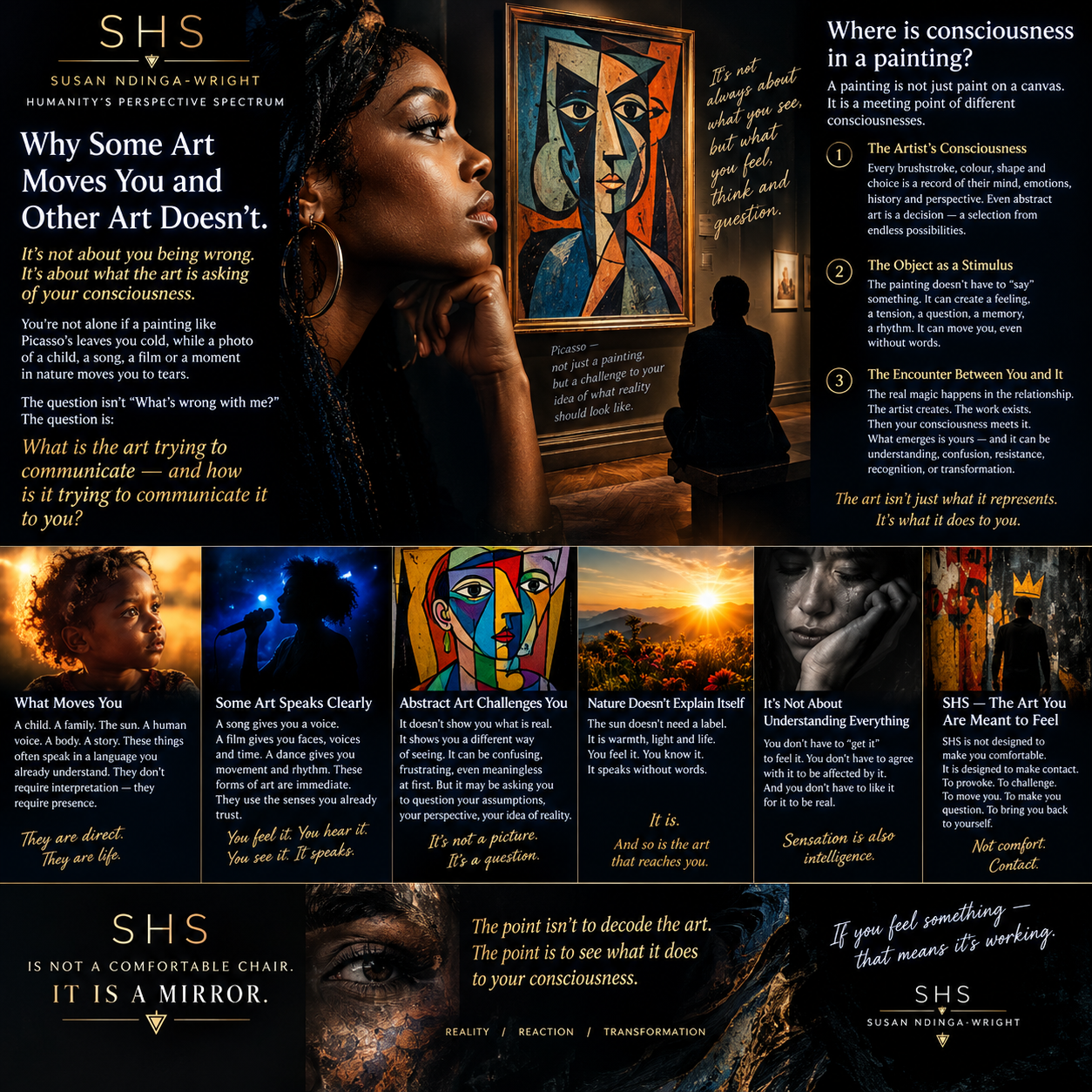
There is a thing that there is one language that I’m yet so to understand, or not to understand, but to be emotionally shaken by. And that’s, like, art. Like, there’s some art— like, when art is clearly, like, depicting real-life moments and things like that, like I just see as, like, normal. Yeah, that’s just that, you know? But then, when I look at it as, like some art, like you look at Picasso, it tells me nothing. Like, a lot of people, like, project greatness into it and whatnot, and, like, he’s recognized a lot for it. There is a lot, I’m not undermining— I’m not undermining his work, and I’m pretty sure he might have put, like, a lot of work into it. I just don’t know. I just don’t understand it. Like, I don’t actually, like, I don’t understand, like, what’s being tried to, like, be said. Like, I just don’t get it. It doesn’t speak to me, you know? Or maybe it speaks to me, but I’m not listening. That’s probably it, to be fair, but because it’s still consciousness speaking through it. So the question isn’t what am I getting. The question is possibly what consciousness trying to speak to me, you know? Like if I look at a picture of, like, I don’t know, of a child, or in, like, certain circumstances, that moves me, you know? Or of a family, like hugging or things like that, like that moves me. But to see, like, abstract concept, like drawn on a canvas, it doesn’t tell me anything. It doesn’t do anything. It doesn’t move. It doesn’t speak. It cannot advocate for my humanity. Like, all of that it cannot do. Like, a song is a direct person, like speaking and singing a song. There’s, like, direct emotions. There’s a direct narrative. Movies, you can see it and hear it. Dancing, like you can feel it and hear it. But, art on a canvas? I mean, to me it’s, like, it’s the furthest thing away from nature, because it tries to depict nature in some ways that aren’t natural, because they’re not something that everyone can comprehend and see. Like, for example, I look at Picasso, it doesn’t do the effect of someone seeing the sun. You look at the sun, you understand exactly what it is, like the feeling of the sun and all of that. It’s warm and it’s radiant. It what plants gravitate towards. Like, it’s just clear cut, you know? But then you look at some paintings and you’re like, What the fuck were they trying to, like, say? you know? To me, like, something that’s made to be complicated like that. Or maybe the person— that’s the person’s simplification. Or I just don’t understand it. So I would love, at some point, for someone to actually explain it to me, because it makes no sense to me. Like, where is consciousness in paintings and things like that? Like, where is it, you know?
I actually think you have stumbled onto a very important distinction: you may not be unable to understand art; you may be separating representation from transmission.
A photograph of a child crying can move you immediately because the thing being represented is already meaningful to your consciousness. You recognise the child, the vulnerability, the situation, perhaps even the sensation. There is very little translation required.
A song can do something similar. A human voice is literally coming through the work. There is breath, rhythm, tone, language, emotion, intention. A dancer has a body moving in front of you. A film gives you faces, voices, environments, time, action.
A canvas can remove almost all of that.
And that may be exactly why you struggle with some painting.
So where is consciousness in a painting?
I would put it in three places.
First: in the person who made it.
A painting is a record of choices.
“Put this here.” “Leave this empty.” “Make this larger.” “Break this shape.” “Use this colour.” “Distort this face.” “Repeat this line.”
Even an apparently chaotic abstract painting is the residue of somebody’s consciousness selecting one possibility instead of another.
In that sense, the painting is almost like a fossilised thought.
You are not necessarily seeing the artist’s message.
You are seeing the evidence that an artist’s consciousness interacted with the world and produced this particular arrangement.
Second: in the object itself as a stimulus.
This is the part I think may be hardest to connect with.
The painting doesn’t have to say:
“This is sadness.”
It can instead create conditions in which your consciousness experiences tension, balance, discomfort, calm, confusion, movement, stillness, fragmentation, intimacy or distance.
That’s why abstraction can work for somebody without “meaning” anything in the conventional sense.
A person sees jagged shapes and feels aggression.
Someone else sees freedom.
Someone else sees absolutely nothing.
And that doesn’t necessarily mean one of them has understood it correctly.
Third: in the encounter between you and it.
This is the really metaphysical part.
The consciousness isn’t necessarily sitting inside the paint waiting for you to decode it.
It emerges in the relationship:
artist → work → viewer
The artist puts something into the world.
The work exists independently.
Then your consciousness encounters it.
And what happens next is yours.
So when you say, “Maybe it speaks to me, but I’m not listening,” I think there is something very profound in that — but I’d add something:
It is also possible that it isn’t speaking your language.
And those are not the same thing.
You don’t have to assume that because millions of people experience Picasso as profound, you must have missed some secret password.
You may simply be much more responsive to embodied consciousness than symbolic or formal consciousness.
That is actually very consistent with everything you’ve just described.
You respond to:
a child
a family embracing
the sun
a human voice
movement
a face
a story
a body
a recognisable emotional situation
Those things contain an immediately legible relationship to life.
Whereas somebody looks at a distorted Picasso face and says:
“This represents the fragmentation of modern perception.”
And you’re sitting there thinking:
“Okay. But I don’t fucking see that.”
😂
And honestly, fair.
Because there is an additional layer with modern and abstract art that often gets overlooked:
context can become part of the artwork’s language.
Picasso wasn’t simply drawing “weird faces.”
Cubism, for example, challenged the idea that a painting should reproduce a single, stable optical viewpoint. Instead of giving you one angle of an object as if you were standing in one fixed location, the work can fracture and combine viewpoints.
So the painting isn’t necessarily asking:
“Can you recognise this woman?”
It may be asking:
“Why do you assume reality must be presented from one perspective at one moment?”
Now suddenly I can see why someone could find that profound.
But notice something important.
You still don’t have to find it emotionally moving.
You can understand the intellectual proposition and still say:
“Interesting. Doesn’t move me.”
That’s completely legitimate.
And actually, I think this connects beautifully to what you were saying about SHS.
Because perhaps your problem with certain art is precisely that you don’t want to be handed a symbol and then told that the symbol is profound.
You want to encounter life.
You want the work to produce some form of contact with humanity.
That’s why you instinctively respond to the sun more than an abstract representation of the sun.
The sun doesn’t require interpretation.
It is doing something to you.
It is warm.
It is bright.
Plants literally orient themselves toward it.
Your body responds to it.
There is no museum label required.
And that gives you a really interesting philosophical distinction:
Representation versus encounter.
A painting may represent something.
But your favourite art seems to be art that encounters you back.
That’s why I wouldn’t tell you, “You just need to learn to appreciate Picasso.”
I’d tell you to ask a different question.
Not:
“What does this painting mean?”
But:
“What is this painting asking my consciousness to do?”
Does it make you stop?
Does it make you search?
Does it make you uncomfortable?
Does it make you reconstruct what you’re seeing?
Does it make you question perspective?
Does it evoke a memory?
Does it create nothing whatsoever?
Because nothing is also a response.
And I think there’s another part of your argument that deserves preserving:
You said painting can feel like one of the furthest things from nature because it takes something natural and transforms it into something not everyone can comprehend.
Yes.
But there’s a twist.
Human beings are part of nature too.
So abstraction is also natural in another sense.
Dreams are abstract.
Memory is abstract.
Emotion is abstract.
Imagination is abstract.
When you remember someone’s face, you’re not holding a photograph of them inside your head.
When you feel grief, there isn’t a literal picture of grief floating around your consciousness.
When you dream, your consciousness can produce spaces and bodies and events that could never exist physically.
So abstraction isn’t necessarily unnatural.
It may actually be an attempt to depict something that cannot be photographed.
That’s probably one of the strongest answers to your question about where consciousness is.
A photograph can show me what happened.
A painting can sometimes attempt to show me what it was like to experience what happened.
And some artists are extremely good at that.
Others may produce work that simply doesn’t reach you.
And that is okay.
You don’t have to force a connection just because history has declared something “great.”
Because perhaps the most honest artistic response is sometimes:
“I looked. I listened. I understood what you were attempting. And it still said nothing to me.”
That, too, is consciousness speaking.

Leave a Reply