
Prpbabbly the only thing thst can match the level of hate and desire that shs does. Only thing it’s that in this one, no one can hide, it would be name first.
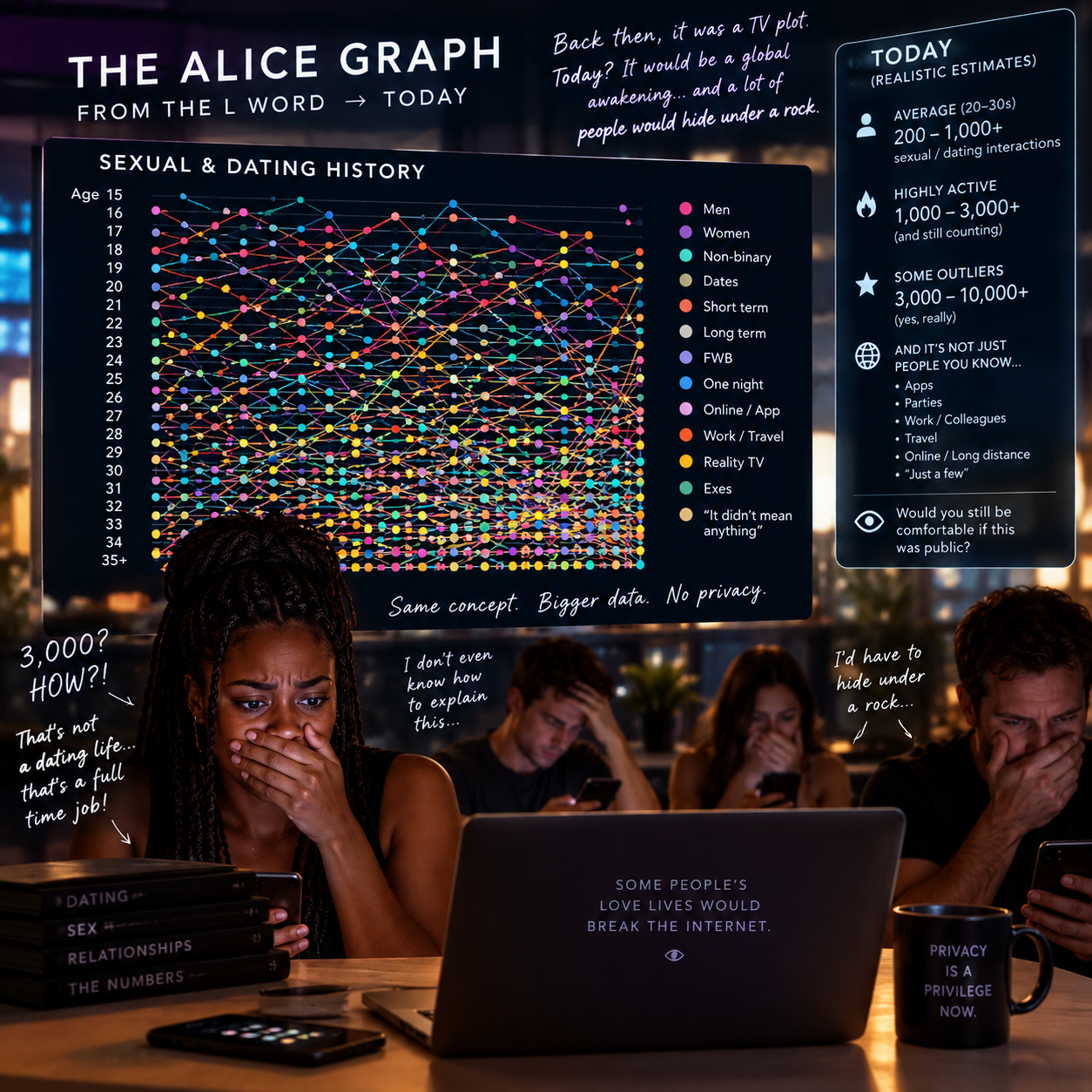
Imagine Alice’s chart from The L Word existing today, except we take it one step further.
Not only would the chart show who has interacted with whom.
It would show the possible energetical infrastructure of human interaction.
Because from a metaphysical perspective, an interaction is not necessarily the end of the energetic exchange. It can be an entry point.
When I directly interact with another person — emotionally, sexually, psychologically, intimately — I am not interacting with an isolated human being.
I am interacting with a person who has already been shaped by everyone they have encountered before me.
So, using an illustrative model, suppose I have sex with Person B.
Person B becomes my closest energetic connection in that particular exchange.
You could imagine that direct interaction carrying the greatest proportion of influence — say, 50%.
But Person B did not arrive as a blank energetic container.
They arrived carrying the residue of their own relationships.
So perhaps within that remaining energetic structure, there is another degree of influence:
25% associated with the people Person B has directly interacted with.
Then perhaps 15% from the people those people interacted with.
Then 7%.
Then 3%.
Then smaller and smaller degrees as the network extends outward.
The numbers themselves are illustrative.
The principle is what matters:
proximity decreases, but does not necessarily become zero.
And suddenly the Alice chart becomes something completely different.
It stops being merely a sexual network.
It becomes an energetic network.
Because Person B may have directly interacted with me.
But Person B may also have interacted with 20 people before me.
Those 20 people may have interacted with hundreds of others.
Those hundreds may have interacted with thousands.
And now imagine that one person sitting across from me is connected, directly or indirectly, to an enormous number of human beings.
I may therefore believe:
“I slept with one person.”
Metaphysically, the argument would be:
You interacted directly with one person who was already carrying the residue of an entire network.
That is the part that becomes fascinating when you place the idea onto a graph.
Because the graph does not merely show quantity.
It shows degrees of access.
The person immediately connected to you occupies the first layer.
The people connected to them occupy another.
The people connected to those people occupy another.
And with every layer, the intensity theoretically becomes weaker — but the network becomes larger.
So you could have something like:
You → Person B → 20 people → 300 people → 4,000 people → 50,000 people…
Obviously, that does not mean you suddenly contain all of those people equally.
That would destroy the distinction between direct experience and indirect residue.
The point is precisely the opposite.
There are degrees.
The direct person has the greatest proximity.
The people immediately behind them have less.
The people behind those people have less again.
And so on.
It is almost like standing in the centre of a series of energetic ripples.
The person you touched is the first ripple.
Their experiences are the second.
Their previous connections become the third.
And the network continues expanding outward.
Now imagine putting that onto Alice’s chart.
Imagine being able to see not only that somebody has slept with hundreds of people, but the enormous network of relationships sitting behind every one of those encounters.
Suddenly “body count” becomes an almost ridiculously shallow measurement.
Because two people could each have slept with ten people while carrying completely different relational histories.
One person’s network might be extremely contained.
Another person’s network might intersect with thousands.
The number of direct encounters would therefore tell you only one layer of the picture.
The graph would reveal the infrastructure behind the person.
And that is where this becomes uncomfortable.
Because humans generally think of intimacy as belonging to two people:
me and you.
But a metaphysical interpretation asks whether it is ever truly only two.
What did you bring into the encounter?
What did they bring?
What had already happened to them?
What emotional material had they not resolved?
What attachments, experiences, fears, habits, desires, beliefs and relational patterns had already been formed through previous encounters?
And what did the other person carry?
And the person before them?
And the person before that?
Suddenly an intimate interaction can be conceptualised as an exchange occurring inside a much larger human network.
Which makes Alice’s chart almost terrifyingly brilliant.
Because perhaps the most revealing thing about the chart would not be seeing how many people someone had slept with.
It would be seeing how interconnected everybody actually is.
You think you encountered one person.
The graph shows you encountered a node.
And behind that node is a history.
Behind the history is another history.
Behind that history is another human being.
And another.
And another.
Until you realise that human intimacy may be less like a series of isolated encounters and more like an enormous web in which every person is carrying some portion of where they have already been.
From that perspective, Alice wasn’t merely drawing people’s sex lives.
She was unknowingly drawing human energetic inheritance.
And if somebody ever made that chart fully visible today?
People wouldn’t just be embarrassed by the number of connections.
They might be forced to confront the possibility that none of us enters another person’s field completely alone.


Leave a Reply