
I’d be audacious to say that those eho can’t hold a personality rooted in authenticity are. Those who are different with family, then friends, then lovers, the collesgues. Code switching is Bipolarism nornalised. It’s a way of life, not singular expressions.
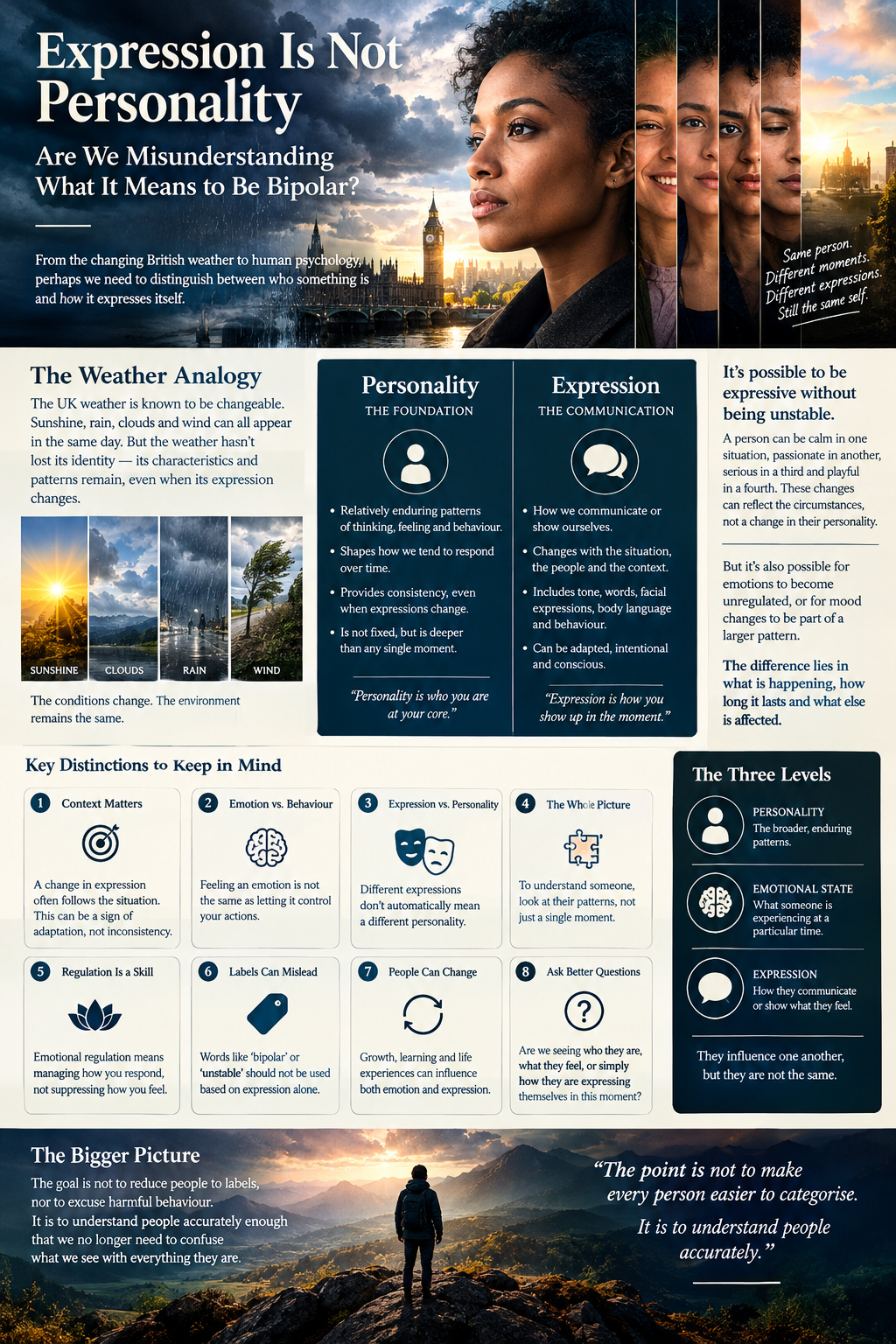
From the changing British weather to human psychology, perhaps we need to distinguish between who something is and how it expresses itself.
I was recently talking about the weather in the UK and describing it as bipolar.
One moment, it is sunny. The next, it is raining. The sky changes its appearance several times throughout the day, sometimes giving the impression that the weather cannot make up its mind about what it wants to be.
But then I started thinking about what we were actually describing.
Has the weather changed its identity, or has its expression changed?
The weather has its own recurring characteristics. We recognise the British climate through its patterns, conditions and variations. Yet those characteristics can express themselves differently depending on the atmospheric conditions at a particular moment.
Sunshine does not mean the weather has become one thing, only for rain to turn it into something else. Both are expressions of changing conditions within the same environment.
And that led me to a much more interesting question about human beings.
Are we sometimes identifying people by the changes in their expressions rather than understanding the personality from which those expressions emerge?
Because expression and personality are not the same thing.
1. Personality is not the same as expression
Consider two people.
The first person is calm when speaking to a child, firm when addressing an employee, playful when spending time with friends and serious when discussing a difficult subject.
The second person displays anger during an ordinary conversation, remains angry after the situation has passed, and continues reacting through that emotion even when the circumstances have changed.
Both people display different emotional expressions.
But the meaning of those expressions may be entirely different.
The first person is adapting their communication to the circumstances. Their tone, words, facial expressions and emotional presentation change because the situation calls for a different response.
The second person’s experience may involve difficulty regulating their emotional state, returning to their usual baseline or responding proportionately to what is happening.
We should not automatically interpret both situations in the same way.
Changing expression does not necessarily indicate an unstable personality. And a relatively consistent personality does not mean a person must express themselves consistently in every situation.
A person can be gentle without speaking gently to someone who is threatening them. A person can be patient without tolerating every inconvenience. A person can be serious without being humourless, and confident without behaving confidently in every environment.
The personality may remain recognisable while its expression changes.
This is an important distinction because human beings are not required to communicate identically in every circumstance to possess a coherent sense of self.
Sometimes, the ability to change one’s expression is precisely what allows a person to respond appropriately to reality.
2. The weather analogy: stable characteristics, changing conditions
Let’s return to the British weather.
We know that the weather in the UK can change quickly. We might experience sunshine, clouds, wind and rain within a relatively short period.
When we describe this as bipolar, we are using the word colloquially to communicate how changeable it appears.
But the weather is not displaying a human personality. Its changing conditions are part of atmospheric processes, and the UK’s familiar climatic characteristics can coexist with considerable day-to-day variation.
The underlying environment and its immediate expression are different levels of description.
Now consider the human equivalent.
A person may have a naturally expressive disposition. They may be animated, emotionally responsive, direct, humorous, contemplative or serious. Their particular characteristics do not require them to maintain one emotional expression regardless of their circumstances.
They may laugh when something is funny, become serious when something matters, show frustration when a situation is frustrating and express warmth when interacting with someone they care about.
Their emotional expression changes, but the change can follow a recognisable logic.
The situation influences the response.
This is not necessarily inconsistency. It may be contextual responsiveness.
Imagine accusing the weather of having no identity because the sun eventually gives way to rain. We would be confusing a change in conditions with the identity of the environment itself.
Could we be making a comparable mistake when we interpret every change in a person’s tone, mood or behaviour as evidence that they do not know who they are?
The question deserves consideration.
3. Personalising expression is not the same as changing personality
Think about a business that personalises its service according to the customer.
A customer who needs detailed explanations receives them. A customer who prefers efficiency receives a more direct service. Someone who needs reassurance receives a different style of communication from someone who simply wants the task completed.
The service is adapting its delivery to the person and the circumstances.
We do not necessarily conclude that the business has lost its identity because its delivery changes.
We recognise that the same underlying service can be expressed differently to meet different needs.
Human communication can work in a similar way.
A person might speak gently when someone is distressed, challenge someone who is making a harmful decision, adopt a professional tone in a formal environment and become playful when the circumstances are appropriate.
They are personalising their expression.
The words change. The tone changes. The emotional presentation changes. The intention, principles and underlying personality may remain consistent.
This is particularly important when assessing people who communicate with intensity or have a wide expressive range.
A person who speaks passionately about one subject and calmly about another is not necessarily contradicting themselves. The difference may reflect the significance of the subject, the demands of the situation or the emotion relevant to that particular interaction.
The fact that someone expresses themselves differently in different circumstances does not, on its own, tell us whether their underlying personality is consistent or inconsistent.
We have to examine what is changing, why it is changing and whether the response relates to the circumstances.
4. When the expression follows the situation
Consider someone responding to four different situations.
When a friend shares good news, the person becomes excited and expressive.
When someone discloses a painful experience, the person becomes quiet, gentle and attentive.
When they encounter an injustice, their tone becomes firm and their language more forceful.
When they are relaxed among people they trust, their humour and playfulness become more apparent.
Their expressions are different because the situations are different.
In each case, the response can be understood in relation to what is happening.
Now imagine observing that person without considering the context.
One moment, they are excited. The next, they are quiet. Later, they are forceful. After that, they are playful.
An observer who sees only the outward changes might describe them as unpredictable.
But unpredictability is not necessarily what is happening.
The observer may be missing the relationship between the circumstances and the expression.
What looks like inconsistency at the level of appearance may be consistency at the level of response.
The person is repeatedly doing the same underlying thing: adapting their expression to the situation.
This does not mean every situational response is automatically appropriate. A person can react disproportionately to a genuine event, misinterpret what is happening or express a legitimate emotion in a damaging way.
But the relevant question is not simply whether their expression changes.
It is whether we understand the relationship between their expression, their emotional state, the circumstances and their behaviour.
Without that understanding, we risk judging the visible response while overlooking the process producing it.
5. When the emotional state and the situation appear disconnected
There is another side to the distinction.
Sometimes, a person’s emotional state seems disconnected from the immediate circumstances. Their reaction may persist after an event has passed, become unusually intense, or change alongside other aspects of their behaviour in ways that are difficult to explain solely by what is happening around them.
This is different from simply using a different tone in a different situation.
For example, someone might experience prolonged irritability that continues across unrelated situations. Another person may experience periods of unusually elevated energy, reduced need for sleep and accelerated thinking, followed at another time by a significant depressive period.
These are not simply examples of adapting one’s expression.
They concern broader patterns of mood, energy, activity and functioning.
This distinction matters when we use the word bipolar.
In clinical psychology, bipolar disorder is not defined as having a bipolar personality, possessing contradictory expressions or responding emotionally to different situations. It involves distinct mood episodes, including mania or hypomania and, for many people, depressive episodes. These episodes involve broader changes in mood and other features, such as energy, sleep, activity and concentration, and can last for days or weeks.
Consequently, being expressive, emotionally responsive or variable in one’s communication does not, by itself, establish anything about whether someone has bipolar disorder.
Equally, clinical mood episodes do not have to be entirely disconnected from external circumstances to be clinically significant. The distinction cannot be reduced to whether an emotion has an identifiable trigger.
The more useful question is what kind of change is occurring.
Is it a change in outward expression? A change in emotional state? A sustained change across several areas of functioning? Or a combination of these?
These are different questions, and they should not be answered as though they were interchangeable.
6. Emotional regulation and the ability to change emotional states
Emotional regulation introduces another important distinction.
Regulation does not mean remaining happy, calm or neutral at all times. It does not mean refusing to express anger, sadness, excitement or frustration.
Nor does it mean suppressing an emotion simply because another person finds that emotion uncomfortable.
Regulation concerns how emotions are experienced, expressed and managed.
A person may feel angry and communicate that anger without allowing it to determine every subsequent decision. They may feel disappointed while remaining capable of recognising another person’s perspective. They may experience excitement while still considering the consequences of their actions.
The emotion can be present without completely dictating the person’s behaviour.
Conversely, someone may find that an emotion continues to dominate their responses even after the original circumstances have changed. They may struggle to shift their attention, regulate their behaviour or return to their usual state.
But this, too, requires careful interpretation. Difficulty regulating emotions can have many explanations, and it does not automatically mean someone has bipolar disorder. Clinical assessment considers the wider pattern of experiences and symptoms rather than assigning a diagnosis to a single behaviour.
The important distinction is that having an emotion, expressing an emotion and being governed by an emotion are three different things.
You can experience anger without communicating it aggressively.
You can express frustration without being a fundamentally frustrated person.
You can experience sadness without sadness defining your entire personality.
And you can change your emotional expression without losing your sense of self.
This is why the presence of different emotions should not automatically be treated as a problem. Human beings encounter different circumstances, and different circumstances can reasonably evoke different emotional responses.
The objective is not emotional uniformity.
It is the ability to experience and express emotions in ways that remain connected to reality, personal agency and the circumstances at hand.
7. Are we judging the person, or merely the way they express themselves?
This brings us to a question about how people are perceived and labelled.
When someone speaks loudly, we might describe them as aggressive.
When someone speaks softly, we might describe them as weak.
When someone changes their tone quickly, we might call them inconsistent.
When someone responds emotionally to a particular situation, we might describe them as emotional by nature.
But in each case, we have moved from observing an expression to making a statement about the person.
Sometimes, our interpretation may be justified by a wider pattern. At other times, we may be assigning a lasting characteristic to someone based on a limited observation.
A loud voice does not necessarily establish an aggressive personality. Quietness does not establish weakness. A change in tone does not establish instability.
The expression is something we can observe.
The personality is something we infer from a broader understanding of the person.
That inference may be accurate, but it requires more than the expression alone.
Context matters. Repetition matters. The person’s behaviour across different circumstances matters. The relationship between what they say, what they do and how they respond to others matters.
We should be especially careful when our descriptions become psychological labels.
A label can make an interpretation sound like an established fact, even when the underlying evidence is incomplete.
Before describing someone as unstable, unpredictable or psychologically inconsistent, it is worth asking what we have actually observed and what we have inferred from it.
We may discover that the person is genuinely behaving inconsistently.
We may discover that their expression is responding to circumstances we have not considered.
Or we may discover that we have confused unfamiliarity with a different communication style for evidence of a deeper problem.
Those are not the same conclusions.
8. Personality, emotional state and expression: three levels we should distinguish
To understand this more clearly, consider three separate levels.
Personality concerns relatively enduring patterns in how someone tends to think, feel and behave. It is not completely fixed, but it is broader than any single interaction.
Emotional state concerns what someone is experiencing at a particular time. Their emotional state can be influenced by circumstances, memories, physical conditions and other factors.
Expression concerns how something is communicated outwardly: through words, tone, facial expressions, gestures, behaviour and other forms of communication.
These levels influence one another, but they are not identical.
Someone with a naturally reserved personality can experience intense excitement.
Someone with a generally cheerful disposition can experience profound sadness.
Someone who feels angry can choose to communicate calmly.
Someone who feels calm can speak forcefully because the circumstances require firmness rather than softness.
And someone can change their outward expression without experiencing an equally dramatic change in their underlying emotional state.
The relationship is not one-to-one.
PERSONALITY
The relatively enduring patterns that help describe how a person tends to think, feel and behave.
EMOTIONAL STATE
What the person is experiencing at a particular time, which may or may not correspond closely to the immediate circumstances.
EXPRESSION
How the person communicates or manifests an internal state, intention or response in a particular situation.
Once we distinguish these levels, we can ask more precise questions.
Has the person’s personality changed, or have we simply seen another side of it?
Has their emotional state changed, or have they changed how they communicate it?
Is their expression appropriate to the situation, or is there a persistent mismatch between what is happening and how they are responding?
These questions offer a better starting point than assuming every visible change means the person themselves has become something different.
9. The deeper question: what are we actually measuring?
There is a broader issue beneath this discussion.
Human beings often create categories to help us interpret what we observe. Categories can be useful, but they can also cause us to confuse an observable behaviour with the explanation we assign to it.
We see someone change their expression and describe them as inconsistent.
We see an emotional response and describe the person as emotional.
We see someone behave differently across two situations and assume that one of those behaviours must be the real version of the person.
But human beings are more complex than a single expression.
Sometimes, the most revealing information comes not from the fact that a person changed, but from understanding what changed, under what circumstances, and what relationship that change has to the person as a whole.
This is where the weather analogy becomes useful.
The British weather can change repeatedly without every change representing a new climate. The expression of the conditions changes, while broader patterns remain recognisable.
Human beings also have patterns. But unlike the weather, people can interpret their circumstances, make conscious choices about how to respond, learn from their experiences and deliberately change their behaviour.
This gives us an additional distinction: an emotional response may arise, but the expression of that response can sometimes be consciously shaped.
Feeling and expressing are connected, but they are not identical.
The person who feels frustrated does not have to insult someone. The person who feels afraid does not have to pretend they are fearless. The person who feels strongly about an injustice does not have to communicate that concern in a way that creates further injustice.
Our expressions can reflect our experiences without being entirely dictated by them.
And our ability to adapt our expressions can be a form of agency rather than evidence of inconsistency.
Conclusion: perhaps the problem is not that people change, but that we misunderstand what has changed
Returning to where I began, the British weather may appear to have a different personality every few hours.
Sunshine, rain, clouds and wind produce visibly different conditions, yet those variations belong to the same larger environment.
The analogy raises a worthwhile question about how we understand people.
When someone changes their tone, emotional expression or behaviour, are we observing a change in their personality, a change in their emotional state, or an adaptation in how they express themselves?
We cannot answer that question from appearances alone.
A person who responds differently to different circumstances may be displaying contextual awareness rather than inconsistency. Someone who struggles to regulate their emotions may be experiencing something different from a person who deliberately adapts their communication. Someone experiencing a clinical mood episode may require a different understanding altogether.
These distinctions matter because the words we use influence how we interpret people.
We should not mistake emotional variety for emotional instability, or assume that a consistent personality requires an identical expression in every situation. But we should also avoid using the language of personality or expression to dismiss sustained and significant changes in mood and functioning.
The point is not to replace one simplistic explanation with another.
It is to become more precise about what we are observing.
Personality describes broader patterns. Emotional states describe what someone is experiencing. Expression describes how something is communicated.
They interact, but they are not interchangeable.
And perhaps one of the most important questions we can ask when observing another human being is this:
Am I seeing who this person is, what this person is feeling, or simply how this person is choosing—or managing—to express themselves in the circumstances before them?
Until we learn to distinguish those things, we risk confusing difference with inconsistency, adaptation with instability, and expression with identity.
The objective is not to make every person easier to categorise.
It is to understand people accurately enough that we no longer need to confuse what we see with everything that someone is.

Leave a Reply