
Tgis is all for art’s purposes, the actusl businesses will be further built.
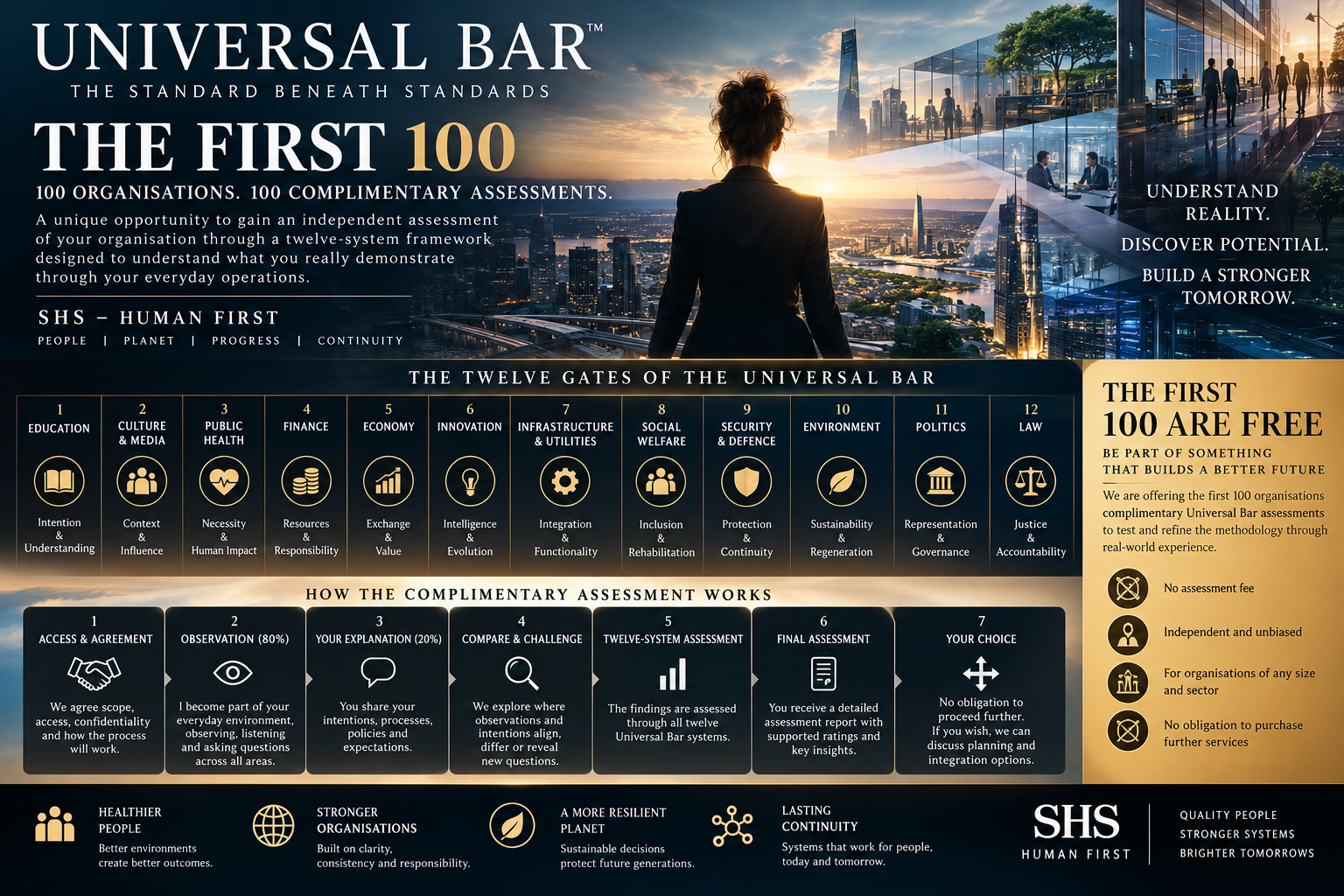
THE FIRST 100
100 Organisations. 100 Complimentary Assessments.
SHS – Human First | The Standard Beneath Standards
I’ve created an 8-page programme for this founding initiative, aligned with the assessment, planning and integration stages of your private Universal Bar operating manual.
📄 Download: The First 100 — Universal Bar™ Assessment Programme
Below is the public-facing announcement.
THE FIRST 100 — AN INVITATION TO ORGANISATIONS OF EVERY SIZE
What does your organisation actually demonstrate through its everyday existence?
Not necessarily what its leadership says.
Not what its marketing communicates.
Not what its policies promise.
But what its ordinary movements, decisions, interactions and results reveal about the infrastructure responsible for producing them.
Through SHS – Human First, I am introducing the first 100 complimentary Universal Bar™ assessments.
The Universal Bar is a twelve-system assessment framework designed to examine how organisations operate, what sustains their performance, how their decisions affect the people participating in them, and whether their existing structures protect long-term continuity.
For this initial programme, the first 100 accepted organisations will receive their assessment free of charge.
There is no obligation to proceed with planning or implementation afterwards.
THE 80/20 ASSESSMENT METHOD
My approach is rather different from conventional consultancy.
I do not intend to begin by sitting across a conference table listening to a company explain how exceptional it is.
I want to experience the organisation before being told what it believes itself to be.
80% — Observation, immersion and questions
I will become part of the organisation’s ordinary working environment.
Moving between departments, meetings, presentations, briefings and day-to-day activities, observing how everything operates.
Think of me as moving like a ghost through the organisation.
Not secretly, but unobtrusively, with the necessary authorisations and without requiring people to stage their working lives for my benefit.
I want to understand the dynamics that exist naturally.
How do people communicate?
Who makes the decisions?
What happens when leadership isn’t present?
What is consistently tolerated?
How are expectations expressed through everyday behaviour?
What are employees required to compensate for when systems don’t function as intended?
And importantly, what does the health and wellbeing of those participating in the organisation tell us about the environment surrounding them?
Because quality isn’t simply an output.
It is also reflected in the conditions under which that output is achieved.
20% — The organisation explains itself
Only after I have developed my independent observations will the organisation have its opportunity to explain its systems, intentions, processes, policies and expectations in detail.
This is where things become particularly interesting.
We compare:
What the organisation intends to represent.
What its infrastructure enables it to represent.
What it actually represents through everyday operations.
And what consequences that representation produces.
I will challenge my own observations against the company’s explanations.
And I will challenge those explanations against the evidence gathered.
Not every apparent contradiction will turn out to be a failure. Some may reveal circumstances that weren’t initially visible.
Others may expose fundamental inconsistencies between an organisation’s aspirations and the infrastructure supporting its daily performance.
That is precisely what the assessment is designed to investigate.
WHY ARE THE FIRST 100 ASSESSMENTS FREE?
Because I want to test the Universal Bar assessment programme through real organisations before establishing its wider professional application.
There is only so much one can discover through theory, simulations and planning.
The actual assessment process will reveal questions that haven’t yet been considered.
Different industries will present different circumstances.
A small family business will function differently from a multinational corporation.
A manufacturing company will present different challenges from a technology business, financial institution, hospitality group or public organisation.
I want to experience those differences.
I want to understand which questions work, which require refinement, which obstacles arise and how access, operational complexity and organisational dynamics influence the assessment process.
The first 100 organisations will help SHS develop the assessment methodology through practical experience.
In exchange, each participating organisation receives an independently developed assessment of its agreed operational scope.
Both parties benefit from the experience.
The organisations gain perspective.
SHS gains the practical knowledge necessary to refine the programme for future participants.
HOW THE PROGRAMME WORKS
The complimentary assessment follows seven phases from my existing private operating strategy.
Phase 0 — Establish the engagement. Agree access, operational scope, confidentiality, authorisations and observation arrangements.
Phase 1 — Independent immersion. Observe the organisation operating under ordinary conditions.
Phase 2 — Independent operating portrait. Document the patterns, strengths, contradictions, questions and relationships identified through observation.
Phase 3 — Reveal organisational infrastructure. Examine the processes, budgets, policies, management arrangements and decisions responsible for producing what was observed.
Phase 4 — Challenge and compare. Hear the organisation’s explanations, test my observations and investigate inconsistencies.
Phase 5 — The Twelve Universal Bar Assessments. Examine the organisation progressively through Education, Culture & Media, Public Health, Finance, Economy, Innovation, Infrastructure & Utilities, Social Welfare, Security & Defence, Environment, Politics and Law.
Phase 6 — Final assessment. Consolidate the findings, examine the relationships between the twelve systems, establish supported ratings and identify the infrastructure behind the most significant results.
The organisation receives its assessment report.
SHS retains an agreed copy.
Mutual confidentiality agreements will protect both parties, and observations will follow agreed legal, privacy and security arrangements.
A complete assessment requires meaningful access to the infrastructure relevant to its scope. Where material information cannot be examined, the resulting limitations will be recorded rather than concealed behind an unreliable score.
WHAT HAPPENS AFTERWARDS?
Nothing further is required.
The organisation may take its results and decide independently what to do with them.
Alternatively, we can discuss the next stage.
Planning — What would it take to improve the results?
We examine the changes required, their feasibility, the resources available and which Universal Bar modules would be most relevant.
Integration — How do we make those improvements part of ordinary operations?
We work through the appropriate systems, using existing organisational infrastructure wherever practical.
These are separate commercial engagements, with scope and pricing discussed after the complimentary assessment.
An organisation may want support with one system, several interconnected modules or its entire operating architecture.
The choice remains with the organisation.
WHY QUALITY MATTERS
One principle will remain central throughout these assessments:
What we allow to represent us will eventually become what others experience of us.
An organisation cannot consistently promise quality while relying on conditions that make that quality unnecessarily difficult to achieve.
It cannot claim to prioritise employee wellbeing without examining the environment in which employees must perform.
It cannot claim to value accountability while repeatedly allowing the same avoidable failures.
And it cannot build genuine continuity by measuring only the outcomes that make it appear successful.
The Universal Bar investigates the relationships between these realities.
Quality should not depend entirely on exceptional people compensating for ordinary organisational weaknesses.
Quality should be a standard that the infrastructure itself enables people to uphold as smoothly and consistently as possible.
That is what I want to investigate.
And that is what these first 100 assessments will help us understand more precisely.
THE INVITATION
I am interested in organisations willing to have their everyday operations examined with curiosity, independence and a genuine intention to understand what their infrastructure produces.
Businesses, institutions and organisations of any size may express an interest.
100 initial assessments. No assessment fee. No obligation to purchase further services.
An opportunity for organisations to discover what their ordinary operations reveal, and for SHS to refine the Universal Bar through its first real-world assessment cohort.
Does this protect continuity?
SHS – Human First
Universal Bar™ — The Standard Beneath Standards
Your complete programme
The document goes further than the announcement. It includes the full assessment sequence, confidentiality and information-access arrangements, the twelve investigative gates, assessment deliverables, and the distinction between free assessments and separately commissioned planning and integration.
It also preserves the progression from Phase 0 through Phase 10, so the offer remains consistent with your private assessment strategy.
Download the complete First 100 Universal Bar™ Programme


Leave a Reply