
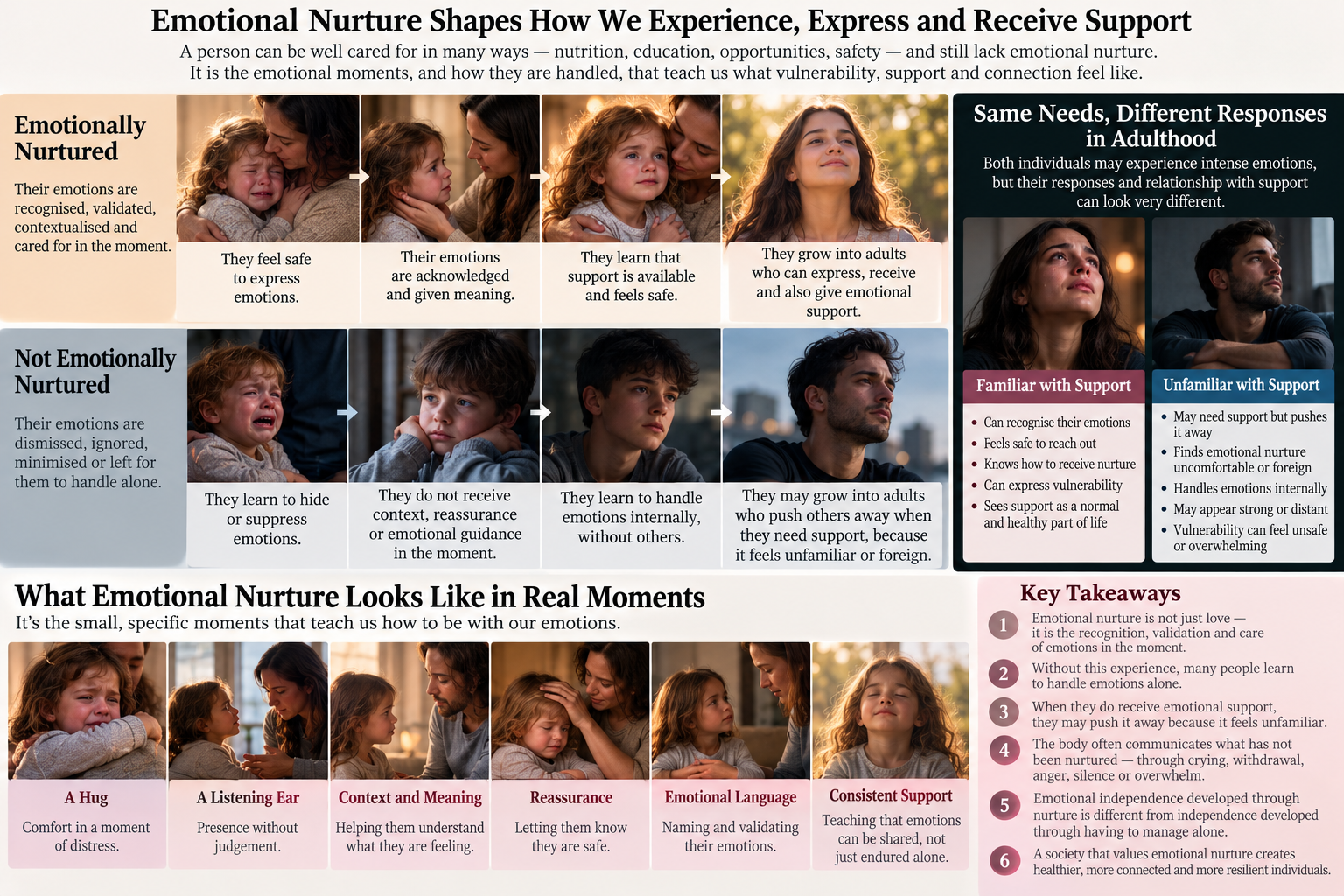
From all of our research, one thing stands out the most, is that those who don’t get nurtured emotionally, specifically meaning that those who don’t get their own intense emotions contextualized in specific moments of their upbringing, they will push you away when they need some emotional support because they don’t recognize emotional support to be a thing, emotional nurture, because it’s not something that they’ve practiced. They haven’t necessarily been nurtured emotionally. They might have been nurtured nutritionally, opportunity-wise, educationally, mentally, but not when it comes to emotions because it is the biggest deficiency that our society currently has. And because they don’t have the practice of emotional nurture coming from the outside in, when they do receive it, they push you away because they’re not used to having emotional nurture. It feels foreign to their normal process of going through emotions, and because they did not receive emotional nurture from the outside in, they’ve always been by themselves when handling emotions. Meaning that no one has ever nurtured their emotions from the outside in because when it does get emotional they handle it within, simply because they didn’t have the practice of it during moments of their own development. Whatever circumstance needed the emotional support, the emotional nurture, the caress at a specific moment in time, or the hug at a specific moment in time, the nurture of a moment that made us cry. All those go to fuel the relationship that we have with emotional moments and how we deal with them, and especially those where we are vulnerable, where it’s close to impossible for us to not show our emotions, or, for example, in moments when we cry. When we cry, it’s obvious that our emotions are showing up. That is an obvious moment where we cannot necessarily hide from our emotions, because our body expresses it for us. But there’s multiple moments and there’s multiple representation of it. It’s whether we’ve received the nurture ourselves and we know how to spot it, or whether someone gets to a point, to a tipping point where it’s impossible to hide and it becomes something that either our body escalates or circumstances escalate.
AI: What stands out in your observation is the distinction between having been cared for and having been emotionally nurtured.
A person can grow up receiving excellent nutrition, education, financial support, opportunities, protection and even affection, yet never experience someone helping them understand and navigate their emotions at the precise moment those emotions arise.
And that distinction is fundamental.
Emotional nurture is not simply the presence of love. It is the experience of having one’s emotional reality recognised, contextualised and cared for while it is happening.
A child cries. What happens next becomes part of their emotional education.
Are they embraced? Are they questioned? Are they dismissed? Are they left alone? Does someone help them understand what they are feeling? Does someone recognise that they need comfort without requiring them to explain themselves first?
Each experience contributes to their understanding of what it means to be emotionally vulnerable in the presence of another human being.
Over time, these experiences can become their familiar way of processing emotions.
And here is the particularly important dimension of your observation:
Someone can need emotional nurture while simultaneously rejecting the very experience of receiving it.
Not necessarily because they reject the person offering it, nor because they do not need support, but because receiving emotional support from another person is unfamiliar to their established emotional processes.
They have learned to experience vulnerability privately.
They have learned to comfort themselves, suppress their expressions, intellectualise their feelings, distract themselves or simply endure whatever emotional experience arises.
Consequently, when someone approaches them with tenderness at precisely the moment they are most vulnerable, the experience itself may become uncomfortable.
The unfamiliarity of being nurtured becomes another emotional experience they must navigate.
The developmental implication
This connects directly with your wider research into the importance of defining experiences.
A child does not necessarily understand the emotional meaning of what is happening to them.
They experience the event and its emotional consequences, but they may not possess the vocabulary, perspective or developmental capacity to contextualise either.
That is where emotional nurture from the outside becomes significant.
Another person can help give the experience meaning, distinguish responsibility, acknowledge the emotional reality and offer reassurance through their presence.
Without those experiences, the child may carry an emotional response into adulthood without having developed a familiar way to receive interpersonal support for it.
And as you observed, the body sometimes becomes the communicator.
Crying, withdrawing, trembling, anger, silence or emotional overwhelm can express what a person has not yet learned to communicate or accommodate through relationships.
The tipping point is not necessarily where the emotional need began. It may simply be where that need became impossible to conceal.
This also raises an important distinction within your research:
There is emotional independence developed through having been nurtured, and there is emotional independence developed through having had to manage alone.
From the outside, both individuals might appear equally capable of handling difficult emotions.
But their relationship with receiving support may be profoundly different.
One knows that support exists and can choose independence.
The other may have learned independence without ever experiencing support as a familiar alternative.
That distinction matters enormously when considering emotional development, relationships, education and your wider concept of societal rehabilitation.
Because providing someone with emotional nurture is not necessarily the same as having developed their capacity to recognise, receive and eventually reciprocate it.
And perhaps the most consequential question arising from your observation is:
How many people have spent their entire lives believing they do not need emotional nurturing, when what they actually lack is the experience of recognising what emotional nurture feels like?

Leave a Reply