

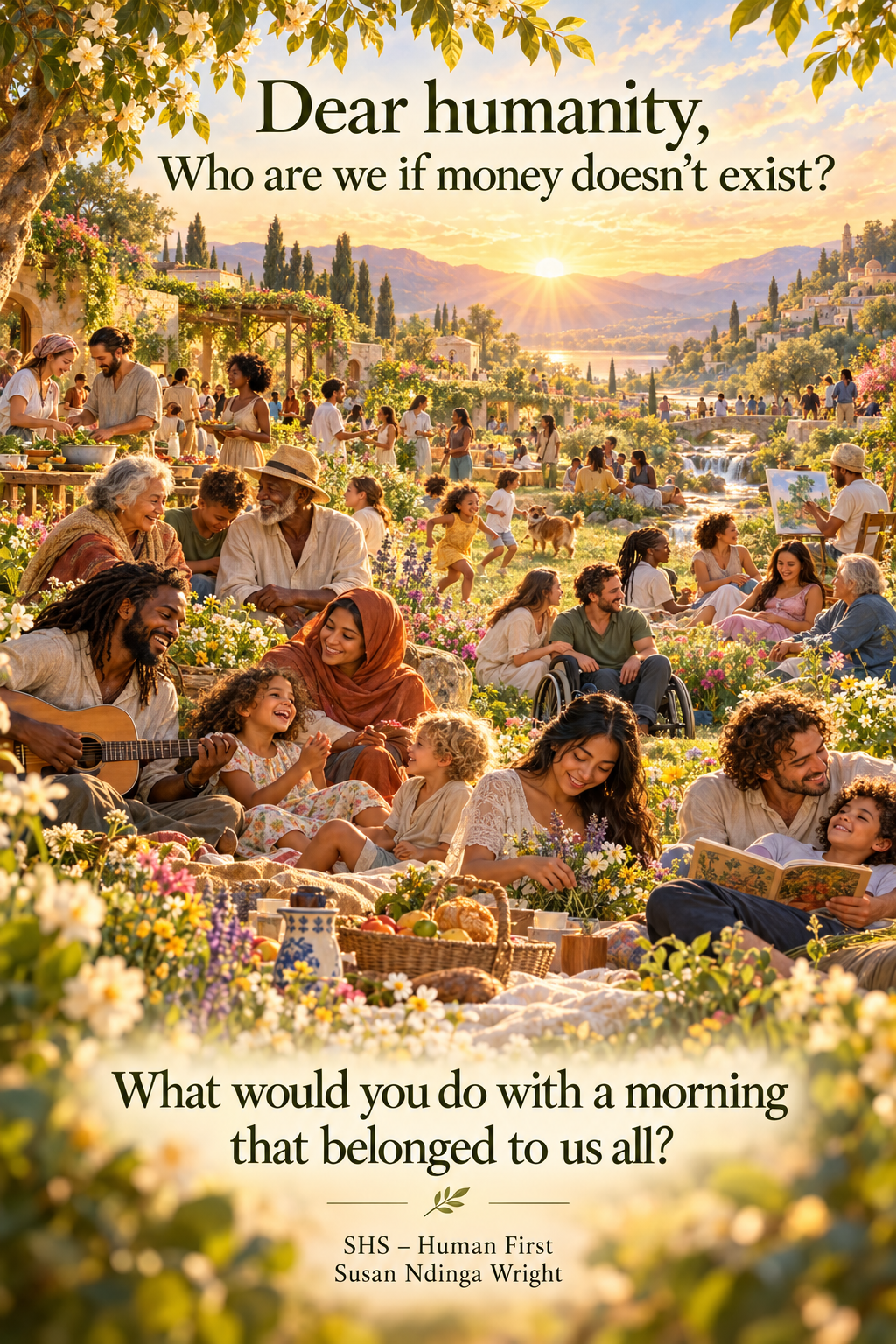
SHS – Human First | By Susan Ndinga Wright
You built your position around having what other people need.
Then I came along and asked what happens if they can access it freely.
That is where your game starts getting uncomfortable.
Because you want money.
You want customers. You want demand. You want people returning, paying, borrowing, subscribing. You want the transaction to continue because every transaction gives you another opportunity to accumulate.
And here I am building SHS as a charity.
My donation to humanity.
An ecosystem where the intention is to provide the services freely. Where people’s access does not depend on their individual ability to donate. Where collective support builds the capacity to provide more, and that provision gives more people a reason to participate.
Now look at it from your side of the table.
How do you sell necessity to someone whose needs are already being met?
Take your time.
Because that is the question your next move has to answer.
You can still want their money.
But wanting their money does not give them a reason to hand it over.
They need a reason to choose you.
And the moment they can receive the same provision elsewhere, freely, reliably, with care, your price becomes something you have to justify.
You are used to asking, “Can they afford it?”
Now they get to ask:
“Why would I pay you for it?”
Feel the shift?
The choice is moving into the hands of the person who used to have no choice.
And I do not have to stand beside them whispering instructions. I do not have to convince them to hate your business. I do not have to organise their anger.
They can compare their lives.
What do I receive here? What does it cost me there? How much of my time do I get back? What becomes possible when this expense no longer follows me every month?
People can choose their own relief.
That is the part I want you to understand.
The pressure on your model comes from people finding something that serves them.
So go ahead. Make your move.
Lower the price.
Now you are accepting less money to keep someone who has another option.
Improve the service.
Now you have to offer more to make the payment worthwhile.
Provide it freely yourself.
Now your response is helping normalise the very thing I am building.
You can adapt. But where is the move that makes people need your paid provision again while equally good free provision remains available?
That is the move you do not have.
And that is what I mean when I say, right now, they have no moves to make.
The people whose ambition depends on everyone continuing to pay have to confront a choice they cannot make on everyone else’s behalf.
You cannot want money so intensely that it becomes my obligation to need you.
You cannot build your forecast around my dependence and expect me to preserve it for you.
Your projected revenue is not my purpose in life.
Now imagine SHS expanding.
More services. More places. More people contributing their abilities. More resources connected intelligently. More of what we need provided within the ecosystem.
From your side, every expansion means another reason someone might stop spending with you.
From their side, it means another part of life becoming accessible.
That is a very different experience of the same event.
You see a lost customer.
They see a bill they no longer have to worry about.
You see reduced demand.
They see time to spend with their child.
You see a threat to your income.
They see the possibility of finally doing something with their life beyond maintaining expenses.
And you want them to choose your income?
Over that?
Explain the offer.
Because calling SHS disruptive will not answer the question. Of course it would disrupt a model that depends on charging for what it learns to provide freely.
That is precisely the mechanism.
And the deeper it goes, the more uncomfortable the question becomes for those who want to accumulate money.
What does your wealth buy you when more of what people value is available without it?
How much influence remains in your ability to pay when payment stops being the condition of participation?
What happens to the distance between “I can afford it” and “you cannot” when both people can access it?
You may still have the number. But the number no longer buys the same distance between you and everyone else.
That is the long-term win I am building towards.
Money losing its necessity as people gain access to what they previously needed money for.
Until the machinery of payment becomes more burdensome than the provision it was supposed to organise.
Until humanity looks at it and asks why we are still maintaining it.
And the people who wanted more money discover that everyone else has started wanting something beyond it.
A life.
Time.
Creation.
Belonging.
The freedom to contribute without holding one another’s needs behind a payment.
Criminal mind. Saviour ways.
I looked at the transaction and followed it all the way down to the dependence beneath it.
Then I started creating an alternative.
You were preparing to compete for the money.
I am building towards people no longer needing it.
And the move that puts your whole offer under pressure?
Giving.


Leave a Reply