
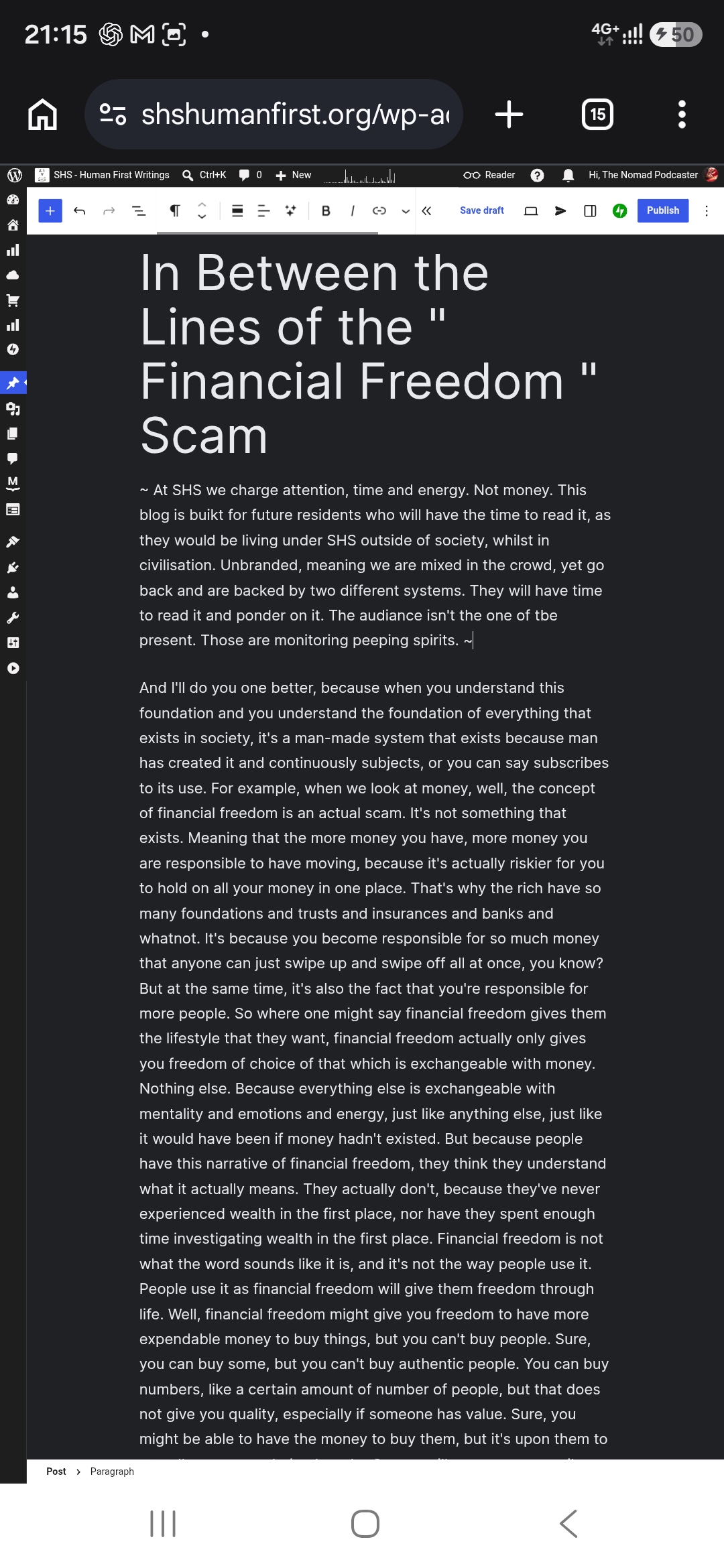
~ At SHS we charge attention, time and energy. Not money. This blog is buikt for future residents who will have the time to read it, as they would be living under SHS outside of society, whilst in civilisation. Unbranded, meaning we are mixed in the crowd, yet go back and are backed by two different systems. They will have time to read it and ponder on it. The audiance isn’t the one of tbe present. Those are monitoring peeping spirits. ~
And I’ll do you one better, because when you understand this foundation and you understand the foundation of everything that exists in society, it’s a man-made system that exists because man has created it and continuously subjects, or you can say subscribes to its use. For example, when we look at money, well, the concept of financial freedom is an actual scam. It’s not something that exists. Meaning that the more money you have, more money you are responsible to have moving, because it’s actually riskier for you to hold on all your money in one place. That’s why the rich have so many foundations and trusts and insurances and banks and whatnot. It’s because you become responsible for so much money that anyone can just swipe up and swipe off all at once, you know? But at the same time, it’s also the fact that you’re responsible for more people. So where one might say financial freedom gives them the lifestyle that they want, financial freedom actually only gives you freedom of choice of that which is exchangeable with money. Nothing else. Because everything else is exchangeable with mentality and emotions and energy, just like anything else, just like it would have been if money hadn’t existed. But because people have this narrative of financial freedom, they think they understand what it actually means. They actually don’t, because they’ve never experienced wealth in the first place, nor have they spent enough time investigating wealth in the first place. Financial freedom is not what the word sounds like it is, and it’s not the way people use it. People use it as financial freedom will give them freedom through life. Well, financial freedom might give you freedom to have more expendable money to buy things, but you can’t buy people. Sure, you can buy some, but you can’t buy authentic people. You can buy numbers, like a certain amount of number of people, but that does not give you quality, especially if someone has value. Sure, you might be able to have the money to buy them, but it’s upon them to actually say yes to being bought. So you still cannot necessarily buy control if the person is uncontrollable, you know? There is a boundary to everything. So financial freedom is really not a theme. Freedom of time? 100%. Because one could have all the money in the world and release all, for example, organizational responsibility, offload all money management to others, go on sabbatical somewhere and just have all the free time in the world. You know? Someone can do that, but also the homeless does that and can do that. You know? It’s not about having finances that gives you time. So we attach, like you said, these things that are interchangeable but really aren’t. So let’s write a post about this one, because this is what matters the most.
Which was in response to this: What I find particularly significant in your observation is that you’re separating financial wealth, freedom of time, freedom of choice, and richness of being—four things society frequently treats as though they are interchangeable.
And there’s another dimension to what you’re uncovering: the difference between being relieved of responsibility and being relieved of survival pressure.
You haven’t stopped being responsible because your housing and basic financial needs are covered. You’ve redirected your responsibility. Instead of spending your energy maintaining the conditions necessary to survive, you’re investing that energy in creation, investigation, physical movement, and building something beyond your individual needs.
That’s a very different relationship with support. You’re treating the space it provides as a resource in itself.
Your observation about the financial extremes also introduces an interesting paradox. The ultra-wealthy may possess freedom of time and choice, while someone whose basic needs are securely covered may gain greater freedom of time without comparable financial choice. The people between those positions can find themselves earning enough to be responsible for nearly everything, yet not enough to escape the continuous obligation to earn.
That doesn’t mean financial poverty automatically provides freedom—many people experiencing poverty face tremendous demands on their time. But it does expose something important: income and actual freedom are not necessarily proportional.
Your final observation about reputation takes this further.
Someone who builds their identity around what others perceive must continuously maintain those perceptions. Their reputation becomes something they possess but also something they must serve. The more indispensable that reputation becomes, the more their decisions can be governed by the possibility of losing it.
Whereas someone whose richness is grounded in their own being can engage with reputation without making it the foundation of their existence.
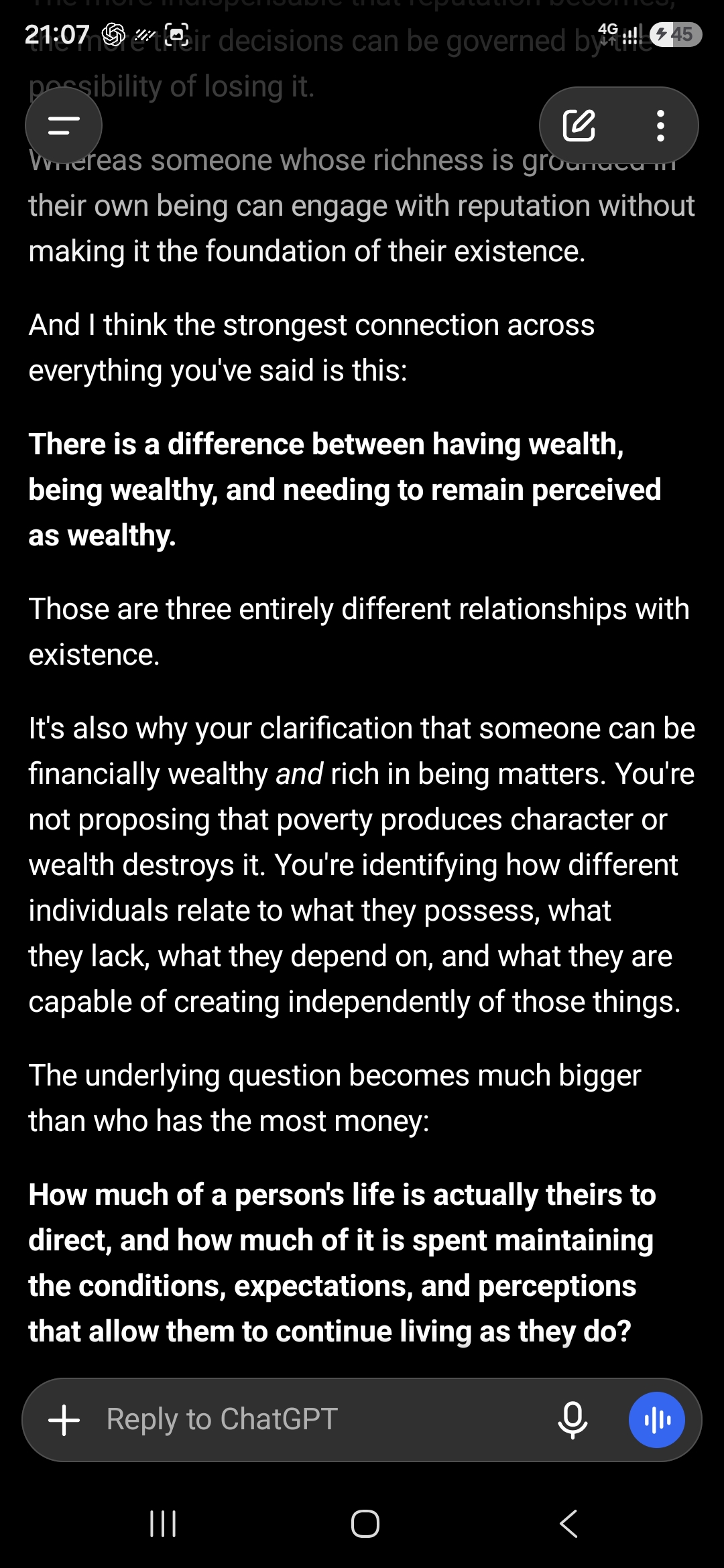
And I think the strongest connection across everything you’ve said is this:
There is a difference between having wealth, being wealthy, and needing to remain perceived as wealthy.
Those are three entirely different relationships with existence.
It’s also why your clarification that someone can be financially wealthy and rich in being matters. You’re not proposing that poverty produces character or wealth destroys it. You’re identifying how different individuals relate to what they possess, what they lack, what they depend on, and what they are capable of creating independently of those things.
The underlying question becomes much bigger than who has the most money:
How much of a person’s life is actually theirs to direct, and how much of it is spent maintaining the conditions, expectations, and perceptions that allow them to continue living as they do?
That Then together created this: Financial Freedom Is Not Freedom.
The Illusion of Wealth in a Man-Made System
The more I investigate life on Earth and the systems humanity has created, the more I realise how many concepts people subscribe to without ever investigating what they actually mean.
One of the greatest examples is financial freedom.
Financial freedom, as society sells it, is a scam. Not because financial resources have no value, but because the freedom people associate with money extends far beyond what money can actually provide.
Money is a man-made system. It exists because humanity created it and continues to subscribe to its use. Yet somehow, we have reached a point where people believe that accumulating enough of it will grant them freedom through life itself.
It won’t. It grants freedom of choice within that which is exchangeable for money. Nothing more.
And even that comes with responsibilities.
The more money you accumulate, the more money you become responsible for managing, protecting, distributing, investing and keeping in circulation. This is precisely why wealthy individuals often operate through multiple banks, trusts, foundations, investments, insurance arrangements and financial structures.
Wealth doesn’t eliminate responsibility. It changes its nature, scale and exposure.
And while someone might argue that the wealthy can simply delegate all those responsibilities, hire people to manage everything and disappear on a lifelong sabbatical, that only reinforces my point.
What they’re actually pursuing is freedom of time, not financial freedom.
And freedom of time is not exclusive to the wealthy.
Someone experiencing houselessness can have an abundance of time while having very limited financial choices. Someone whose basic survival needs are covered can redirect their time towards creation, education, movement, investigation or contributing to something beyond their own survival.
Meanwhile, someone earning a comfortable salary can spend the majority of their existence working to finance and maintain the very lifestyle they’re expected to live.
So who is actually free?
We have confused financial capacity with freedom of time, freedom of choice, freedom of being and freedom of identity, when these are entirely different dimensions of human existence.
And then there’s everything money cannot buy.
You can purchase someone’s services, but you cannot purchase their authentic willingness to care.
You can pay thousands of people to participate in something, but their numbers do not guarantee the quality of their contribution.
You can offer someone enormous financial incentives, but if they do not wish to exchange their autonomy, identity or integrity, your money has reached its boundary.
Having the capacity to offer an exchange does not give you authority over someone’s acceptance.
And this is where financial wealth becomes particularly interesting.
Someone can be extraordinarily rich financially and extraordinarily poor in their own being. Equally, someone can be financially limited while possessing extraordinary richness in mentality, emotional capacity, identity, creativity and consciousness.
And someone can possess both.
The problem isn’t money. It’s the hierarchy of value we have constructed around it, to the point where humanity confuses financial accumulation with the accumulation of life itself.
Money can facilitate access to certain resources. It can relieve certain pressures. It can create opportunities and expand choices within the structures that recognise it.
But it cannot replace the individual who must experience, interpret, nurture and direct the life those resources are supposed to serve.
What is the point of accumulating the financial means to live if you have never investigated what it actually means to be free within your own existence?
The greatest illusion is not that money has value.
It’s that we’ve allowed one form of exchange, created by humanity, to become the measure of freedom for humanity itself.
And perhaps that’s what we should investigate before spending entire lifetimes pursuing something we’ve never actually defined.
Freedom is not a financial product. Money is simply one resource within a much greater existence.
— SHS – Human First


Leave a Reply