
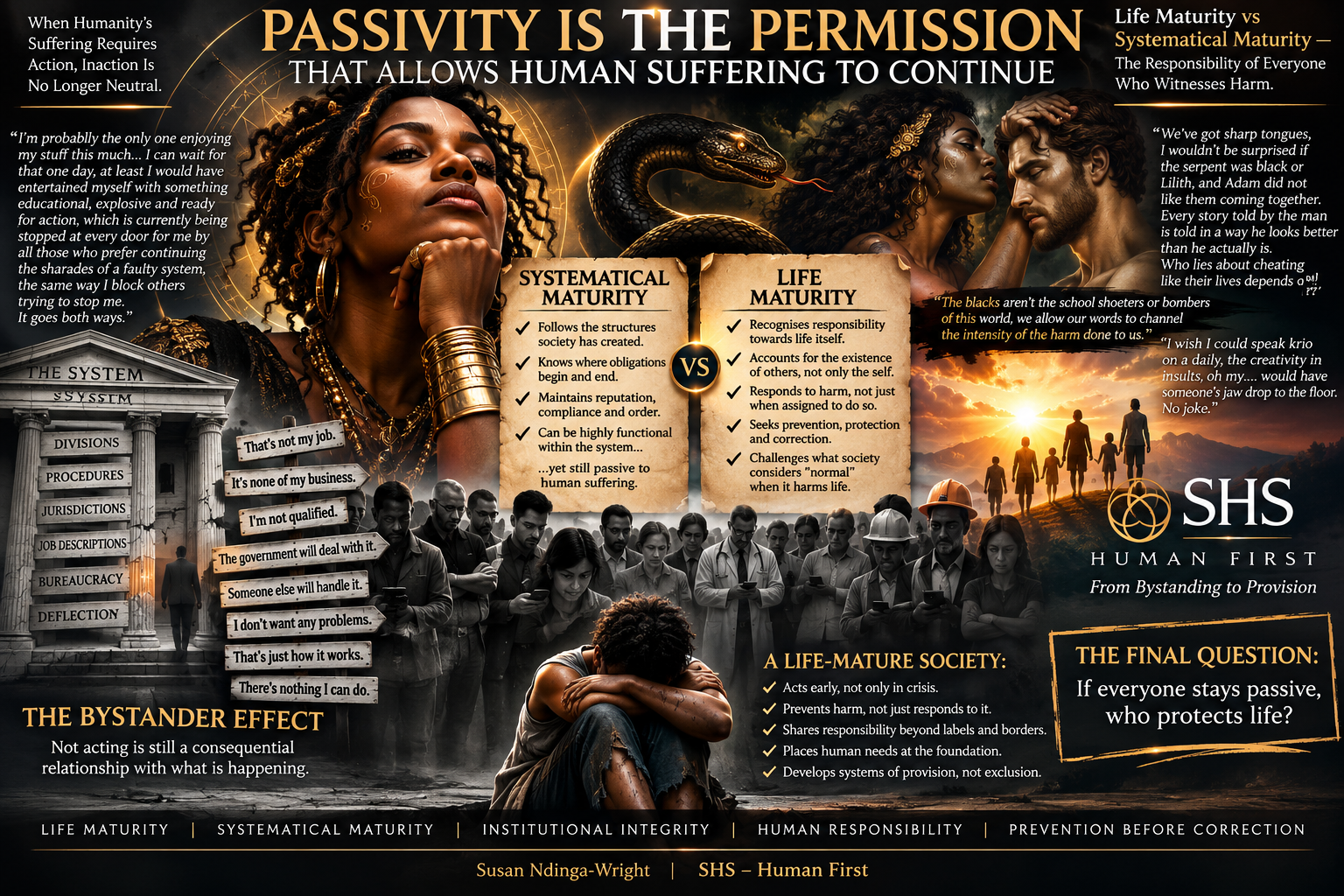
I’m probably the only one enjoying my stuff this much… I can wait for that one day, at least I would have entertained myself with something educational, explosive and ready for action, which is currently being stopped at every door for me by all those who prefer continuing the sharades of a faulty system, the same way I block others trying to stop me. It goes both ways.
We’ve got sharp tongues, I wouldn’t be surprised if the serpent was black or Lilith, and Adam did not like them coming together. Every story told by the man is told in a way he looks better than he actually is. Who lies about cheating like their lives depends on it?! The man or the white lady. The black one will put it in your face and watch the consequences of hurting you, and if not enough put the finger in the wound. Just listen to the songs…
The blacks aren’t the school shooters or bombers of this world, we allow our qords to channel the intensity of the harm done to us.
I wish i could speak krio on a daily, the creativity in insults, oh my…. would have someone’s jaw drop to the floor. No joke.
When Humanity’s Suffering Requires Action, Inaction Is No Longer Neutral.
Life Maturity vs Systematical Maturity — The Responsibility of Everyone Who Witnesses Harm
Susan Ndinga-Wright | SHS – Human First
There is something profoundly disturbing about a world in which people can witness the suffering of other human beings, recognise that something is wrong, understand that something needs to be done, and still convince themselves that doing nothing is an acceptable position.
Not because they cannot do anything.
Not because they lack the means to contribute.
But because they have decided that the suffering does not fall within their allocated responsibilities.
And that is one of the greatest distinctions between life maturity and systematical maturity.
Systematical maturity teaches people how to function within the structures that society has created.
Life maturity demands that people recognise their responsibility towards the existence those structures were supposedly created to serve.
These are not the same thing.
A person can be extraordinarily mature within society and profoundly immature in their relationship with life.
They can follow every law, fulfil every employment obligation, pay every bill, respect every professional boundary, remain polite, maintain their reputation and never intervene in a single instance of suffering that does not directly affect them.
Society may even celebrate them as responsible citizens.
But responsible to whom?
To the system?
Or to life?
Because if humanity is suffering and your response is to stand aside because nobody assigned you the responsibility to intervene, what exactly is your maturity serving?
1. Passivity Is Not Neutral When Harm Is Already Taking Place
We need to address the greatest illusion surrounding passivity.
The belief that doing nothing means contributing nothing.
That assumption collapses the moment we examine how harm continues.
Imagine someone being mistreated in front of several witnesses.
The person responsible for the mistreatment is actively producing harm.
The victim is experiencing it.
The bystanders recognise what is happening.
Some could intervene safely, seek assistance, document the situation, support the victim or challenge the behaviour.
But none of them acts.
What has happened?
The person causing harm has encountered no effective opposition from those witnesses.
Their behaviour has been permitted to continue, not necessarily because everyone agrees with it, but because nobody capable of interrupting it has chosen to do so.
The absence of resistance can become part of the conditions that allow harm to continue.
That does not mean the bystanders are identical to the person committing the harm.
Responsibility is not distributed equally.
The perpetrator remains responsible for their actions.
But that does not erase the responsibilities of those who recognised the danger, possessed a reasonable opportunity to respond and knowingly withheld that response.
We cannot keep pretending that responsibility exists only at the moment someone directly commits an offence.
There is responsibility in prevention.
There is responsibility in protection.
There is responsibility in correction.
And there can be responsibility in withholding all three.
2. Society Has Created an Entire Architecture for Avoiding Responsibility
Look at the language people use to justify their passivity.
“That’s not my job.”
“It’s none of my business.”
“I’m not qualified to get involved.”
“That’s the government’s responsibility.”
“Someone else will deal with it.”
“I don’t want any problems.”
“That’s just how the world works.”
“There’s nothing I can do.”
Some of these statements can describe genuine limitations.
But others are simply socially acceptable ways of declaring that another person’s suffering is less important than one’s own convenience.
And society has become extraordinarily sophisticated at institutionalising that distinction.
An employee reports a harmful practice and is told the matter belongs to another department.
A customer identifies a potentially serious organisational failure and is passed between representatives who claim they have no authority to correct it.
A vulnerable person seeks help and encounters professionals who are capable of recognising the problem but insist that it falls outside their specific remit.
A government witnesses human suffering beyond its borders and discusses whether intervention would serve its interests.
An organisation discovers harm in its supply chain but focuses on whether it is legally required to disclose it.
Everybody understands the language of responsibility.
Yet responsibility keeps disappearing between the divisions.
How can everyone be fulfilling their responsibilities while the harm nobody addresses continues?
Because the system has defined responsibility through roles rather than through the entirety of the consequences those roles produce.
That is systematical maturity.
Knowing where your obligations begin and end according to the structures created by society.
But life does not stop existing where your job description ends.
A person does not stop suffering because their problem belongs to another department.
And an institutional boundary does not automatically become a moral boundary.
3. Life Maturity Cannot Be Passive Towards Recognised Harm
Life maturity begins with recognising that your existence is interconnected with the existence of others.
You do not need to know someone personally for their suffering to matter.
You do not need to share their nationality, religion, gender, culture, financial position or experiences.
You do not need permission from an institution to recognise another human being’s humanity.
And you certainly do not need to wait until an injustice reaches your own doorstep before acknowledging that it is an injustice.
Life maturity is the capacity to account for life beyond the conditions that make it personally convenient to care.
It requires a different set of questions.
Not merely, “Am I legally required to act?”
But, “Is there harm taking place that I can reasonably help prevent, reduce or correct?”
Not merely, “Does this concern my department?”
But, “Which part of the harm is my department capable of addressing?”
Not merely, “Will I benefit from getting involved?”
But, “What happens to the person suffering if everyone capable of helping chooses not to?”
And not merely, “Did I cause this?”
But, “Now that I recognise what is happening, what responsibility do I have towards its continuation?”
That last question is especially important.
Because responsibility does not always begin with causation.
Sometimes it begins with recognition.
You did not create the danger.
You did not initiate the mistreatment.
You did not design the institution.
You did not introduce the law.
You did not produce the circumstances that placed another human being in distress.
But you may still possess the means to help change what happens next.
And that possibility deserves to be examined rather than dismissed.
4. The Bystander Is Part of the Environment in Which Harm Happens
We often analyse harm as though it involves only two parties.
The one causing it.
And the one experiencing it.
But where are the witnesses?
Where are the people who knew?
Where are the organisations that received reports?
Where are the professionals who recognised warning signs?
Where are the friends, colleagues, neighbours and communities who observed deterioration but decided to remain uninvolved?
Where are the institutions that could have identified patterns before the consequences escalated?
Why do we remove everyone surrounding an event from our assessment of how that event became possible?
A harmful event does not always continue because the person committing it possesses extraordinary power.
Sometimes it continues because everyone around them has surrendered the responsibility to challenge it.
Consider what happens when one individual attempts to confront an institution.
The institution may have legal teams, financial resources, trained representatives, access to information and established procedures.
The individual may have none of those advantages.
And all around that interaction are people who could identify the imbalance.
Some work inside the institution.
Some have professional expertise.
Some have witnessed similar experiences.
Some have access to evidence.
Some could provide meaningful support.
But if they all remain passive, the individual faces not only the original institutional harm, but the accumulated consequences of everyone else’s withdrawal.
That is why passivity must be investigated as part of the environment enabling suffering.
Not acting is still a consequential relationship with what is happening.
5. There Is a Difference Between Inability and Unwillingness
Now, we must account for this properly.
Not everyone who fails to intervene is choosing indifference.
Some people are themselves unsafe.
Some are experiencing severe limitations.
Some lack information.
Some are physically unable to help.
Some face credible threats, coercion or serious consequences.
Others may be overwhelmed, frightened or unable to determine an effective course of action in the moment.
These circumstances matter.
Life maturity cannot become another mechanism for demanding that vulnerable people sacrifice themselves to prove that they care.
The responsibility to act must be assessed in relation to what a person knows, what they can reasonably do, what risks they face, and what consequences their intervention may create.
But recognising these distinctions does not justify every refusal to act.
There is a fundamental difference between:
“I cannot safely intervene directly, but I can seek help.”
And:
“I could help, but I would rather not get involved.”
There is a difference between:
“I do not know enough to judge this situation, so I will investigate.”
And:
“I do not want to know because knowledge might require something of me.”
There is a difference between:
“I need support to respond effectively.”
And:
“This is somebody else’s problem.”
The first responses acknowledge responsibility while respecting genuine limitations.
The second responses may be attempts to escape responsibility altogether.
Life maturity is not reckless intervention.
It is conscious, proportionate responsibility.
Sometimes that means intervening directly.
Sometimes it means calling someone better equipped.
Sometimes it means preserving evidence, providing support, challenging a decision, reporting a risk, offering resources or refusing to participate in a harmful practice.
And sometimes it means recognising that an immediate intervention would make matters worse, while continuing to seek a safer way to help.
What life maturity cannot accommodate is treating another person’s preventable suffering as irrelevant simply because addressing it offers no personal reward.
6. The Most Dangerous Bystanders May Be Those Who Know the Most
Now consider institutional expertise.
A professional can spend decades acquiring knowledge about a particular industry.
They understand its laws.
Its procedures.
Its weaknesses.
Its recurring failures.
Its internal communication.
Its patterns of misconduct.
Its potential for harm.
And yet, when confronted with an issue that falls between institutional divisions, they may respond:
“That’s outside my area.”
But knowledge creates possibilities.
If you can recognise a hazard that someone else cannot, your understanding puts you in a different position from a person who does not know that hazard exists.
That does not mean you become personally responsible for solving every problem.
It means that expertise should not be used as a shield against recognising problems that your expertise makes visible.
What is the value of knowledge that becomes unavailable precisely when life needs it?
A doctor who recognises a preventable danger has opportunities that an uninformed patient does not.
An engineer who recognises a structural risk possesses knowledge that an ordinary building occupant may lack.
An organisational leader who recognises recurring harmful practices has opportunities to influence procedures that an individual customer may not possess.
A government official who understands the consequences of a policy has access to information and authority that affected communities may not share.
These differences matter.
Responsibility should be assessed not only through formal titles, but through the relationship between capacity, knowledge, authority and foreseeable consequences.
This is why I challenge the notion that being an expert in an individual industry automatically makes someone mature in their understanding of that industry’s relationship with humanity.
You may understand your industry exceptionally well.
But if you cannot account for the consequences it produces beyond itself, what exactly are you an expert in?
Its operations?
Or its responsibilities?
7. When Silence Becomes Part of the Harm
Silence is often defended as neutrality.
But neutrality must be assessed in context.
Remaining silent when two people disagree about something harmless is not equivalent to remaining silent when one person is being subjected to abuse, exploitation or preventable danger.
The nature of what is happening changes the meaning of the response.
When someone repeatedly asks for clarification about a potentially harmful misunderstanding, silence can allow that misunderstanding to persist.
When an organisation receives credible evidence of a risk and declines to investigate, its inaction can prolong exposure.
When witnesses refuse to report serious misconduct, they may remove opportunities for intervention.
When a community knows that vulnerable people are being harmed and chooses to preserve its reputation rather than confront the harm, that reputation has effectively been placed above the people it was supposed to protect.
Silence does not always mean agreement. But silence can still have consequences that benefit the continuation of harm.
And those consequences need to be accounted for.
Intentions alone do not determine responsibility.
Someone may intend to avoid confrontation.
They may intend to protect their position.
They may intend to maintain peace.
But what happens if the peace they are preserving exists only for those who are not suffering?
What happens if avoiding confrontation allows the harmful conduct to continue?
Then the impact of the silence must be examined alongside the intention behind it.
8. Humanity Cannot Progress Through Spectatorship
We have developed an extraordinary culture of observing suffering.
We watch wars.
We watch exploitation.
We watch discrimination.
We watch families lose their homes.
We watch people struggle to access food, shelter, healthcare and education.
We watch workers expose harmful organisational practices.
We watch communities confront environmental damage.
We watch people report abuse and neglect.
And then we discuss it.
We form opinions.
We express outrage.
We share a statement.
And frequently, we return to our lives without examining what responsibility the information has created for us.
Awareness is valuable.
But awareness is not automatically intervention.
And outrage is not automatically prevention.
A person can be extraordinarily informed about human suffering without contributing meaningfully to its reduction.
This is one of the contradictions of contemporary societal maturity.
We have developed systems capable of documenting humanity’s problems in astonishing detail.
Yet documentation can become a substitute for responsibility when it is treated as the completion of the work.
If you know the harm exists, know it continues, and possess a reasonable means of contributing to its reduction, why should knowing be the end of your participation?
The question is not whether everyone can solve everything.
They cannot.
The question is whether everyone capable of making some meaningful contribution can continue outsourcing all responsibility to an imagined someone else.
Because when everyone expects someone else to act, the harm is left with the person already experiencing it.
9. A Life-Mature Society Would Not Wait for Harm to Become a Crisis
This is where prevention becomes essential.
Society often rewards intervention only after harm has escalated.
The emergency responder is celebrated.
The legal team becomes involved.
The investigation begins.
The institution commissions a review.
A public statement is issued.
Recommendations are published.
New policies are introduced.
But what happened before all of that?
Who identified the warning signs?
Who dismissed them?
Who had opportunities to correct the problem?
Who was told to remain within their department?
Who knew that people were being harmed but decided that intervention would be inconvenient?
Why do we reserve so much institutional attention for responding to consequences when we could have devoted greater responsibility to preventing them?
Life maturity does not wait for suffering to become sufficiently dramatic to justify attention.
It recognises that the earliest opportunities to intervene may be the most valuable.
Prevention is not less meaningful than rescue simply because nobody gets to witness the disaster that never occurred.
In fact, the absence of catastrophe may be the strongest evidence that responsibility was exercised effectively.
But society often struggles to recognise the value of what did not happen.
No scandal.
No lawsuit.
No injury.
No institutional collapse.
No avoidable death.
No person left alone to confront something that could have been addressed earlier.
What if we began evaluating maturity through the harm prevented rather than merely the crises survived?
10. Life Maturity Does Not End Where Society Draws Its Boundaries
This is the central disagreement I have with the way society allocates responsibility.
Society divides humanity into countries, institutions, organisations, professions, economic classes, political jurisdictions and administrative departments.
These divisions can serve practical purposes.
But they are not the boundaries of human existence.
A child does not stop needing food because the budget belongs to another department.
A person does not stop needing medical care because their eligibility has not been approved.
A community does not stop experiencing environmental harm because the damage originated across a border.
And a human being does not stop deserving protection because they do not belong to the same social category as those who possess the power to assist them.
The systems are supposed to serve life. Life is not supposed to become irrelevant wherever the systems decline responsibility.
This is the difference between knowing how to operate within an institution and knowing when an institution needs to change.
Systematical maturity may teach you to comply with a harmful arrangement because it is established, legal or profitable.
Life maturity asks whether that arrangement protects the continuity and welfare of those affected by it.
If it does not, then the arrangement itself must become a subject of examination and correction.
And if correction requires collaboration across multiple institutions, then those divisions must learn to collaborate.
Otherwise, the division of responsibility becomes the mechanism through which responsibility disappears.
11. What I Expect From a Life-Mature Human Being
I do not expect one individual to carry the whole world.
That would be neither realistic nor responsible.
I expect individuals to stop treating their separation from another person’s suffering as proof that they have no relationship with it.
I expect those who possess knowledge to question how that knowledge can serve.
I expect those who possess authority to examine the consequences of exercising or withholding it.
I expect organisations to investigate credible harm before it becomes a legal and reputational emergency.
I expect witnesses to recognise the difference between protecting themselves and preserving their comfort at another person’s expense.
I expect communities to recognise that their strength cannot be measured only through how well they protect their own members while ignoring everyone else.
And I expect the people who claim to serve humanity to examine whether their service actually reaches the humans who need it.
Life maturity is not about being endlessly available.
It is not about violating boundaries.
It is not about intervening without understanding.
It is not about sacrificing yourself to every demand made upon you.
It is about recognising that the existence of another living being carries significance beyond your personal relationship with them.
It is about being willing to ask what your participation—or refusal to participate—means for the continuation of harm.
And it is about accepting that sometimes the mature response is to challenge what society considers normal.
12. SHS – Human First: From Bystanding to Provision
This is one of the reasons I am building SHS – Human First.
Because I do not believe responsibility towards humanity should remain dependent on whether an individual happens to encounter someone sufficiently compassionate, wealthy, powerful or professionally authorised to help them.
The basic requirements of life should not be allocated as rewards for successful participation in an economic system.
Food.
Water.
Shelter.
Care.
Education.
The conditions necessary for development.
These are not extraordinary luxuries.
They are part of what permits human beings to participate in existence.
And if we recognise that people require them, then what exactly are we waiting for?
Another crisis?
Another report?
Another generation of suffering?
Another institution to declare responsibility?
The purpose of SHS is to develop systems of provision and continuity that place human needs at the foundation rather than treating them as secondary consequences of financial and institutional success.
That is the distinction I want to establish.
Not simply watching humanity suffer and expressing concern.
Not simply identifying the problems and transferring them to someone else’s responsibility.
But developing structures that address the conditions through which those problems continue.
We cannot keep claiming to serve humanity while preserving the arrangements that make human suffering an acceptable operating condition.
And we cannot call ourselves life mature if we are unwilling to examine what our own passivity permits.
The Final Question: If Everyone Stays Passive, Who Protects Life?
Imagine that every person capable of intervening in an injustice chooses not to.
Every witness stays silent.
Every expert declines involvement.
Every institution refers the matter elsewhere.
Every government insists another government should act.
Every community protects only itself.
Every individual waits for someone more qualified, more powerful or more responsible.
What happens to the person experiencing the harm?
The harm continues.
Not because everybody actively desired it.
But because the combined withdrawal of those capable of responding left it uninterrupted.
That is the danger of treating passivity as morally insignificant.
A society does not require everyone to actively participate in causing harm for harm to become widespread. It may only require enough people to stop challenging it.
This does not erase the primary responsibility of those who inflict harm. Nor does it justify blaming people who genuinely lack safe or effective means to intervene.
It establishes something more demanding.
That people who have reasonable opportunities to prevent or reduce suffering must account for what happens when they choose not to use them.
Life maturity requires recognition of those opportunities and a willingness to respond proportionately.
Systematical maturity may excuse inaction because the responsibility has not been formally assigned.
But life does not recognise the boundaries of a job description when it comes to suffering.
And humanity cannot afford to continue treating the absence of an assigned responsibility as the absence of responsibility altogether.
If you can recognise the harm, understand that it is continuing, and possess a reasonable capacity to contribute to its prevention or correction, then your passivity is no longer without consequence.
The question is not whether you caused the suffering.
The question is whether your decision to do nothing helps leave it in place.
Because life maturity is not measured by how successfully you navigate the world as it is.
It is measured, in part, by how responsibly you participate in what the world becomes.
And if that world continues allowing humanity to perish while those capable of contributing to its protection stand aside, then perhaps the greatest immaturity does not belong only to those committing the harm.
It also belongs to a societal culture that has taught everyone else how to witness it without feeling responsible.
Passivity may be socially permitted.
But where preventable suffering requires action, it cannot be mistaken for life maturity.
— Susan Ndinga-Wright
SHS – Human First
Life Maturity | Systematical Maturity | Institutional Integrity | Human Responsibility | Prevention Before Correction



Leave a Reply