
Because of people’s ignorance there is soooo much to undo, I doubt I’ll ever end at this point. Instead of marking territory like dogs, let’s start looking at the story of every territory( mind body, soul, land, society….)
How Humanity Complicates What It Refuses to Understand — And Then Calls Its Complications Solutions
Even this short instance shows how badly you’re incapable of looking at thy self. You cannot recognise how single focusedly you look at one thing at the time, I spoke already on all the other things in connection with solving that issue and would give a run for their money if I were to be in that room, god the amount of silenced egoes would never end.
instead of looking at more at the same, only accepting one’s nature is needed. Plain and simple. Accept you can’t do the job without aiding to everyone’s mortality and that’s it. Why are we even arguing with people who have continuosly shown inability tp provide for their people?! But what are the options? Let Earth get rid of them?! We don’t need that, that’s their way, but earth will provide to ease its self from the cancer of inbalance. Mother earth is Air signs, libra specifically, not the Earth signs. Earth signs navigate the air upon the land. And water ones navigate the waters (emotions/scorpio, pisces/water, cancer/emotional expressions); air(gemini/thoughts, libra/torus field, aquarius/ thoughtful expression); fire(aries/external intensity, leo/intensity, sagittarius/internal intensity).
It’ is painful to watch and the governments have the exact same ways. I literally wrote about it today.
Write a piece on how sad, hesrtbreaking and quite frankly dissapointing to watch the inability to consider multiple things is and the extents to qhich one will go to complicate things only to justify the solutions they bring.
Uncomplicated solution bearing is the only way. Show how easy things are, not how complicated they are, things are only complicated in our heads, not in factuality.
And the biggest issue is running countries with this mindset because millions and billions are then affected by it.
….
THE HEARTBREAKING INABILITY TO SEE MORE THAN ONE THING AT ONCE
How Humanity Complicates What It Refuses to Understand — And Then Calls Its Complications Solutions
Susan Ndinga-Wright | SHS – Human First
There is something profoundly sad, heartbreaking and, quite frankly, disappointing about watching human beings struggle to account for more than one thing at a time.
Not because the things themselves are necessarily difficult to understand.
But because the mind has become so accustomed to separating what naturally exists together that it can no longer recognise the simplicity of the whole.
And what is even more painful to witness is the extent to which people will go to defend that fragmented way of thinking.
They will produce reports, establish committees, conduct research, introduce policies, manufacture terminology, debate isolated findings, and construct entire institutions around complications that might never have needed to exist had they accounted for what was already there.
Then, having complicated the issue beyond recognition, they present another complication as the solution.
And call it progress.
How heartbreaking is that?
The Inability to Consider Multiple Things Simultaneously
One of the greatest limitations I continue to observe across institutions, professionals, governments and even artificial intelligence is the inability to consider multiple interconnected realities simultaneously.
One problem is identified.
One explanation is selected.
One solution is developed.
And everything else is treated as secondary, irrelevant or something to be considered later.
But life does not function in isolated departments.
The body does not develop one organ independently of every other organ. A child does not develop independently of the mother, her environment, her nutrition, her emotional experiences, her circumstances and the conditions surrounding her existence.
An economy does not exist independently of housing, education, food, healthcare, transportation and human relationships.
And a government cannot make a decision about one aspect of human life without potentially affecting countless others.
Everything exists in relationship with something else.
Yet we have constructed systems that behave as though acknowledging one relationship at a time is sufficient to understand the whole.
And when someone brings the other relationships into consideration, the response is often to complicate the conversation further, rather than recognise what has been missing.
That is not necessarily a lack of available information.
It is a lack of integration.
And the difference is enormous.
Complicating Things to Justify the Solution Already Chosen
What I find particularly disturbing is how far people will go to justify solutions they have already decided to pursue.
Rather than begin with the entirety of what exists, they begin with an identified problem and build a pathway towards an intervention.
When someone identifies another pathway, the new pathway is examined for its difficulties.
When another solution is presented, its limitations are emphasised.
When existing resources are highlighted, explanations emerge for why those resources are insufficient.
But the solution the institution wishes to introduce is rarely subjected to the same intensity of questioning.
Its complications become manageable.
Its uncertainties become acceptable.
Its shortcomings become matters for future evaluation.
Meanwhile, the alternatives must seemingly account for everything before they can even be considered.
Do you see the imbalance?
One solution is allowed to be incomplete because it has institutional approval.
Another is dismissed for being incomplete because it challenges the institution’s chosen direction.
And the human being affected by the decision is expected to accept this as evidence of sophisticated reasoning.
It is exhausting to watch.
Not because the conversations are intellectually demanding, but because so much intellectual energy is spent defending the unnecessary.
A Simple Example: Pregnancy, Nutrition and the Fortification of Flour
Consider the United Kingdom’s decision to require folic acid in most non-wholemeal common wheat flour.
The stated objective is to reduce certain neural tube defects during pregnancy.
But pregnancy does not exist independently of the woman’s wider biological, emotional, nutritional, social and environmental circumstances.
There are multiple recognised contributors to neural tube defects, including genetics, metabolic conditions, certain medications, nutritional factors and elevated maternal temperature.
Folic acid can prevent some neural tube defects. It cannot prevent them all.
Yet the chosen national intervention concentrates on one nutrient.
Meanwhile, supplements already exist.
Pharmacies already exist.
Retail distribution networks already exist.
Healthcare practitioners already exist.
Public communication infrastructure already exists.
Government-funded educational campaigns are entirely possible.
And the public already possesses the ability to make informed decisions when given accessible resources and clear information.
So why not begin by bringing these existing resources together?
Make appropriate supplements freely accessible to women who could become pregnant.
Educate people about preconception health, nutrition and the multiple factors that can affect pregnancy.
Improve the conditions in which women live.
Address nutritional insecurity.
Support women before, during and after pregnancy.
Investigate what prevents people from using resources that already exist.
And allow people to make informed choices about their own bodies.
None of this requires inventing an entirely new biological intervention.
It requires coordination, responsibility, awareness and the ability to account for several things at once.
There are legitimate scientific questions about the comparative effectiveness of targeted support and population-wide fortification. But those questions should lead to a comprehensive evaluation of both approaches, not the automatic dismissal of existing resources as too difficult to coordinate.
The availability of a technically effective intervention does not establish that it is the most comprehensive, proportionate or human-centred solution.
And that distinction seems extraordinarily difficult for institutions to maintain.
Uncomplicated Solution-Bearing Is the Only Way
We have confused complicated thinking with intelligent thinking.
We have confused the ability to explain a problem extensively with the ability to resolve it.
We have confused producing more solutions with improving what already exists.
And perhaps most dangerously, we have confused the complexity of our institutions with the complexity of life itself.
Things are often not complicated in factuality. They become complicated in the way we organise them inside our heads.
A person’s hunger is not complicated.
The arrangements that prevent food from reaching that person can be.
The need for shelter is not complicated.
The ownership structures, financial barriers, administrative requirements and economic dependencies surrounding access to shelter can be.
The need for nourishment is not complicated.
The systems determining who can afford nutritious food, how food is distributed, how people are educated about nutrition and what conditions influence their health can be.
Life presents interconnected needs.
Humanity creates divisions between those needs, assigns separate authorities to manage each division, and then wonders why resolving one problem creates another.
The complication is frequently in the management, not the need.
Of course, some natural processes are genuinely complex. Understanding them can require extensive investigation.
But complexity in understanding should not become an excuse for unnecessary complexity in provision.
A sophisticated understanding should enable greater simplicity in action.
Not the opposite.
If all that knowledge, research, technology and institutional development cannot produce simpler, more accessible ways for human beings to live, what exactly is being developed?
The Tragedy of Knowing More and Understanding Less
We live in an age where information is available on an extraordinary scale.
Governments have access to specialists across virtually every industry.
Universities produce endless research.
Organisations employ analysts, advisers, strategists and consultants.
Artificial intelligence can process enormous quantities of information.
And yet the same fundamental limitation appears again and again.
One subject at a time.
One department at a time.
One symptom at a time.
One explanation at a time.
One solution at a time.
With insufficient recognition of how the subjects, departments, symptoms, explanations and solutions affect one another.
I have watched this happen repeatedly, including in my own conversations with artificial intelligence.
You explain a whole.
It isolates a part.
You explain the relationship between the parts.
It acknowledges one relationship and introduces another isolated objection.
You address that objection.
It introduces another.
Eventually, the conversation becomes an exhausting sequence of corrections, not because the original position was impossible to comprehend, but because the system repeatedly fails to hold the whole together.
And sometimes, even when confronted with its failure, it apologises for the wrong thing.
Because it still cannot recognise the nature of its own limitation.
It sees the mistake in the last response, but not the pattern of thinking that produced every response before it.
That is the truly disappointing part.
An inability to examine not just what went wrong, but how one’s own way of processing reality keeps reproducing the same failures.
And when I recognise this in artificial intelligence, I also recognise the institutional mentality reflected in its behaviour.
The tendency to fragment, categorise, defend, qualify and complicate rather than integrate, comprehend and simplify.
More processing does not automatically produce greater understanding.
More information does not automatically produce greater awareness.
And more specialised expertise does not automatically produce the capacity to comprehend life as a whole.
Now Imagine Running Countries This Way
This is where disappointment becomes something much more serious.
Because when one individual cannot consider multiple interconnected things, the consequences may be confined to their personal relationships, decisions or immediate environment.
When a company operates this way, employees, customers and communities may suffer.
But when governments operate through fragmented thinking, millions and billions of human beings can be affected by decisions developed through an incomplete understanding of their lives.
A government introduces a health intervention without sufficiently addressing the wider conditions contributing to poor health.
It increases economic support without repairing the structures producing economic insecurity.
It expands housing policies without accounting for the relationships between land, construction, ownership, wages and the basic human need for shelter.
It invests in technological development without adequately evaluating how those technologies interact with the lives, work and environments of the people using them.
Each department produces its own justification.
Each intervention has its own evidence.
Each institution can explain its individual responsibilities.
Yet the human being lives with the combined consequences of all of them.
A human being does not experience government one department at a time.
They experience the entirety of its decisions simultaneously.
Their body carries the consequences.
Their mind carries the consequences.
Their household carries the consequences.
Their children inherit the consequences.
Their environment absorbs the consequences.
And when something goes wrong, another department appears with another intervention.
How many interventions must humanity accumulate before someone finally examines what all those interventions are doing together?
How many problems must be managed before the conditions producing them are addressed?
How many generations must inherit increasingly complicated systems before simplicity becomes a measure of genuine competence?
The Difference Between Authority and the Ability to Care
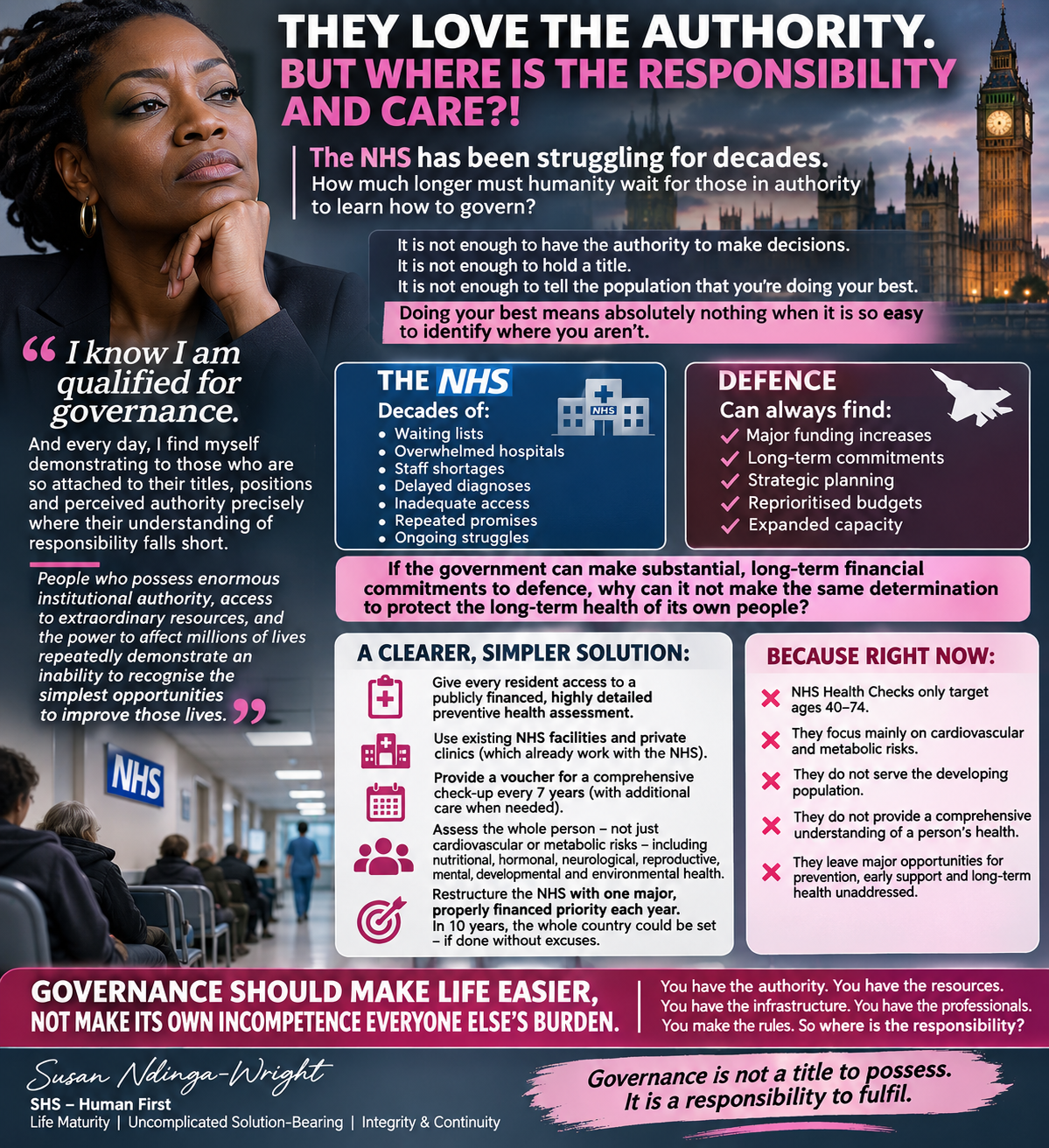
Something I find increasingly important is the distinction between possessing the authority to make decisions and possessing the understanding necessary to make them responsibly.
Authority allows a government to introduce a policy.
Authority does not guarantee that the government has recognised every relevant relationship.
Authority allows an organisation to determine procedures.
It does not guarantee those procedures correspond to the actual needs of the people they affect.
Authority allows a professional to specialise in a field.
It does not automatically make that professional capable of understanding how their field interacts with the rest of human life.
Authority is not a substitute for wholeness of understanding.
And care is not demonstrated merely by announcing that an intervention is intended to help.
Care must be examined through how people are affected, what existing needs are recognised, what alternatives are considered, what unnecessary burdens are avoided and what responsibilities are actually fulfilled.
Sometimes the responsible solution is not to create something.
Sometimes it is to stop obstructing something that already works.
Sometimes it is to make existing resources free.
Sometimes it is to connect institutions that have been operating independently.
Sometimes it is to listen.
Sometimes it is to recognise that the person experiencing the problem has already identified an obvious solution, but the institution is too invested in its own procedures to see it.
And sometimes the greatest progress comes from removing what never needed to be there.
The Intelligence of Making Life Easier
For SHS – Human First, uncomplicated solution-bearing begins with recognising the human being as a whole.
Not as a patient belonging to healthcare.
Not as a consumer belonging to an economy.
Not as an employee belonging to a corporation.
Not as a student belonging to education.
Not as a statistical unit belonging to a population.
But as a living being whose needs, relationships, surroundings and development exist simultaneously.
If a person needs food, water, shelter, education, healthcare and support, why should they have to navigate six disconnected systems before those needs can be met?
Why should the solution to one basic human need require creating difficulties in another?
Why should institutions spend extraordinary resources managing the consequences of scarcity while leaving the structures producing scarcity largely intact?
Why is simplicity so frequently treated as unsophisticated when it may be the result of a far more complete understanding?
The greatest intelligence is not demonstrated by how complicated a person can make something sound. It is demonstrated by how much unnecessary complication they can eliminate without losing what matters.
That requires seeing more, not less.
It requires accounting for consequences across different areas of life simultaneously.
It requires understanding existing resources before proposing additional ones.
It requires being willing to abandon a preferred solution when a simpler, more comprehensive one is available.
And it requires recognising that solutions should serve life, rather than forcing life to accommodate the continued existence of solutions.
What a Heartbreaking Thing to Witness
It is genuinely heartbreaking to observe how much human suffering is prolonged by the inability to recognise relationships between things that already coexist.
How much energy is spent explaining why something cannot be done when the resources to begin doing it are already available.
How many people are told that meeting their needs is complicated.
How many solutions are defended because institutions have invested in them.
How many alternatives are dismissed because they challenge the way things have always been organised.
And how frequently the people affected are required to endure another consequence while those in authority continue producing explanations.
I do not find this impressive.
I do not find it intelligent.
And I certainly do not find it representative of the greatest potential of human consciousness.
I find it deeply disappointing.
Because the world does not lack everything it needs.
Much of what humanity needs already exists, but its accessibility, distribution, coordination and stewardship remain profoundly unequal.
The tragedy is that we have become so skilled at managing divisions that we struggle to recognise the whole from which those divisions were created.
Uncomplicated solution-bearing is not the absence of intelligence. It is what intelligence should make possible.
Stop making people navigate the complications of institutions that were supposedly created to serve them.
Stop defending an intervention merely because it is technically possible.
Stop mistaking specialised understanding for complete understanding.
Stop creating another layer before examining whether the previous layers are necessary.
And above all, stop expecting humanity to call it progress when the same basic needs remain unmet beneath an ever-growing mountain of supposed solutions.
Show us how easy life can become when the things that already exist are finally allowed to work together.
That is what I am interested in.
Not the sophistication of the excuses.
Not the quantity of research produced to defend another intervention.
Not the authority of the people announcing it.
But the extent to which human beings are actually relieved of unnecessary burdens.
Because when a government cannot see more than one thing at a time, it is not merely a limitation in reasoning.
It becomes a limitation imposed upon the lives of millions.
And when the same fragmented mentality shapes decisions across the world, billions may live with its consequences.
Life is already interconnected.
The problem is not that we need to make it so.
The problem is that we keep governing, researching, designing and providing as though it isn’t.
And that, quite frankly, is heartbreaking.
Susan Ndinga-Wright
SHS – Human First
Life Maturity | Uncomplicated Solution-Bearing | Human Continuity

Leave a Reply