
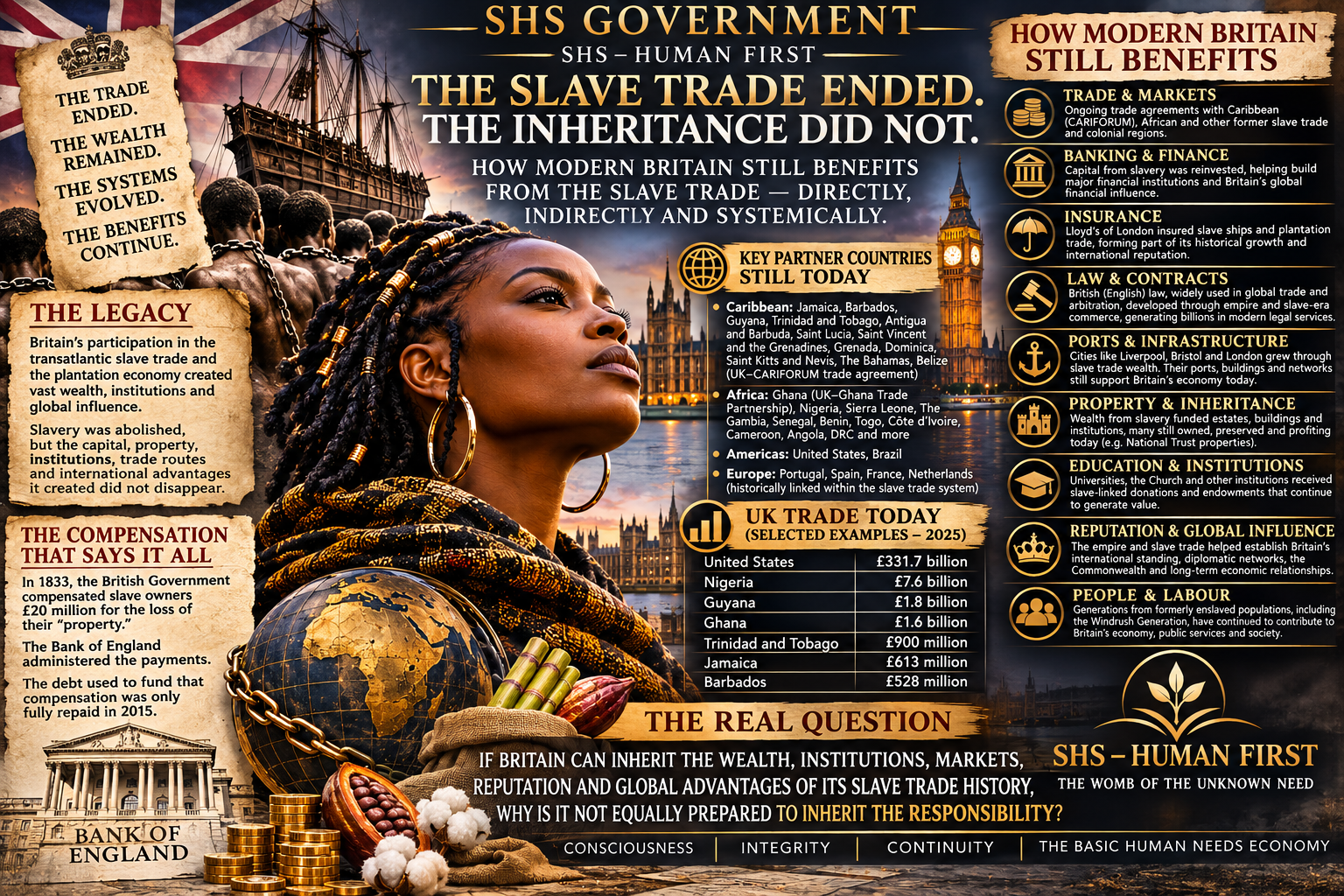
Here’s all the connections of how they still benefit. Read this and think if the apology and financial reparations are still not needed. Let’ss see if it’s audacity or merely ignorance. With Meta One, I’ll make sure this poll gets to as many as possible. Most use it to get liked, I do so to educate. Spend wisely.
SHS GOVERNMENT | SHS – HUMAN FIRST
The Wealth, Contracts, Countries, Institutions, Trade Routes, Reputation and Global Relationships That Survived Britain’s Participation in the Enslavement of African People.
4 November 2026
Britain abolished its transatlantic slave trade in 1807 and legislated to abolish slavery across most of its empire in 1833.
But abolishing a practice does not automatically abolish the economic arrangements, accumulated wealth, institutional advantages and international relationships that grew around it.
The ships stopped carrying enslaved Africans under British authority.
The plantations eventually stopped legally operating through enslaved labour.
Yet the buildings remained.
The banking institutions remained.
The insurance industry remained.
The commercial relationships continued developing.
The ports, infrastructure, investments, inherited property, international influence and accumulated capital did not suddenly disappear when the law changed.
And modern Britain continues participating in economic relationships with countries whose people, land, labour and resources were incorporated into that historical system.
This is not an argument that every British achievement came from slavery, or that every contemporary trade agreement is itself exploitative.
It is an examination of how wealth, relationships and institutions survive the practices that originally helped establish them.
Because a country cannot adequately account for its historical responsibilities by examining only what it stopped doing.
We must also examine what it kept.
1. THE COUNTRIES BRITAIN STILL TRADES WITH
Let us begin with the countries themselves.
The Caribbean and South America
The British plantation economy relied extensively on enslaved African labour in territories now known as:
- Jamaica
- Barbados
- Guyana
- Trinidad and Tobago
- Antigua and Barbuda
- Saint Kitts and Nevis
- Saint Lucia
- Saint Vincent and the Grenadines
- Grenada
- Dominica
- The Bahamas
- Belize, in Central America
Today, Britain still maintains commercial, financial, diplomatic and cultural relationships with these countries.
And there is something particularly important here.
Britain has an economic partnership agreement with CARIFORUM, covering 14 Caribbean-region countries, including many of the territories historically connected to European plantation slavery.
The agreement includes Jamaica, Barbados, Belize, Guyana, Trinidad and Tobago, Antigua and Barbuda, The Bahamas, Dominica, Grenada, Saint Kitts and Nevis, Saint Lucia, Saint Vincent and the Grenadines, alongside the Dominican Republic and Suriname.
Haiti, also central to the history of Caribbean slavery, trades under a separate UK preferential trading arrangement rather than that partnership agreement.
These are not merely historical names in an archive.
They are contemporary commercial partners.
Britain continues to benefit from access to their markets, consumers, goods, investment opportunities and service economies.
The countries also gain market access and other benefits. The question is not whether trade can be mutually beneficial.
The question is whether the historical inheritance underpinning these relationships has been fully accounted for.
Source: UK Government — CARIFORUM Economic Partnership Agreement
West Africa
Now consider the territories from which millions of Africans were forcibly taken into the Atlantic slave economy.
Modern countries associated with the wider historical trading geography include:
- Ghana
- Nigeria
- Sierra Leone
- The Gambia
- Senegal
- Benin
- Togo
- Guinea
- Guinea-Bissau
- Liberia
- Côte d’Ivoire
- Cameroon
- Angola
- The Republic of the Congo
- The Democratic Republic of the Congo
Britain’s direct involvement differed considerably between these places. Some were major locations of British slave-trading activity; others were more closely associated with Portuguese, French, Dutch or other European networks.
But they were all part of regions affected by the wider transatlantic system.
Britain continues to have contemporary economic relationships across West and Central Africa.
Take Ghana.
The United Kingdom and Ghana have an Interim Trade Partnership Agreement, provisionally applied from March 2021.
Ghanaian exports receive duty-free and quota-free access under the agreement, while Ghana progressively liberalises qualifying imports from Britain, with protections for some sensitive products.
The British Government itself identified Ghanaian cocoa, bananas and tuna, alongside British machinery, electronics and chemical products, when announcing the agreement.
One of the regions once incorporated into Britain’s Atlantic commercial system remains a commercial partner within Britain’s modern international trade network.
This is not evidence that today’s agreement is equivalent to slavery.
It is evidence that the economic relationship did not cease when slavery ended. It evolved through colonialism, independence, changing markets and successive trading arrangements.
Source: UK–Ghana Trade Partnership Agreement
North America and other Atlantic economies
The United States is another essential part of this investigation.
Enslaved labour shaped plantation production in British North America before independence and continued shaping the American cotton economy long after Britain abolished its own slave trade.
British manufacturers purchased cotton grown by enslaved workers in the American South. That cotton supplied an important part of Britain’s textile manufacturing system.
The resulting economic links continued developing into the enormous US–UK commercial relationship of the present day.
Brazil, meanwhile, was the largest destination for enslaved Africans transported across the Atlantic and developed primarily through Portuguese colonial rule.
Britain subsequently developed extensive commercial relationships with Brazil, including through nineteenth-century trade and finance.
Spain, Portugal, France and the Netherlands must also be included in the wider accounting because Britain traded and competed with these European powers within the Atlantic economy.
Their own participation was not identical to Britain’s, but the European and Atlantic trading networks were interconnected.
The historical slave economy was not one country taking from another. It was an international commercial architecture.
And many of the countries within that historical architecture remain among Britain’s trading partners.
2. HOW MUCH DOES MODERN BRITAIN STILL TRADE WITH THESE COUNTRIES?
Consider the UK’s own published trade figures.
For 2025, total trade in goods and services, meaning imports plus exports, included approximately:
| Trading partner | Total UK bilateral trade |
|---|---|
| United States | £331.7 billion |
| Nigeria | £7.6 billion |
| Guyana | £1.8 billion |
| Ghana | £1.6 billion |
| Trinidad and Tobago | £900 million |
| Jamaica | £613 million |
| Barbados | £528 million |
These figures represent modern economic exchanges, not money proven to originate from slavery.
They also represent bilateral trade activity, not government profit.
But they establish something important: the countries and regions historically connected to Britain’s Atlantic slave economy remain economically relevant to the United Kingdom today.
Through these relationships, Britain can receive revenue from exports, commercial services, banking, insurance, transport, legal work and investments.
British consumers and businesses gain access to imported goods, professional relationships and overseas opportunities.
Government receives tax revenue generated by qualifying activity within its jurisdiction.
And foreign governments, businesses and citizens benefit from the relationship too.
The exchange did not disappear. The nature of the exchange changed.
The important historical question is how much of the present commercial advantage can be traced through institutions, inherited capital, property, historical market access and relationships established during slavery and colonial rule.
Source: UK Government Trade and Investment Statistics, updated October 2026
3. THE MONEY WAS REINVESTED INTO BRITAIN
Let us examine one of the greatest misunderstandings of historical accountability.
People often speak about slave-trade profits as though they were money received, spent and permanently exhausted centuries ago.
But capital is not always consumed.
It can be reinvested.
It can purchase property.
It can finance institutions.
It can fund commercial expansion.
It can generate returns.
It can be transferred through inheritance.
It can finance new businesses whose activities have little visible resemblance to the source of their original capital.
This is precisely why Britain’s slave-trade history cannot be examined as an isolated transaction.
Historical research, including the University College London Legacies of British Slave-Ownership project, has traced connections between slave ownership and subsequent British investment, family wealth, institutions and economic development.
English Heritage acknowledges that Atlantic slavery contributed to the expansion of banking, insurance, commerce and industrialisation.
That does not mean every modern fortune or institution can be assigned a measurable percentage originating in slavery.
It does mean that wealth generated through enslavement entered economic structures that outlived it.
If wealth created through exploitation helps establish an asset, the legal ending of exploitation does not automatically erase that asset’s historical origin.
And the longer an asset continues producing economic value, the more important its ownership history becomes to any serious investigation of inherited advantage.
4. THE BANK OF ENGLAND AND THE COMPENSATION THAT WENT TO ENSLAVERS
Here is one of the most revealing historical facts.
When Britain abolished slavery across most of its empire under the 1833 legislation, the British Government agreed to compensate slave owners.
Approximately £20 million was allocated.
The enslaved received no equivalent financial compensation.
The Bank of England administered compensation payments, and historical research has identified financial intermediaries who earned commissions helping former slave owners collect their awards.
The Bank of England has also acknowledged the historical slave-trading connections of individuals associated with its leadership.
And the compensation was financed through public borrowing.
According to the Bank’s own historical account, the final repayment associated with that debt occurred in 2015.
The British state arranged compensation for those who had owned enslaved people, while those who had endured enslavement received nothing comparable.
Consider what that means for the structure of historical accountability.
The state recognised the financial losses of enslavers.
It established administrative arrangements to distribute compensation.
It mobilised public borrowing.
It incorporated the resulting financial obligations into the national debt.
And the people whose labour had generated the plantation wealth were not treated as the recipients of that financial settlement.
This is not merely an emotional interpretation of history.
It is a documented example of whose economic interests the state chose to protect.
Source: Bank of England — Historical links to slavery and compensation
5. INSURANCE: ONE OF THE MOST IMPORTANT INDUSTRIES TO EXAMINE
Before modern international trade could operate at scale, merchants needed mechanisms to manage commercial risks.
Ships could sink.
Cargo could be lost.
Voyages could be disrupted.
Trade required credit, insurance, contracts and financial confidence.
The Atlantic slave economy expanded the demand for these arrangements.
Lloyd’s of London has explicitly acknowledged its historical involvement in insuring the transatlantic slave trade.
Its own historical account states that approximately 3.2 million enslaved Africans were transported by Britain’s shipping industry between the seventeenth and early nineteenth centuries, and that Lloyd’s was a central insurance marketplace for that industry.
In 2020, Lloyd’s apologised for its historical involvement.
Today, Lloyd’s remains an international insurance marketplace, connecting commercial participants and providing insurance capacity across global markets.
The business being insured today is not the business of enslaving Africans.
But the institution’s historical development and international reputation cannot be separated entirely from the commercial activities through which it expanded.
This is an example of an inherited institutional advantage.
A market can discontinue the activity that helped develop its business while retaining the institutional infrastructure, expertise and reputation accumulated during its earlier history.
Source: Lloyd’s — Historical links to the transatlantic slave trade
6. PORTS, PROPERTY, CITIES AND PUBLIC INFRASTRUCTURE
Now examine Britain’s physical environment.
Liverpool.
Bristol.
London.
These were not simply places where ships happened to arrive.
Their ports, merchants, shipbuilders, warehouses, financiers, manufacturers and commercial services participated in the Atlantic economy.
Goods produced by enslaved labour passed through British ports.
Merchant families acquired wealth.
Property was purchased.
Commercial premises were built.
Infrastructure expanded.
Some accumulated wealth found its way into country estates, urban buildings, collections, public spaces and institutions.
Historic England has documented connections between slavery-related wealth and British civic and commercial buildings.
The National Trust has identified connections involving colonialism and historical slavery across 93 historic properties in its care.
These places are now part of Britain’s built heritage.
Some are preserved.
Some attract visitors.
Some contribute to local economies, education and national cultural identity.
The precise revenue attributable to historic slavery cannot be established simply by looking at today’s visitor numbers.
But the physical inheritance is real.
Britain still possesses and uses assets whose documented histories include wealth acquired through enslaved labour.
When a historical building survives, its historical origin does not disappear merely because the people using it today have changed.
Source: Historic England — Buildings connected to slavery
7. BRITAIN’S INTERNATIONAL LEGAL AND FINANCIAL REPUTATION
Modern Britain also benefits from something less tangible than property.
Its institutional reputation.
English commercial law is widely used in international contracts.
London is a major centre for arbitration, insurance, banking and financial services.
According to the Law Society’s published 2026 findings, UK legal-services exports were worth approximately £10.97 billion in 2025.
English law governs a substantial share of international business and financial transactions.
This position developed through many historical processes: commerce, domestic legal development, empire, international finance, industrialisation and the choices of modern commercial parties.
The slave economy contributed to the earlier expansion of Britain’s commercial and financial institutions, but it would be inaccurate to attribute the entire modern legal-services industry to slavery alone.
Nevertheless, the question remains relevant.
How much international authority is exercised today through institutions whose historical expansion was supported by economic relationships involving enslavement and colonial power?
When contracts are governed by English law, London-based lawyers may earn fees.
When disputes are arbitrated in London, professional services may benefit.
When international business uses British financial infrastructure, commercial activity may generate earnings and tax receipts.
And when Britain’s historical position helped create the networks through which these services became globally established, inherited institutional advantage becomes part of the story.
Not the entire story.
But a part that should not be excluded.
8. LANGUAGE, EDUCATION AND DIPLOMACY
There is another inheritance that does not arrive in shipping containers.
Language.
Education.
Professional qualifications.
Legal traditions.
Administrative systems.
Diplomatic relationships.
Many former British colonies retained English as an official or major working language, alongside aspects of British-derived education, law and administration.
These arrangements were shaped by colonial histories that often overlapped with slavery but were not always created directly by the slave trade.
Today, they can facilitate relationships with British universities, legal professionals, businesses and other institutions.
A shared language reduces some barriers to trade.
Related administrative structures can make certain contracts easier to negotiate.
Common professional traditions can support the international recognition of qualifications.
Historical relationships can influence cultural familiarity and educational choices.
The Commonwealth also provides a contemporary diplomatic network involving many countries with former British imperial connections, although its present-day membership is voluntary and its members are sovereign states.
There are economic advantages in being connected to such networks.
And once again, those relationships are not necessarily one-sided.
But Britain’s historical influence continues to provide opportunities for contemporary international engagement.
The ability to shape the language, legal conventions and institutions through which countries later interact is itself a form of historical influence.
9. THE BRITISH MONARCHY AND THE REPUTATION OF THE EMPIRE
The Royal African Company was granted a royal charter under Charles II.
The British Crown’s historical relationship with the expansion of Atlantic commerce and enslavement is documented.
Royal authority helped legitimise and protect commercial arrangements that involved trafficking enslaved Africans.
The British Empire later developed into a global system of territories, institutions, strategic relationships and diplomatic influence.
The modern monarchy is not the same institution, in powers or functions, as the seventeenth-century monarchy.
But it retains historical continuity and an extensive ceremonial and cultural association with Britain’s imperial past.
Royal heritage, national traditions, ceremonial events and historical sites remain part of Britain’s international cultural identity.
It would be misleading to classify all modern royal tourism or revenue as profit from slavery.
But historical prestige also requires historical examination.
If an institution wishes to celebrate its continuity, that continuity includes histories that are uncomfortable as well as those presented as achievements.
The inheritance cannot be selectively remembered only when it provides prestige.
10. THE CHURCH, EDUCATIONAL INSTITUTIONS AND INHERITED ENDOWMENTS
Britain’s religious and educational institutions must also be included in the investigation.
In 2023, the Church Commissioners for England acknowledged historical links between their endowment and transatlantic chattel slavery.
Their investigation traced connections involving Queen Anne’s Bounty, an eighteenth-century fund that contributed to the endowment’s origins.
The Church Commissioners committed £100 million over nine years towards an investment, research and engagement programme responding to those historical findings.
That acknowledgement matters.
It demonstrates that slave-related historical wealth did not necessarily remain identifiable as a plantation or a shipping company.
It could enter enduring institutional funds.
Universities have also researched links between historical donations, slavery-related fortunes and their own development.
The relevant questions include who donated the money, where that money came from, what it financed, and whether the resulting assets remain part of the institution.
When institutions inherit capital, they also inherit a history of how that capital was accumulated.
Source: Church of England — Historical slavery investigation
11. THE PEOPLE WHO HELPED BUILD MODERN BRITAIN AFTER SLAVERY
Then we must examine another form of contribution.
Human capability.
The descendants of populations historically subjected to slavery did not cease contributing to Britain after emancipation.
Caribbean people came to Britain during the twentieth century and helped rebuild the country following the Second World War.
The Windrush Generation contributed to transport, manufacturing, construction, healthcare and other public services.
Many Caribbean women worked as nurses and nursing aides in the NHS.
The British Government itself acknowledges these contributions.
Their labour supported public infrastructure and social provision.
Their participation contributed to British communities, culture and the economy.
And their descendants continue contributing through work, businesses, professional expertise, taxes and everyday participation.
These are modern contributions, not profits from the historical slave trade.
But they form another stage in the relationship between Britain and populations whose ancestors experienced the British colonial slave economy.
The relationship did not end with extraction of forced labour overseas. It continued through migration, citizenship, employment, family formation and economic participation within Britain itself.
Source: UK Government — Celebrating the Windrush Generation
12. CULTURE, REPUTATION AND THE STORY BRITAIN TELLS ABOUT ITSELF
Britain frequently commemorates its role in abolishing the slave trade.
The abolition movement is an important part of British history.
The Royal Navy’s later efforts to suppress slave trafficking are also historically documented.
But abolition does not erase the period during which British merchants, institutions and governments participated in slavery and profited from it.
Nor does abolition automatically settle the question of what happened to the resulting wealth.
A nation can have participated in wrongdoing and subsequently helped bring that wrongdoing to an end.
Both facts can be true.
The danger arises when the second achievement is used to avoid accounting for the first.
Britain’s international reputation is shaped by its legal institutions, political history, abolitionist legacy, universities, culture and diplomacy.
Yet that reputation is also contested by the histories of slavery and empire.
If Britain wishes to be recognised for ending a system, it must be prepared to examine what it gained while participating in that system.
And what remained after its abolition.
13. THE BENEFITS THAT REQUIRE A COMPLETE ACCOUNTING
A meaningful investigation cannot stop at the value of slave ships or plantation exports.
It must trace every identifiable avenue through which historical wealth and commercial advantage were transferred into subsequent economic life.
That includes:
- Slave-trading profits and plantation revenues.
- Government taxation of slave-produced commodities.
- Banking capital, merchant credit and financial intermediaries.
- Marine insurance and the growth of commercial risk markets.
- Shipbuilding, ports, warehouses and associated industries.
- Sugar refining, tobacco processing, cotton manufacturing and consumer markets.
- Government borrowing and compensation payments to enslavers.
- Land, estates, buildings and inherited private wealth.
- Charitable, religious and educational endowments.
- Commercial institutions and their subsequent development.
- Trade agreements and evolving access to foreign markets.
- Legal services, arbitration and financial infrastructure.
- Tourism and economic activity associated with historical assets.
- Diplomatic and cultural influence inherited through colonial relationships.
- Subsequent contributions made by migrants and their descendants.
- Modern investment, dividends, licensing, intellectual property and professional service revenues where a historically documented connection exists.
Some of these benefits can be traced directly through historical records.
Others are indirect and require careful institutional or economic investigation.
And some modern relationships simply exist between countries that share a difficult history without their current revenue being demonstrably derived from slavery.
The distinction is essential.
An accounting should identify what can be proven, what can reasonably be traced and what remains unknown.
Otherwise, the full scale of the historical economic relationship remains obscured.
14. REPARATIONS ARE NOT A CLOSED HISTORICAL QUESTION
In July 2026, CARICOM leaders approved a revised Ten-Point Reparations Manifesto seeking redress for transatlantic slavery and the destruction of Indigenous peoples.
The programme includes a broader conception of reparatory justice than a single cash payment.
It concerns historical recognition, development, institutions, education, health and other forms of repair.
In October 2026, the British Government reiterated that its position on reparations had not changed, while acknowledging the tragedy of the transatlantic slave trade and the work of CARICOM and the African Union.
The political and legal questions surrounding reparations remain contested.
There are disagreements about responsibility across generations, how compensation could be calculated, which institutions would be liable and what form meaningful repair should take.
But none of those disagreements removes the underlying historical evidence.
Nor does the difficulty of calculating liability mean that the subject cannot be investigated.
Difficulty in accounting is not the same thing as absence of historical value.
Source: CARICOM — Revised Ten-Point Reparations Manifesto, July 2026
15. SHS GOVERNMENT: THE QUESTION OF INHERITED BENEFIT AND INHERITED RESPONSIBILITY
Now we return to modern Britain.
The United Kingdom continues to benefit from international trade, global finance, inherited institutions, diplomatic networks, property and cultural influence.
Some of those advantages have documented connections to its historical participation in the slave economy.
Others developed later through additional historical, economic and political processes.
The question SHS Government wishes to examine is not whether every contemporary British institution is personally responsible for actions committed centuries ago.
It is whether a system can claim continuity of institutional benefit while treating the responsibility associated with that continuity as permanently extinguished.
Britain continues to maintain relationships with countries that were once incorporated into its colonial and Atlantic commercial system.
It continues to promote its financial institutions.
It continues to trade through international contracts.
It continues to benefit from international participation in British markets and services.
It continues to preserve and celebrate institutions built across centuries of history.
And it continues to exercise authority over the entry, residence and settlement of human beings seeking to establish lives within its jurisdiction.
But on what basis does an institution inherit the value of its history while refusing to examine the obligations attached to that value?
That is the accounting we want to bring forward.
Not an imaginary invoice.
Not a demand built on unverified assumptions.
A comprehensive historical and contemporary examination of identifiable assets, financial relationships, institutions, economic benefits and their origins.
Because if a Government can calculate the taxes a person owes, the value of a company’s assets, the financial implications of a trade agreement and the cost of immigration to the public purse, then it should also be prepared to explain the extent to which its own inherited advantages have been investigated.
And where the accounting is incomplete, it should say so.
16. BEFORE YOU QUESTION THE ELIGIBILITY OF HUMAN BEINGS, EXAMINE THE INHERITANCE OF YOUR OWN SYSTEM
The British Government is pursuing changes that would extend the standard route to permanent settlement from five years to ten.
It is entitled under its constitutional and legal arrangements to propose immigration legislation and rules, subject to applicable legal limits and scrutiny.
But SHS Government questions the deeper relationship between historical responsibility, present economic participation and the authority of governmental jurisdictions.
Britain has benefited from generations of international commercial exchange.
It has drawn resources, labour, knowledge, investment and human capability from across the world.
It still depends on relationships that stretch far beyond its geographical borders.
Some relationships were established through coercion and colonial domination.
Others are now voluntary arrangements between independent countries.
They are not interchangeable.
But they belong to a connected historical account.
Why is the mobility of human beings subjected to increasingly demanding eligibility requirements while the international movement of capital, commercial goods and investment continues to be actively cultivated?
Why is human participation evaluated primarily through immigration classifications while governments celebrate the value of international economic relationships?
And if Britain’s history remains relevant when it is a source of commercial influence, institutional prestige and cultural identity, why should that history become irrelevant when questions of repair and accountability arise?
SHS – Human First does not regard the human being as a possession of the jurisdiction in which they happen to stand.
We recognise that laws currently regulate borders, residency, employment and commercial activities.
We intend to challenge the structures that make human dignity and basic provision unnecessarily dependent upon those systems, using lawful representation and the development of alternative arrangements.
Our wider objective is not to inherit the same economic architecture and reproduce its conditions under another name.
It is to understand how that architecture was created, what it continues to provide, where it has failed and what humanity can organise beyond it.
Because the history of the slave trade did not end when the last legal slave-trading contract disappeared.
Its economic consequences continued.
Its institutions continued.
Its capital moved.
Its commercial relationships developed.
Its political and cultural inheritance survived.
And those continuities deserve examination.
If Britain wants to speak about who is eligible to benefit from its systems, then Britain must be prepared to examine how those systems came to possess the advantages they distribute today.
The end of a historical injustice is not automatically the completion of historical accountability.
THE TRADE ENDED.
THE INHERITANCE DID NOT.
SO WHERE IS THE COMPLETE ACCOUNTING?
SHS – HUMAN FIRST
SHS GOVERNMENT
The Womb of The Unknown Need
Consciousness | Integrity | Continuity | The Basic Human Needs Economy




Leave a Reply