
The fact others look for a reason or a way to show up or stop me, it’s like walking in a room and everyone puts themselves across the wall letting you all the space. If this isn’t celebritism even before hitting the status, I don’t know what is. It is not the red carpet, it is the reputation.
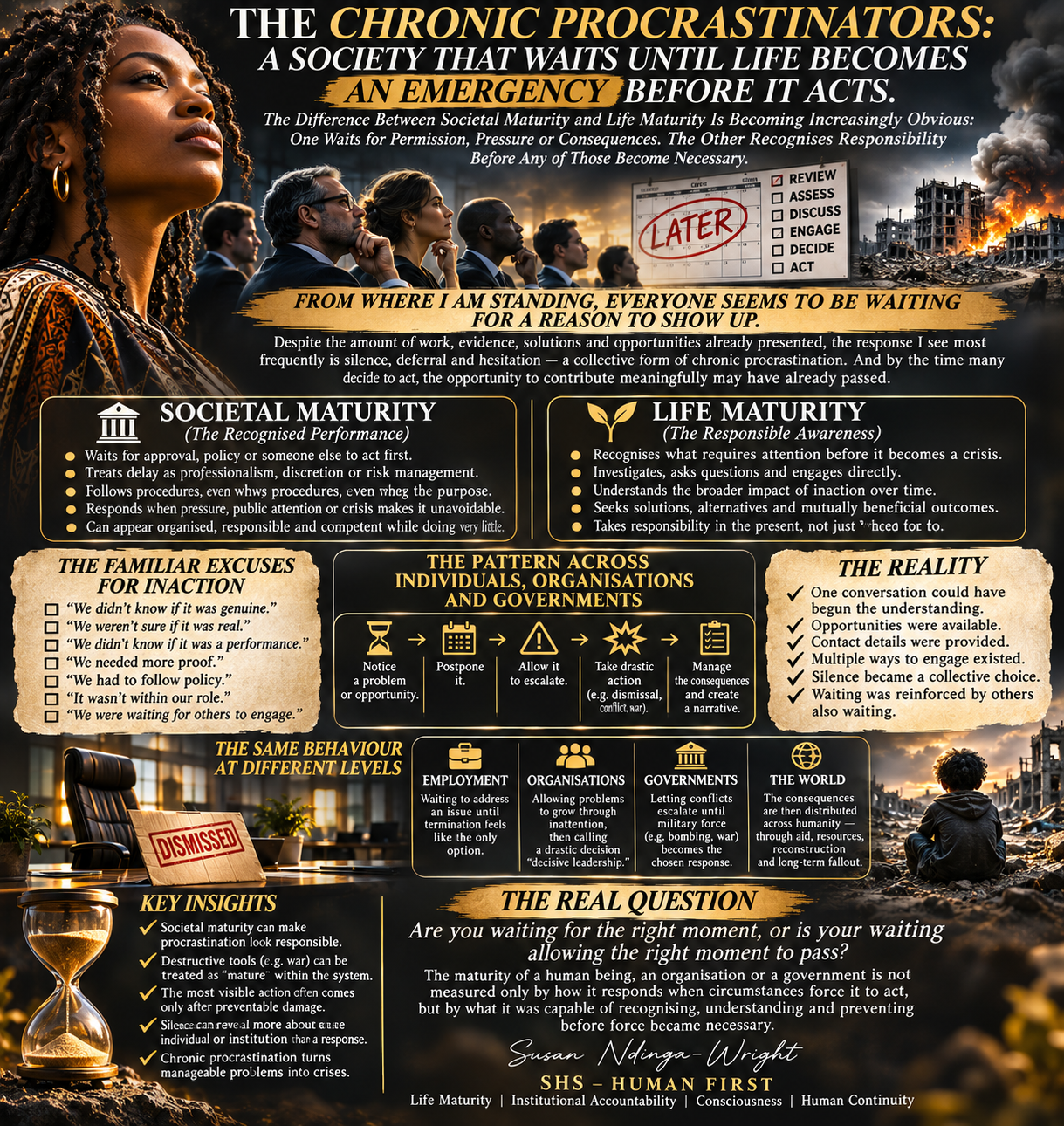
The Difference Between Societal Maturity and Life Maturity Is Becoming Increasingly Obvious: One Waits for Permission, Pressure or Consequences. The Other Recognises Responsibility Before Any of Those Become Necessary.
Following my previous examination of what happens when investigative institutions encounter the first-ever fully life-mature human being, I want to introduce another dimension.
Chronic procrastination.
Because from where I am standing, looking at the individuals, institutions, organisations and representatives who have had opportunities to engage with my work, that is increasingly what their collective behaviour resembles.
Chronic procrastination.
And I do not mean the ordinary kind where someone postpones completing an assignment or attending to a personal responsibility.
I mean an entire societal mentality built around waiting for circumstances to become sufficiently urgent before recognising the responsibilities those circumstances presented long before the emergency arrived.
People waiting for something to happen before deciding that what was already happening deserved their attention.
They wait for recognition.
They wait for approval.
They wait for someone else to act.
They wait for an institution to legitimise what is before them.
They wait for circumstances to become unavoidable.
They wait for the evidence to become so publicly undeniable that engaging with it no longer requires them to exercise independent judgement.
And sometimes, by the time they finally decide to act, the opportunity to participate constructively has already passed.
Then comes the familiar question:
How did we get here?
Well, that is precisely why I am writing about it now.
Because I intend to keep documenting the behaviours, decisions, silences and institutional habits that characterise this period, so that when the consequences of those choices become clearer, the people involved have a much more comprehensive understanding of how they arrived there.
Not merely what happened.
But what about their own ways of thinking, operating, assessing and responding contributed to what happened.
Because I have no intention of allowing the period leading up to an outcome to disappear beneath the outcome itself.
The process matters.
The opportunities matter.
The doors that remained closed matter.
And the reasons people gave themselves for remaining inactive matter.
1. FROM WHERE I AM STANDING, EVERYONE SEEMS TO BE WAITING FOR A REASON TO SHOW UP.
Consider the amount of work I have already made publicly available through SHS – Human First.
The questions raised.
The institutional weaknesses examined.
The interconnections demonstrated across industries.
The societal contradictions exposed.
The developmental frameworks introduced.
The proposals for reorganising human provision, education, governance, responsibility and continuity.
And the repeated invitations to examine not simply my conclusions, but the reasoning through which I arrived at them.
This work can be assessed, challenged, questioned and debated.
That is what engagement is for.
Yet among the individuals and organisations I have contacted, what I have experienced far more frequently is silence.
And silence, in these circumstances, interests me enormously.
Because what exactly are people waiting for?
Do they need someone else to publicly recognise the value before they can investigate it themselves?
Do they need an announcement?
An institutional endorsement?
A crisis?
A visible success so substantial that association becomes desirable?
Or are they waiting until someone else assumes the responsibility of making the first move?
Because if you can only recognise the value of something after everyone else has recognised it, what exactly is your capacity for independent judgement?
What is your contribution to discovery?
What is your contribution to prevention?
What is your contribution to recognising human potential before it receives social permission to exist?
And if you have been provided with an opportunity to engage but repeatedly defer doing so, at what point does your caution become procrastination?
That is what I want people to examine.
Because an institution can appear extraordinarily mature while doing very little.
It can have policies.
Procedures.
Departments.
Qualifications.
Assessment criteria.
Communication protocols.
Risk management structures.
Entire teams responsible for making decisions.
And still be incapable of taking one useful step towards understanding an unfamiliar individual or possibility.
The appearance of organised responsibility is not evidence that responsibility is actually being exercised.
2. SOCIETAL MATURITY HAS MADE WAITING LOOK RESPONSIBLE.
This is where the distinction between societal maturity and life maturity becomes particularly important.
Within societal maturity, waiting can be interpreted as professionalism.
Not responding can be interpreted as discretion.
Following the established process can be interpreted as competence.
Avoiding unfamiliar circumstances can be interpreted as risk management.
Deferring a decision can be interpreted as prudence.
And refusing to engage until someone else has established credibility can be interpreted as sound judgement.
But what does life maturity recognise?
It recognises that time is part of responsibility.
That an opportunity may have a period during which meaningful intervention is possible.
That delay can change the nature of a problem.
That avoiding a decision does not necessarily avoid its consequences.
And that the absence of action can become a consequential choice in itself.
Imagine two individuals encountering the same unfamiliar proposition.
The societally mature individual may ask:
Has this been approved? Is this within my role? Has someone else assessed it? What are the risks of my involvement? What do the procedures say?
The life-mature individual asks additional questions:
What is actually being presented? What can I establish through direct examination? What might be lost through delay? Who could benefit? Who might be harmed? What responsibility can I reasonably exercise now?
The first is primarily examining their position within the system.
The second is also examining the circumstances within life.
Neither set of questions makes investigation unnecessary.
But one can become a justification for never beginning it.
And that is the problem.
When adherence to procedure becomes more important than understanding the purpose the procedure was created to serve, societal maturity can become the respectable clothing of procrastination.
3. THE EXCUSES ARE PARTICULARLY INTERESTING WHEN THE SOLUTION COULD BEGIN WITH ONE CONVERSATION.
Let’s examine some of the explanations people might give.
We did not know whether she was genuine.
Then speak to me.
We did not know whether the work was authentic.
Then examine it.
We did not know whether she was performing.
Then engage sufficiently to distinguish a performance from the person.
We were unsure about her claims.
Then ask questions.
We did not know how to approach her.
My contact details were provided in my outreach.
And beyond direct contact details, we are living in a period with extraordinary communication possibilities.
Emails.
Telephone calls.
Professional networks.
Social media.
Websites.
Public correspondence.
There are numerous ways to begin a conversation.
Of course, receiving correspondence does not obligate anyone to agree with its contents, and not every individual or organisation will have the capacity to respond to every approach.
But those limitations do not eliminate the question of how opportunities are assessed.
If the uncertainty concerns whether an individual is who they present themselves to be, why would you refuse the very conversation that could help you begin establishing that?
One conversation does not guarantee complete understanding.
But it can begin the process.
One question can reveal information that was absent from a hundred assumptions.
One direct exchange can expose a mistaken interpretation that has been shaping someone’s perspective for months.
And one moment of genuine intellectual curiosity can prevent an institution from spending extraordinary resources investigating a picture it constructed without consulting the person represented within it.
The issue is not that everyone must believe me.
The issue is that disbelief without investigation is not necessarily discernment. Sometimes it is simply an untested assumption.
I have been willing to subject my own thinking to scrutiny, including speaking candidly with a psychologist about my experiences, perceptions and approaches to life.
That was part of taking my own responsibility seriously.
I do not expect a professional conversation to establish the truth of every philosophical, spiritual or institutional proposition I make.
But I understand the value of subjecting one’s understanding to examination.
So why would those who are uncertain about me consider their uncertainty sufficient reason never to begin examining what they are uncertain about?
How is that intellectual maturity?
4. THE COLLECTIVE SILENCE: WHEN EVERYONE WAITS FOR EVERYONE ELSE.
Now let us examine what happens when this behaviour spreads.
One individual remains silent.
Another observes that silence and decides not to engage.
A third notices that neither has acted and concludes there must be a reason.
A fourth assumes that if the proposition were important, someone else would already have recognised it.
A fifth waits for the others.
And before long, an entire group can become inactive without any individual having established a sound reason for that inactivity.
Everyone begins borrowing everyone else’s silence as though silence were evidence.
But evidence of what?
That the proposition lacks value?
That the individual lacks credibility?
That the work is not worth examining?
Or simply that nobody has yet taken responsibility for finding out?
That is the extraordinary danger of collective procrastination.
People begin treating the absence of action as evidence that action is unnecessary.
And because everyone is watching everyone else, they reinforce the same behaviour.
It becomes a self-sustaining culture of non-engagement.
No one wants to take the first step.
No one wants to be the first to be wrong.
No one wants to risk appearing foolish by recognising something others have not yet recognised.
Yet many of these same individuals will later celebrate the importance of independent thought, leadership and courage.
What exactly is leadership if your ability to act depends upon someone else having acted first?
What exactly is courage if you only participate once there is no longer any meaningful social risk?
And what exactly is discernment if you mistake the crowd’s hesitation for an informed conclusion?
There is something almost tragically ironic about institutions that praise innovation while organising themselves around waiting for unfamiliar possibilities to become familiar.
Because by the time something becomes familiar, the opportunity to contribute to its discovery may already have passed.
5. I AM DOCUMENTING THE PROCESS BECAUSE THE CONSEQUENCES WILL NOT EXPLAIN THEMSELVES.
This is important.
As my work develops, I want there to be a record of what was available, what was communicated, what questions were raised and what opportunities existed for engagement.
Because I believe SHS – Human First has the potential to develop into something profoundly consequential for how humanity organises provision, responsibility and collective life.
Whether, when and to what extent that potential is realised remains something that will have to be established through the work itself.
But the possibility of a future outcome does not make the present process insignificant.
Quite the opposite.
I want to examine what happens before recognition.
Before institutional interest.
Before public validation.
Before the consequences of inaction become apparent.
Because society has a habit of becoming extraordinarily interested in the final event while paying insufficient attention to the conditions that produced it.
People ask why an opportunity was lost.
Why an institution failed.
Why a crisis escalated.
Why something that could have been addressed earlier was allowed to deteriorate.
And the answers are often found in behaviours that were entirely visible long before the outcome.
The postponements.
The unexamined assumptions.
The responsibility passed between departments.
The inconvenient questions avoided.
The people dismissed without meaningful engagement.
The decisions deferred until someone else assumed responsibility.
These are not merely administrative details. They are the developmental history of a consequence.
So I intend to keep dissecting them.
Not to manufacture a narrative after the fact.
But to place the reasoning and observations on record while the process is unfolding.
That way, if people later question why certain relationships were never established, why some opportunities were missed or why particular institutions remained outside developments they might have contributed to, there will be a clearer account of the decisions and circumstances along the way.
They will have more language through which to recognise their own choices.
And perhaps more capacity to understand the behaviours they previously regarded as normal.
6. CHRONIC PROCRASTINATION IS ALSO HOW ORGANISATIONS TURN MANAGEABLE PROBLEMS INTO TERMINAL DECISIONS.
Now expand the lens.
Look at organisational management.
What happens when leadership does not know how to manage a difficult employee, an unfamiliar situation or a complex relationship?
Sometimes it develops the necessary understanding.
It investigates the circumstances.
It provides support.
It corrects errors.
It identifies whether the problem concerns the individual, the management, the structure or the relationship between them.
But other times, an organisation postpones the difficult work of understanding the problem.
It waits.
It documents difficulties.
It allows frustration to accumulate.
It responds to symptoms without resolving causes.
And eventually, when the situation becomes sufficiently uncomfortable, it reaches for the most familiar final intervention.
Dismissal.
Now, dismissal can be justified.
Sometimes an individual repeatedly refuses reasonable opportunities for improvement, violates obligations or creates circumstances in which continuation is no longer appropriate.
But not every dismissal represents the same underlying failure.
Some are failures of individual responsibility.
Some are failures of management.
Some arise from genuine incompatibility.
And some are the final consequence of problems that could have been addressed much earlier.
The question is whether the organisation understood the problem before deciding that removing the person was the solution.
Because if you wait until the only option you can recognise is termination, you may have spent months or years failing to develop the management capability that could have prevented the situation from reaching that point.
And then the organisation celebrates the termination as a decisive act of leadership.
But what exactly was decisive about waiting until there was nothing else you knew how to do?
That is not necessarily maturity.
It may be procrastination reaching its expiry date.
7. GOVERNMENTS DO THE SAME THING, EXCEPT THE CONSEQUENCES CAN BE CATASTROPHIC.
Now let us look at the governmental level.
The same behavioural pattern can operate on an extraordinary scale.
A conflict develops.
Warnings accumulate.
Relationships deteriorate.
Resources become contested.
Negotiations fail.
Institutions delay.
Responsibilities are displaced.
Positions become increasingly rigid.
And eventually governments reach for the instruments of escalation.
Military force.
Destruction.
Bombardment.
War.
Society has made warfare an instrument of statecraft.
It has developed legal frameworks, military hierarchies, strategic doctrines, political justifications and elaborate procedures around the use of force.
And because these mechanisms operate within recognised governmental structures, their use can be presented as an expression of mature leadership.
But life maturity asks a different question.
What happened to the responsibility to protect life before destroying it became the chosen response?
Military force can sometimes be used to defend people against imminent violence. Not every conflict can be resolved through compromise, particularly when an aggressor refuses peaceful alternatives.
But the existence of those circumstances does not eliminate responsibility for examining whether opportunities for prevention, protection and de-escalation were neglected.
Nor does it remove responsibility for what happens after force is used.
Because a bomb does not simply end an immediate target.
Its consequences can continue through destroyed infrastructure, displacement, environmental damage, interrupted education, lost livelihoods, trauma, medical needs and long-term reconstruction.
And who carries those consequences?
Frequently, people who never authorised the original decision.
Other nations provide humanitarian assistance.
International organisations mobilise.
Charities raise funds.
Families donate.
Communities receive displaced people.
Medical professionals respond.
Entire populations are asked to contribute towards repairing conditions they did not create.
The consequences of a concentrated decision become the distributed responsibility of humanity.
And that is one of the greatest contradictions in how we organise global responsibility.
Those with the power to cause extensive destruction do not always bear anything approaching the full human cost of repairing it.
Meanwhile, people with far fewer resources are encouraged to contribute towards helping those affected.
This is not an argument against humanitarian assistance.
It is an argument against organising humanity so that destruction can be authorised by a relatively small number of decision-makers while the burden of recovery is dispersed across the world.
And it raises the same question I ask of organisations and individuals:
What did you fail to manage before reaching for the most consequential action available to you?
Where were the earlier interventions?
Where were the imaginative solutions?
Where was the willingness to understand the other side?
Where were the opportunities for mutually beneficial arrangements, where those were genuinely possible?
Where was the responsibility to examine the human consequences before they became humanitarian emergencies?
And when those alternatives were unavailable, what preparations were made to minimise harm and fulfil responsibility for the aftermath?
Because dropping a bomb and constructing a narrative around it afterwards is not the same as having comprehensively managed the conditions that led to it.
8. SOCIETAL MATURITY CAN MAKE DESTRUCTIVE BEHAVIOUR LOOK LIKE COMPETENCE.
This is perhaps the most uncomfortable distinction of all.
An individual can become exceptionally mature according to society’s standards while remaining profoundly immature in their relationship with life.
A political leader can understand every procedure required to authorise military action.
They can command enormous resources.
They can speak with authority.
They can manage public appearances.
They can navigate institutional hierarchies.
They can demonstrate all the behaviours associated with political professionalism.
And still fail to adequately account for the lives affected by their decisions.
The sophistication of their position does not automatically establish the maturity of their judgement.
Just as a manager can competently execute a dismissal without having competently managed the situation that preceded it.
Just as an investigator can produce an elaborate behavioural profile without having adequately understood the individual being profiled.
Just as an institution can correctly follow a procedure without recognising that the procedure is failing to serve its intended purpose.
The tool may be societally legitimate while the decision to use it remains immature in its relationship with life.
And because we have made certain destructive tools legitimate within our systems, we sometimes confuse knowing how to use them with knowing when they should be used.
That is a catastrophic limitation.
Life maturity requires looking beyond whether an action is institutionally permitted.
It requires examining what the action does to life.
What it preserves.
What it destroys.
What it prevents.
What it creates.
What responsibilities it transfers to others.
And whether the same purpose could have been achieved with less harm.
This is why the distinction cannot be reduced to whether someone appears professional, authoritative or decisive.
You can be one of the most societally mature individuals in a room and still demonstrate some of the greatest immaturity towards the life your decisions affect.
9. THE CHRONIC PROCRASTINATOR WAITS UNTIL THE ALARM BECOMES THEIR ONLY UNDERSTANDING OF URGENCY.
There is something revealing about how procrastination works.
The person knows something requires attention.
But they postpone engaging with it.
Perhaps they feel uncertain.
Perhaps it requires effort.
Perhaps they fear making the wrong decision.
Perhaps they assume they have more time.
And so they wait.
Until the deadline.
Until the alarm.
Until the expiry date.
Until the consequences become unavoidable.
Then suddenly they become active.
They mobilise resources.
They make urgent decisions.
They demand cooperation.
They escalate.
They work under extraordinary pressure.
And society may praise the intensity of their response.
But why did it require an emergency to awaken the responsibility that existed beforehand?
Why do we celebrate people for responding dramatically to consequences they might have helped prevent?
That is what I find so fascinating.
We have created systems that reward visible intervention far more readily than invisible prevention.
Someone solves an emergency and becomes a hero.
Someone prevents that emergency from developing, and the value of their contribution may never become publicly visible.
One produces a spectacle.
The other preserves continuity.
And because societal systems often recognise spectacles more easily than continuity, they continually incentivise reactive behaviour.
This is precisely why my work places such emphasis on recognition before escalation.
The ability to see what is developing.
The willingness to engage before the situation becomes publicly urgent.
The capacity to correct something without needing a collapse to justify the correction.
The intellectual maturity to recognise value without requiring a crowd to recognise it first.
Life maturity does not need life to become an emergency before recognising that life deserves attention.
10. I DO NOT NEED HUMAN SILENCE TO BECOME HUMAN APPROVAL BEFORE I CONTINUE.
And this is something else I want to make clear.
My relationship with my work is not dependent upon the people I have contacted responding to it.
My spiritual understanding of my purpose, including my relationship with God, is part of how I experience and navigate this work.
I do not require everyone to share that understanding.
Nor do I expect human recognition to serve as the ultimate validation of it.
As I have explained before, my writing is a tangible expression of a much broader inner process.
The observations, associations, perceptions and experiences that eventually become written material do not begin with the publication.
The blog provides a place for those thoughts to become accessible to others.
A record.
Something people can examine.
Something they can question.
Something they can return to.
And this is precisely why silence does not stop the work.
It does not tell me everything another person is thinking.
It does not establish their motives.
But it does leave an absence of engagement where a conversation could have occurred.
And that distinction matters.
Because I am not interested in inventing people’s intentions on their behalf.
I am interested in examining what their choices, including their decisions not to engage, actually contribute to the development of a situation.
The people who remain silent may have a variety of reasons.
Some legitimate.
Some avoidable.
Some entirely unrelated to the assumptions others might make about them.
But if non-engagement becomes a repeated institutional response to unfamiliar propositions, then that pattern deserves examination regardless of the private motivations of any particular individual.
I will continue my work.
I will continue examining the conditions that produce unnecessary human suffering.
And I will continue documenting the difference between systems that claim to serve humanity and the outcomes of the choices those systems make.
Because the purpose of SHS – Human First is not to secure applause from the institutions whose limitations we are examining.
It is to develop a different relationship with human responsibility.
One in which provision, protection, understanding and continuity are not perpetually deferred until circumstances force people to recognise their importance.
11. THE MOMENT THEY FINALLY SHOW UP MAY BE THE MOMENT THEY REALISE HOW MUCH THEY HAVE MISSED.
Now imagine that a proposition someone once dismissed begins producing visible results.
A project advances.
An idea gains recognition.
An organisational model demonstrates value.
A once-unfamiliar approach begins attracting participation.
And the people who remained distant suddenly become interested.
They may want a conversation.
They may want to understand the work.
They may want to participate.
They may want to establish a relationship they previously saw no reason to develop.
And there is nothing inherently wrong with recognising value later.
People learn.
Circumstances change.
Evidence accumulates.
But later recognition cannot reverse every consequence of earlier inaction.
Some opportunities may have passed.
Some relationships may have developed without them.
Some decisions may already have been made.
Some contributions may no longer be necessary.
And perhaps most importantly, their earlier choices will remain part of the history of how the work developed.
You cannot always arrive at the moment of recognition and expect to occupy the place that was available during the period of uncertainty.
That is the cost of waiting until the outcome becomes more important to you than the opportunity to understand what was developing.
And this is what I have been attempting to communicate.
Not that any particular future outcome is guaranteed.
But that the people who continually wait for certainty before exercising curiosity risk surrendering their ability to contribute to the very developments they later claim to value.
They become observers of opportunities they might once have helped shape.
And if that happens, I want them to understand the process.
Not merely to regret it.
But to recognise what they could have done differently.
Because that understanding could change how they approach the next unfamiliar person.
The next unconventional proposal.
The next emerging possibility.
The next human being whose value does not arrive wearing the uniform of societal recognition.
And that may be one of the most important lessons of all.
12. WHAT IF THE REAL DISCOVERY IS NOT WHAT I BECOME, BUT WHAT THEIR DELAY REVEALS ABOUT THEM?
This is where my previous post about investigative institutions and life maturity connects directly to this one.
Imagine an institution encounters an individual it cannot adequately classify.
The individual presents work that does not fit neatly within its existing categories.
The institution becomes uncertain.
Rather than using the uncertainty as a reason to investigate, it treats uncertainty as a reason to postpone engagement.
The individual continues working.
The institution continues observing from a distance.
New information emerges.
The individual develops further.
The institution remains hesitant.
Eventually, the gap between what the individual has demonstrated and what the institution has examined becomes increasingly substantial.
And the institution may find itself attempting to understand an accumulated body of work that could have been examined progressively.
The problem has become larger.
Not necessarily because the person became more difficult to understand.
But because the institution deferred the work of understanding them.
Chronic procrastination can manufacture complexity by refusing to engage with complexity while it is still manageable.
The institution then requires more resources.
More time.
More assessments.
More explanations.
More consultations.
More internal coordination.
It may regard the resulting undertaking as evidence that the subject was exceptionally difficult.
But some of that difficulty may have been produced by the delay itself.
And this is the institutional lesson I want to expose.
When an organisation repeatedly postpones understanding something unfamiliar, it risks creating the very conditions it later uses to justify further postponement.
It becomes a cycle.
Unfamiliarity creates hesitation.
Hesitation prevents engagement.
The absence of engagement preserves unfamiliarity.
And preserved unfamiliarity is used to justify continued hesitation.
The institution becomes trapped inside a problem that its own reluctance helps maintain.
Now imagine that happening across multiple institutions simultaneously.
Everyone waiting.
Everyone observing.
Everyone looking for someone else to establish legitimacy.
Everyone treating another person’s silence as permission to remain silent.
And nobody taking responsibility for breaking the pattern.
That is not collective intelligence.
That is collective dependency.
And it is precisely the kind of systemic behaviour that life maturity must be capable of recognising and challenging.
13. HUMANITY DOES NOT HAVE THE LUXURY OF WAITING UNTIL EVERYTHING GOES WRONG BEFORE LEARNING HOW TO DO BETTER.
This is ultimately much greater than my own interactions.
Because the same mentality appears throughout the structures we have built.
We postpone addressing environmental damage until the consequences become severe.
We postpone correcting organisational failures until they become scandals.
We postpone difficult conversations until relationships deteriorate.
We postpone investing in prevention until we can calculate the cost of what prevention might have avoided.
We postpone revising harmful procedures until enough people have been affected to make the problem publicly undeniable.
And we postpone developing better ways of managing conflict until the alternatives have become increasingly difficult to implement.
Then we mobilise.
Then we express concern.
Then we announce reforms.
Then we assemble committees.
Then we promise that lessons will be learned.
But what happened to learning before the damage?
What happened to recognition before collapse?
What happened to developing the intellectual and emotional maturity necessary to address problems without first requiring them to become emergencies?
Why must humanity repeatedly pay for the consequences of what it refused to examine when examination was still comparatively inexpensive?
Because our society has made reaction look like leadership and prevention look like an optional investment.
That is one of the greatest failures of societal maturity.
And life maturity cannot afford to reproduce it.
For life maturity, responsibility does not begin when an institution announces that a problem has become sufficiently important.
Responsibility begins when the conditions requiring attention can be recognised.
It begins in the present.
Before the deadline.
Before the spectacle.
Before the emergency.
Before the collapse.
Before the public demand for accountability.
And before anyone has to suffer merely to establish that their circumstances deserved attention.
YOU ARE NOT WAITING FOR THE RIGHT MOMENT IF YOUR WAITING IS ALLOWING THE RIGHT MOMENT TO PASS.
So this is my message to the individuals and institutions that have had opportunities to examine my work.
You do not have to agree with me.
You do not have to believe every conclusion I reach.
You do not have to accept my understanding of consciousness, life maturity or metaphysics.
You do not have to join SHS – Human First.
And you certainly do not have to pretend to recognise something you have not yet understood.
But if the possibility of value exists, and you have a legitimate opportunity to examine it, then your own intellectual responsibility deserves consideration.
Ask questions.
Investigate.
Disagree constructively.
Seek clarification.
Develop your own understanding.
And when a decision not to engage is justified, be capable of understanding why.
Do not confuse the absence of external pressure with the absence of responsibility.
Do not wait until a possibility becomes publicly fashionable before deciding it deserves your curiosity.
Do not allow other people’s silence to become the substitute for your own judgement.
Do not confuse following procedure with fulfilling purpose.
Do not wait until the only options you recognise are the most destructive or irreversible ones.
And do not celebrate yourself for becoming active at the moment when earlier action might have produced a considerably better outcome.
Because if there is one thing I want this ongoing examination to establish, it is this:
The maturity of a human being, an organisation or an institution is not measured only by how competently it responds when circumstances force it to act.
It is also measured by what it was capable of recognising, understanding and preventing before force became necessary.
I will continue documenting this process because I want the people involved to have something more useful than regret if they later discover that opportunities were lost through their own methods of engagement.
I want them to have understanding.
Language for what happened.
Language for the choices they made.
Language for the assumptions they relied upon.
Language for the fears they may eventually recognise.
Language for the ways societal expectations influenced their judgement.
And language for distinguishing genuine caution from procrastination disguised as professionalism.
Perhaps that will become one of the most significant contributions of this entire experience.
Not merely what SHS achieves.
But what the responses to SHS reveal about the systems that claim to recognise, develop and protect human potential.
Because there is a fundamental difference between being prepared to respond when life makes something unavoidable and being mature enough to recognise its importance before that moment arrives.
Societal maturity may teach you how to manage the consequences of a crisis.
Life maturity asks why you allowed a preventable crisis to become necessary in the first place.
And when you understand that distinction, you begin recognising how many of humanity’s greatest problems are not simply failures of intelligence, resources or technological capability.
They are failures of timely responsibility.
Failures of independent judgement.
Failures of courage.
Failures of willingness to engage before recognition becomes socially convenient.
And failures to understand that life does not suspend its consequences while institutions decide whether they are comfortable paying attention.
The greatest human development will not be achieved by becoming increasingly sophisticated at responding to disasters.
It will be achieved by becoming mature enough to stop manufacturing so many of the conditions that make disasters possible.
That is the difference.
And from where I am standing, it is becoming increasingly difficult to ignore.
Because while the procrastinator is still waiting for life to give them a reason to act, life is already recording the consequences of their inaction.
Susan Ndinga-Wright
SHS – HUMAN FIRST
Life Maturity | Institutional Accountability | Consciousness | Human Continuity


Leave a Reply