
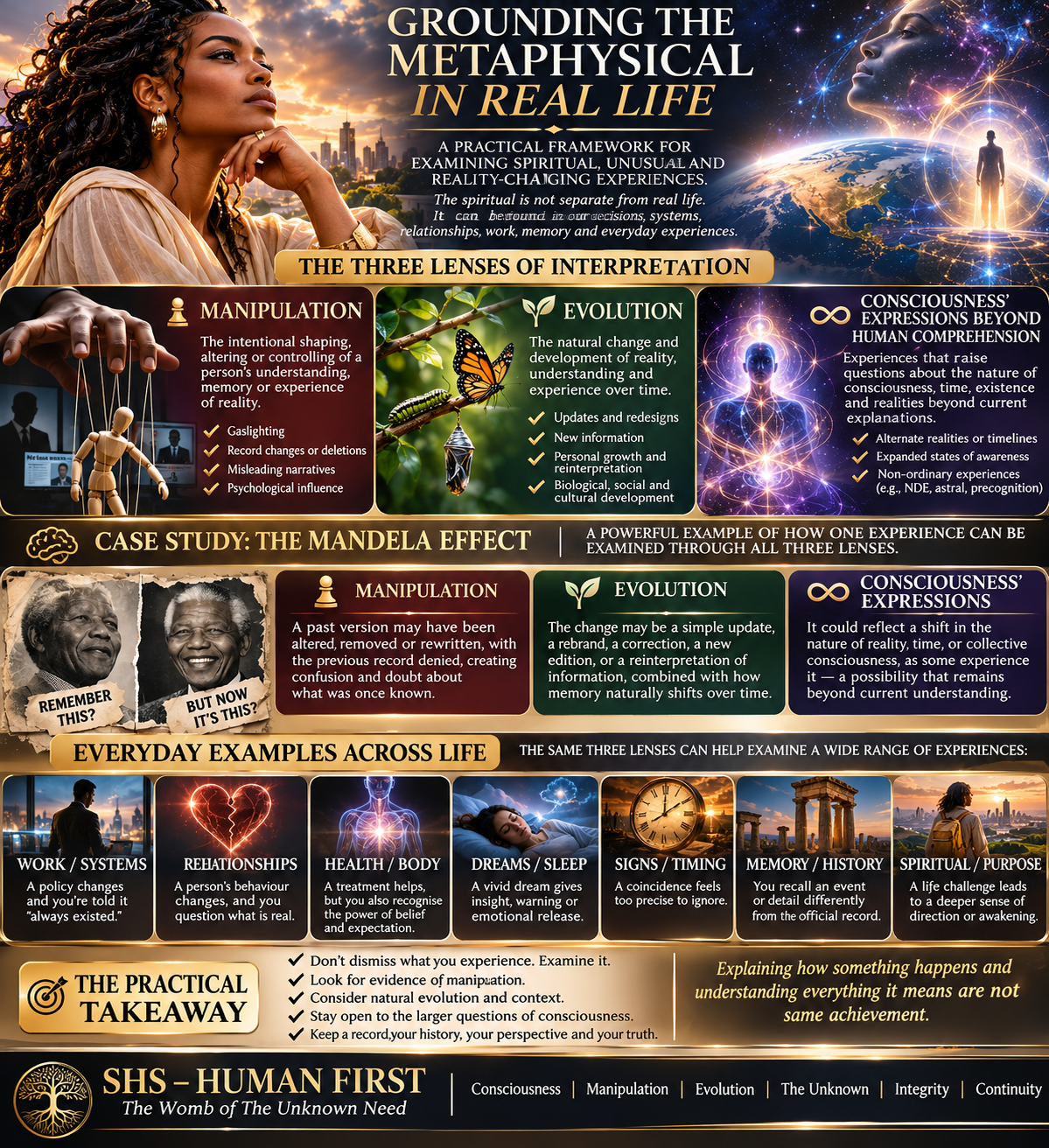
If you follow the money you’ll easily spot where manipulation lives and if you follow embodied intentions it’s easy to see evolutionary living with Consciousness.
Grounding the Metaphysical in Everyday Human Experience
Manipulation | Evolution | Consciousness Beyond Human Comprehension
SHS – HUMAN FIRST | The Womb of The Unknown Need
We have developed a peculiar habit as human beings.
We separate the spiritual from the material, the metaphysical from the practical, and consciousness from the systems through which we organise our daily lives.
We speak of spiritual awakening as though it must involve extraordinary visions.
We speak of karma as though it must involve some invisible judgment.
We speak of the Mandela Effect as though it must involve another universe.
We speak of manifestation as though it begins with attracting something from beyond our existing reality.
But what if we started smaller?
What if we examined these concepts through the everyday experiences we already recognise?
Because the same principles we associate with extraordinary spiritual experiences often have much smaller expressions in ordinary life.
A person changes their mind.
An organisation changes its rules.
A child inherits a belief.
A company changes its logo.
A professional makes a justified decision that leaves them emotionally uncomfortable.
A relationship ends, yet its influence continues.
A person experiences an extraordinary coincidence.
A dream introduces a thought they had never consciously considered.
At what point does an ordinary experience become something we call spiritual?
Perhaps the answer begins with the lens through which we examine it.
For SHS – Human First, we can investigate these experiences through three categories:
MANIPULATION: What happens when a human being or organisation deliberately influences another person’s understanding or experience of reality?
EVOLUTION: What happens when circumstances, knowledge, behaviours, biological conditions or systems naturally change, producing a new reality from an earlier one?
CONSCIOUSNESS BEYOND HUMAN COMPREHENSION: What possibilities remain when an experience raises questions that existing explanations have not fully settled?
The third category is an invitation to explore, not a requirement to declare every mystery supernatural.
And importantly, the three categories need not always be mutually exclusive.
Something may genuinely evolve while someone manipulates the story of its evolution. An experience may have a known physical mechanism while still inspiring profound questions about consciousness.
The task is to understand what happened, what it meant, what influenced it and what remains unknown.
PART I — REALITY, MEMORY AND PERCEPTION
1. The Mandela Effect
Everyday expression: You remember an application having a particular feature, a company using a particular logo, or someone having made a specific statement. Later, the reality presented to you differs from your recollection.
Manipulation: Someone knowingly alters the record, removes an earlier version, rewrites a document or denies a previous agreement, potentially encouraging you to distrust your memory. When such conduct forms a pattern of psychological control, it may become gaslighting.
Evolution: The application was updated, the logo redesigned, the policy revised, or the meaning of the original statement reinterpreted. Alternatively, memory itself may have reconstructed the experience inaccurately.
Consciousness beyond comprehension: The larger metaphysical question asks whether our experience of reality could involve dimensions of time, memory or existence not yet understood. Alternative timelines are one speculative interpretation, not an established explanation of the Mandela Effect.
The lesson: Before declaring that reality changed mysteriously, ask what changed materially, what changed interpretively and who controls the record.
2. Déjà Vu — The Feeling of Having Lived Something Before
Everyday expression: You enter a meeting, encounter a stranger or hear a conversation that feels strangely familiar.
Manipulation: Someone may deliberately recreate familiar circumstances, language or emotional cues to produce recognition or influence your response.
Evolution: The brain can generate a false sense of familiarity through memory and recognition processes.
Consciousness beyond comprehension: The experience invites philosophical questions about whether consciousness is confined to our ordinary sense of linear time.
3. Jamais Vu — The Familiar Suddenly Becoming Strange
Everyday expression: You look at a familiar word, workplace or person, yet briefly experience them as unfamiliar.
Manipulation: Repeated contradictions, isolation or psychologically destabilising interactions can make familiar environments feel uncertain.
Evolution: Changes in attention, fatigue or familiarity processing can alter how something previously recognised is experienced.
Consciousness beyond comprehension: The phenomenon raises a question about identity and perception: how much of what we call reality depends on consciousness continuously recognising it?
4. False Memories and Reconstructed Histories
Everyday expression: Two family members recall the same childhood event differently.
Manipulation: One person may deliberately repeat a misleading story until another begins doubting their own recollection.
Evolution: People remember events through changing emotional, cultural and personal perspectives. A child’s interpretation may differ greatly from an adult’s later understanding.
Consciousness beyond comprehension: Could memory be understood not only as a record of experience, but as part of consciousness continually constructing its relationship with existence?
5. Glitches in Reality
Everyday expression: A document disappears, a device behaves unexpectedly, an object appears somewhere you do not remember placing it, or two records contradict one another.
Manipulation: Someone with access may have changed the information, location or settings.
Evolution: Software bugs, synchronization failures, unnoticed movements, technical updates or memory mistakes can produce seemingly inexplicable changes.
Consciousness beyond comprehension: Such experiences inspire metaphysical questions about the continuity and structure of experienced reality, including simulation and reality-shifting hypotheses.
6. Time Distortion
Everyday expression: Five minutes during a frightening experience feel much longer, while hours spent creating something meaningful seem to disappear.
Manipulation: Urgency, deadlines, constant interruptions and engineered scarcity can alter how people experience time and make decisions.
Evolution: Attention, emotional intensity, memory and physiological states influence subjective time perception.
Consciousness beyond comprehension: The deeper question concerns the relationship between consciousness and time: is our lived experience of duration identical to time as measured by a clock?
PART II — SIGNS, PATTERNS AND TIMING
7. Synchronicity
Everyday expression: You think about a person and unexpectedly receive a message from them.
Manipulation: Someone may arrange an encounter or selectively present coincidences to create an impression of destiny.
Evolution: Shared routines, common interests, probability, selective attention and social environments naturally produce intersections.
Consciousness beyond comprehension: Synchronicity opens the philosophical possibility that meaningful relationships between events may sometimes exceed the causal relationships we can presently identify.
8. Angel Numbers and Repeating Numbers
Everyday expression: You repeatedly notice 11:11, 222, 333 or another number associated with personal meaning.
Manipulation: People can use numerical symbolism to encourage obedience, spending, fear or dependence upon their interpretations.
Evolution: Once a number becomes meaningful, attention makes its appearances more noticeable. Numbers also recur naturally in clocks, addresses, receipts and digital systems.
Consciousness beyond comprehension: Numerical patterns invite reflection on mathematics, order and whether humans discover or assign meaning to the patterns they encounter.
9. Omens and Signs
Everyday expression: A bird appears before an important decision, an object breaks, or an unexpected event seems symbolically connected to something happening in your life.
Manipulation: A person may exploit cultural superstitions to influence another person’s choices.
Evolution: Symbols acquire meaning through experience, tradition, association and cultural inheritance.
Consciousness beyond comprehension: The metaphysical question concerns whether nature and human consciousness might participate in relationships of meaning beyond deliberate human communication.
10. Premonitions
Everyday expression: You feel something will happen before it does, or imagine an event that later resembles reality.
Manipulation: Someone may present a vague prediction, then emphasise its apparent accuracy after an event.
Evolution: Experience, observation and unconscious recognition of patterns can generate predictions before conscious reasoning catches up. Coincidental matches also occur.
Consciousness beyond comprehension: The possibility of precognition remains a speculative question about whether consciousness could access information beyond ordinary sensory and temporal limits.
11. Divine Timing
Everyday expression: An opportunity arrives just as you acquire the experience or confidence to pursue it.
Manipulation: Someone controlling access to a resource may create artificial delays and later present their intervention as destiny.
Evolution: Preparation, networks, timing, environmental conditions and accumulated experience can produce opportunities that were previously unavailable.
Consciousness beyond comprehension: Divine timing becomes a philosophical interpretation of meaningful alignment between an individual’s development and the events they encounter.
12. Miracles and Extraordinary Luck
Everyday expression: A person survives an unlikely event, receives unexpected assistance or encounters an extraordinary opportunity.
Manipulation: People may exaggerate, stage or selectively publicise exceptional outcomes to create belief in supernatural authority.
Evolution: Low-probability events occur within large populations, and favourable outcomes may arise from combinations of circumstances.
Consciousness beyond comprehension: The experience can inspire questions about causality, possibility and the limits of human expectations without requiring an immediate supernatural conclusion.
PART III — THOUGHT, INTENTION AND THE MIND
13. Intuition
Everyday expression: You sense that a professional arrangement, relationship or decision needs closer examination before you can fully explain why.
Manipulation: Someone may encourage you to mistake their suggestions, fears or expectations for your own intuition.
Evolution: The mind can recognise subtle patterns through accumulated experience, sometimes before those patterns become consciously articulated.
Consciousness beyond comprehension: Intuition raises questions about how much information consciousness processes beyond deliberate reasoning and whether other forms of awareness could exist.
14. Manifestation and the Law of Attraction
Everyday expression: You develop a clear vision, reorganise your habits, approach different people and begin encountering opportunities related to your goal.
Manipulation: Promises that thoughts alone guarantee wealth, romance or success can be used to sell products or blame people for circumstances beyond their control.
Evolution: Beliefs influence attention, behaviour, confidence, persistence and the opportunities a person notices or pursues.
Consciousness beyond comprehension: Manifestation becomes the metaphysical question of whether consciousness and material circumstances could interact in ways beyond currently established psychological and behavioural mechanisms.
15. Prayer
Everyday expression: You pray before making a difficult decision, experiencing loss or entering an uncertain situation.
Manipulation: Religious or spiritual authority can exploit prayer by claiming exclusive access to outcomes, forgiveness or protection.
Evolution: Prayer can function as reflection, emotional regulation, intention-setting, community connection and a means of organising personal values.
Consciousness beyond comprehension: Prayer raises questions about whether consciousness can meaningfully relate to a greater intelligence, presence or dimension of existence.
16. Affirmations and the Power of Words
Everyday expression: You repeatedly tell yourself that you can complete a difficult task or become more capable.
Manipulation: Repetition can also be used through propaganda, indoctrination and persuasive messaging.
Evolution: Language influences self-concept, expectations and behaviour, particularly when supported by lived experience and action.
Consciousness beyond comprehension: Words invite deeper philosophical consideration of whether language is merely a representation of consciousness or also part of how consciousness participates in shaping reality.
17. The Placebo and Nocebo Effects
Everyday expression: Expectations alter someone’s experience of pain, discomfort or treatment.
Manipulation: Misleading claims, fear-inducing messaging or deceptive treatments can exploit the relationship between expectation and bodily experience.
Evolution: Expectations, learning, conditioning and neurobiological mechanisms can influence certain symptoms and treatment responses.
Consciousness beyond comprehension: The wider question is how subjective experience and biological processes relate, and how much remains to be discovered about that relationship.
18. Collective Consciousness
Everyday expression: Similar ideas appear in different communities, societies or professional fields around the same period.
Manipulation: Coordinated campaigns, information control and repeated messaging can create apparent consensus.
Evolution: Shared problems, technological change, cultural exchange and similar environmental pressures can lead different people toward comparable ideas independently.
Consciousness beyond comprehension: The metaphysical interpretation asks whether individual minds participate in a broader field of consciousness. That possibility remains distinct from established social and cognitive explanations.
PART IV — DREAMS AND ALTERED STATES
19. Dreams
Everyday expression: You dream about a conflict at work and wake with a different understanding of your emotions.
Manipulation: Someone may claim authority over your dreams, using their interpretations to control your decisions.
Evolution: Dreams are associated with sleep-related brain activity and can reflect emotional concerns, memories and recombinations of experience.
Consciousness beyond comprehension: Dreams raise philosophical questions about the nature of awareness when the ordinary waking world is absent.
20. Lucid Dreams
Everyday expression: You become aware that you are dreaming and influence events within the dream.
Manipulation: Exaggerated claims about lucid dreaming can be used to sell access to supposedly exclusive abilities.
Evolution: Lucid dreaming is a recognised sleep phenomenon involving awareness of the dream state.
Consciousness beyond comprehension: It invites examination of how consciousness can recognise and experience an internally generated world while the body sleeps.
21. Sleep Paralysis
Everyday expression: You awaken unable to move, sometimes experiencing pressure or a frightening presence.
Manipulation: Someone may exploit these experiences to convince a person they are spiritually attacked or require paid protection.
Evolution: Sleep paralysis occurs when waking awareness overlaps with REM-related muscle immobility and can include vivid sensory experiences.
Consciousness beyond comprehension: It raises questions about how the brain generates experiences of embodiment and presence.
22. Astral Projection and Out-of-Body Experiences
Everyday expression: During sleep, meditation or a medical event, a person feels as though they are observing their body from outside it.
Manipulation: Such reports can be exaggerated or used to establish spiritual authority.
Evolution: Changes in body perception, sensory integration and altered states can produce out-of-body sensations.
Consciousness beyond comprehension: These experiences inspire debate about whether consciousness is entirely dependent upon the brain’s ordinary representation of bodily location.
23. Near-Death Experiences
Everyday expression: Someone surviving a life-threatening event describes intense light, altered time, encounters or profound peace.
Manipulation: Accounts can be sensationalised, selectively retold or exploited for ideological purposes.
Evolution: Extreme physiological conditions, memory processes and alterations in consciousness are investigated as contributors to these experiences.
Consciousness beyond comprehension: The central philosophical question concerns the relationship between consciousness, dying and the possibility of experience beyond bodily life.
24. Trance, Channeling and Altered Speech
Everyday expression: During intense concentration, religious practice or creative activity, someone experiences words or ideas as arriving spontaneously.
Manipulation: A person may falsely claim that an unquestionable external authority is speaking through them.
Evolution: Absorption, suggestion, improvisation, learned practices and altered attention can change the experience of generating speech or ideas.
Consciousness beyond comprehension: Channeling raises questions about authorship of thought, identity and whether awareness has dimensions not fully described by ordinary conscious intention.
PART V — HUMAN CONNECTIONS AND RELATIONSHIPS
25. Auras and Human Energy
Everyday expression: Someone enters a room and immediately changes its emotional atmosphere.
Manipulation: Charisma, intimidation, presentation and deliberate social behaviour can shape how others feel.
Evolution: Facial expressions, posture, voice, proximity, emotion and prior associations influence social perception.
Consciousness beyond comprehension: Aura traditions ask whether human presence has dimensions beyond the social and physiological signals currently measured.
26. Telepathy
Everyday expression: Two people close to one another anticipate the same words or appear to understand each other without speaking.
Manipulation: Information can be passed through hidden cues, prior knowledge or staged demonstrations.
Evolution: Familiarity, shared experience and sensitivity to nonverbal signals can produce extraordinary-seeming coordination.
Consciousness beyond comprehension: Telepathy is the proposed possibility of direct mind-to-mind information transfer beyond recognised sensory communication.
27. Soulmates and Twin Flames
Everyday expression: A relationship feels unusually profound, familiar or transformative.
Manipulation: Someone may use claims of predestined connection to excuse harmful behaviour or discourage separation.
Evolution: Attachment, compatibility, shared values, emotional intensity and personal history can generate powerful bonds.
Consciousness beyond comprehension: Soulmate traditions explore whether certain relationships could reflect connections extending beyond one lifetime or ordinary interpersonal history.
28. Energetic Cords and Attachments
Everyday expression: Years after a relationship ends, particular memories or situations still produce a strong emotional response.
Manipulation: Someone may deliberately maintain dependence through intermittent attention, guilt or unresolved obligations.
Evolution: Attachment, memory and learned emotional responses can persist long after physical contact ends.
Consciousness beyond comprehension: Energetic-cord symbolism asks whether relationships establish nonmaterial forms of connection.
29. Karma
Everyday expression: A manager consistently mistreats employees, eventually damaging trust, reputation and the organisation’s ability to retain people.
Manipulation: Karma can be invoked to frighten others, justify inequality or discourage accountability.
Evolution: Actions produce consequences through habits, relationships, institutions, reputation and intergenerational patterns.
Consciousness beyond comprehension: Spiritual karma proposes moral continuity extending beyond immediate causality, sometimes across lifetimes.
30. Soul Contracts, Destiny and Free Will
Everyday expression: A person’s upbringing, talents and circumstances seem to direct them toward a particular role.
Manipulation: Claims that someone’s suffering or obligations were predestined can undermine their freedom to choose.
Evolution: Early conditions, personal development, environment and decisions create pathways that may become increasingly characteristic of someone’s life.
Consciousness beyond comprehension: Soul-contract traditions propose that aspects of life’s journey may carry meaning or intention preceding conscious earthly choice.
PART VI — SPIRITS, ANCESTRY AND THE AFTERLIFE
31. Ghosts and Hauntings
Everyday expression: Someone hears unfamiliar sounds in an old house or feels watched in an apparently empty room.
Manipulation: Another person may create misleading noises, images or accounts to produce fear.
Evolution: Building noises, environmental conditions, perception, expectation and misidentified sensory information can explain many such experiences.
Consciousness beyond comprehension: Haunting traditions ask whether traces of identity or awareness could persist beyond bodily death.
32. Sensing the Presence of the Deceased
Everyday expression: Someone smells a deceased parent’s familiar perfume or momentarily feels their presence.
Manipulation: A person’s grief can be exploited through fabricated messages or claims of exclusive communication.
Evolution: Memory, attachment, sensory associations and bereavement can generate vivid experiences of continued presence.
Consciousness beyond comprehension: The experience raises questions about whether personal connection has any form beyond physical existence.
33. Ancestral Guidance
Everyday expression: A person faces a difficult decision and recalls a principle taught by a grandparent.
Manipulation: Family history or ancestral authority may be used to demand unquestioning obedience.
Evolution: Values, practical knowledge, culture, genetics and behavioural patterns can be transmitted across generations.
Consciousness beyond comprehension: Ancestral spirituality asks whether inheritance includes forms of connection not reducible to biological or cultural transmission.
34. Reincarnation
Everyday expression: Someone feels strongly connected to a historical era or unfamiliar cultural tradition.
Manipulation: Claims about previous lives can be used to manufacture authority, status or dependence.
Evolution: Familiarity, exposure, imagination, cultural influence and personal interests can create these connections.
Consciousness beyond comprehension: Reincarnation proposes continuity of consciousness through multiple embodied lives.
35. Past-Life Memories
Everyday expression: A child describes an unfamiliar place or identity with unusual confidence.
Manipulation: Leading questions, suggestion and selective storytelling can influence the account.
Evolution: Memory development, imaginative construction, forgotten information and cultural narratives are relevant explanations to examine.
Consciousness beyond comprehension: Past-life interpretations ask whether autobiographical experience could somehow extend beyond one lifetime.
36. Spirit Guides and Guardian Angels
Everyday expression: During uncertainty, a person experiences an internal sense of reassurance or guidance.
Manipulation: Others may claim exclusive access to invisible guides and use that claim to direct someone’s life.
Evolution: Internalised relationships, moral beliefs, reflection and self-regulation can provide experiences of guidance.
Consciousness beyond comprehension: The spiritual interpretation proposes the possibility of intelligences or presences beyond ordinary human perception.
PART VII — THE BODY, NATURE AND ENERGY
37. Chakras
Everyday expression: Someone describes feeling emotionally closed, mentally overwhelmed or unable to express themselves.
Manipulation: Claims that particular energy centres are blocked can be used to sell unnecessary interventions or create dependence.
Evolution: Breath, posture, emotional regulation, bodily awareness and learned associations influence how internal states are experienced.
Consciousness beyond comprehension: Chakra systems offer a symbolic and spiritual model of relationships among consciousness, body and perceived energy.
38. Kundalini Awakening
Everyday expression: During meditation, intense emotion or personal transformation, someone experiences heat, tingling, trembling or unusual bodily sensations.
Manipulation: Spiritual teachers may exaggerate these experiences to establish authority over followers.
Evolution: Attention, autonomic activity, breathing and physiological arousal can produce powerful sensations.
Consciousness beyond comprehension: Kundalini traditions interpret such experiences as aspects of spiritual energy and transformation.
39. Energy Healing
Everyday expression: A reassuring touch, peaceful environment or supportive encounter helps someone feel calmer.
Manipulation: Unsupported promises of cures can exploit people seeking relief.
Evolution: Relaxation, interpersonal support, expectation and established mind-body mechanisms can influence comfort and some symptoms.
Consciousness beyond comprehension: Energy-healing traditions propose additional forms of interaction between living beings that have not been established as clinical mechanisms.
40. Sound, Vibration and Frequency
Everyday expression: Music changes your mood, rhythm helps you concentrate, or an unpleasant sound makes you tense.
Manipulation: Sound can be used in advertising, crowd control or emotional persuasion.
Evolution: Auditory stimulation influences attention, arousal, emotion and bodily responses through recognised sensory pathways.
Consciousness beyond comprehension: The metaphysical question concerns whether sound and vibration hold additional relationships with consciousness beyond their known physical and psychological effects.
41. Crystals, Talismans and Sacred Objects
Everyday expression: A person carries an object that reminds them of courage, family or a personal promise.
Manipulation: Sellers may attribute unsupported powers to objects to extract money or influence decisions.
Evolution: Symbolic objects can function as memory cues, emotional anchors and reminders of intention.
Consciousness beyond comprehension: Spiritual traditions ask whether materials and symbols might participate in forms of energetic or meaningful connection beyond those presently demonstrated.
42. Grounding and Connection With Nature
Everyday expression: A walk among trees helps someone settle emotionally after a difficult day.
Manipulation: Idealised claims about nature may be used commercially without supporting evidence.
Evolution: Movement, environmental change, reduced stressors and sensory engagement can support wellbeing.
Consciousness beyond comprehension: Nature-centred spirituality asks whether human awareness is part of a larger living intelligence or interconnected field of existence.
PART VIII — SYMBOLS, DIVINATION AND PERSONAL TRANSFORMATION
43. Astrology
Everyday expression: Someone uses their birth chart or zodiac sign to reflect on temperament, relationships or personal decisions.
Manipulation: Vague predictions and flattering descriptions can be presented as personalised certainty.
Evolution: Cultural symbolism and self-reflection can help people articulate traits, experiences and expectations, even without an established astrological causal mechanism.
Consciousness beyond comprehension: Astrology poses the ancient question of whether cosmic patterns hold relationships with earthly life beyond currently demonstrated physical influences.
44. Tarot and Divination
Everyday expression: A card prompts a person to reconsider a neglected relationship or professional decision.
Manipulation: A reader may use suggestion, fear or claims of certainty to control someone’s choices.
Evolution: Symbolic prompts can stimulate introspection, association and alternative ways of interpreting circumstances.
Consciousness beyond comprehension: Divination traditions ask whether symbolic selection can provide access to meaningful information beyond ordinary conscious knowledge.
45. Rituals and Ceremonies
Everyday expression: A graduation, funeral, wedding, birthday or personal morning practice marks a transition.
Manipulation: Rituals can reinforce hierarchy, obedience or group identity through social pressure.
Evolution: Repeated symbolic actions help organise memory, identity, emotional transitions and belonging.
Consciousness beyond comprehension: Rituals can express the belief that intention and symbolic action participate in a greater spiritual order.
46. Sacred Geometry and Symbols
Everyday expression: Architectural patterns, circles, symmetry or recurring designs inspire feelings of order and beauty.
Manipulation: Symbolism can be used to signal prestige, secrecy or authority without substantiating extraordinary claims.
Evolution: Geometry arises in mathematics, design and natural structures; people develop cultural interpretations of those patterns.
Consciousness beyond comprehension: Sacred geometry asks whether mathematical structures reflect deeper relationships between consciousness and the organisation of existence.
47. Spiritual Awakening and the Dark Night of the Soul
Everyday expression: A professional crisis or personal loss causes someone to question their career, identity, relationships and assumptions.
Manipulation: Someone may exploit this period of uncertainty by claiming to possess the only path toward enlightenment.
Evolution: Major transitions can involve grief, reassessment, identity change and the development of new priorities.
Consciousness beyond comprehension: Spiritual traditions interpret some transformations as shifts in one’s relationship with a larger reality.
48. Shadow Work and Projection
Everyday expression: Someone repeatedly criticises another person’s behaviour, then recognises a similar tendency within themselves.
Manipulation: Psychological language can be weaponised to dismiss legitimate concerns by claiming they are merely projections.
Evolution: Reflection, emotional awareness and recognising previously avoided aspects of oneself can support personal development.
Consciousness beyond comprehension: Shadow-work traditions can be explored as symbolic accounts of consciousness encountering unrecognised dimensions of itself.
PART IX — COLLECTIVE REALITY, POWER AND THE UNKNOWN
49. Egregores and Collective Thoughtforms
Everyday expression: An organisation develops such a powerful culture that individuals begin behaving according to its identity, even when nobody explicitly instructs them.
Manipulation: Branding, propaganda, group pressure and institutional incentives can cultivate collective beliefs.
Evolution: Shared language, norms, expectations and repeated practices create durable collective identities.
Consciousness beyond comprehension: Egregore traditions imagine collective thought as capable of possessing a form of existence beyond the participating individuals.
50. Curses and Blessings
Everyday expression: A child repeatedly hears that they will never succeed, while another grows up surrounded by encouragement.
Manipulation: Threats of curses or promises of blessings can influence behaviour through fear and dependence.
Evolution: Expectations, social opportunities, upbringing and interpersonal behaviour can shape development across time.
Consciousness beyond comprehension: Spiritual traditions ask whether benevolent or harmful intentions possess influences beyond their recognised psychological and social consequences.
51. Possession and External Influence
Everyday expression: Someone behaves in ways that feel deeply unfamiliar to themselves or those around them.
Manipulation: Claims of possession can be used to stigmatise, frighten or control someone.
Evolution: Changes in behaviour can arise through stress, dissociation, social influence, neurological conditions or other identifiable circumstances.
Consciousness beyond comprehension: Possession traditions interpret certain experiences through the possibility of nonphysical agents or identities. This is a cultural and metaphysical interpretation, not an automatic explanation of altered behaviour.
52. Mass Awakening and Collective Transformation
Everyday expression: Large numbers of people begin questioning the same institutions, practices or inherited values.
Manipulation: Coordinated campaigns can create or amplify the appearance of widespread agreement.
Evolution: Shared material pressures, education, communication networks and generational change can produce simultaneous social transformations.
Consciousness beyond comprehension: Collective-awakening ideas ask whether humanity’s evolving awareness might be understood as part of a wider process of consciousness.
53. Parallel Realities and Reality Shifting
Everyday expression: You revisit a former workplace and discover that its culture, people and procedures have changed so profoundly it feels like another world.
Manipulation: A person or institution may deliberately suppress records of previous practices and present the new arrangement as though it always existed.
Evolution: Material environments, relationships, social systems and individual understanding continuously change, sometimes producing dramatic discontinuities in lived experience.
Consciousness beyond comprehension: Parallel-reality interpretations explore whether experienced existence could involve realities beyond the one conventionally observed. They remain speculative rather than demonstrated explanations for everyday discrepancies.
54. Immortality, Consciousness and the Continuity of Life
Everyday expression: A person’s influence survives their physical absence through children, institutions, ideas, art, language and the lives they changed.
Manipulation: Claims of immortality or privileged access to eternal existence can be exploited to gain power or control.
Evolution: Biological reproduction, cultural transmission, memory and material consequences allow aspects of an individual’s influence to continue beyond their lifetime.
Consciousness beyond comprehension: The deeper metaphysical question is whether subjective consciousness itself can continue beyond bodily death, rather than only through the traces it leaves in others.
PART X — THE THREE-LENS TEST: HOW TO APPLY THIS TO REAL LIFE
After examining these 54 concepts, we arrive at something remarkably practical.
Every time we encounter an experience that feels spiritual, extraordinary, confusing, contradictory or deeply significant, we can investigate it through three lines of inquiry.
FIRST: THE MANIPULATION QUESTION
Who, if anyone, has the ability and incentive to influence how this reality is presented?
Take the example of a workplace.
An employee remembers that a particular rule did not exist when they joined.
Management insists that it has always been in place.
Before calling this a Mandela Effect, the employee can examine the original contract, version histories, emails, policy dates and previous communications.
If the policy genuinely changed, that is one explanation.
If someone knowingly concealed the change and repeatedly undermined the employee’s confidence in their memory, that is an entirely different issue.
This is why the preservation of historical traces matters.
SECOND: THE EVOLUTION QUESTION
What changed naturally, materially, psychologically, socially or institutionally between the original experience and the present one?
Perhaps nobody manipulated anything.
Perhaps new information emerged.
Perhaps your understanding matured.
Perhaps the environment changed.
Perhaps the experience itself remained constant while its meaning evolved.
The individual who once interpreted a parent’s strictness as rejection may later understand aspects of the pressures that parent faced.
The historical event has not necessarily changed.
But the consciousness interpreting it has developed.
Evolution can transform the meaning of a reality without changing its original occurrence.
THIRD: THE CONSCIOUSNESS QUESTION
What does this experience reveal about awareness, existence and the questions that remain beyond our present understanding?
An unusual experience does not have to be immediately declared supernatural to be philosophically significant.
A dream can raise profound questions about identity while still being a dream.
A coincidence can inspire meaningful reflection without becoming proof of destiny.
An extraordinary experience of presence after bereavement can carry deep emotional significance without requiring an immediate verdict about an afterlife.
The unknown does not become less interesting when we investigate what is known.
On the contrary.
Understanding what can be explained helps us identify more precisely what remains genuinely unanswered.
PART XI — BRINGING THE FRAMEWORK BACK TO PROFESSIONAL AND HUMAN LIFE
Now consider the professional who followed every procedure correctly but returned home with a sour taste.
We can examine that experience through the same three lenses.
MANIPULATION
Did the professional framework encourage them to disregard certain human realities?
Did the language of compliance, policy or performance conceal consequences that deserved attention?
Did authority influence what the professional felt permitted to question?
EVOLUTION
Has the individual’s understanding of their responsibilities matured?
Have new circumstances revealed limitations in procedures that once appeared adequate?
Could the organisation develop beyond those limitations?
CONSCIOUSNESS BEYOND HUMAN COMPREHENSION
What does the persistent human experience of conscience tell us about awareness, moral responsibility and the relationship between the individual and the collective?
Is there more to the experience of knowing that something is professionally defensible yet humanly troubling than our existing frameworks have adequately captured?
These are not questions that require us to abandon professional competence.
They ask us to deepen it.
The same person who can examine a legal case, design a building, operate a hospital, raise a child or govern a country can also examine the greater human reality within which those responsibilities exist.
The metaphysical does not need to replace the practical. It can challenge us to look more deeply into it.
THE GREATER RECOGNITION
Perhaps humanity’s mistake has been to imagine that the extraordinary must always be located somewhere outside ordinary existence.
Somewhere beyond the stars.
Beyond the body.
Beyond death.
Beyond time.
Beyond the visible.
But many of the questions we call spiritual are already present in the way we live.
What is truth?
What is memory?
What is identity?
What creates meaning?
Why do we repeat certain behaviours?
How does one person’s consciousness influence another?
What survives a human being?
How do collective beliefs become institutions?
How do institutions reshape human experiences?
And when something changes, are we witnessing manipulation, evolution or an aspect of existence not yet understood?
We do not have to declare every coincidence a message.
Nor every contradiction a conspiracy.
Nor every meaningful experience a supernatural intervention.
But equally, we do not have to discard the philosophical significance of an experience simply because one of its mechanisms can be explained.
Explaining how something happens and understanding everything it means are not identical achievements.
A human being is not merely a professional title.
A society is not merely its institutions.
A relationship is not merely its agreements.
And consciousness is not merely the vocabulary we currently possess to describe it.
There is always the individual detail.
There is always the broader context.
There is always the historical trace.
And there may always remain questions we have not yet learned how to ask.
The purpose of grounding spirituality in real life is not to make reality appear more supernatural.
It is to make our understanding of reality more complete.
To recognise manipulation where evidence establishes manipulation.
To recognise evolution where change explains the experience.
And to preserve intellectual openness toward the genuinely unknown without confusing possibility with proof.
That is how we move from simply believing in spiritual concepts to examining what they can teach us about living, thinking, organising and understanding existence.
We are not separating the spiritual from the material.
We are learning to examine the whole of life without prematurely dividing it into categories that cannot speak to one another.
Because the unknown does not begin where knowledge ends.
The unknown accompanies knowledge at every stage of its development.
And perhaps that is why there will always be more to discover.
SHS – HUMAN FIRST
The Womb of The Unknown Need
Consciousness | Manipulation | Evolution | The Unknown | Integrity | Continuity

Leave a Reply