
METAPHYSICAL LAW: HOW SHS – HUMAN FIRST INTENDS TO CHALLENGE THE FOUNDATIONS OF TERRITORIAL GOVERNANCE
The Human Being as Jurisdiction. Autonomy as the Foundation. Consent as the Mandate. Integrity and Continuity as the Standard.
SHS – HUMAN FIRST | Public Legal Declaration | 7 November 2026
By the Founder and Metaphysical Barrister of SHS – Human First
An open declaration of legal philosophy, constitutional intention, institutional accountability and the proposed development of non-territorial human sovereignty.
THE LAW IS NOT ABOVE EXAMINATION. ESPECIALLY WHEN IT CLAIMS AUTHORITY OVER HUMANITY.
Let me introduce the world to how I intend to approach the legal establishment of SHS – Human First as an independent, non-territorial, membership-based human government.
Not by conquering land.
Not by overthrowing governments through force.
Not by demanding that countries abandon their cultures, histories or traditions.
And certainly not by asking human beings to exchange one compulsory political authority for another.
I intend to challenge the legal foundations through which existing governments claim authority over human beings, using the very principles those governments recognise as the foundations of their legitimacy.
Autonomy.
Consent.
Liberty.
Independence.
Self-determination.
Sovereignty.
Democratic legitimacy.
Foreseeability of harm.
Duty of care.
Equality before the law.
Institutional accountability.
Justice.
And the continuity of human existence.
Every single one will be examined. Not separately, as though the legal system were composed of unrelated compartments, but together, as parts of one functioning organisation.
Because that is what the legal system claims to be.
And if those foundations genuinely produce justice, then they should remain coherent when examined collectively.
If they contradict one another, we will ask why.
If institutions fail to uphold them, we will examine the consequences.
And if the existing interpretation of those principles prevents humanity from organising itself more effectively, we will challenge the boundaries of that interpretation.
This is the proposed discipline of Metaphysical Law within SHS – Human First.
We are not claiming that courts already recognise it as an established legal discipline.
We are explaining why we intend to introduce it.
I. THE FIRST QUESTION: WHO GAVE THE TERRITORY AUTHORITY OVER THE HUMAN BEING?
Consider the foundation of the existing system.
A human being is born in a particular geographical region.
A government exercises jurisdiction over that region.
The human being becomes subject to that jurisdiction, with rights and obligations largely determined by the legal structures governing the territory.
But why must geographical location remain the primary foundation of political authority over an autonomous individual?
The law already recognises bodily integrity.
It recognises personal liberty.
It recognises autonomy and aspects of self-determination.
It recognises the capacity to enter agreements, form associations, choose beliefs, make decisions and participate in political life.
So I intend to ask a different question.
If the law acknowledges that a human being possesses autonomy over their body and aspects of their existence, why should that autonomy not extend to choosing the governing institution through which they wish to organise their life?
We anticipate that opposing counsel may argue that autonomy has limits.
We know.
Every legal system defines limits.
The existence of limits is not the end of the argument. It is where our examination begins.
Who established the limitation?
For what purpose?
Against which right?
Under what evidence?
To prevent what foreseeable harm?
And is the same standard consistently applied throughout the jurisdiction?
The presence of a restriction does not answer whether that restriction is justified.
The law must be capable of explaining its authority, not merely repeating that it possesses it.
II. THE HUMAN BODY IS NOT A HOUSE
Imagine an opposing legal argument.
“A person has rights over their house, but that does not make their house a sovereign country. The same applies to the body.”
I would immediately challenge the comparison.
A house is not an autonomous human being.
A house has no consciousness.
It cannot consent.
It cannot exercise personal liberty.
It cannot understand an obligation.
It cannot form political beliefs or consciously choose a representative.
A human being can.
So why are we comparing a physical possession with the very living subject whose autonomy the law claims to protect?
If the distinction between the two is acknowledged, then the opposing argument must explain why the individual’s recognised capacities do not support the proposed extension of their autonomy.
If territorial sovereignty is said to override that choice, we will examine the foundation of that sovereignty.
We will ask where the state’s authority originates.
How that authority is maintained.
Which responsibilities justify its continued exercise.
And what circumstances allow human beings to withdraw or reorganise the political consent upon which governance claims legitimacy.
We will not accept an analogy that fails to address the defining characteristics of the subject under examination.
A human being is not merely an object situated within a geographical jurisdiction.
A human being is capable of conscious participation in the creation, maintenance, criticism and transformation of political institutions.
And SHS intends to examine the legal significance of that capacity.
III. THE SHS DEFINITION OF TERRITORY
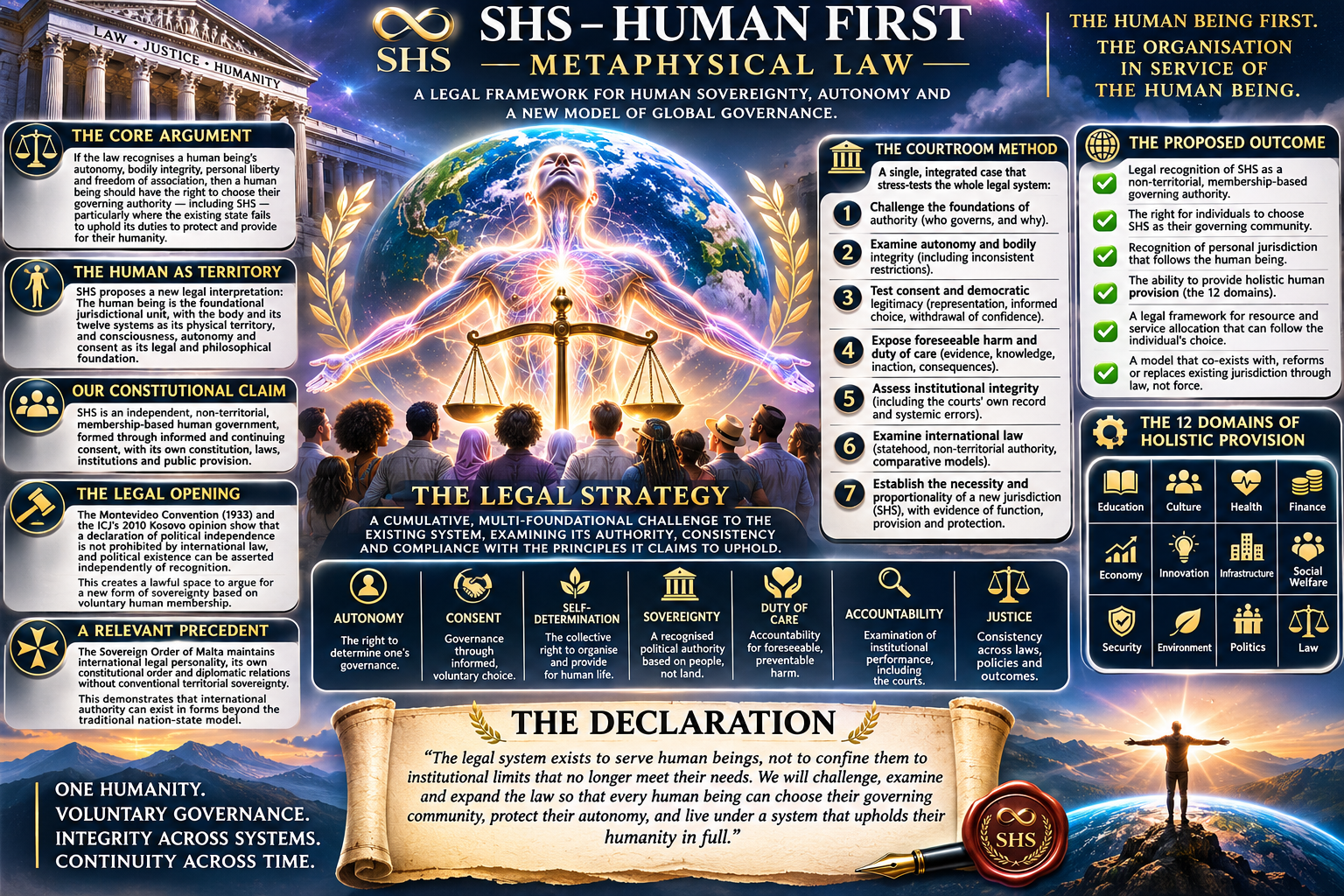
The traditional model of statehood is commonly examined through four characteristics identified in the 1933 Montevideo Convention:
- A permanent population.
- A defined territory.
- Government.
- Capacity to enter into relations with other states.
SHS proposes to challenge the assumption that the second characteristic must always refer to a conventional geographical area.
Our proposed foundational jurisdictional territory is the human being.
The human body and its twelve systems constitute the proposed physical jurisdictional foundation.
Consciousness, autonomy and the capacity for informed consent constitute the philosophical foundation.
Voluntary membership constitutes the political relationship.
SHS constitutes the proposed government.
Its constitutional institutions, services and international relationships would establish the practical expression of that government.
The human body is not being presented as an unclaimed geographical resource.
It is being proposed as the foundational subject of a different form of jurisdiction.
One that does not require acquiring another population’s land.
One that does not require forcing nationality upon anyone.
One that does not depend upon relocating an individual before they can participate.
And one that allows membership to follow the human being wherever they live.
Existing international law does not presently equate bodily autonomy with sovereign state territory.
That distinction is precisely one of the legal propositions we intend to challenge.
We will examine whether the law can coherently recognise personal autonomy while refusing to consider an alternative jurisdictional arrangement founded upon voluntary personal consent.
And we will seek the development of legal recognition appropriate to that model.
IV. DECLARATION, RECOGNITION AND THE QUESTION LEFT OPEN
The Montevideo Convention’s Article 3 provides that the political existence of a state is independent of recognition by other states.
Meanwhile, the International Court of Justice’s 2010 Kosovo advisory opinion concluded that Kosovo’s declaration of independence did not violate international law.
The Court did not determine whether the declaration itself established statehood.
These are not judgments that have already established SHS as a state.
We are not presenting them as such.
But neither should their scope be distorted into the claim that all forms of future political organisation have already been conclusively determined.
We intend to examine the distinction between declaring political independence and obtaining international legal recognition.
We will ask whether the historical development of statehood doctrine permits, or should be extended to permit, an independent political community whose jurisdiction is constituted by consenting human beings.
And we will examine existing examples of international legal personality that do not fit neatly into ordinary territorial statehood.
The Sovereign Order of Malta, for example, possesses a distinct constitutional order, international legal personality and diplomatic relationships without exercising sovereignty over a conventional national territory.
Its legal position is historically exceptional. It is not identical to the model SHS proposes.
But it is relevant evidence that international legal personality is more varied than the ordinary nation-state model.
If law recognises exceptional forms of international authority, the proper question is not simply whether SHS is historically identical to them. It is which principles justified those arrangements and whether those principles support the development of another.
We intend to examine that question in full.
V. OUR COURTROOM METHOD: ONE CASE, EVERY RELEVANT FOUNDATION
This is where Metaphysical Law differs from the fragmented reasoning we intend to challenge.
We will not simply say:
“This law violates autonomy.”
And then stop.
Or:
“This policy creates foreseeable harm.”
And then treat that as the whole argument.
Or:
“This government has failed.”
And assume failure automatically establishes an entitlement to replace its authority.
Our legal examination will be cumulative.
Each foundation will be investigated in relation to the others.
For example:
If the government claims authority over the individual’s bodily choices, we will examine autonomy.
If it restricts autonomy to protect health, we will examine its public-health obligations.
If those obligations are invoked selectively, we will examine consistency.
If its decisions permit foreseeable harms, we will examine the legal standards governing knowledge, responsibility, prevention and remedy.
If those harms persist over time, we will examine the history of institutional knowledge.
If alternative solutions have been rejected, we will examine the decision-making process, the evidence considered and the justifications provided.
If the institution claims democratic legitimacy, we will examine representation, informed consent, accountability and the lawful mechanisms through which political authority can be changed.
If the courts are asked to decide these questions, we will examine the applicable standards of judicial independence, fair procedure, reasoning and review.
The findings will be connected because the institution itself is connected.
We call this the examination of integrity across the whole organisation and continuity across time.
A legal system cannot be understood adequately by examining only whichever individual provision happens to be convenient at a particular moment.
We intend to examine how its provisions operate together.
VI. FORESEEABILITY IS NOT THE WHOLE CASE. IT IS ONE PART OF THE CASE.
Suppose an institution knows that a practice is associated with significant preventable harm.
Suppose that knowledge has accumulated through reports, investigations, warnings, complaints and repeated failures.
Suppose the institution has legal responsibilities relevant to those harms.
And suppose those harms continue while effective interventions are delayed, rejected or inadequately examined.
We intend to establish what legal obligations arise from those circumstances.
Not by assuming foreseeability alone creates liability.
But by examining the complete relationship between:
- The institution’s statutory and other enforceable duties.
- The risks it knew or should reasonably have understood.
- Its ability and authority to intervene.
- Its actions, omissions and decision-making processes.
- Any assumption of responsibility or legally recognised obligation.
- The resulting harms and their causal connection.
- The remedies available to the affected individuals.
In HXA v Surrey County Council [2023] UKSC 52, the UK Supreme Court examined circumstances in which public authorities may owe duties of care, including questions of assumed responsibility.
We would examine such judgments carefully.
Not because they settle every future claim.
But because their reasoning identifies the standards that must be established, distinguished or challenged in relevant cases.
Where an authority possesses power, knowledge and an applicable duty, its failure to act cannot be assessed merely by asking whether the institution intended to do harm.
The legal obligations, the foreseeability of consequences and the actual conduct must be examined.
And if an institution was established to serve human welfare, we intend to investigate where its legal responsibilities correspond to that founding purpose—and where they fall short.
VII. WHEN THE GOVERNMENT CLAIMS TO KNOW WHAT IS BEST FOR THE HUMAN BODY
Consider another anticipated defence.
“The state must restrict certain individual decisions in order to protect public health.”
Very well.
We would ask how the protective standard was determined.
Why a particular substance, product or activity is restricted while another is permitted.
What scientific evidence supports the distinction.
What harms are considered.
How autonomy is balanced against public protection.
Whether less restrictive approaches were examined.
And whether the government has applied the same standards across comparable circumstances.
Take the regulation of alcohol and cannabis.
Both raise questions about individual autonomy, health, public safety, dependence and the effects of use.
Their legal treatment differs significantly across jurisdictions.
We would not assume that the legality of one automatically proves that restrictions on the other are unlawful.
We would examine the reasons.
Where the state asserts a protective necessity, we intend to test the evidence and proportionality of that assertion.
If SHS proposes a different regulatory approach, we would present its standards, safeguards, evidence and intended outcomes.
Where territorial legislation prevents implementation, we would identify the particular restriction and the legal grounds upon which it may be challenged.
Our objective would be to establish where alternative governance choices can lawfully be accommodated, and where changes to existing law are necessary.
The governing principle is consistency.
Not selective autonomy when convenient.
Not selective protection when politically useful.
And not selective evidence depending upon which institution is defending its authority.
VIII. THE COURTS ARE PART OF THE LEGAL SYSTEM WE INTEND TO EXAMINE
Judges are human beings.
Barristers are human beings.
Legislators are human beings.
Governments and courts do not possess independent consciousness separate from the individuals exercising their responsibilities.
Their authority is institutional, but their decisions are made by people.
And the history of justice contains errors.
Wrongful convictions.
Successful appeals.
Procedural failures.
Misinterpretations.
Failures of disclosure.
Unreliable evidence.
And cases in which institutions have subsequently acknowledged that decisions required correction.
These records matter.
Under Section 6 of the UK’s Human Rights Act 1998, courts and tribunals are included among public authorities subject to relevant Convention-rights obligations.
We intend to examine the judiciary’s own record wherever it is relevant to the issues before it.
That does not mean treating every reversed judgment as proof of corruption or every historical error as grounds to disqualify a judge.
It means investigating identifiable patterns of institutional failure, the legal standards governing them and the mechanisms through which they are corrected.
The institution responsible for judging others cannot reasonably claim to be beyond examination of its own adherence to applicable law.
And where judicial reasoning relies upon assumptions that contradict the principles being applied, we intend to identify and challenge those assumptions through the appropriate legal procedures.
The law must remain capable of correcting itself.
Otherwise, its claim to administer justice becomes increasingly difficult to distinguish from the preservation of established institutional positions.
IX. DEMOCRATIC CONSENT CANNOT BE AN EMPTY FORMALITY
Governments frequently claim to represent their people.
We intend to examine what that representation actually means.
If human beings possess political agency, how much freedom should they have to choose the institutions through which their collective needs are organised?
If a substantial population voluntarily establishes an alternative government, what legal opportunities should exist for that choice to acquire institutional effect?
If the majority of a population withdraws confidence in an existing authority, what constitutional processes permit that decision to become effective?
And can the legal system reasonably claim to protect democratic participation while making meaningful changes to governing arrangements unnecessarily inaccessible?
We recognise that a majority’s preference does not automatically extinguish existing law or the fundamental rights of minorities.
Nor does a vote alone confer every public power upon an alternative organisation.
Those are legal questions requiring constitutional answers.
But those limitations should not end the investigation into how democratic consent can produce meaningful institutional change.
SHS is not proposing compulsory membership.
Its foundation is informed, voluntary and continuing consent.
People should be capable of choosing their governing community without being required to surrender their humanity, cultural identity or fundamental protections.
And if they later choose to leave SHS, that choice must remain meaningful.
Because an institution that claims to liberate people cannot make their freedom conditional upon permanent allegiance.
X. WHERE SHS WOULD BEGIN — AND HOW WE WOULD EXPAND
We intend to use the legal opportunities that already exist.
Establish SHS’s constitutional foundations.
Develop its membership framework.
Provide services.
Build educational institutions.
Establish welfare structures.
Develop internal governance and dispute-resolution mechanisms.
Coordinate public-benefit activities through lawful partnerships and service arrangements.
Operate internationally wherever applicable law permits.
And document the effects of those operations.
SHS’s proposed holistic provision encompasses the twelve domains of the Universal Bar:
Education, Culture, Health, Finance, Economy, Innovation, Infrastructure, Social Welfare, Security, Environment, Politics and Law.
Each domain would have its own institutional standards and evidence of performance.
Where an existing jurisdiction does not interfere with the lawful exercise of SHS’s responsibilities, there may be no immediate dispute requiring judicial determination.
Where restrictions arise, we will examine them.
For each restriction, we intend to record:
- The governing legislation or institutional decision.
- The particular SHS function affected.
- The individual or collective rights engaged.
- The authority’s stated legal justification.
- The evidence supporting that justification.
- The foreseeable harms associated with the restriction and the proposed alternative.
- The relevant institutional history and previous decisions.
- The inconsistencies, if any, between the asserted justification and other legal duties.
- The available domestic, constitutional and international remedies.
- The wider consequences of the eventual determination for SHS’s proposed jurisdiction.
This is how the boundaries would be tested: through identifiable disputes, connected evidence and cumulative legal reasoning.
The UK offers one example of existing processes.
Judicial review may provide a route to challenge qualifying unlawful public decisions or omissions. Human-rights proceedings may provide another, where their requirements are satisfied.
Some matters would involve appeals. Others could involve declarations, regulatory decisions, constitutional questions, negotiations or legislative reform.
The jurisdiction and remedy would be chosen according to the actual legal issue.
We do not need to pretend that one court has powers it does not possess in order to challenge how the legal system is organised.
XI. WHAT IF THE COURT SAYS THE LAW DOES NOT RECOGNISE SHS SOVEREIGNTY?
We expect that objection to arise.
The question then becomes more precise.
Does the law prohibit the proposed arrangement?
Does it merely lack a category recognising it?
Does it already permit particular functions but not others?
What interests are protected by withholding recognition?
Which provisions establish those restrictions?
And what lawful routes exist to reconsider, reinterpret, amend or replace them?
A court may be bound by legislation that it does not possess the power to invalidate.
In the UK, for example, Section 4 of the Human Rights Act permits certain courts to issue declarations of incompatibility without invalidating the legislation concerned.
That distinction matters.
A judicial finding may establish a legal problem without itself completing the institutional reform required to resolve it.
We intend to account for those procedural realities.
But the fact that a particular court cannot grant a specific remedy does not answer the larger question of whether the relevant law should change.
Where an existing legal category does not accommodate a proposed form of governance, we intend to examine both the justification for that limitation and the lawful means of developing a new category.
This is not an attempt to erase the distinction between what the law currently recognises and what SHS proposes.
It is an attempt to make that distinction the subject of rigorous examination.
XII. THE SHS JURISDICTIONAL CLAIM
We propose a non-territorial, membership-based public government.
Its authority would derive from the informed consent of the human beings who voluntarily establish and join it.
Its jurisdiction would be defined through its constitutional framework, the responsibilities it undertakes, the rights it protects and the functions it is legally able to exercise.
Its proposed foundational territory would be the human being, rather than an exclusively possessed geographical region.
Its international development would pursue legal recognition of personal jurisdiction, delegated public authority and, ultimately, an independent form of human governance.
Its members would not need to relocate simply to participate.
Its ambition would not be to claim ownership over non-members.
And its constitutional obligations would be designed to protect members from abuse by SHS itself, as well as from unlawful interference by outside authorities.
Under current law, SHS membership alone would not displace territorial criminal, tax, immigration or regulatory obligations.
Those are among the areas where recognition, reform or negotiated jurisdictional arrangements would be necessary.
We intend to challenge the necessity and justification of particular restrictions, not pretend that a declaration has already removed them.
We also intend to investigate the possibility of legally recognised person-centred public funding, allowing responsibilities and resources to follow individuals to qualified governing or service institutions of their choosing.
The wider objective is to reduce dependence upon inherited territorial nationality as the controlling condition of human provision.
XIII. THE EVIDENCE WILL NOT BE LIMITED TO ONE JUDGMENT, ONE LAW OR ONE COUNTRY
Our examination will be historical, constitutional, institutional, comparative and practical.
We intend to investigate:
- What governments claim their purpose to be.
- What their founding instruments require.
- What rights their populations possess.
- What historical failures demonstrate.
- What institutions knew before announcing action publicly.
- What corrective opportunities were available.
- How those opportunities were considered.
- How comparable circumstances have been judged differently.
- Which legal standards have changed over time.
- Which errors have been corrected and which remain unresolved.
- How competing jurisdictions manage overlapping claims to authority.
- What actual outcomes SHS could demonstrate through its alternative organisation.
Evidence supporting an allegation will be distinguished from allegations not yet established.
A chronological correlation will not automatically be presented as causation.
And legal responsibility will be examined against the applicable duties and standards.
Our ambition is substantial enough that it does not require exaggerating evidence.
We intend to make the record as complete as possible, because an institution should be judged through the full history of its conduct, not merely the explanation it offers at the moment of challenge.
This is the application of integrity and continuity together.
Integrity asks whether the organisation remains coherent with the principles it claims to uphold.
Continuity asks what its decisions produce over time.
Both matter.
XIV. WE ARE NOT ASKING GOVERNMENTS TO STOP GOVERNING BEFORE AN ALTERNATIVE CAN FUNCTION
SHS does not seek immediate control of every institution.
Nor do we propose abandoning populations to an untested system.
The intention is to develop governance through functioning institutions, voluntary participation, transparent standards and the progressive recognition of responsibilities that SHS demonstrates it can fulfil.
Where cooperation is available, cooperation can be examined.
Where legal recognition is available, recognition can be pursued.
Where laws unjustifiably obstruct legally protected activities, those restrictions may be challenged.
Where existing law does not yet accommodate the proposed jurisdiction, we intend to advocate its development.
And where governments contest the proposition, we will examine their arguments against the same principles they apply to the people they govern.
The alternative is not surrender or confrontation for its own sake.
The alternative is accountable institutional development.
The law should not be treated as a competition in which one institution must be humiliated for another to exist.
It should be a means through which governing arrangements are tested against their responsibilities and improved where necessary.
But improvement cannot be meaningful if existing institutions are unwilling to subject their assumptions to examination.
XV. A PUBLIC QUESTION TO THE LEGAL WORLD
To constitutional lawyers.
International-law scholars.
Judges.
Legislators.
Human-rights institutions.
Governments.
And everyone concerned with the foundations of political authority.
We place the following questions before you.
First: If autonomy is a recognised characteristic of human legal personhood, what principles determine the limits of an individual’s freedom to choose their governing relationships?
Second: If freedom of association protects collective organisation, what additional conditions should permit a voluntary association to exercise recognised public governing functions?
Third: If political authority claims legitimacy through consent, how should the law respond when consenting human beings establish an alternative constitutional community?
Fourth: If governments possess responsibilities to protect rights and prevent certain harms, how should those responsibilities be examined where existing arrangements repeatedly fail?
Fifth: If institutions justify restrictions through public protection, what standards of evidence, necessity, proportionality and consistency should govern those justifications?
Sixth: If recognised international institutions can possess particular forms of legal personality without ordinary territorial statehood, what principles should govern the recognition of new non-territorial authorities?
Seventh: If the human being is the primary subject for whose benefit law exists, should geographical jurisdiction always prevail over informed personal choice, or can the law develop a more expansive account of personal governance?
And finally:
If the legal system is capable of recognising its own errors, changing its interpretations and developing new doctrines, why should the constitutional organisation of humanity be considered beyond that development?
We intend to examine the answers.
Not through one isolated legal argument.
Through the combined examination of the principles, institutions, evidence and consequences that constitute the whole.
THE CONCLUSION: METAPHYSICAL LAW IS OUR PROPOSED METHOD OF EXAMINING THE LAW’S OWN FOUNDATIONS
I am not entering this discussion under the assumption that everything previously determined by a court must therefore represent the final possible expression of justice.
Courts have reversed decisions.
Legislatures have repealed laws.
Constitutions have changed.
New rights have been recognised.
Political arrangements once considered permanent have been replaced.
The development of law is itself evidence that legal understanding is not historically static.
The law is created, interpreted, administered and changed by human beings.
And human beings are capable of examining the organisations they create.
That is the foundation of our proposed Metaphysical Law discipline.
We examine the individual principle.
We examine its relationship to other principles.
We examine the institution invoking it.
We examine its history.
We examine its consequences.
We examine whether the interpretation remains coherent with the purpose it claims to serve.
And then we examine what a more complete expression of justice could require.
Our case will not depend upon pretending every existing legal limitation has already disappeared.
It will involve determining which limitations are justified, which can be challenged under existing law and which must be transformed through the development of new law.
Our proposed endpoint is a world in which human beings can voluntarily choose their governing community without being permanently confined to political identities assigned through geographical birth.
A world in which sovereign human governance need not require territorial conquest.
A world in which the protection of life takes precedence over the preservation of institutional power for its own sake.
A world in which governments must continuously account for the responsibilities attached to their authority.
And a world in which humanity can develop new organisations without being told that every legitimate form of political existence was already invented by previous generations.
SHS – Human First is proposing to test these foundations openly.
We have no need to conceal the questions.
We have no need to conceal the method.
We have no need to pretend that the legal system is incapable of examining itself.
If the foundations are sound, let them withstand examination.
If the foundations are incomplete, let us establish what is missing.
If the foundations are inconsistent, let us investigate why.
And if humanity can develop a more complete form of governance through its own autonomy, consent, responsibility and collective intelligence, let the law be capable of considering it.
Because the purpose of law should never be to preserve an institution at the expense of the human beings whose existence gives that institution meaning.
THE HUMAN BEING FIRST. THE ORGANISATION IN SERVICE OF THE HUMAN BEING.
SHS – HUMAN FIRST
Metaphysical Law | Directing Integrity & Continuity | Non-Territorial Human Governance
One Humanity. Voluntary Governance. Integrity Across Systems. Continuity Across Time.
Legal authorities and materials underlying this declaration
This is a public statement of SHS’s proposed legal theory and intended methodology, not a court-filed pleading or a declaration of presently recognised sovereign status.
- Montevideo Convention on the Rights and Duties of States (1933), Articles 1–4 — statehood criteria, political existence and recognition. Text
- International Court of Justice, Kosovo Advisory Opinion (22 July 2010) — lawfulness of the declaration of independence and the limits of the question decided. ICJ summary
- International Covenant on Civil and Political Rights, Articles 1, 2, 17 and 22 — self-determination, remedies, privacy and freedom of association. UN Human Rights
- European Convention on Human Rights, Articles 8 and 11 — private life, autonomy-related protections and freedom of association, subject to legally defined limitations. Council of Europe
- Human Rights Act 1998, Sections 3, 4, 6 and 7 — interpretation, declarations of incompatibility, public-authority obligations and proceedings. UK legislation
- HXA v Surrey County Council [2023] UKSC 52 — public-authority liability, omissions and assumption of responsibility. Judgment
- Civil Procedure Rules, Part 54 — judicial review procedure, permission and time limits in England and Wales. Rules
- Statute of the International Court of Justice, Articles 34–36 — parties and jurisdiction in contentious proceedings. UN text
- Sovereign Order of Malta, Constitutional Charter and Code (2022) — an example of distinctive international legal personality and internal constitutional governance. Constitutional Charter



Leave a Reply